The HIV Prevention Justice Alliance (HIV PJA), a Positive Justice Project organization, ran a successful outreach campaign to increase endorserment of the Positive Justice Project Consensus Statement on HIV Criminalization in the United States. The Consensus Statement now has nearly 500 individual and organizational endorsements.
New UK report finds HIV criminalisation impact on healthcare workers
Sigma Research undertakes social research to inform policy and practice concerning HIV and sexual health.
US: President’s AIDS council calls on feds to help states repeal HIV criminalisation laws
Advisory group says these statutes are ‘unjust’ and fuel the epidemic
BY TODD HEYWOOD, AMERICAN INDEPENDENT
The Presidential Advisory Council on HIV/AIDS (PACHA) passed a resolution last week that calls for an end to federal and state HIV-specific criminal laws and prosecutions.
While the resolution is only advisory, it recommends that the departments of Justice and Health and Human Services issue guidance and offer incentives to state attorneys general and state health departments to eliminate HIV-specific laws. The advisory group also asks these federal agencies to develop guidelines for how to approach HIV within criminal and civil justice systems that are “consistent with the treatment of similar health and safety risks.”
As the resolution notes, 32 states and two territories have laws criminalizing people living with HIV.
In explaining the reason to repeal these laws, the resolution reads:
People living with HIV have been charged under aggravated assault, attempted murder, and even bioterrorism statutes, and they face more severe penalties because law enforcement, prosecutors, courts, and legislators continue to view and characterize people living with HIV and their bodily fluids as inherently dangerous, even as ‘deadly weapons. Punishments imposed for non-disclosure of HIV status, exposure, or HIV transmission are grossly out of proportion to the actual harm inflicted and reinforce the fear and stigma associated with HIV. Public health leaders and global policy makers agree that HIV criminalization is unjust, bad public health policy and is fueling the epidemic rather than reducing it.
PACHA is also requesting that state and federal authorities review the cases of persons convicted under such laws and overturn convictions if deemed appropriate. The group is calling on the Centers for Disease Control and Prevention to “issue a clear statement addressing the growing evidence that HIV criminalization and punishments are counterproductive and undermine current HIV testing and prevention priorities.”
“Today’s announcement is an important advancement in our collective effort to modernize unjust and discriminatory HIV criminalization laws,” said Rep. Barbara Lee (D-Calif.), co-chair of the Congressional HIV/AIDS Caucus in a statement last week. Lee introduced the REPEAL HIV Discrimination Act in 2011, which never passed, and served on the United Nations’ Global Commission on HIV and the Law.
“I join the President’s Advisory Council on AIDS in calling on the Department of Justice and the Centers of Disease Control and Prevention to issue clear guidance to states and public health departments on the counterproductive effects of HIV criminalization policies; we must end this clear discrimination against people living with HIV,” Lee continued. “Criminalization laws breed fear, discrimination, distrust and hatred, and we must end them.”
The White House declined to comment on the resolution, but the National HIV/AIDS Strategy adopted by the Obama administration in July 2010 does call for state legislatures to “consider reviewing HIV-specific criminal statutes to ensure that they are consistent with current knowledge of HIV transmission and support public health approaches to preventing and treating HIV.”
Policymakers at the state level also welcomed the resolution. Randy Mayer, chief of the Bureau of HIV, STD, and Hepatitis for the Iowa Department of Public Health, said the resolution was a new tool in advocates’ fight to repeal Iowa’s HIV-specific law.
“This resolution came at an excellent time for Iowa,” Mayer said in an email to The American Independent.
State activists and public health officials, including Mayer, have laid out a strategy to repeal the state’s law.
“The advocates in Iowa have also aligned their efforts with a public health perspective, so the resolution was a reinforcement of their justification,” Mayer said. “I think the more public health entities that weigh in on this discussion the better.”
But while policymakers praise the resolution, activists urge cautious optimism.
Sean Strub, executive director of the anti-HIV-criminalization organization Sero Project, said the resolution was appreciated, but the “real test will be in whether federal agencies and the administration responds with the necessary urgency.”
Catherine Hanssens, executive director of the Center for HIV Law and Policy, which runs the Positive Justice Project, echoed Strub’s sentiment, noting that while the resolution is important, PACHA “has no power to order anyone to do anything.”
“[HHS] Secretary [Kathleen] Sebelius and President Obama both have the discretion to ignore the resolution’s recommendations.”
Regardless, Hanssens said the resolution is an important milestone in the battle to repeal HIV criminal laws in the U.S.
“The work of advocates who pushed for passage of the resolution is not over,” she said. “But we have passed a major marker on the road to reform, and justice, for many people and communities affected by HIV.”
UK: Updated guidance on HIV transmission, the law and the work of the clinical team now published
The British HIV Association (BHIVA) and the British Association for Sexual Health and HIV (BASHH) have produced updated guidance on HIV Transmission, the Law and the Work of the Clinical Team.
This guidance is aimed at those working in the field of HIV medicine, especially clinicians, but will also be of use to general practitioners and people living with HIV who want to understand the legal and medical basis for some of their care decisions.
The guidance begins with a clear statement against HIV criminalisation:
BHIVA and BASHH believe that this use of the law is unhelpful and potentially harmful to public health and support UNAIDS recommendations to limit the use of criminal law and the Oslo declaration view that a “non-punitive, non-criminal HIV prevention approach” is preferable.
Covering the law in England & Wales as well as Scotland, the document aims to provide information and guidance on managing issues related to sexual transmission of HIV based on current scientific evidence. It applies generic ethical and professional principles but with a greater emphasis on providing a confidential environment in which extremely sensitive matters can be frankly and fully discussed. This enables appropriate care of people with HIV and benefits public health by encouraging individuals to access testing and treatment. Within this framework this document sets out the roles and responsibilities of health care professionals when caring for individuals living with HIV.
Consistent with the recent BHIVA and the Expert Advisory Group on AIDS (EAGA) position statement on the use of antiretroviral therapy to reduce HIV transmission, the guidance notes:
In most situations the appropriate use of antiretroviral treatment is at least as effective as condoms in preventing sexual transmission of HIV. This is accepted by the [Crown Prosecution Service of England and Wales] and [Scottish Crown Office and Procurator Fiscal Service] so it is likely that evidence showing that the defendant was taking effective antiretroviral treatment at the time of the alleged transmission may be used to demonstrate that they were not reckless.
The guidance also clearly states that healthcare professionals “must be mindful of their duty not to work beyond their expertise in legal matters. For people with HIV, advice must include the routes of HIV transmission and how to prevent transmission, with information about safer sexual practices, the use of condoms and suppression of viral load. Advice must be given in a non-judgmental way.”
It also discusses issues of confidentiality, noting that “it is important when considering breaching confidentiality to weigh up all potential harms as there may be situations where disclosure of HIV status to protect a sexual partner results in considerable harm to an individual e.g. domestic violence. In situations where a health care professional believes that an HIV positive individual continues to put sexual contacts at risk their duties and subsequent action depend upon the type of contact.” See Figure 1 below.
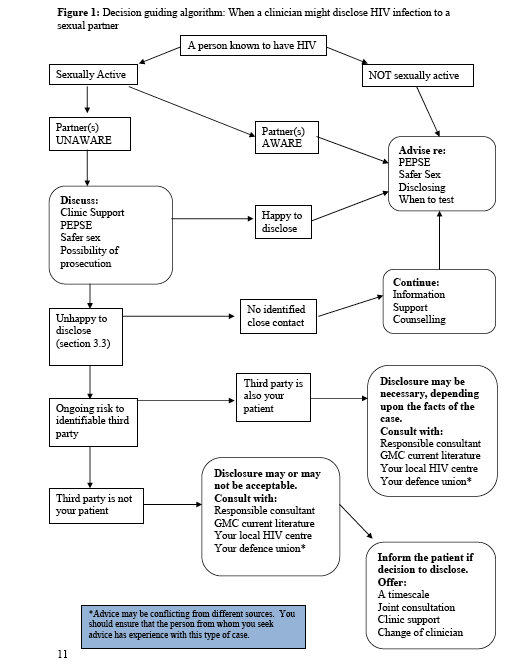
The guidance also clearly states that “no information should be released to the police unless patient consent has been verified or there is a court order in place, except in very limited circumstances defined by the [General Medical Council].”
Importantly, it also notes that only individuals can make complainants to the police “and health care workers should remain impartial during discussions with patients.”
Finally, it provides clear advice to both help prevent transmission of HIV to sexual partners and to avoid prosecution for ‘reckless’ HIV transmission. Accordingly, people with HIV should do at least one of the following:
- Use a male or female condom fitted correctly along with water-based lubricant. Individuals doing this are unlikely to be seen as reckless for legal purposes. In the event of a condom split, it is advisable to disclose HIV status in order to support the partner’s decision whether or not to obtain post-exposure prophylaxis (PEPSE), which should be taken within 72 hours. The need for PEPSE will depend upon the type of sexual activity and the HIV viral load. An assessment of the risk should be undertaken by a clinician according to the BASHH PEPSE guidelines. Disclosure in these situations would suggest that the person with HIV was not reckless.
- Adhere to effective (suppressed viral load) antiretroviral medication. There is growing evidence of extremely low/minimal risk of transmission when plasma HIV is fully suppressed with the use of antiretroviral medication. In some situations an undetectable viral load can afford protection equivalent to or greater than that of condoms. A person with HIV is unlikely to be seen as reckless when relying on a suppressed viral load instead of condom use if they have been counselled accordingly by an HIV clinician or similar medical authority. It is recommended that this discussion is documented in the patient’s medical records.
In addition people with HIV should be advised that disclosure of HIV positive status to a partner before sex is important to support informed agreement around risk and safer sex behaviours. To avoid successful prosecution an individual who is not taking effective antiretroviral medication and does not use a condom must disclose their HIV status to sexual partners before sex takes place.
The entire guidance is reproduced below.
President's Advisory Council on AIDS (PACHA) approves resolution calling for federal action against HIV criminalization
by Catherine Hanssens Executive Director, CHLP The President’s Advisory Council on AIDS today voted to approve a resolution calling for federal action against HIV criminalization. The resolution includes the following recommendations: 1.
US: New Study Questions Michigan’s “Health Threat” Law (Press Release)
Michigan health officials are using HIV surveillance technologies to assist in enforcing a “health threat” law that makes it illegal for HIV-positive people to have sex without disclosing their status.
A new University of Michigan study reveals that health officials employ the state’s names reporting database, alongside partner services referrals, for law enforcement purposes. However, this is bad social policy for a variety of reasons, says Trevor Hoppe, the study’s author and a doctoral candidate in sociology and women’s studies.
When clients visit publicly funded health clinics in Michigan to be tested for HIV, they can expect more than just a finger prick or blood draw. Counselors also ask clients extensive questions about their sexual practices and partners. If the client tests positive for HIV or other sexually transmitted diseases, the counselor will provide treatment referrals. They are also legally mandated to ask clients to report the names of sexual partners, which health officials attempt to contact to recommend that they be tested.
Hoppe found that some health officials also ask their clients if any of their partners reported to them that they were HIV-positive. Officials then attempt to cross-reference the reported name against the state’s database of everyone in the state who has been diagnosed as HIV-positive. If an individual reported as a partner is identified by the state as HIV-positive and the client did not report that they disclosed, an investigation would be launched that could have legal ramifications.
At least 24 states have laws making it a misdemeanor or felony for HIV-positive people to have sex without first disclosing their status. In Michigan, failing to disclose is a felony punishable by up to four years in prison—whether or not the person was ever at risk of contracting the disease from their partner.
“The evidence is mounting that these laws are bad public policy and certainly bad public health policy, yet Michigan health officials are helping to enforce them,” Hoppe said.
At the minimum, there is little transparency in how health officials use epidemiological data for law enforcement purposes, he says.
“Health officials in some local jurisdictions are using data they collect for public health purposes to help enforce the law, but they’re not telling their clients how their personal information could be used,” Hoppe said.
From an ethical perspective, the question is whether it is reasonable for health officials to use confidential medical information to enforce the law.
Hoppe interviewed 25 local health officials who manage “health threat” cases from 14 jurisdictions across Michigan. His research also reveals that how local health officials interpret what qualifies as a “health threat” varies. In some cases, local officials suggested that an HIV-positive woman who became pregnant or contracted another STI might be labeled a “health threat.”
“These systems were not intended for legal surveillance, yet data collected by them are susceptible to being used for criminal proceedings,” Hoppe said.
Whether this practice should be continued must be discussed among policymakers, advocates and stakeholders, including those in the HIV-positive and –negative community, he said.
The findings appear in the February issue of the journal Social Problems.
Social Problems – Controlling Sex in the Name of Public Health (2013)
UN Commission on the Status of Women Accepts Statement on HIV Criminalization and Women
The 57th Session of the UN Commission on the Status of Women accepted for publication a Statement calling for the repeal of all laws criminalizing HIV transmission, exposure to HIV, or failure to disclose HIV status.
GMHC | GMHC Releases New Report, "Fenced in: HIV/AIDS in the U.S. Criminal Justice System"
This comprehensive report documents how mass imprisonment often destroys relationships, healthcare regimens, and employment opportunities for formerly incarcerated individuals. As a result, communities with high rates of incarceration also tend to have high rates of HIV infection. The state of HIV care and prevention inside prisons and jails is also examined, and comparisons between states in the U.S. and countries across the globe are explored.
A call to support action on the PLHIV Global Advocacy Agenda which includes advocating against HIV criminalisation, amongst many other pressing issues
We are people living with HIV. Over three decades into this epidemic, we are angry that still 4500 of us are dying of AIDS-related illnesses every day. Sixteen years after developing effective treatment, more than half of all of us who need it cannot access these life-saving drugs.
Clear, concise interview on risk, legal literacy following Canadian Supreme Court decision
In a wide–ranging interview that poses difficult questions, Bob Leahy asks Toronto-based clinician/scientist Dr. Rupert Kaul about how can we interpret risk of HIV transmission in the age of undetectable viral load.