Canada: New documentary, ‘Positive Women: Exposing Injustice’ has world premiere in Toronto

Last night saw the world premiere of a compelling, heart-wrenchingly moving 45 minute documentary film executive produced by the Canadian HIV/AIDS Legal Network that tells the intimately personal stories of four women living with HIV in Canada. It argues that the current legal situation which criminalises sexual behaviour between consenting adults and discriminates against those living with HIV is irrational, ineffective and unjust.

Positive Women: Exposing Injustice features four courageous positive women bravely speaking from the heart on this important issue:

  • Diane, from Quebec (the defendant in the Supreme Court case R v DC) who was charged for not telling her partner that she had HIV at the beginning of an ultimately abusive relationship;
  • Jessica, a young woman who chose not to pursue charges against the man who infected her, and who has some of the best lines in the film (she calls disclosing her HIV-positive status, “dropping the H-bomb”!);
  • Lynn, an Aboriginal woman who has personally faced extreme stigma and violence due to her HIV-positive status; and
  • Claudia, a Latina woman who describes the challenges of disclosure and intimate relationships for women living with HIV. 

Legal experts, doctors, counsellors and support workers also appear in the film to complement the women’s stories and to challenge current Canadian legal practice that is oppressing the very women they are meant to protect. Anyone who believes that HIV criminalisation protects women needs to see this film.

It will next be screened in Washington DC at the International AIDS Conference on Thursday July 26th in the Global Village Screening Room from 18:00-19:00.  The screening will be followed by a question and answer session.

For more information about the documentary, which was produced and directed by Alison Duke, visit http://www.positivewomenthemovie.org/index.html

Norway: Prof. Matthew Weait delivers stirring clarion call to recognise harm of HIV criminalisation

Yesterday Professor Matthew Weait, Professor of Law and Policy at Birkbeck College, University of London delivered a stirring lecture to the public health professionals involved in implementing Norway’s HIV strategy.  As Norway is currently reconsidering its criminal code as it relates to HIV and other infectious diseases, ‘Criminalisation and Effective HIV Response’ was a clear clarion call to “recognise that HIV is not a legal problem capable of a legal solution, but a public health issue to be dealt with as such.”

What I would urge you to recognise is that the appeals for change are being made not only by people living with HIV and the civil society organisations advocating on their behalf, but increasingly by health professionals, virologists, epidemiologists and others who have come to recognise that punitive responses to HIV are counter-productive and damaging in efforts to respond effectively to the spread of the virus. This is a critically important point, and their voice needs to be heard.

With Matthew’s permission, I am publishing the entire lecture below.  You can also download the full text (with full detailed footnotes and references) from Matthew’s blog.
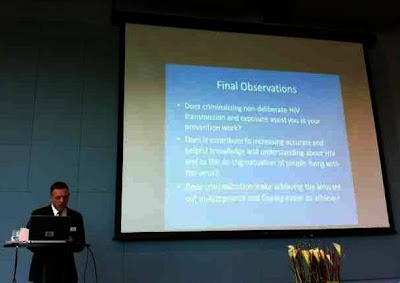
Professor Matthew Weait in Oslo
Courtesy of Charlotte Nördstrom

As a country which many in the world look to for progressive policy-making grounded in evidence and human rights principles, Norway’s response to HIV is not simply a matter of national importance, but is of significance both to the developing countries to which it provides economic and other assistance in the fight against endemic HIV, and to high-income countries whose epidemics are similarly limited and concentrated in particular population groups.

Your current national strategy – Acceptance and Coping – states as follows:

The comprehensive aim of this strategy is that at the end of the strategy period, Norway will be a society that accepts and copes with HIV in a way that both limits new infection and gives persons living with HIV good conditions for social inclusion in all phases of their lives.

The strategy document sets out a number of specific goals, each of which discusses measures that will be taken in order to deliver on the strategy. My focus today is on the way criminalisation of HIV transmission and exposure might impact on that strategy. I will start, though, with some background and context.

1. International Thinking and National Law

At the 26th special session of the UN General Assembly in 2001, States party to the International Covenant on Economic, Social and Cultural rights (including Norway) declared their commitment to

… enact, strengthen or enforce, as appropriate, legislation, regulations and other measures to eliminate all forms of discrimination against and to ensure the full enjoyment of all human rights and fundamental freedoms by people living with HIV/AIDS and members of vulnerable groups …

This commitment is yet to be realised. Since the beginning of the epidemic new and existing legislative measures have been introduced and enforced that impede rather than further the central goal of reducing onward transmission of HIV, of minimising the spread of the epidemic, and protecting the rights of PLHIV and those most at risk of infection.

In a 2010 Report, the UN Special Rapporteur on the Right to Health referred to this commitment in the context of the criminalisation of HIV transmission and exposure. Drawing on the best available evidence he emphasised that criminalisation has not been shown to limit the spread of HIV, that it undermines public health efforts and has a disproportionate impact on vulnerable communities.

Drawing on the UNAIDS International Guidelines on HIV/AIDS and Human Rights and more recent UNAIDS/UNDP policy, he reiterated that the criminal law should only be deployed in very limited circumstances. In particular, people should not be prosecuted where there is no significant risk of transmission, where they are unaware of their HIV positive status, do not understand how HIV is transmitted, have disclosed their status (or honestly believe their partner to know it), failed to disclose because of a fear of violence or other serious negative consequences, took reasonable precautions against transmission, or have agreed on a level of mutually acceptable risk.

Norway, in common with most other countries, falls significantly short of the UNAIDS guidance and of the Special Rapporteur’s recommendations. Its current criminal law imposes liability irrespective of a person’s viral load, those who transmit HIV non-intentionally, and on those who merely expose others to the risk of infection. Also, and more exceptionally, it allows for the criminalisation and punishment of those who engage in unprotected sex, even when they have disclosed their HIV positive status to their partner and where the partner has consented to the risk of transmission. Although its penal code allows for the criminalisation of other serious diseases, almost all cases that have been brought to the courts have concerned HIV – and so although it is not an HIV-specific law in theory, the practice is very different.

2. The Enforcement of Law

This use of the criminal law has placed Norway – along with its Scandinavian and Nordic neighbours, at the top of the leader board of HIV criminalisation in Europe, and very high globally. When we look at rate of convictions per 1000 PLHIV in the European region, we see a higher rate of conviction in northern European countries, especially those in Nordic and Scandinavian countries.

This variation in intensity of criminalization as measured by convictions seems strange at first glance, especially when you contrast it with the HIV prevalence estimates.

It is especially notable that the bottom three countries with respect to criminalisation (Italy, France, UK) have – conversely – the highest numbers of people living with HIV, and (in general) higher than average prevalence.

What, then, might be explanations for this? We have to be cautious, given the non-systematic nature of the data collection; but I do think that we can begin to understand the pattern if we think about some of the social, cultural and historical differences between countries in the region.

So, for example, we can see that the top five criminalising countries in the region all have laws which impose liability for the reckless or negligent exposure (and thus have a wider potential scope for criminalisation). We can also see that these same countries all have high confidence in their judicial systems (which may go some way towards accounting for a person’s willingness to prosecute after a diagnosis, believing that their complaint will be dealt with efficiently and fairly). Even more interestingly, I think, are the correlations that we see when we look at variations in interpersonal trust, as measured by the World Values Survey.

Here we can see the top five countries in the region with respect to interpersonal trust (and the only countries where the majority of respondents trusted other people), are all in the top half of criminalizing countries, with rates of conviction in excess of 1 / 1000 PLHIV.

These correlations between interpersonal trust and conviction rates in the region become even more interesting when we learn that, according to reliable empirical research, the Scandinavian and Nordic countries have a lower fear of crime, are less punitive in their attitudes to those who commit crime, and – in general – have lower rates of imprisonment for convicted offenders than other countries. If this is the case, why would HIV transmission and exposure criminalization be so high?

My answer to this is tentative, but it seems plausible to suggest that the sexual HIV cases that get as far as court and a conviction are ones which are paradigm examples of breach of trust. It is not inconsistent for a society to have a lower than average generalised fear of crime, or lower than average punitive attitudes, and at the same time to respond punitively to specific experiences of harm, especially when that arises from a belief that the person behaving harmfully could have behaved otherwise and chose not to. Indeed, it seems entirely plausible that where there are high expectations of trust, breaches of trust (for example, non-disclosure of HIV status) are treated as more significant than where value in trust is low. Combine this with countries (such as your own and Sweden) which are committed to using law to ensure public health, and which consequently are prepared to using it to respond to the risk of harm (HIV exposure), as well as harm itself (HIV transmission), and we can see why the pattern of criminalization appears to be as it is.

3. Impact of Criminalisation on PLHIV and Most at Risk Populations

What is the impact of criminalisation?

This is a difficult question to answer, because it depends on what we mean by impact. First, there is the impact on the individual people who have been, and continue to be, prosecuted – people who have been investigated, convicted, jailed and publicly shamed, sometimes simply for having put others at risk, sometimes for transmitting HIV unintentionally, sometimes when they have been completely open about their status with a partner in a relationship which subsequently breaks down. For these people, being HIV positive and failing to live up to the exacting standards the law in this country, and others in this region, demands of them has turned them into criminals with all the social and economic disadvantages that entails. Here we could think specifically of your own fellow country man Louis, who had a charge of transmission dropped when it transpired that he was not the source of his partner’s infection, but is still being prosecuted for exposure.

Second, and critically, there is the impact on public attitudes towards, and responsibility as regards HIV, PLHIV and sexual health generally. Here I am not talking just about the individual experience of the two Thai women in Bergen who stopped in a bar for a drink after shopping and, in front of other customers, were thrown out by the owner because of a recent case in the town involving a Thai sex worker (from that point on, being Thai themselves (though legally in the country and married to Norwegian men) made them guilty, positive and dangerous simply by association). I am talking more of the broader impact that such an example illustrates.

Criminalisation, because it places responsibility for transmission risk on people with diagnosed HIV, serves to reinforce the idea that responsibility for one’s own sexual health belongs with those people. The existence of criminal law provides people who have consciously taken risks with an official mechanism for declaring their victim status. It provides grown, adult, men who have unprotected sex with migrant sex workers an opportunity to deny any responsibility they might have for actually taking responsibility themselves. It provides people (in Norway) who in fact consent to sex with a person who has disclosed his or her positive status the opportunity to take revenge if the relationship breaks down. If we can blame someone else for misfortune, or for being in situations where there is a risk of harm, it is only natural that some of us will; and the sensationalist media coverage (as bad here as it is anywhere in the world) merely serves to confirm this and to sustain the ignorance which the FAFO study highlighted. The headlines are, as you well know, always in the form “HIV-man (or woman) exposes x number of women (or men) to HIV.” They are never in the form “X number of people put themselves at risk by having unprotected sex”.

Finally, I would just like to mention Maria (not her real name) who I interviewed here in Oslo in March 2012. For her, a mother of two children who was contacted by the police about the arrest of a man she had had a sexual relationship with (but who was not in fact the source of her HIV infection) the trial in which she was made to be a complainant has resulted in her being so afraid of legal repercussions that she has not had sex for eighteen months. For Maria, and people like her, a guilty verdict does not necessarily result in closure, and it does not result in a reversal of sero-status. It simply creates another potential criminal who better beware. If, as Acceptance and Coping states, Norway is serious about reducing the number of new infections, enabling people to feel secure in testing and in discussing their positive status more openly, it must recognise that criminalisation of the kind that exists in this country does nothing to assist in those endeavours.

4. Barriers to Change

What, then, are the barriers to change? I ask this question recognising that the Commission led by Professor Aslak Syse has yet to report on its findings and make recommendations, and here I will mention only two.

The first thing I would say here is that here are many in the Scandinavian and Nordic region who are calling for a change in the law. However, there has been, and continues to be, among politicians and policy makers – as well as among some public health professionals – a scepticism about calls to decriminalise non-deliberate HIV transmission and exposure.

Take politicians first. Their scepticism stems, I think, from a belief that arguments in favour of decriminalisation when made by advocacy organisations are – in effect – arguments for being allowed to practise unsafe sex with impunity: without consequence. If a gay man living with HIV argues that he should not be punished if he has unprotected sex, or does not disclose his status to a partner, or happens to transmit HIV during consensual sex (even when this is the last thing he wishes to do) it is very easy to hear that as someone claiming a right to be irresponsible. Put simply, the fact that at a national level in this region the decriminalisation advocacy work has been pursued largely – though not entirely – by civil society organisations has resulted in a less than sympathetic response from those in a position to deliver change – especially those elected politicians whose principal concern is their immediate electorate and public opinion more generally. Nor, for a long time, has the medical profession been entirely supportive. For doctors, especially those in official public health positions at national and regional level, it has been problematic to support those who seem to wish to challenge their role in protecting the health of society generally. For health professionals, arguments for repealing the coercive powers given to them under communicable disease legislation, or of the criminal law that provides the final sanction against those who do not comply with regulations, are easily read as arguments for allowing people with HIV the right to undermine the very thing it is their responsibility to achieve: as a right to put healthy people at risk of disease and illness.

Faced with the way in which their arguments have been interpreted by those with political power, it is small wonder that those appealing for change have met with limited success, despite arguments consistent with those of expert international organisations (such as UNAIDS). What I would urge you to recognise is that the appeals for change are being made not only by people living with HIV and the civil society organisations advocating on their behalf, but increasingly by health professionals, virologists, epidemiologists and others who have come to recognise that punitive responses to HIV are counter-productive and damaging in efforts to respond effectively to the spread of the virus. This is a critically important point, and their voice needs to be heard.

The second factor that sustains the legitimacy of punitive laws in a country, and makes their reform difficult, is the nature of the epidemic in that country. Like other Nordic countries, Norway’s HIV epidemic is localised both socially and geographically. It is predominantly an urban disease affecting MSM and migrants from high-prevalence regions in Africa and Asia. Recognition of this has led to targeted prevention strategies, which is of course welcome; but it has also contributed to the ignorance about HIV among the general population (as shown by the FAFO study), and – critically, I think – to a perception that HIV is, and remains, someone else’s problem. Epidemiologically this may be correct. HIV does not, in general, impact directly on the lives of the vast majority of Norwegians. Few will know someone living with HIV, and even fewer someone who is open about his or her positive status. A consequence of this is that measures which would be seen as gross infringements of civil liberties and personal freedom if applied to the general population are seen as a reasonable and legitimate response. It is as if HIV were a snake that has found its way into a party full of animal rights activists. They cannot simply kill it (that would be wrong, and there are some limits to how one may reasonably respond to phobias) but it is justifiable to take any containment measures necessary to stop it getting any closer.

If you doubt this, consider the following two questions. First, we know that a significant number of new transmissions of HIV are from those who are newly infected and undiagnosed. If the criminal law on exposure and transmission were logical, should it not be applied to all those who have unprotected sex with a partner, who have had unprotected sex in the past, and who do not have a recent negative test result? And if we think non-disclosure is a justification for criminal liability, should we not criminalise all those who fail to disclose the fact that they have had unprotected sex in the past and are uncertain of their HIV status? Being HIV positive is not the relevant risk: infectiousness is.

Why don’t we do that when it is the logical approach? Because such rules would apply to the vast majority of adults in Norway, not merely to a containable and definable sub-section of those adults. And even those who might respond to this proposition by pointing out that undiagnosed HIV is far more common among MSM and migrants would have a hard time justifying criminalising all unprotected homosexual (but not heterosexual) sexual activity, and the unprotected sexual activity of migrant people from high-prevalence regions with native Norwegians. This would be seen, I suspect, as a grossly discriminatory and offensive approach – despite the fact that it makes far more sense than the one that you have here.

As to the second question, consider this. Norway, in common with its neighbours, has a strong tradition of overseas aid, and an official, publicised commitment to providing assistance to developing countries in their fight against HIV and AIDS. Indeed, the Government of Norway has publicly stated that it “ … wishes to focus on how legislation and public services can do more to reduce vulnerability and increase dignity and better cooperation into the fight against AIDS”.

The question therefore is: should Norway encourage the high-prevalence countries to which it provides support to adopt its legal model their HIV response? Put simply, do you think it would be appropriate to criminalise HIV transmission, exposure and non-disclosure where it is endemic? My guess is that your answer to that would be no. But if the answer is no, you must ask yourselves – as matter of fundamental ethics – why not? Why is it appropriate to respond punitively to PLHIV living in Norway when to do so in Botswana, or Malawi, or Swaziland would be wrong?

It seems to me that the answer to this question, even if it is a difficult and uncomfortable one to acknowledge, is that for as long as HIV only affects a small and definable minority punishment is defensible. As long it is “over there”, among the gays and the migrants and the IDUs, and for as long as coercive powers will not impact on the vast majority of the population, criminalisation is something that can be legitimated and politically defended without fear of popular protest. If this is correct, it is particularly offensive and pernicious. Exposure is exposure wherever it takes place in the world; transmission is transmission; HIV is HIV; disclosure is either to be required as a matter of principle, or not. If criminalisation is not something that one country would countenance for human beings in countries in which HIV continues to be a real and immanent threat, and – critically – human beings for whom HIV infection is far less easy to manage, and still results in significant mortality, then on what possible principled basis is it justifiable to use the criminal law against those in one’s own country, where HIV is a manageable condition and where the quality of life for diagnosed PLHIV is as high as it possibly could be? If there is any substance to the claim that the legal response to PLHIV in Norway is discriminatory – which many of its critics suggest – that substance finds its expression here.

5. Final Observations

Norway is placed better than any other nation at the present moment to reform its law so that it complies with UNAIDS recommendations. The work of the Law Commission, which will report in the autumn of 2012, has been more focused and comprehensive than any other initiative I know of. Its report will, I have no doubt, present arguments both for and against the present law, and those arguments will be supported by the best available evidence. Ultimately, though, legal reform is in the hands of politicians, and their concerns extend beyond the logic of prevention. What those politicians need is the support of those who work in the field, at the sharp end of HIV prevention, diagnosis and treatment. Without that, it will be all too easy to adopt minimal reforms that do not go to the heart of the matter, or to kick the report into the long grass and carry on as before. It is not for me to tell you what your law should be. All I can do is urge you to read the Oslo Declaration, published here just recently, and to watch the video accompanying that. All I can do is encourage you to recognise that the authors of the HIV Manifesto, a radical initiative demanding the repeal of paragraph 155 of the Penal Code, was not written by people who simply want to have sex without consequences but by intelligent, rational and thoughtful people. All I can ask you to do is to recognise that HIV is not a legal problem capable of a legal solution, but a public health issue to be dealt with as such. All I can suggest is that in thinking about this complex topic you ask yourself the following simple questions.

Does criminalising non-deliberate HIV transmission and exposure assist you in your prevention work?

Does it contribute to increasing accurate and helpful knowledge and understanding about HIV and to the de-stigmatisation of people living with the virus?

And does criminalisation make achieving the aims set out in Acceptance and Coping easier to achieve?

If the answer to any or all of these questions is no, then the arguments for HIV criminalisation of the kind and intensity that currently exist in this country are not, I would suggest, as strong as those against.

International civil society experts launch the Oslo Declaration on HIV Criminalisation

A group of 20 expert individuals and organisations from civil society around the world working to end inappropriate criminal prosecutions for HIV non-disclosure, potential exposure and non-intentional transmission from around the world came together in Oslo, Norway on 13 February 2012 to create the Oslo Declaration on HIV Criminalisation.

The Declaration provides a clear roadmap for policymakers and criminal justice system actors to ensure a linked, cohesive, evidence-informed approach to produce a restrained, proportionate and appropriate use of the criminal law, if any, to cases of HIV non-disclosure, potential exposure and non-intentional transmission.

It is a direct response to the increasing numbers of people living with HIV who are being arrested, prosecuted and convicted and the rapid rise in the number of countries enforcing, enacting or proposing HIV-specific legislation to enable these prosecutions. This, despite a growing body of evidence suggesting that the criminalisation of HIV non-disclosure, potential exposure and non-intentional transmission is doing more harm than good in terms of its impact on public health and human rights.

The civil society meeting took place on the eve of the global High Level Policy Consultation on the Science and Law of the Criminalisation of HIV Non-disclosure, Exposure and Transmission, convened by the Government of Norway and the Joint United Nations Programme on HIV/AIDS (UNAIDS). The objective of the High Level Policy Consultation was to provide a global forum in which policymakers and other concerned stakeholders could consider their current laws and policies regarding the criminalisation of HIV non-disclosure, exposure or transmission in light of the most recent and relevant scientific, medical, public health and legal data.

Although the Oslo Declaration is not an official High Level Policy Consultation document, it supports the objective of the meeting, and encourages policymakers to review their own laws and policies, and to take any and all steps necessary to achieve the best possible outcomes in terms of justice and protection of public health in order to support effective national responses to HIV and uphold international human rights obligations.

The Declaration’s creation is led by, and includes, people living with HIV, including survivors of HIV criminalisation, and supported by committed HIV advocates from all over the world. Their expertise covers medical, social, ethical, political, human rights and judicial issues relating to HIV and the criminal law.

The Oslo Declaration, the full version of which can be downloaded here (and which includes full references to support the statements), consists of the following 10 points:

1.    A growing body of evidence suggests that the criminalisation of HIV non-disclosure, potential exposure and non-intentional transmission is doing more harm than good in terms of its impact on public health and human rights.

2.    A better alternative to the use of the criminal law are measures that create an environment that enables people to seek testing, support and timely treatment, and to safely disclose their HIV status.

3.    Although there may be a limited role for criminal law in rare cases in which people transmit HIV with malicious intent, we prefer to see people living with HIV supported and empowered from the moment of diagnosis, so that even these rare cases may be prevented. This requires a non-punitive, non-criminal HIV prevention approach centred within communities, where expertise about, and understanding of, HIV issues is best found.

4.    Existing HIV-specific criminal laws should be repealed, in accordance with UNAIDS recommendations.  If, following a thorough evidence-informed national review, HIV-related prosecutions are still deemed to be necessary they should be based on principles of proportionality, foreseeability, intent, causality and non-discrimination; informed by the most-up-to-date HIV-related science and medical information; harm-based, rather than risk-of-harm based; and be consistent with both public health goals and international human rights obligations.

5.    Where the general law can be, or is being, used for HIV-related prosecutions, the exact nature of the rights and responsibilities of people living with HIV under the law should be clarified, ideally through prosecutorial and police guidelines, produced in consultation with all key stakeholders, to ensure that police investigations are appropriate and to ensure that people with HIV have adequate access to justice.

We respectfully ask Ministries of Health and Justice and other relevant policymakers and criminal justice system actors to also take into account the following in any consideration about whether or not to use criminal law in HIV-related cases:

6.    HIV epidemics are driven by undiagnosed HIV infections, not by people who know their HIV-positive status.  Unprotected sex includes risking many possible eventualities – positive and negative – including the risk of acquiring sexually transmitted infections such as HIV. Due to the high number of undiagnosed infections, relying on disclosure to protect oneself – and prosecuting people for non-disclosure – can and does lead to a false sense of security.

7.    HIV is just one of many sexually transmitted or communicable diseases that can cause long-term harm.  Singling out HIV with specific laws or prosecutions further stigmatises people living with and affected by HIV. HIV-related stigma is the greatest barrier to testing, treatment uptake, disclosure and a country’s success in “getting to zero new infections, AIDS-related deaths and zero discrimination”.

8.    Criminal laws do not change behaviour rooted in complex social issues, especially behaviour that is based on desire and impacted by HIV-related stigma.  Such behaviour is changed by counselling and support for people living with HIV that aims to achieve health, dignity and empowerment.

9.    Neither the criminal justice system nor the media are currently well-equipped to deal with HIV-related criminal cases.  Relevant authorities should ensure adequate HIV-related training for police, prosecutors, defence lawyers, judges, juries and the media.

10.    Once a person’s HIV status has been involuntarily disclosed in the media, it will always be available through an internet search. People accused of HIV-related ‘crimes’ for which they are not (or should not be found) guilty have a right to privacy. There is no public health benefit in identifying such individuals in the media; if previous partners need to be informed for public health purposes, ethical and confidential partner notification protocols should be followed.

The 20 original endorsing individuals/organisations are (in alphabetial order)

AIDS Fondet, Denmark

AIDS Fonds, Netherlands

AIDS & Rights Alliance for Southern Africa (ARASA), Namibia

Edwin J Bernard, HIV Justice Network, UK/Germany

Center for HIV Law and Policy, United States

Kim Fangen, HIV Manifesto, Norway

Global Network of People Living with HIV (GNP+),Netherlands

Groupe sida Genève, Switzerland

HIV Finland, Finland

HIV Nordic, Nordic countries

HIV Norway, Norway

HIV Sweden,Sweden

International Planned Parenthood Federation (IPPF), United Kingdom

Ralf Jürgens, Consultant, HIV/AIDS, health, policy and human rights, Canada

Sean Strub, SERO Project, United States

Robert Suttle, SERO Project, United States

Swedish Association for Sexuality Education, (RFSU), Sweden

Swedish Federation for Lesbian, Gay, Bisexual and Transgender Rights (RFSL), Sweden

Terrence Higgins Trust, (THT), United Kingdom

Matthew Weait, Professor of Law and Policy, United Kingdom

To find out more or to sign on to the Oslo Declaration please visit: hivjustice.net/oslo.

Oslo Declaration on HIV Criminalisation (HJN, 2012)

Advocates working to end inappropriate criminal prosecutions for HIV non-disclosure, potential exposure and non-intentional transmission from around the world explain why they support the Oslo Declaration on HIV Criminalisation.

Video produced for the HIV Justice Network by Nick Feustel, georgetown media.

Mark S King: HIV Criminalization Face-Off

(7 min, My Fabulous Disease, USA, 2012)

What if you could witness a face-to-face confrontation between a man living with HIV and the sex partner accusing him of not revealing his status? Wouldn’t you like to be a fly on that wall? The fireworks could be mighty, as emotions raged between the furious accuser and the positive person trying to defend his actions. What might that meeting look like, exactly?

In this video, you’re about to find out.

Read more at Mark’s brilliant blog, My Fabulous Disease.

Perpetuating Stigma (In The Life Media, US, 2012)

Public television stations across the United States aired Perpetuating Stigma, an episode from the award-winning documentary series In The Life, in February 2012. This special report investigates the injustices that arise when a person’s HIV status becomes a crime, with a focus on how women have been stigmatized and prosecuted under these laws.

Perpetuating Stigma features HIV positive women whose personal stories challenge the theory behind HIV criminalization laws and expose the reality of their impact.

In The Life’s decision to continue coverage of HIV criminalization, specifically with a report on women, is motivated by the lack of a fair media perspective on this issue,” stated Michelle Kristel, executive director of In The Life Media.


HIV is Not a Crime

(8 min, Zero, USA, 2012)

This short film is part of Sero’s ongoing documentation of the experiences of people with HIV who have been prosecuted for “HIV crimes”.  To see a growing collection of individual interviews please visit Sero’s video page.

Film by Sean Strub/Sero • Edited by Leo Herrera/HomoChic

Sweden: Campaign to change draconian, punitive policies for PLHIV aiming for Government review

In Sweden, the Communicable Diseases Act requires people with diagnosed HIV to disclose in any situation where someone might be placed at risk and to also practise safer sex (which, in Sweden, means using condoms – the impact of treatment on viral load and infectiousness is not yet considered to be part of the safer sex armamentarium.)

But in Sweden you’re damned if you do (disclose) and damned if you don’t because Sweden is one of several countries in western Europe – including Austria, Finland, Norway, and Switzerland – where people with HIV can be (and are) prosecuted for having consensual unprotected sex even when there was prior disclosure of HIV-positive status and agreement of the risk by the HIV-negative partner. Sweden uses the general criminal law for these prosecutions of which there have been at least 40 – out of an HIV population of around 5,000.

And if you think the Swedes aren’t being overly harsh, then watch the harrowing documentary, ‘How Could She?’ about a young woman, Lillemore, who was in such denial that she did not tell anyone that she was HIV-positive (including the doctors who delivered her two children). Even though both children were born HIV-free, and no-one was harmed by her non-disclosure, following the break-up of her marriage, her ex-husband reported her to the authorities and she was sentenced to 2 1/2 years in prison.

Fortunately, most of these countries with overly-draconian policies towards people with HIV are well advanced in the process of examining (and hopefully, changing for the better) such laws and policies.

Norway has set up a special committee to examine whether its current law should be rewritten or abolished: its recommendations are due in May.

Switzerland is currently revising its Law on Epidemics, to be enacted later this year, and, according to my sources, the latest version appears to be mostly consistent with UNAIDS’ recommendations.

In 2010, Austria’s Ministry of Justice conceded that an undetectable viral load is considered a valid defence, even if they say individual judges can ignore their recommendation, although much more could still be done to remove the legal onus for HIV prevention on people with HIV.

And Finland has established an expert group on HIV/AIDS within the Finnish National Institute for Health and Welfare with the aim to ensure legislative reform, and address laws and polices that reinforce stigma and discrimination.

But Sweden – which has the most HIV-related prosecutions per capita of people with HIV in Europe (and probably the world) and that’s not including the 100+ more people with HIV who have been forcibly detained and isolated under the Communicable Diseases Act – is lagging behind, and continues to enforce its ‘human rights-unfriendly’ policies.

Fortunately, civil society is fighting back. In 2010, HIV-Sweden, RFSU (the Swedish Association for Sexuality Education) and RFSL (the Swedish Federation for Lesbian, Gay, Bisexual and Transgender Rights) began a three-year campaign to raise awareness and advocate against Sweden’s over-punitive HIV-related policies.

A recent conference held just before World AIDS Day put together by the campaign and attended by police, prosecutors and politicians highlighted the many human rights concerns over Sweden’s current laws and policies. I was honoured to be one of only two non-Swedes to speak at the meeting (which was held mainly in Swedish – so a big thank you to Elizabeth, my personal “whisper” translator) – you can see the agenda and download a copy of my presentation here.

Download Google translated version of full article here

The meeting and associated campaign received a lot of press coverage, including the front page of the biggest circulation morning paper in Sweden on World AIDS Day.

Download ‘HIV, Crime and Punishment’

At the meeting, HIV Sweden, RFSL and RFSU launched an important new manifesto, ‘HIV, Crime and Punishment‘ that clearly explains what the problems are for people with HIV (and public health) in Sweden and asks for three actions from the Swedish Government:

  • A review of Swedish law, including the Communicable Disease Act as well as the application of the criminal law to HIV non-disclosure, exposure and transmission.
  • An endorsement by Sweden of the 2008 UNAIDS Policy Brief on the criminalisation of HIV transmission, which says that criminal prosecutions should be limited to unusually egregious cases where someone acted with malicious intent to transmit HIV, and succeeded in doing so.
  • A renewed, clear focus of Sweden’s National HIV Policy on a human rights-based approach to HIV prevention, care, support and treatment, and sex education. 

Let’s hope that Sweden’s policymakers take heed. After all, how can a country which supports UNAIDS’ global efforts, and is perceived to be a global champion for human rights around the world treat people with HIV in its own country as second class citizens?

Don’t think Sweden is that bad?  Check out the 2005 case of Enhorn v  Sweden at the European Court of Human Rights which found that Sweden had unlawfully isolated a man with HIV for a total of seven years, a violation of Article 5 § 1 of the Convention, ‘right to liberty and security of person’.

‘HIV is not a crime’ by Sean Strub

Regular readers may be familiar with the case of Nick Rhoades from Iowa, who was arrested, prosecuted and sentenced to 25 years in prison because he didn’t disclose he was HIV-positive during a one-night stand with another man, despite using condoms and having an undetectable viral load.  Following intervention from human rights groups and HIV advocates, Nick’s 25 year sentence was eventually suspended, but he remains on parole and on the sex offenders list.

Nick is one of three courageous individuals who appear in the trailer for POZ Magazine founder, Sean Strub’s, ongoing documentary project ‘HIV is not a crime‘. Sean’s film will shed light on laws and prosecutions which treat people living with HIV as second-class citizens (Sean’s term is “viral underclass”) and which are informed by stigma, not science.

Sean and I share a common understanding that, especially in the United States, but not exclusively so, HIV criminalisation is having a serious negative impact on both human rights and public health. The high number of cases in the United States is primarily because many states are still enforcing outdated HIV-specific laws many of which were drafted earlier in the AIDS epidemic when HIV-related life expectancy was poor.  Reflecting moral panic and poor understanding of HIV transmission risks, their impact is still very much felt today, as Sean’s film will show.

Sean’s documentary project could not have come at a more crucial moment, as efforts are underway on a federal level in the United States (and also on a state level including in Iowa) to modernise (or, ideally, totally repeal) these draconian laws. By focusing on the impact these laws have had on people who are often erroneously characterised by such laws – and the media – as vectors of the HIV epidemic, and even sometimes as “monsters”, and showing their vulnerability and humanity, Sean’s film should help explain in very personal and human terms why these laws are wrong and why they should be repealed.

Sean is looking for funding to complete the documentary (funders, please note!) and he also tells me in an email

I’m looking for additional people to interview, including those who have been prosecuted or are facing prosecution, as well as accusers, people who filed charges or considered filed charges and others.  To date I have only interviewed Americans, but I am looking for people with criminalization experiences in other countries as well.

Next week, Sean and I (along with Nick and fellow documentary interviewee, Robert Suttle) will be attending the UNAIDS Programme Coordinating Board’s thematic on HIV and enabling legal environments in Geneva and then will be briefly in London on Friday 16th.  If you have a story to tell and will be in Geneva or London next week (or indeed if you are living anywhere else in the world, bearing in mind that Sean is based in the United States) please contact Sean or leave a comment below (I moderate all comments before they are published and so this is simply a way to get in touch with me – I will forward messages to Sean).

US: Positive Justice Project Members Endorse REPEAL HIV Discrimination Act

Press Release

New York, September 23, 2011 – Members of the Positive Justice Project, a national coalition dedicated to ending the targeting of people with HIV for unreasonable criminal prosecution, voiced their support for the REPEAL HIV Discrimination Act that Congresswoman Barbara Lee (D-CA) introduced today.

Download the REPEAL ACT here

The bill calls for review of all federal and state laws, policies, and regulations regarding the criminal prosecution of individuals for HIV-related offenses. It is the first piece of federal legislation to take on the issue of HIV criminalization, and provides incentives for states to reconsider laws and practices that unfairly target people with HIV for consensual sex and conduct that poses no real risk of HIV transmission.

The proposed bill is being met with widespread support.  Ronald Johnson, Vice President for Policy and Advocacy at AIDS United (a Positive Justice Project member) says, “AIDS United supports the REPEAL HIV Discrimination Act. It’s long past time for a review of these criminal and civil commitment laws and we welcome Representative Barbara Lee’s efforts to help local and state officials understand and make needed reforms.”

Thirty-four states and two U.S. territories now have laws that make exposure or non-disclosure of HIV a crime. Sentences imposed on people convicted of HIV-specific offenses can range from 10-30 years and may include sex offender registration even in the absence of intent to transmit HIV or actual transmission.   Though condom use significantly reduces the risk of HIV transmission, most HIV-specific laws do not consider condom use a mitigating factor or as evidence that the person did not intend to transmit HIV.

For example, a man with HIV in Iowa received a 25-year sentence for a one-time sexual encounter during which he used a condom and HIV was not transmitted; although the sentence was eventually suspended, he still was required to register as a sex offender and is barred from unsupervised contact with children. People also have been convicted for acts that cannot transmit HIV, such as a man with HIV in Texas who currently is serving 35 years for spitting at a police officer.

“The Repeal HIV Discrimination Act relies on science and public health, rather than punishment, as the lead response to HIV exposure and transmission incidents.  It embodies the courage and leadership needed to replace expensive, pointless and punitive reactions to the complex challenge of HIV with approaches that can truly reduce transmission and stigma,” remarked Catherine Hanssens, Executive Director of the Center for HIV Law and Policy and a founder of the Positive Justice Project

Representative Lee’s bill requires designated officials to develop a set of best practices, and accompanying guidance, for states to address the treatment of HIV in criminal and civil commitment cases.  The bill also will provide financial support to states that undertake education, reform and implementation efforts.   A fact sheet created by The Center for HIV Law and Policy, AIDS United, Lambda Legal and the ACLU AIDS Project summarizes the problems with HIV criminalization and the measures the REPEAL HIV Discrimination Act takes to address them.

“The REPEAL HIV Discrimination Act will serve a critical role in educating Members of Congress and the public about the harmful and discriminatory practice of criminalizing HIV.  Such state laws often originated during times when fear and ignorance over HIV transmission were widespread, and serve to stigmatize those who are living with HIV.  Our criminal laws should not be rooted in outdated myths.  Rep. Lee is to be commended for her tireless leadership on behalf of those who are living with HIV/AIDS,” said Laura W. Murphy, director of the ACLU Washington Legislative Office.

Scott Schoettes, HIV Project Director at Lambda Legal summarized the support of many. “Lambda Legal wholeheartedly supports the ‘REPEAL HIV Discrimination Act.’ It is high time the nation’s HIV criminalization laws were reformed to reflect the modern reality of living with HIV, both from medical and social perspectives. Except for perhaps the most extreme cases, the criminal law is far too blunt an instrument to address the subtle dynamics of HIV disclosure.”      

Other PJP member statements in support of the REPEAL HIV Discrimination Act:

“The HIV Prevention Justice Alliance expresses our strong commitment to HIV decriminalization and ongoing support for Representative Barbara Lee’s Repeal HIV Discrimination Bill. We have seen how the criminalization of HIV has increased instead of reduced HIV stigma and panic. We have also seen how the criminalization of HIV further targets communities – black, Latino/a, queer, transgender, low income, sex worker, homeless, drug user – which are already disproportionately impacted by HIV/AIDS and mass incarceration. We applaud Congresswoman Lee’s courageous effort to support resiliency and dignity of HIV positive people and loved ones and affirm her continued support for prevention justice and decriminalization.”

—Che Gossett, Steering Committee Member, HIV Prevention Justice Alliance

“This is definitive legislation in the national fight to end HIV discrimination and for survivors of criminalization.”

—Robert Suttle, Member of Louisiana AIDS Advocacy Network (LAAN)

“A Brave New Day is in full support of Rep. Barbara Lee’s Anti-Criminalization bill.”

—Robin Webb, Executive Director of A Brave New Day

“We feel strongly that many such statutes violate human rights, are constitutionally vague, are irrational, and violate the laws of science in that they attempt to characterize known scientifically proven facts about transmission as irrelevant to the issue of potential damage and danger.   We feel that people’s ‘fear’ if irrational cannot provide a basis for a criminal statute or prosecution under same and that a statute cannot be both legal and illogical.”

—David Scondras, Founder/CEO, Search For A Cure

For a list of organizations supporting the REPEAL HIV Discrimination Act, click here.