TOPEKA, Kansas – A promise from Kansas’ health department Thursday to continue protecting AIDS and HIV patients from being quarantined has resolved a dispute over a legislative proposal for helping medical personnel and emergency workers who may have been exposed to infectious diseases.
UK: Updated guidance on HIV transmission, the law and the work of the clinical team now published
The British HIV Association (BHIVA) and the British Association for Sexual Health and HIV (BASHH) have produced updated guidance on HIV Transmission, the Law and the Work of the Clinical Team.
This guidance is aimed at those working in the field of HIV medicine, especially clinicians, but will also be of use to general practitioners and people living with HIV who want to understand the legal and medical basis for some of their care decisions.
The guidance begins with a clear statement against HIV criminalisation:
BHIVA and BASHH believe that this use of the law is unhelpful and potentially harmful to public health and support UNAIDS recommendations to limit the use of criminal law and the Oslo declaration view that a “non-punitive, non-criminal HIV prevention approach” is preferable.
Covering the law in England & Wales as well as Scotland, the document aims to provide information and guidance on managing issues related to sexual transmission of HIV based on current scientific evidence. It applies generic ethical and professional principles but with a greater emphasis on providing a confidential environment in which extremely sensitive matters can be frankly and fully discussed. This enables appropriate care of people with HIV and benefits public health by encouraging individuals to access testing and treatment. Within this framework this document sets out the roles and responsibilities of health care professionals when caring for individuals living with HIV.
Consistent with the recent BHIVA and the Expert Advisory Group on AIDS (EAGA) position statement on the use of antiretroviral therapy to reduce HIV transmission, the guidance notes:
In most situations the appropriate use of antiretroviral treatment is at least as effective as condoms in preventing sexual transmission of HIV. This is accepted by the [Crown Prosecution Service of England and Wales] and [Scottish Crown Office and Procurator Fiscal Service] so it is likely that evidence showing that the defendant was taking effective antiretroviral treatment at the time of the alleged transmission may be used to demonstrate that they were not reckless.
The guidance also clearly states that healthcare professionals “must be mindful of their duty not to work beyond their expertise in legal matters. For people with HIV, advice must include the routes of HIV transmission and how to prevent transmission, with information about safer sexual practices, the use of condoms and suppression of viral load. Advice must be given in a non-judgmental way.”
It also discusses issues of confidentiality, noting that “it is important when considering breaching confidentiality to weigh up all potential harms as there may be situations where disclosure of HIV status to protect a sexual partner results in considerable harm to an individual e.g. domestic violence. In situations where a health care professional believes that an HIV positive individual continues to put sexual contacts at risk their duties and subsequent action depend upon the type of contact.” See Figure 1 below.
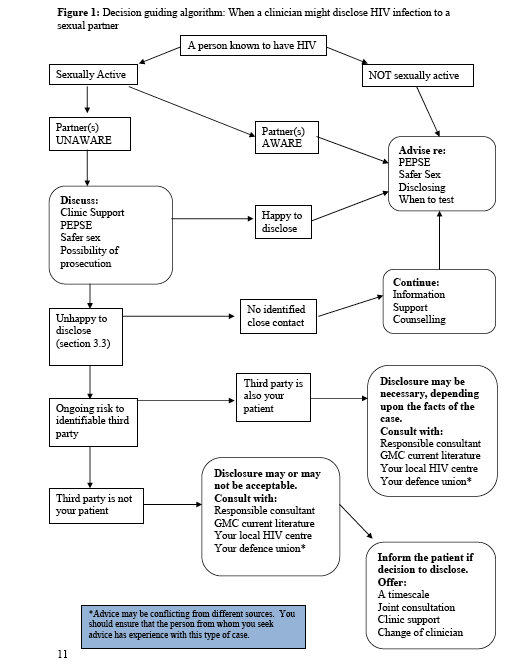
The guidance also clearly states that “no information should be released to the police unless patient consent has been verified or there is a court order in place, except in very limited circumstances defined by the [General Medical Council].”
Importantly, it also notes that only individuals can make complainants to the police “and health care workers should remain impartial during discussions with patients.”
Finally, it provides clear advice to both help prevent transmission of HIV to sexual partners and to avoid prosecution for ‘reckless’ HIV transmission. Accordingly, people with HIV should do at least one of the following:
- Use a male or female condom fitted correctly along with water-based lubricant. Individuals doing this are unlikely to be seen as reckless for legal purposes. In the event of a condom split, it is advisable to disclose HIV status in order to support the partner’s decision whether or not to obtain post-exposure prophylaxis (PEPSE), which should be taken within 72 hours. The need for PEPSE will depend upon the type of sexual activity and the HIV viral load. An assessment of the risk should be undertaken by a clinician according to the BASHH PEPSE guidelines. Disclosure in these situations would suggest that the person with HIV was not reckless.
- Adhere to effective (suppressed viral load) antiretroviral medication. There is growing evidence of extremely low/minimal risk of transmission when plasma HIV is fully suppressed with the use of antiretroviral medication. In some situations an undetectable viral load can afford protection equivalent to or greater than that of condoms. A person with HIV is unlikely to be seen as reckless when relying on a suppressed viral load instead of condom use if they have been counselled accordingly by an HIV clinician or similar medical authority. It is recommended that this discussion is documented in the patient’s medical records.
In addition people with HIV should be advised that disclosure of HIV positive status to a partner before sex is important to support informed agreement around risk and safer sex behaviours. To avoid successful prosecution an individual who is not taking effective antiretroviral medication and does not use a condom must disclose their HIV status to sexual partners before sex takes place.
The entire guidance is reproduced below.
Norway: National Association of People Living with HIV responds to Norwegian Law Commission report
Yesterday was the deadline for written responses to the Norwegian Law Commission report which shocked and disappointed HIV and human rights advocates in Norway and around the world on its release last October.
After spending almost two years examining every aspect of the use of the criminal law to punish and regulate people with communicable diseases (with a specific focus on HIV) the Commission recommended that Norway continues to essentially criminalise all unprotected sex by people living with HIV regardless of the actual risk of HIV exposure and regardless of whether or not there was intent to harm. The only defence written into the new draft law is for the HIV-negative partner to give full and informed consent to unprotected sex that is witnessed by a healthcare professional.
Since then, Professor Matthew Weait has published Some Reflections on Norway’s Law Commission Report on Criminal Law and the Transmission of Disease on his blog highlighting some of problems with the arguments used in the report.
We have also published an interview with Kim Fangen, the only member of the Commission to vote against the use of a specific law to control and punish people with HIV and other sexually transmitted infections, which presented an alternative vision.
Today, we publish the English translation of the written response by Nye Pluss, the Norwegian national association of people living with HIV.
The organisation found that, overall, the report has three key weaknesses:
• It does not take into account the formidable global challenges related to HIV and AIDS and is not consistent with the international responsibilities that Norway has to follow-up recommendations that have come from a variety of organisations, including UNAIDS.
• It does not take into account the medical advances that have taken place in the HIV field over the past few years., in particular that HIV treatment is, in fact, now prevention, and that testing and treatment (“treatment as prevention”) is one of the most important preventive measures to combat the global HIV epidemic.
• It does not acknowledge that HIV criminalisation will help to prevent effective contact tracing and counselling, and thus influence the HIV response in the wrong direction. A desire for the use of punishment is, therefore, at the expense of public health.
Nye Pluss recommends that the Government and Parliament reject the choice of the majority’s conclusions in this area and remove the particular provisions of the Criminal Code.
The HIV Justice Network fully supports their arguments and conclusions and hopes that Norways parliamentarians follow the lead of Labour’s Håkon Haugli and The Conservative Party’s Bent Høie who came out against any specific law last July.
Below is the English translation of the Nye Pluss response, shortened and paraphrased in some areas, but with their full agreement and permission. The original Norwegian version can be read here.
Nye Pluss’s board has read and discussed the Norwegian report. Our perspective is that, as people living with HIV, all aspects of Norwegian HIV policies, including any special penal provision, must have the net result of fewer new infections. Our primary perspective is therefore one of public health.
We have found that, overall, this report has three key weaknesses:
• It does not take into account the formidable global challenges related to HIV and AIDS and is not consistent with the international responsibilities that Norway has to follow-up recommendations that have come from a variety of organisations, including UNAIDS.
• It does not take into account the medical advances that have taken place in the HIV field over the past few years., in particular that HIV treatment is, in fact, now prevention, and that testing and treatment (“treatment as prevention”) is one of the most important preventive measures to combat the global HIV epidemic.
• It does not acknowledge that HIV criminalisation will help to prevent effective contact tracing and counselling, and thus influence the HIV response in the wrong direction. A desire for the use of punishment is, therefore, at the expense of public health.
Below, we elaborate our views on these three objections.
Norway’s international responsibility in the fight against HIV
The fight against HIV and AIDS is one of the biggest challenges we face in the world: two million die every year due to AIDS-related illnesses. Around 35 million people live with HIV globally. Nearly three million are newly infected with HIV each year. Norwegian authorities have a responsibility to contribute to the international HIV response. We therefore believe that the discussion on penalising HIV exposure or transmission in Norway must be seen in relation to the international challenges we face. This report does not live up to those challenges.
At page 184 the report states:
“UNAIDS ‘work is global, but is mainly aimed at countries where the prevalence of HIV and AIDS is high. UNAIDS has no European office, such as WHO and recommendations etc. have a global objectives and are hardly suitable for Scandinavian or European conditions. The committee’s review will be largely based on our cultural context, which can be very different from the global.”
It therefore concludes that UNAIDS’ work and recommendations specifically relating to criminal laws are not relevant for Norway, while Norwegian authorities support UNAIDS efforts globally. This is, in our opinion, a somewhat arrogant and culturally discriminatory attitude to the situation in other countries. Although Norwegian law is only applicable in Norway, we expect that Norwegian laws at home should also follow, and are not contrary to, the beliefs and policies that we export to other countries in the world.
“Treatment as prevention” – a medical breakthrough in the fight against HIV
A medical breakthrough took place when the first effective HIV medicines appeared in 1996. In countries where there was good access to these medicines, the number of AIDS-related deaths fell quickly and drastically. Treatment as prevention is, perhaps, just as big a breakthrough – we now know that effective HIV medication prevents new HIV infections. New research shows that the risk of infection is reduced by 96%, more than any other prevention method.
[Several paragraphs discuss international policy relating to ‘treatment as prevention’….]
Nye Pluss notes with surprise that the report only once refers to “treatment as prevention” and even then in a way that gives the impression that the authors of this section have not acquired up-to-date knowledge of the issue. It is regrettable that such an important resource which claims to provide a basis for Parliament to examine Norwegian HIV policy in a holistic context – not least relating to the criminal law – treats such an important part of international HIV policy so superficially. We believe that it is a serious academic failure not to discuss the effects of punitive sanctions on earlier testing and treatment.
Criminal law regulation of serious infectious diseases – an obstacle in the fight against HIV
HIV criminalisation has been a growing problem in many countries around the world in recent years. Criminalisation helps to maintain stigma and prevent openness about HIV, and is thus an unwanted obstacle in HIV treatment and prevention. In addition, HIV criminalisation in many countries works to suppress women and minority groups that are particularly vulnerable to HIV.
Nye Pluss believes that the criminalisation of HIV exposure and transmission has been a barrier to effective HIV prevention in Norway. In some groups, annual HIV figures have tripled over the last ten years, compared with the previous decade.
A future, efficient Norwegian HIV policy will depend on effective and efficient testing, counselling, contact tracing and treatment, such as a “treatment as prevention” strategy. Effective testing of affected populations, effective tracing of possible infected sexual partners and effective treatment is, along with condoms and awareness, cornerstones of reducing new infections in Norway.
For those of us living with HIV, it is important that a future Norwegian strategy is successful, so that fewer people acquire HIV in Norway….One such major obstacle to achieve reduced infection figures is the criminalisation of HIV through a special provision in the Criminal Code, as advocated by the majority of the committee behind the report.
In the pharmaceutical industry….the manufacturer must show that the drug’s harmful effects do not exceed its positive effects… Surely it is possible that an HIV law will negatively impact vulnerable groups of people with HIV who have immigrated from countries with non-democratic regimes, who are more likely to go underground if there are threats of punitive sanctions, so that testing, disclosure, contact tracing, treatment and counselling is not available to them? Nye Pluss consider it obvious that there exists such a legitimate doubt and that this is precisely one of the reasons that some MPs have requested a separate investigation of the criminal law as it relates to HIV. “It is therefore surprising that the majority of the commission’s members argue, without any scientific evidence, that there would be no negative impact to an HIV law.”
Moreover, many members of the committee suggest that “decriminalization could be perceived as a signal that infecting others or exposing others to infection, is no longer a serious matter”(page 248). This is an unscientific, tautological statement based on the completely undocumented assumption that because HIV exposure and transmission is criminalised in Norway it has worked as a prevention tool, and that decriminalising it would lead to more infections, despite a lack of any evidence supporting this.
Nye Pluss believes the committee majority here are completely wrong, and we can refer to international research studies that support this.
[A summary of studies from Canada (O’Byrne, 2012), the US (Sero, 2012), Scotland (Bird and Leigh-Brown, 2001), and England (Whitlock, Warwick et al, 2010) showing a negative impact of HIV criminalisation follows.]
Nye Pluss finds it surprising that the majority of the Committee does not seem to be familiar with the research that has been done in recent years which shows that HIV criminalisation has unique negative impacts on willingness to test, to disclose to sexual partners, and in the creation of uncertainty amongst health care workers and counsellors. This somewhat surprising rejection of the existence of such research and thus a lack of discussion of such readily available research, weakens, in Nye Pluss’s perception, a range of the majority’s conclusions on the importance of the criminal law’s impact on public health: not to discuss the importance of documented research in this area is a serious mistake and results in the majority’s conclusions on public health failing in crucial ways.
Another key point of the debate around a penalty provision for people with HIV is the growth we have seen in HIV figures among particularly vulnerable groups, such as men who have sex with men, over the last ten years…The extremely serious issue that is raised is whether the relatively large number of prosecutions over the past decade has affected HIV testing behaviour, thus increasing the number of untreated individuals, resulting in more new infections.
It is a serious public health issue when there is a tripling of HIV infection among men who have sex with men for the last ten years in Norway. We are in absolutely no doubt that public health has not benefitted from the use of the Penal Code, and are of the opinion that the studies and analyses conducted to date, and as mentioned above, show with great clarity that the increased number of criminal trials over the last decade have impacted Norwegian society and public health in an extremely negative way. Nye Pluss cannot see that the Criminal Code’s provisions against HIV, which the majority recommend, will result in fewer HIV cases.
Nye Pluss believes that the latest scientific advances pertaining to HIV treatment and prevention will do perfectly well by themselves without assistance from the criminal law, including those few cases where restrictive measures for infection control law would be needed against an individual.
Conclusions
Nye Pluss believes that the Committee’s recommendations to maintain the criminal regulation of HIV exposure and transmission and other general dangerous diseases, would undermine Norway’s international responsibility to participate in a common front to combat HIV in the world.
We must recognise that since 100% safe sex is not possible it would be impractical to allow the courts to put a specific limit on what is punishable in a world where sex is a universal activity for the continuation of humanity … To punish a select few who have not mastered ‘safer sex’ – defined narrowly as condom use – is neither a fair or an effective tool in this fight, but rather the opposite.
No matter where you draw the line regarding what is, or is not, a criminal offense, a specific penal code criminalising HIV exposure and transmission will prevent effective prevention, early testing, contact tracing, treatment and counselling, and will put a spoke in the wheels of the “treatment as prevention” strategy that promises to be the breakthrough in the fight against HIV. That the criminal law should be both an obstacle to international responsibility and to effective measures for domestic public health in this area is unacceptable for society.
Nye Pluss recommends that the Government and Parliament reject the choice of the majority’s conclusions in this area and remove the particular provisions of the Criminal Code.
New Zealand: ‘HIV predator’ is named; seventh complainant adds further charges
The man dubbed the ‘HIV predator’ had his name and face splashed all over New Zealand’s media today in what has become the biggest criminal HIV transmission case in NZ history. There are now seven complainants (six men, one woman) of whom five are alleging that the man was source of their HIV infection.
As well as his name and several photos, today’s report on GayNZ.com includes many of the details left out of their earlier reporting, including his online dating profile nicknames and the name of the street he lived on in Auckland. They also highlight that HIV testing centres are anticipating a rise in HIV testing today and over the weekend as people recognise the man. But surely this is as much a ‘fishing expedition’ as a public health warning.
Today’s story on TVNZ.com includes a quote from Bruce Kilmister, chief executive of NZ’s PLHIV organisation, Body Positive
[Kilmister] said the alleged charges significantly changed a lot of people’s lives. “Everybody who has had an association with him in the past should come forward for a test. But it’s also a timely reminder that everybody has a responsibility to keep themselves safe and follow safe sex practice. HIV positive people have an added responsibility not to transmit the virus, and the best way they can do that is to have safe sex.”
To put the case into perspective, according to data from New Zealand’s Ministry of Health (AIDS New Zealand Issue 63 – March 2009 ) only 184 people were newly diagnosed with HIV in 2008 – of whom 91 were acquired via sex between men, but only 70% of these were acquired in New Zealand, most of whom lived in Auckland – and this was the highest number ever recorded. Since there are now five gay men (aged between 17 and 31) who claim the accused man infected them, this ‘cluster’ alone would represent around 8% of new diagnoses.
Adding to the panic is the 19 year-old female complainant (who has not tested positive). Between 1999-2008 there were only 52 women diagnosed with HIV that was heterosexually acquired in New Zealand. The TVNZ article continues
The fact a woman had allegedly been affected raised concerns the virus may have spread into the heterosexual community. “The reality is that most women think of the pill as the beginning and end of safe sex. It needs to be a message that goes right across the broad spectrum,” [said Kilmister.]
If this man is the source of five (or possibly more) infections, this certainly is a public health concern, and the criminal justice system involvement is, indeed, a result of the failure of public health. The call for new and better public health laws in New Zealand are understandable, and certainly would be better than the current system which required media and CJS intervention.
However, last year the NZ Ministry of Health published a study examining HIV prevalence in New Zealand, both diagnosed and undiagnosed (AIDS New Zealand Issue 62 – November 2008) which found a prevalence of 4.4% amongst men who have sex with men attending sexual health clinics, of whom only half were diagnosed. Undiagnosed people can’t disclose – and cannot be publically (or even privately) named and shamed as a way to warn others about specifically avoiding them. Undiagnosed people may also be having as much – or more – ‘promiscuous’ sex as the so-called ‘HIV predator’.
Earlier in the week, TVNZ ran an in-depth look at the case and interviewed Michael Stevens, the man who orginally brought the allegations to GayNZ.com and Simon Harger-Forde, director of HIV prevention at New Zealand AIDS Foundation. It makes for uncomfortable viewing by making patient confidentiality appear to be something bad, and conflating two issues (non-disclosure resulting in HIV exposure or transmisison being a criminally liable act and the lack of an effective public health response) without any examination of the issue of shared responsibility for sexual health. Only at the very end does Mr Harger-Forde say that laws don’t protect anyone, and that everyone should be using condoms.
Finally, an interesting blog posting from a feminist commentator, which highlights other concerns – that this case will end up leading to further stigmatisation of gay men and people living with HIV in New Zealand, and concludes:
Safe sex is crucial, of course, but it’s also crucial that the … case doesn’t become an exercise in victim-blaming, with homophobic overtones. And it’s also important that [his] behaviour doesn’t prompt a backlash against HIV positive people, who have the same needs for affection, companionship and intimacy as the rest of us.