Matthew Weait, from the University of Portsmouth, writes on how stigma and the law affect the lives of people with HIV

HIV Stigma and the Criminal Law

December 1st marks World AIDS Day, an opportunity for people worldwide to unite in the fight against HIV, show their support for people living with HIV and to commemorate people who have died. Matthew Weait, from the University of Portsmouth, writes here on how stigma and the law affect the lives of people with HIV.

Today, December 1st, is World AIDS Day.  According to the latest available data from UNAIDS, 1.1 million people died from AIDS-related causes in 2015, there are just over 2 million new HIV infections globally every year, and just under 40 million people are living with the virus.  These are depressing figures, particularly in light of the advances in our understanding of HIV, its prevention and treatment, the laudable rise in the number of people accessing antiretroviral therapy (ART) (up from 7.5 million to 18 million in the past five years), and the massive impact of ART on reducing the likelihood of onward transmission.

Despite the fact that the life expectancy of people on ART has improved significantly, especially for those who receive a timely diagnosis, and that there exist effective ways of avoiding infection, the stigma associated with HIV remains.  The impact of this stigma, and the associated discrimination which people living with HIV (PLHIV) and those in key populations are subjected to, is substantial and undermines the work being done to promote access to health and other services critical to curtailing the epidemic.

Stigma is not only correlated with adverse health outcomes for PLHIV (including depression and lower adherence to medication), but also with non-disclosure of status and with less safe sexual practices.  It is for these reasons that combating stigma, and the factors which contribute to it, has long been identified as a public health priority.

Among the most pernicious contributors to HIV stigma is the widespread and inappropriate use of criminal laws against PLHIV and those at heightened risk of infection.  For example, PLHIV or those suspected of being HIV-positive have been and are at risk of being investigated, prosecuted and imprisoned for exposure offences – where no transmission takes place – even where there is negligible risk (as when a PLHIV is on effective treatment and has an undetectable viral load), where there is no risk (e.g. through biting or spitting), and even where a partner has consented to the risk involved.

In some countries, such as Canada, the very fact of non-disclosure of status can, irrespective of risk, turn otherwise consensual sex into sexual assault.  And where transmission does in fact occur (which is more likely when someone does not know their status and is not on treatment than when they do know and are), PLHIV are at risk of extended custodial punishment, even if it is not their intention to cause harm.

These laws serve no public health purpose and, because it is typically only those that have a positive diagnosis who may be found criminally liable, do nothing to incentivise the testing which is a pre-requisite of treatment and care.

It is not only those already living with HIV who suffer from the enforcement of punitive laws.  The social opprobrium associated with and / or criminalization of transgender people, homosexuality, sex work, and injecting drug use in many countries of the world (including nations with high HIV prevalence) reinforces stigma, makes it harder to support those at heightened risk of acquiring the virus, and in fact makes infection more likely.

If the possession of condoms is treated as evidence of sex work, sex workers may not carry them; and if the possession of syringes is treated as evidence of drug use, the chance that these will be shared increases, as does the risk of transmitting blood-borne viruses (including HIV and hepatitis C).  Put simply, the policing of these communities, and the absence of harm reduction opportunities in the carceral settings they may find themselves in as a result of that policing, exacerbate risks which are already greater than for the general population.

The adverse impact of using criminal law in the fight against HIV, and on those directly and indirectly affected by it, has been extensively researched and documented.  The consensus among expert bodies such as UNAIDS and the Global Commission on HIV and the Law is that countries should review their punitive laws and significantly restrict their use, and there have been a number of progressive and welcome developments both in law reform and in policing, many of these led by coalitions of activists and clinicians.  At the same time, and despite the evidence of the harm that they cause, and the stigma which it feeds and sustains, countries continue to pass and enforce these laws.

Irrespective of any moral or ethical questions there may be about HIV transmission, exposure, or non-disclosure, it is incontrovertible that the criminal law makes the elimination of HIV harder.  If we are going to end the epidemic, this needs to be recognised and acted on as a priority. If not, more people will become infected, more people will get sick, more people will have a lower quality of life – even when virally suppressed – and more people will die.

Published in BioMed Central on Dec 1, 2016

US: New Report from the William Institute finds HIV criminalisation laws in California do not reflect medical science

LOS ANGELES —  In California, outdated HIV criminalization laws do not reflect the highly effective medical advances for reducing the risk of HIV transmission and extending the quantity and quality of life for people living with HIV.

HIV criminalization is a term used to describe laws that either criminalize otherwise legal conduct or that increase the penalties for illegal conduct based upon a person’s HIV-positive status.  California has four HIV-specific criminal laws.

In HIV Criminalization in California: Evaluation of Transmission Risk, researchers Amira Hasenbush and Dr. Brian Zanoni suggest that these HIV criminal laws in California are not in line with medical science and technology related to HIV and may, in fact, work against best public health practices.

“Nine out of ten convictions under an HIV-specific criminal law or sentence enhancement have no proof of exposure to HIV, let alone transmission,” said Amira Hasenbush.  “No HIV criminal laws in California require transmission for a conviction.”Key findings include:

  • From 1988 until June 2014, 379 incidents resulted in convictions for an HIV-specific felony or sentence enhancement.
    • Of those, 100 percent required no actual transmission of HIV.
    • 98 percent did not require intent to transmit HIV.
    • 93 percent involved no specific allegation of conduct that is likely to have transmitted the virus:
      • Ninety percent of convictions were in solicitation incidents in which it is unknown whether any contact beyond a conversation or an exchange of money was initiated, thus possibly not having any exposure to HIV.
      • Three percent of incidents involved oral sex, a sex act whose transmission risk is estimated as “low” by the CDC.
      • Only seven percent of incidents involved vaginal or anal sex by definition of the crime.

HIV criminal laws have been disproportionately applied to sex workers. This has a disproportionate impact on women and people of color. Since solicitation by definition includes survival and subsistence sex work, these laws are also likely to disproportionately impact LGBT youth and transgender women of color.

Laws that criminalize conduct of a person who knows that they are HIV-positive may disincentivize testing and work against best public health practices.

The Williams Institute, a think tank on sexual orientation and gender identity law and public policy, is dedicated to conducting rigorous, independent research with real-world relevance.

Full report can be read here


Canada: Canadian Report highlights a "clear pattern of racism" in media reporting of HIV-related offences

Media accused of racism in reporting HIV-related crime

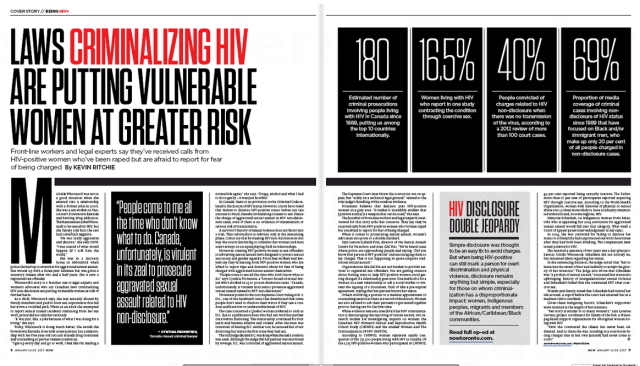
Black males with HIV account for 20 per cent of the 181 people charged for no disclosing HIV status to sexual partners, but 62 per cent of newspaper articles focused on their cases.

Canadian mainstream media disproportionally focus on black immigrant men criminally charged for not disclosing HIV status to their sexual partners when the majority of offenders are white, says a new study.

To mark World AIDS Day on Wednesday, a team of Canadian researchers released the pioneering study last week identifying “a clear pattern of racism” toward black men in the reporting of HIV non-disclosure in Canadian newspapers.

“The most striking revelation of this report was the grand scale of stereotyping and stigmatizing by Canadian media outlets in their sensationalistic coverage of HIV non-disclosure cases,” said Eric Mykhalovskiy, a York University sociology professor, who leads the team.

“It’s upsetting to read myths masquerading as news and repeating the theme of how black men living with HIV are hypersexual dangerous ‘others.’ This approach not only demeans journalism, but it inflames racism and HIV stigmatization, undermining educational and treatment efforts.”

Based on the database of Factiva, an English-language Canadian newspaper articles from 1989 to 2015, researchers from York, University of Toronto and Lakehead University identified 1,680 reports of HIV non-disclosure cases. Of those reports 68 per cent, or 1,141 of the articles, focused on racialized defendants.

According to court records of HIV-related criminal cases in Canada, African, Caribbean and black men living with HIV, the virus that causes AIDS, account for 20 per cent or 36 of the 181 people charged for these offenses. However, 62 per cent or 1,049 of the 1,680 media reports focused on these 20 per cent of the cases.

Immigrants and refugees receive particularly higher amount of coverage. While only 32 of the 181 accused are known to be migrants to Canada, yet stories about their offences represented 62 per cent (1,046 of 1,680) of the media coverage.

“The report documents the media’s stigmatizing and unjust racial profiling of black heterosexual immigrant men in HIV non-disclosure cases that perpetuates systematic discrimination,” said Christian Hui, an HIV activist and co-founder of the Canadian Positive People Network.

“We know next to nothing about them other than their name, age, residence, occupation, the charges they face,” said the report. “What is distinct about the coverage of African, Caribbean and black male defendants is how (they) are linked with racializing forms of representation in ways that amplify connections between HIV, criminality, race and ‘foreignness.’”

Mykhalovskiy said the research team recognized that accused criminals often refuse to speak with the media at their counsel’s advice, but it does not change the fact black immigrant offenders are disproportionally represented in the coverage.

The study urges the Canadian media to treat HIV non-disclosure as a health issue and not simply a crime story; to stop using mug shots that further stigmatizing and discriminate people with HIV as criminals; and to reach out to AIDS service organizations when interviewing sources for these stories.

Published in The Star, on Dec 1, 2016

Uganda: 5 months after filing their initial petition, activists renew their call to amend HIV law

Activists renew call for HIV law amendment

By Noah Jagwe

They argue that the law contains clauses that could deter all the benefits in the fight against the scourge.

According to this group, the law instead instills fear in communities about HIV disclosure and also fuels stigmatization.

Earlier this year, some 60 civil society organizations across the country challenged the criminalization of HIVin Uganda as well as other ‘harmful’ provisions in the Act.

Dora Kichoncho Musinguzi, the executive director Uganda Network on Law and Ethics, said the salient features that are scanned out in the law which they consider discriminatory are: Clauses 21, 41 and 43 of the Act that seek to criminalize HIV, particularly intentional transmission.

The Act would require mandatory disclosure of one’s HIV status, failure of which would be regarded as “criminal”, and attempting to or, intentionally transmitting the virus.

Failure to use a condom where one knows their HIV status would constitute a criminal offence, making them liable for prosecution.

The provisions in the HIV Act, according to Kichonco, do not only stigmatize and discriminate against people living with HIV, but also deter communities from seeking HIV services such as HIV testing and subsequently HIV treatment.

“It is five months since we filed the petition. The government has not responded to our case. This is procedurally wrong and negates justice,” she said.

Kichoncho said if the law continues “as we could see”, it would heighten stigmatization of people living with HIV and that many of the targets such as 90% of people knowing their status, 90% of those who with HIV are on treatment and 90% with suppressed  viral load set by the country might not be achieved.

“The law has been counterproductive to all the achievements Uganda has made.”

She said the legal environment in Uganda is not conducive and human rights have not been respected. “Laws that criminalize and stigmatize people with HIV must be repealed.”

Meanwhile, Dorothy Nassolo, communications officer of Forum of People Living with HIV/Aids Networks in Uganda said there is a crisis the country might not stand.

She said a number of patients have been hacked to death because they have been discovered by their spouses for taking ARVs covertly.

National Forum of People Living with HIV/AIDS officer Milly Katana said the most affected group by the law are women through gender-based violence at home.

Katana said it’s better for Uganda to look at other alternatives for instance biomedical tools, medical male circumcision and condoms. –

Published in New Vision on Dec 1, 2016

HIV Criminalization: Masking Fear and Discrimination (Sero, US, 2016)

A short documentary for the Sero Project produced by Mark S King, written by Christopher King, and edited by Andrew Seger.

Canada: New report explores mainstream Canadian newspaper coverage of HIV non-disclosure criminal cases, highlighting stigmatizing representations of African, Caribbean and Black men living with HIV

Abstract:

This report explores mainstream Canadian newspaper coverage of HIV non-disclosure criminal cases in Canada. It pays particular attention to how defendants’ race and immigration status figure into the newspaper representations of such cases. We empirically enquire into claims that African, Caribbean and Black (ACB) people living with HIV are negatively portrayed and overrepresented in Canadian newspaper stories about HIV non-disclosure cases. Our analysis is based on what, to our knowledge, is the largest data set of news coverage of the issue: a corpus of 1680 English-language Canadian newspaper articles about HIV non-disclosure criminal cases in Canada written between 1 January 1989 and 31 December 2015. Our quantitative and qualitative findings show that Canadian mainstream newspapers are a source of profoundly stigmatizing representations of ACB men living with HIV. For example, Black immigrant men living with HIV are dramatically overemphasized in Canadian mainstream newspaper stories about such cases. While these men account for only 15% of defendants charged they are the focus of 61% of newspaper coverage. Mainstream newspapers rely on forms of language that transfer a long history of exaggerated connections between criminality, race, sex, and otherness to the site of HIV. The result is that ACB men living with HIV are repeatedly represented as dangerous, hypersexual, foreigners who pose a threat to the health and safety of individuals (White women) and, more broadly, the imagined Canadian nation.
The report is available to download here


Czech Republic: Police drop charges against all 30 gay men living with HIV following Prague Public Health Authority ‘witch hunt’

All criminal charges have been dropped against the 30 gay men living with HIV who were reported to the police by the Prague Public Health Authority earlier this year after they were diagnosed with an STI, Czech media report today.

The draconian behaviour of Prague Public Health led to widespread condemnation by human rights defenders.

A change.org petition initated by the European AIDS Treament Group (EATG) was signed by more than 1000 supporters, including the HIV Justice Network.

Today’s media report in Aktuálně.cz notes that three of the 30 men had been indicted for potential HIV transmission (under a law criminalising ‘the spread of infectious human diseases‘) but prosecutorial authorities withdrew the charges due to lack of evidence.

Police spokesman, Jan Danek, told the paper that following an investigation there was no case to prove against any of the 30 men and all charges had been dropped.