UK: Court of Appeal upholds man’s conviction for recklessly passing on genital herpes during sex with ex-girlfriend

Today, the Court of Appeal upheld David Golding’s 2011 conviction for ‘recklessly’ infecting his ex-girfriend with genital herpes (HSV-2) during a brief relationship.  However, his original 14 month sentence was reduced to three months (as time served, Mr Golding was released on bail in September 2011 after spending six weeks in prison) because of the exceptional delay in bringing the case to appeal. “Accordingly,” wrote Lord Justice Treacy on behalf of fellow judges Mr Justice Bean and His Honour Judge Lakin, “notwithstanding our view as to the propriety of the initial sentence, we exercise our power to reduce that sentence in the light of what has occurred subsequently.”

The Court found that Mr Golding understood both that he had the infection and how it is transmitted, and by not preventing transmission – or disclosing his condition thereby allowing the complainant to make an informed decision whether or not she wanted to risk acquiring herpes – was guilty of reckless grievous bodily harm under Section 20 of the Offences Against The Person Act 1861.

Notably, the Court reaffirmed that in this case herpes was a “really serious bodily harm”, although it noted that in a future contested trial it would be up to a jury to consider whether the herpes infection was, indeed, really serious, on a case-by-case basis.

20. As to the impact of herpes, the evidence was that whilst it was not a life threatening condition, it is incurable. The initial infection is described as an unpleasant and painful acute illness with debilitating effects. On occasion admission to hospital may be required, (not in this case), and most affected people can return to work within a week or so. Episodes may recur throughout life. Generally when they do, they are milder and shorter in impact. Psychological disturbance is common in the immediate aftermath of the initial episode. HSV-2 has a higher recurrence rate than HSV-1.

62. ….The evidence of the painful symptoms, their effect at the time, their recurrence, and the prospect of their recurrence without effective cure for an indefinite period was in our judgment sufficient for a jury to consider that it amounted to really serious bodily harm.

During the Appeal, Mr Golding testified that he had not been given clear information that genital herpes might be transmtted even in the absence of a “flare up”. The Court did not believe Mr Golding, and because there were no medical notes regarding how he had been counselled (despite him testifying that he only received confirmation of his herpes diagnosis over the phone from a GUM receptionist and a general leaflet on STIs at his initial visit) and because both medical experts – Dr Kenneth Mutton (for the Crown) and Professor George Kinghorn (for the defence) –  said that “best practice” would be for a newly diagnosed person to be counselled about “the possibility of infectivity even when a person is asymptomatic” the Court found Mr Golding was, in fact, reckless.

22. The available medical notes were not specific as to advice provided to the appellant. According to Dr Mutton, he would have expected a full discussion to have taken place in April 2008 at the Genito-urinary Clinic following the guideline of the British Association for Sexual Health and HIV. This refers to condom use when lesions are present, the possibility of infectivity even when a person is asymptomatic, and disclosure of the condition to a partner.

23. Professor Kinghorn, in the absence of particular evidence as to the advice given to the appellant, thought that it was less likely that the appellant would have been told that he was infectious when no lesions were present. However, he conceded that since the turn of the century, the state of medical knowledge in this respect available to general practitioners had improved. He also acknowledged that a GP following best practice would have included advice about asymptomatic transfer.

This will have important future implications for the clinician-patient relationship, not only at GUM clinics, but also for GPs. It suggests that courts will assume this “best practice” has taken place – even if it hasn’t – and it will be hard for a future defendant to prove that he or she hadn’t been counselled in this way if there is nothing in their medical notes.

Given the public policy implications of this ruling, there may well be an application to appeal the case to the Supreme Court.

Unusually, it was the CPS that had initiated this appeal after seeing a report from Dr Mutton, produced after Mr Golding was sentenced (following an initial guilty plea) which raised the issue of whether genital herpes could be described as “really serious bodily harm” so as to come within Section 20. In the latest (unpublished) version of its legal guidance on prosecuting Intentional or Reckless Sexual Transmission of Infection it had suggested that genital herpes could be prosecuted under Section 47 of the OAPA 1961, actual bodily harm.

Mr Golding had been prepared to plead guilty under Section 47 in his original trial, but the judge had made it clear that he would only accept a plea (or a full trial) under Section 20. In effect, however, the Court of Appeal has dodged a bullet by avoiding a clear statement that sexual herpes transmission is always serious bodily harm.

As it stands, the reckless (or intentional) transmission of any sexually transmitted infection (whether or not it is considered to be objectively serious by, for example, BASHH or other medical experts) could be prosecuted in England & Wales and a jury will decide whether the infection is subjectively serious according to the testimony of the complainant and medical experts.

It should be recalled that the original draft of the CPS guidance, published in 2006, covered not only the intentional or reckless sexual transmission of HIV, but also chlamydia; genital herpes; gonorrhoea; hepatitis A, B and C; LGV (lymphogranuloma venereum); non-specific urethritis (NSU), and syphilis.

Back in 2007, in response to the draft, the Government’s Expert Advisory Group on AIDS (EAGA) noted that including so many non-serious STIs was “one of the most disturbing aspects of the document.” It conceded that “broadening the policy to cover other infections may be desirable to avoid stigmatising HIV,” but added that “there is a danger of confusion because of significant differences between the infections listed.” It questioned the CPS’s understanding of the nature of STIs, how they are transmitted and whether they actually cause any serious harm in pragmatic terms.

As an example it used the case of genital herpes, which “is simply a cold sore on the genitals, indeed half of all cases in the UK are thought to be caused by transmission of herpes from the mouth to the partner’s genitals during oral sex. It causes little serious physical harm and most people who contract it are not even psychologically disturbed by it in the longer term. Even given the definition in the document, it seems to defy common sense that this could constitute grievous bodily harm.”

EAGA added that HSV, the virus that causes genital herpes, is often passed from parent to child with a kiss on the cheek. “Why should it be grievous bodily harm to infect a partner with genital herpes through sex, but not when an adult infects a child by kissing their cheek, or another adult by kissing their mouth?”

It stressed that “the CPS needs to take the advice of experts regarding the seriousness of [STIs]. In the vast majority of cases, seeking to prosecute transmission would be an entirely disproportionate response.”

The Herpes Viruses Association (HVA) issued a press release following today’s verdict which stated that “we are appalled at the court’s failure to overturn the guilty verdict. Herpes virus transmission should not be in the legal arena at all.”

HVA charity director Marian Nicholson said: “This charity represents around forty million people in the UK who carry herpes simplex infections. Over half the cases of genital herpes are caused by the common facial cold sore type (HSV-1) usually by oral sex. The implications of the judgment are that any of them could be sent to prison if they transmit this infection to a partner.”

She said: “I am pleased that David Golding has not been sent back to prison – but this ruling is inappropriate. It is not in anyone’s interest to send people to prison for passing on such a common and usually unnoticed condition.”

She continued, “We should take responsibility for our own sexual health and not assume that a partner is infection-free. Many infections are caught from people who don’t know they have them so blaming someone else is pointless.”


R v Golding [2014] EWCA Crim 889
Canada: More than 70 scientific experts sign on to consensus statement on HIV transmission risks in the context of criminal law

More than 70 scientific experts Canada-wide have today released a consensus statement confirming when there is a low-to-zero possibility of a person living with HIV transmitting the virus in various situations.

The statement was developed out of a concern that “a poor appreciation of the scientific understanding of HIV and its transmission” is contributing to the overly broad use of criminal charges against people for alleged non-disclosure of HIV status in Canada.

It concludes that “HIV physicians and scientists have a professional and ethical responsibility to assist those in the criminal justice system to understand and interpret the science regarding HIV. This is critical to prevent miscarriage of justice and to remove unnecessary barriers to evidence-based HIV prevention strategies.”

According to a press release issued today

The Canadian HIV/AIDS Legal Network, the HIV & AIDS Legal Clinic Ontario (HALCO), la

Coalition des organismes communautaires québécois de lutte contre le VIH/sida (COCQ-SIDA) and the Ontario Working Group on Criminal Law and HIV Exposure applaud this consensus statement. Grounded in a comprehensive review of the most recent and relevant scientific evidence, the statement confirms that current Canadian law is going too far and ignoring the science. We welcome scientific experts speaking out against the many unjust prosecutions against HIV-positive people that we are seeing in Canada, which have too often resulted in draconian sentences for conduct that posed no significant risk of transmitting the virus.

In 2012, we expressed our deep disappointment with the decisions of the Supreme Court of Canada in the cases of R. v. Mabior and R. v. D.C. Under these rulings, people living with HIV can be sent to jail and registered as sexual offenders for life for not disclosing their status even if they have used a condom or had an undetectable or low viral load, had no intent to harm and indeed did not transmit HIV. We characterized these decisions as being unfair, harmful to both individual and public health, and at odds with the science. Since these rulings, we have witnessed trial judges struggling with the difficulties they pose, particularly when this overly broad approach contradicts the scientific evidence.

Today, scientists themselves have detailed their concerns with the continued overuse of some of the most serious charges in the Criminal Code in circumstances in which prosecutions are entirely unjustified. In the consensus statement released today, scientists have sent a strong message to Crown prosecutors and judges calling for restraint.

Indeed, scientists’ assessment of the evidence supports our long-standing call for, at most, an extremely limited use of the criminal law. Among other things, the science supports the position that people who practice safer sex (e.g., by using a condom) or who are under effective antiretroviral therapy should not be prosecuted or convicted for HIV non-disclosure. Prosecuting people in such circumstances runs counter to available scientific evidence showing that the risk of transmission is negligible or even nil. Such misuse of the criminal law does nothing to help curb the HIV epidemic and drives people further away from effective HIV prevention, care, treatment and support services.

We welcome the stand taken today by medical experts and scientists from all across Canada and endorsed by the Association of Medical Microbiology and Infectious Disease Canada. It is time for the Canadian criminal justice system to take into account what the science tells us about HIV and its transmission; this evidence cannot be legitimately disregarded.

Read the full consensus statement below or download (for free) from Canadian Journal of Infectious Diseases & Medical Microbiology at http://www.pulsus.com/cjidmm

Loutfy M et al. Canadian consensus statement on HIV and its transmission in the context of criminal law.

Canada: Supreme Court rules that unwanted pregnancy is a similar 'harm' to HIV

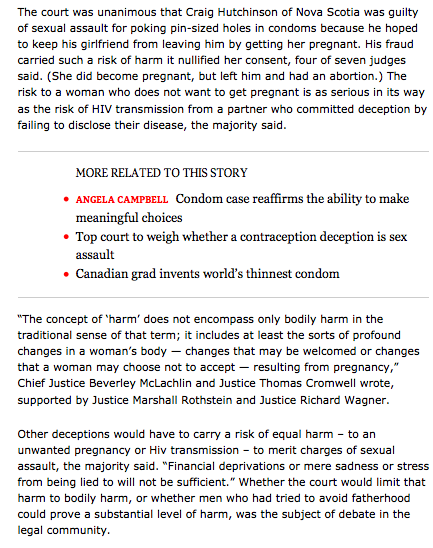
Men who sabotage condoms may turn an otherwise consensual act with a woman into sexual assault, and women who lie about using birth control have been left with some uncertainty about whether they, too, could face charges, under a Supreme Court ruling yesterday on deception before sex.

See also Court avoids making HIV prosecutions easier

The Supreme Court of Canada heeded the warnings of HIV groups in a narrow 4-3 judgment March 7.

The court upheld the conviction of Craig Hutchinson for aggravated sexual assault. Hutchinson poked holes in condoms he used with his girlfriend. He did this without her consent, hoping that she would become pregnant, which she did. There are parallels with HIV -ondisclosure cases, which also involve keeping information from someone before a sexual encounter.

The court had two legal routes available to it to convict. One route would have used the fraud provisions in the Criminal Code. This is essentially the same legal principle used in HIV-nondisclosure cases and requires both a dishonest act and some harm, or risk of harm. The majority of the Supreme Court endorsed this approach today.

The other route could have further crowbarred open HIV-nondisclosure prosecutions. A minority of judges at the Supreme Court would not have required any proof of harm in order to secure a conviction in Hutchinson’s case. This was also the reasoning of the majority of the Nova Scotia Court of Appeal.

The Canadian HIV/AIDS Legal Network and the HIV and AIDS Legal Clinic Ontario (HALCO) intervened last year to argue that the Court of Appeal’s approach would unfairly extend the criminal law to cases where there was no realistic risk of HIV transmission.

Chief Justice Beverley McLachlin agreed, saying that the court must act to protect the existing legal test and avoid “replac[ing] the clarity and restraint achieved by [HIV-nondisclosure] decisions with confusion and over-criminalization.”

This will likely seem insufficient for those who believe courts already go too far to criminalize the lives of HIV-positive people. But the court did accept the reasoning of HIV groups that intervened in the case — which it refused to do the last two times HIV nondisclosure was before the Supreme Court.

Cecile Kazatchkine, a lawyer at the Legal Network, says that the court avoided setting a bad precedent.

“This case doesn’t have any implications for people living with HIV,” Kazatchkine says. “There was a danger that it would, but it didn’t.”

“The Legal Network and HALCO have been really diligent; we decided to intervene, and put all of our energy into this case, even though it wasn’t an HIV case, to make sure the court didn’t reach a decision that makes things worse for people living with HIV.”

In December 2012, the Supreme Court released its decision in the HIV non-disclosure case of Mabior. Panned by HIV groups, a unanimous court required HIV positive people to inform their partners about their health status, unless they have both a low viral load and wear a condom.

In Mabior, the Crown asked the court to criminalize non-disclosure, regardless of whether there was any risk of transmission. That approach was rejected by the court at the time, and rejected again in the March 7 decision. Kazatchkine says that the decision will send a message to Crowns to stop trying to equate non-disclosure in all cases with sexual assault.

Kyle Kirkup, a doctoral student at the University of Toronto Faculty of Law, agrees.

“I think maybe this shows that Mabior is the high water mark of criminalization and that’s the message that the Supreme Court of Canada is trying to send, that the court is not willing to go further.

“If you adopted a broader definition of consent, the concern was that people with HIV would have to disclose in all kinds of situations where there is not a realistic possibility  of transmission, like oral sex and mutual masturbation.”

Nonetheless, the reaction to today’s decision is a far cry from years past, when HIV groups called for an end to criminal prosecutions altogether.

Kazatchkine admits that the Legal Network was in an awkward position when it argued for the court to uphold its earlier decision — a decision which the Legal Network publicly denounced at the time.

The case nonetheless may prove to be an important one in the development of the law of sexual assault. While Hutchinson may have opened the door to other non-HIV related fraud charges, the facts in the case were so unusual that it’s hard to know how broad the impact of the case will be, says Kirkup.


PARTNER study findings of zero transmissions amongst mixed HIV status gay and heterosexual couples where the positive partner has a low viral load has important legal implications

As reported today at the 21st Conference on Retroviruses and Opportunistic Infections, the multinational PARTNER study found zero HIV transmissions from condomless sex within mixed-HIV-status couples when the HIV-positive partner had his or her viral load suppressed below 200 copies/mL.

“It really is up to people themselves to judge if anything they do in life is ‘safe’ or ‘not safe,’” Lundgren stressed in the March 4 press conference. That said, these interim results have implications for legal issues around HIV, and for avoiding unnecessary use of post-exposure prophylaxis: If the HIV-positive partner has a fully suppressed viral load, Lundgren observed, “there is no reasonable legal action you could take against people who aren’t using condoms, and there’s really not a major concern if the condom breaks—and there’s certainly no indication for PEP.”

Uganda: ‘Trial by media’ of nurse accused of exposing a child to HIV via injection sets a ‘dangerous precedent’

The ongoing case of Rosemary Namubiru, the Ugandan nurse accused of exposing a child to HIV during the course of administering an injection, is highlighted in a powerful press release issued yesterday by AIDS Free World.  Fortunately, Ms Namubiru is being supported by several advocacy and human rights organisations as well as by individual HIV advocates in Uganda.

The inflammatory media coverage (an example of which is this horribly invasive TV news story, above) not only increased HIV-related stigma and violated Ms Namubiru’s right to a fair trial, but is also being used to help justify the passing of the draft HIV Prevention and AIDS Control Bill 2010 which includes a number of problematic provisions including mandatory HIV tests for pregnant women and their partners, and forced disclosure of HIV status to a newly diagnosed person’s partner by a medical practitioner. In addition, the Bill contains two overly broad and problematic HIV-specific criminal statutes.

In late 2009, a group of more than 50 Ugandan and international organisations and individuals released a report criticising many of the provisions of an earlier draft. That early advocacy resulted in the removal of a criminal penalty for the transmission of HIV from mother to child through breastfeeding.

Advocacy co-ordinated by the Uganda Network on Law, Ethics and HIV/AIDS (UGANET), continues to argue that the unfavourable clauses must be completely removed and that Uganda must assent to the East African Community (EAC) HIV & AIDS Prevention and Management Act which contains provisions meant to supersede Ugandan law.

Read the entire press release below and download the PDF version here.

HIV-Positive Nurse Tried by Media

––Uganda’s first court case dealing with criminalization of HIV transmission could have far-reaching consequences––

February 11, 2014 (Kampala, Uganda)––Rosemary Namubiru, a Ugandan nurse, stands accused of exposing a child to HIV during the course of administering an injection. The incident incited a media firestorm, leading to Namubiru’s arrest and trumped-up charges of attempted murder. That these were baseless charges was confirmed at the opening of the trial today when the charge was changed to criminal negligence; charges that could still carry up to seven years in prison. As the trial begins, it is clear that the damage has already been done. Namubiru was tried and convicted in the public eye by the media, violating her rights and presumption of innocence.

The implications of this case are far-reaching: the Namubiru case appears to be the first in Uganda’s courts dealing directly with HIV exposure and transmission. Efforts to criminalize HIV transmission, and the failure of both the media and the prosecutors office to act responsibly, set a dangerous precedent and could have grave consequences for the fundamental rights of people living with HIV and AIDS in Uganda and beyond.

Case Summary

Rosemary Namubiru, 64, a nurse with 35 years of experience, was working at the Victoria Medical Centre in Kampala, Uganda. On January 7, 2014, Namubiru was attempting to give an injection to an ill 2-year-old patient. Neither she nor the mother could calm the distraught child. With the child writhing and kicking, the needle accidentally pricked Namubiru’s finger; she stopped what she was doing, washed and bandaged her pricked finger, and returned to the child. She was eventually able to administer the injection.

Uncertain about whether the same needle was used throughout, the mother became concerned about the possibility that her child had been exposed to HIV. It was confirmed that Namubiru is HIV-positive and is on anti-retroviral drugs. The child was given an HIV test; the results were negative. A precautionary 2-month post-exposure prophylaxis regimen was initiated, after which the child will be re-tested.

Rosemary Namubiru was arrested in front of a bevy of journalists. She was held by the Criminal Investigations Department for four days before her first appearance in court. She was charged with attempted murder, which carries a sentence of up to life imprisonment, and remanded to Luzira National Prison to await trial. On February 7, 2014, she was denied bail and returned to prison to await trial.  Minutes before the trail began on February 11, 2014, the prosecutor announced the charge would be changed to “negligent act likely to spread infection of disease.”  With this new charge in place, the prosecutor began to call its witnesses, and the trial is ongoing.

Trial by media

Since the moment of her arrest, Rosemary Namubiru has been found guilty in the court of public opinion. Even though research has shown that the likelihood of HIV transmission from a needle puncture is miniscule––only 0.32% of those exposed to HIV through a subcutaneous puncture became infected––Namubiru has been singled out and vilified in the press because of her HIV-positive status.

Here are just a few of the libelous accusations that appeared in the media reports in the immediate aftermath of her arrest:

* An article with the headline “Killer nurse charged with attempted murder” went on to accuse Namubiru of “maliciously infecting her patients, mainly the children with her HIV positive blood.”

* Another claimed that she “drew her own HIV-infected blood and injected it into a two-year old child.”

* Shortly after Namubiru’s arrest, one article stated that police were “investigating allegations that the woman has been engaging in the act for a pretty long time.”

* An article that appeared in The Africa Report speculated about Namubiru’s mental state, calling her “the fiendish nurse” and claiming “the baby’s incessant cries drove her mad.”

* One journalist opined that “as police struggled to find an appropriate charge to punish such an evil act, it became clearer that our laws are inadequate to cover such emerging but deadly crimes.”

* An editorial about the case declared, “The majority of our doctors and nurses may well be great professionals, but it’s also true that among them are many people who do not harbour good intentions for one reason or another. These could be inherently evil-minded, bitter or mentally unstable.”

False and sensational accounts by irresponsible media can prejudice the outcomes of trials and violate the fundamental human rights of people living with HIV and AIDS. Section 28 of Uganda’s constitution guarantees that every person charged with a criminal offence shall “be presumed to be innocent until proved guilty.”

A miscarriage of justice

Even before the trial began, serious questions surfaced regarding Rosemary Namubiru’s ability to receive a fair hearing. From the spectacle of her arrest—recorded by media who were clearly alerted in advance–-to the baseless original charge of attempted murder, and the rush to trial before the defense could prepare, it is clear that this is a sensationalized case.

Throughout the process, there have been numerous violations of Rosemary Namubiru’s rights:

* According to Section 23(4)(b) of the Ugandan constitution, an accused person can only be held for up to 48 hours before a hearing. Namubiru was held for four days before her first court appearance.

* The prosecution argued against granting bail, stating that Namubiru poses a grave risk to the public, even though there is no evidence of intent to commit any crime.

* Namubiru had no lawyer present when police extracted a statement from her; she was unable to access legal counsel until she had been in detention for a week.

* The Prosecutor claimed on February 7, 2014 that the State had completed its investigation and was ready to proceed to trial. Namubiru’s lawyers had not yet seen the State’s evidence, and were informed that they would receive the file the day before the trial was slated to begin. Section 28 of Uganda’s constitution guarantees that every person charged with a criminal offence shall “be given adequate time and facilities for the preparation of his or her defence.”

What are the broader implications of this case?

HIV advocates fear that the Namubiru case could set a dangerous precedent, in terms of both the criminalization of HIV transmission and the treatment of people living with HIV and AIDS.

Many advocates worry that the case could be used to justify passing the proposed HIV Prevention and AIDS Control Bill 2010. The bill includes two overly-broad sections on the criminalization of HIV, as well as a number of other troubling provisions that would restrict the rights of persons living with HIV and AIDS. If the government moves to legislate the criminalization of HIV, specific groups—including pregnant women, who are easily identified within the chain of transmission—could be targeted for criminal charges. (For more on the proposed bill and its implications, please visit www.uganet.org).

AIDS-Free World unequivocally disagrees with the notion of having a separate criminal code for people who are HIV-positive. If a person attempts to do bodily harm to another, regardless of the means, the existing laws should apply. By creating laws that specifically criminalize HIV transmission, the courts place the emphasis on the person, rather than the crime.

The media frenzy created by this case illustrates the degree to which HIV stigma still exists. Many advocates warn that the introduction of HIV-specific laws would be a dramatic setback in efforts to eliminate discrimination, particularly in the workplace.

Expert global guidance on the criminalization of HIV transmission

In its landmark report, the Global Commission on HIV and the Law recommended that:

“To ensure an effective, sustainable response to HIV that is consistent with human rights obligations:

2.1. Countries must not enact laws that explicitly criminalise HIV…exposure. Where such laws exist, they are counterproductive and must be repealed.

2.2. Law enforcement authorities must not prosecute people in cases of HIV…exposure where no intentional or malicious HIV transmission has been proven to take place.

2.4. Countries may legitimately prosecute HIV transmission that was both actual and intentional, using general criminal law, but such prosecutions should be pursued with care and require a high standard of evidence and proof.

—–

Rosemary Namubiru is being supported by several advocacy and human rights organizations, including the International Community of Women Living with HIV, Eastern Africa (ICWEA), Uganda Network on Law, Ethics and HIV/AIDS (UGANET), The National Forum of People Living with HIV in Uganda and AIDS-Free World (NAFOPHANU), and by individual HIV advocates including Canon Gideon Byamugisha, Milly Katana, Major Rubaramira Ruranga.


Switzerland: How effective HIV treatment has impacted upon the criminalisation of HIV exposure

The preventative effect on HIV transmission of being virally suppressed due to antiretroviral therapy (ART), as recognized by the Swiss Commission for HIV/AIDS in 2008, has helped to reduce the criminalization of HIV exposure in Switzerland. Since the Swiss statement’s release, there have been acquittals of two HIV exposure cases in 2009, no further prosecutions for HIV exposure and alterations to the law used in these cases, according to study results presented at EACS 2013 in Brussels, Belgium.

Although Switzerland is not the only country to criminalize HIV, the country did have one of the most severe HIV criminal legislation in Europe, together with Sweden and Austria. Swiss law had considered exposure to HIV, defined as sex without a condom between an HIV-infected individual and an HIV-uninfected individual, a criminal offense. This was the case even if the HIV-uninfected partner gave consent, there was no transmission or the HIV-infected partner did not know his or her status.

The criminal cases were based in two articles of the Swiss penal code: 122, which concerns serious bodily harm, and 231, which covers transmission of human diseases. The latter, despite supposedly being a public health measure, had only been invoked in cases of HIV exposure or transmission. From 1990 onward, this legal apparatus had resulted in more than 80 proceedings, with 48 prosecutions — over half of them due to exposure only, with no transmission having happened.

This scenario started changing in 2008, according to Deborah Glejser and Sascha Moore Boffi, from Groupe Sida Genève, a Swiss community-based HIV organization. Glejser performed a survey that reviewed criminal judgments in Swiss cantonal and federal courts, statements by stakeholders and policy makers and records of parliamentary sessions since 2009. Glejser states that the turning point for advocacy work against criminalization was the declaration issued by the Swiss Commission for HIV/AIDS (now known as the Swiss Commission for Sexual Health) in 2008.

The Swiss statement, as it became known, stated that “HIV-positive individuals on effective antiretroviral therapy who have had an undetectable viral load for at least six months and without sexually-transmitted infections are sexually non-infectious.” Due to the worldwide controversy created by the declaration, it was not immediately used in court, with Swiss prosecutors trying to have it removed from debates so as not to be used as a defense. Although there was international acknowledgement of the Swiss statement in 2009, advocacy groups did not wait for it, using policy briefs by UNAIDS to show that criminal laws against HIV transmission had no impact on the spreading of the virus or containment of the epidemic.

A breakthrough came in December 2008 in the case of an HIV-infected man who was condemned to a year and a half of prison by a Geneva court. The man knew he had an undetectable viral load and had sex with two consenting HIV-uninfected women. Although no transmission occurred, the two women sued the man, who appealed the sentence. Three months later, the court cleared him of the charges stating that he was undergoing ART at the time and had little chance to infect his partners. This was the first decision of its kind in Switzerland, but not the only one. A second acquittal happened in 2009. Since then, no further prosecutions have been carried out for HIV exposure when the HIV-infected partner was on effective ART.

For Glejser, these acquittals were a major step forward and set a legal precedent, leading to a significant decrease in the number of prosecutions after 2009. This was supported in later years by changes in legislation, such as the 2012 reformation of article 231, preventing prosecution when informed consent is given. With the new wording, the article will only be invoked for intentional or malicious transmission.

HIV exposure can still be prosecuted under article 122, but thanks to a 2013 ruling by the Swiss federal court (equivalent to the U.S. Supreme Court), HIV transmission is no longer considered serious bodily harm, falling under common assault and making it easier for defendants to use the Swiss statement for defense, as well as resulting in lesser sentences.

Canada: Nova Scotia court acquits young man with undetectable viral load of aggravated sexual assault for HIV non-disclosure despite no condom use

by Cecile Kazatchkine, Senior Policy Analyst, Canadian HIV/AIDS Legal Network

On November 8 2013, the Provincial Court of Nova Scotia in Canada released a very encouraging decision in a case of HIV non-disclosure. A young man with an undetectable viral load who had not disclosed his HIV positive status to his sexual partner before engaging in unprotected sex was acquitted of aggravated sexual assault.

The couple had engaged in vaginal sex on three occasions. Twice, they used a condom. On the third occasion, however, it was found that they had unprotected vaginal sex without ejaculation. At no time, did the young man disclose his HIV status. In fact, the judge found that he had actively concealed that he was HIV positive to his sexual partner who had inquired about rumours that he had AIDS.

In 2012, the Supreme Court of Canada ruled in R. v. Mabior and R. v. D.C., that a person living with HIV has a legal duty to disclose his or her HIV positive status to a sexual partner where there is a “realistic possibility of HIV transmission.” The Supreme Court was clear that where a condom is used and the HIV positive partner has a low viral load, there is no “realistic possibility of HIV transmission” and thus, no duty to disclose under the criminal law. These decisions were understood to mean that a person living with HIV must disclose his or her HIV positive status before having vaginal sex unless he or she uses a condom and has a low viral load.

None the less, the Provincial Court of Nova Scotia acquitted the young man, despite the factual finding that he had engaged in unprotected sex. The Court described two different routes to its conclusion.

The first route relates to the analysis of the consent given by the complainant. In Canada, one element that the prosecution must prove in a non-disclosure prosecution is that the complainant would not have consented to sex if he or she had known about his or her partner HIV positive status. At trial, the complainant testified that had she known that the accused was HIV positive she would not have had unprotected sex with him. But she also said that had she known that his risk of transmitting HIV was virtually non-existent, she would have consented.

As described by Justice Campbell, that the risk of transmission was infinitesimally small was the “true state of affairs” based on the evidence before the Court. Indeed, the unchallenged medical expert called by the defence testified that he did not believe that there was any risk of transmission in this case. He further concluded that “in an act of sexual intercourse someone with an undetectable viral load such as [the accused] had a one in one million chance of transmitting the virus. That might be as high as one in 500 000 (…)” and described the risk as “very close to zero.”

According to the Court, the complainant’s statement that had she known the extremely low degree of risk she would have consented to unprotected sex with the accused is part of the context that needs to be taken into account when determining whether the consent was vitiated or not. As summarised by Justice Campbell:

[t]o ignore [the complainant]’s acknowledgement that with full knowledge of the facts she would have had unprotected sex with [the accused] would amount to a strange privileging of half-truth, deception and misconception over truth. The truth is that she would have had unprotected sex with him had she known the facts. My conclusion is that her consent was not vitiated by the deception.

The second route relates to the realistic possibility of transmission. The Court found that that element had not been met either. This conclusion is at odds with the predominant interpretation of Mabior and D.C. — that unprotected sex, even with an undetectable viral load, would necessarily be considered as representing a “realistic possibility of transmission.”

In a recent decision, the Ontario Court of Appeal had ruled that there was no need for the Crown to bring medical evidence of “a realistic possibility of transmission” in each case. The Court of Appeal ruled that proving unprotected sex would be sufficient to establish “a realistic possibility of transmission” and that evidence of the accused’s exact viral load at the time and the associated degree of risk of HIV transmission would be irrelevant in such circumstances. (There was no medical evidence on the risks of transmission before the Ontario Court of Appeal or evidence of the accused’s viral load.)

The Provincial Court of Nova Scotia, however, did not accept that the Supreme Court of Canada or the Ontario Court of Appeal decisions had definitely closed the doors to different findings with respect to whether “a realistic possibility of HIV transmission” existed based on the medical evidence before the judge in a particular case.  Concerned about the potential for discrimination against people living with HIV in the absence of any risk, the Provincial Court of Nova Scotia stated that the Supreme Court decisions “can and should be interpreted in a way that in not incompatible with an approach that respects both the scientific evidence in each case and the fact finding role of trial courts.”  According to the Court, “[t]he Supreme Court did not intend (…) to impose evidentiary findings on trial courts that are incompatible with the evidence actually before those courts.”

In the case at bar, the medical evidence called by the defence was clear: the risk of transmission was approaching zero. The Court was careful to specify the risk determination was a finding of fact (versus a finding of law), specific to the case, and ruled that the legal conclusion arising from that fact was that, even in the absence of a condom, the legal test of a “realistic possibility of transmission” was not met.

This decision is an encouraging development in the law on HIV non-disclosure in Canada. While trial court decisions have limited precedential authority in the Canadian legal system, this decision remains important as it demonstrates that Mabior and D.C — which have been strongly criticised for being at odds with the science and previous case law — need not prevent science from prevailing over prejudice. Medical evidence can and should play a critical role in cases of HIV non-disclosure, exposure and transmission, something both defence lawyers and medical experts in HIV will need to be very mindful of.

Mainstream media news reports can be found here and here.  The full judgement is below.

R. v. J.T.C. 2013 NSPC 105 (November 8 2013)