Senegal: Senegal’s crackdown on the LGBT+ community puts French asylum policy under pressure

Senegal: Anti-homosexuality law disrupts asylum procedures in France and influences in the Sahel region

Translated with Deepl. Scroll down for the original article in French.

Five to ten years in prison for consensual relations between adults. A few days after the law was enacted, a Senegalese asylum seeker was turned back at the French border. At least 52 arrests since February have already been reported. Fear is taking hold, departures are accelerating, and Paris finds itself facing an explosive political test.Senegal: First Conviction Under the Tougher Anti-Homosexuality Law, Growing Concerns »>Senegal: a legal crackdown with immediate effects

Adopted on 11 March 2026 by 135 out of 165 MPs, enacted on 30 March and published in the Official Gazette on 31 March 2026, the new Senegalese law doubles the penalties for same-sex relations (from five to ten years’ imprisonment) and increases fines (from two to ten million CFA francs). For the first time, it also criminalises the “promotion, support or financing” of homosexuality, bisexuality and transsexuality, making these offences punishable by three to seven years’ imprisonment and fines ranging from 500,000 to five million CFA francs.

In the official version, the text responds to a call for firmness and social cohesion. But on the ground, according to civil society sources, the trend is clear: a rise in homophobia and a wave of arrests. Since early February 2026, at least 52 people have been arrested on charges of ‘unnatural acts’ or ‘wilful transmission of HIV’. The UN, through Volker Türk, has expressed its “deep concern”, whilst Human Rights Watch has condemned this as a violation of fundamental rights. Health organisations such as AIDES are warning of a major health risk, fearing a setback for HIV prevention and testing.

France and asylum: between promised protection and procedural filters

France has long recognised persecution based on sexual orientation as grounds for asylum. As early as 2021, the Council of State had removed Senegal from the list of “safe countries”, opening the way for Senegalese nationals to undergo the standard, non-accelerated procedure. Individual stories illustrate the urgency. Assane, in his thirties, left Senegal around September 2025 following threats from his family and social rejection. He applied for asylum in France, a symbol of the quest for safety shared by many exiles, according to organisations such as STOP Homophobie, which report a rise in applications.

But protection is not automatic. In September 2025, the Toulouse Administrative Court of Appeal upheld a rejection, deeming the evidence insufficient. On 31 March 2026, at the border, the asylum application of another Senegalese man, Moussa, was refused by the Ministry of the Interior. He was returned to Istanbul on 7 April. ANAFE is critical: fears deemed “insufficiently substantiated”, questions “inappropriate and intrusive”. At the heart of the French system, a difficulty persists: how to assess personal accounts, often lacking material evidence, when the fear of being “outed” in the country of origin is precisely the main risk?

What is really at stake: rights, sovereignty and influence in the Sahel

Beyond the purely legal issue, this law has become a political marker. According to observers, it forms part of a broader movement in which cultural sovereignty and control over the social agenda are being asserted in the face of external pressures. The UN, international NGOs and health actors are challenging this on the grounds of human rights and public health. Paris faces a delicate dilemma: upholding its asylum doctrine or tightening its borders in line with national political priorities.

The regional dimension is unavoidable. In the Sahel, the competition for influence is intensifying. Debates on sovereignty – amplified by the emergence of the Alliance of Sahel States (AES) – are reshaping relations with Western partners. According to recent analyses, the United States is adopting a more pragmatic approach towards the AES to revive security and economic exchanges. In this context, every domestic decision – whether concerning security or society – becomes a signal sent to both allies and critics. Where does the balance lie between national assertiveness and respect for international human rights commitments?

Direct human impact: hidden lives, heightened risks

In practical terms, fear is shifting sides: on one side, Senegalese LGBTQ+ people who are altering their daily lives – hasty moves, increased silence, severed family ties – to survive; on the other, healthcare workers and community activists who fear their actions will be equated with ‘promotion’. Under these circumstances, some people avoid healthcare facilities, delay HIV testing and expose themselves to complications. In France, the legal uncertainty faced by asylum seekers – delays, evidence requirements, interviews – prolongs their anxiety and material insecurity. How far will France go to reconcile humanity with migration control?

Clear answers to five key questions

Why is this important? Because a national law has immediate cross-border effects: exile, pressure on asylum systems, diplomatic tensions, and health risks highlighted by AIDES.

Who benefits? Political actors who champion a stance of cultural sovereignty, according to observers, and those who advocate strict migration control on this side of the Mediterranean.

Who suffers? Firstly, LGBTQ+ people targeted by penalties and social stigma; secondly, health organisations, which may be hindered; and finally, asylum services that are already overwhelmed.

Hidden consequences? A retreat in healthcare provision, more selective visa diplomacy and increased polarisation of opinion between universal rights and cultural norms.

Why now? The regional political landscape places sovereignty at the centre. The law, passed and enacted between February and March 2026, comes at a time when the balance of power in the Sahel is shifting and partners are readjusting their positions

Strategic dimension: Paris, Dakar and the power play

For Paris, every deportation or asylum grant becomes a message sent to French and West African public opinion. According to diplomatic sources, France must walk a tightrope: avoiding appearing to dictate standards whilst upholding its international commitments. For Dakar, the law embodies a choice in favour of public order and cohesion, accepted as such by its supporters, and which forms part of a discourse on sovereignty currently sweeping across the Sahel region.

At the regional level, the shift in the US stance towards the AES – described by analysts as a blend of security and economic pragmatism – confirms that the Sahel is a theatre of adjustments, not certainties. The Senegalese episode is not an isolated case: it reveals how domestic policies now influence human flows, aid, cooperation and perceptions of influence. For Mali and its neighbours, the challenge is twofold: to preserve sovereignty without triggering spirals of isolation, and to keep open channels of cooperation that are vital for security and public health.

What may follow: three scenarios

Scenario 1 – Procedural: France refines its criteria for asylum evidence, without denying protection, to manage a potential influx. Effect: a stricter but clear legal framework.

Scenario 2 – Diplomatic: a discreet dialogue takes place between Paris and Dakar, with mediation by multilateral actors, to prevent adverse health effects whilst respecting sovereign choices.

Scenario 3 – Societal: civil society adapts its community health practices to remain within the legal framework, at the risk of a decline in attendance at HIV services.

Conclusion: a fault line that transcends borders

This law is not merely found in a criminal code; it is found in lives lived in shades of grey, in airport waiting rooms, in border control offices. Between claimed sovereignty, asserted rights and human realities, the Sahel stands as a field of precarious balances. The question is no longer who is right in theory, but who will, in practice, bear the human cost of their choices.

But ultimately, one question remains: who really benefits from this situation?


Cinq à dix ans de prison pour des relations consenties entre adultes. Quelques jours après la promulgation de la loi, un demandeur sénégalais est refoulé à la frontière française. Au moins 52 arrestations depuis février sont déjà rapportées. La peur s’installe, les départs s’accélèrent, et Paris se retrouve face à un test politique explosif.

Adoptée le 11 mars 2026 par 135 députés sur 165, promulguée le 30 mars et publiée au Journal Officiel le 31 mars 2026, la nouvelle loi sénégalaise double les peines pour les relations entre personnes de même sexe (de cinq à dix ans de prison) et alourdit les amendes (de deux à dix millions de FCFA). Pour la première fois, elle criminalise aussi la « promotion, le soutien ou le financement » de l’homosexualité, de la bisexualité et de la transsexualité, assortissant ces faits de trois à sept ans d’emprisonnement et d’amendes allant de 500 000 à cinq millions de FCFA.

Dans la version officielle, le texte répond à une demande de fermeté et de cohésion sociale. Mais sur le terrain, selon des sources de la société civile, la dynamique est claire : montée de l’homophobie et vague d’arrestations. Depuis début février 2026, au moins 52 personnes ont été interpellées pour des accusations d’« actes contre nature » ou de « transmission volontaire du VIH ». L’ONU, par la voix de Volker Türk, dit sa « profonde préoccupation » et Human Rights Watch dénonce une atteinte aux droits fondamentaux. Des acteurs de santé comme AIDES alertent sur un risque sanitaire majeur, redoutant un frein à la prévention et au dépistage du VIH.

France et asile : entre protection annoncée et filtres procéduraux

La France reconnaît de longue date les persécutions liées à l’orientation sexuelle comme motif d’asile. Dès 2021, le Conseil d’État avait retiré le Sénégal de la liste des « pays sûrs », ouvrant aux ressortissants sénégalais une procédure normale et non accélérée. Des parcours individuels racontent l’urgence. Assane, trentenaire, a quitté le Sénégal autour de septembre 2025 après menaces familiales et rejet social. Il a déposé une demande d’asile en France, symbole d’une quête de sécurité partagée par de nombreux exilés, selon des associations comme STOP Homophobie qui évoquent une hausse des sollicitations.

Mais la protection n’est pas automatique. En septembre 2025, la Cour administrative d’appel de Toulouse a confirmé un rejet, estimant les pièces insuffisantes. Le 31 mars 2026, à la frontière, la demande d’asile d’un autre Sénégalais, Moussa, est refusée par le ministère de l’Intérieur. Il est réacheminé vers Istanbul le 7 avril. L’Anafé critique : craintes jugées « insuffisamment fondées », questions « malvenues et intrusives ». Au cœur du dispositif français, une difficulté persiste : comment apprécier des récits intimes, souvent sans preuve matérielle, quand la peur d’être « outé » au pays d’origine est précisément le risque principal ?

Ce qui se joue vraiment : droits, souveraineté et influence au Sahel

Au-delà de la seule question juridique, cette loi devient un marqueur politique. Selon des observateurs, elle s’inscrit dans un mouvement plus large où la souveraineté culturelle et la maîtrise de l’agenda social sont revendiquées face aux pressions extérieures. L’ONU, des ONG internationales et des acteurs de santé contestent sur le terrain des droits humains et de la santé publique. Paris est placé devant une équation délicate : assumer sa doctrine d’asile ou durcir ses frontières au gré des priorités politiques nationales.

La dimension régionale est incontournable. Dans le Sahel, la compétition d’influence s’intensifie. Les débats sur la souveraineté – amplifiés par l’affirmation de l’Alliance des États du Sahel (AES) – redessinent les relations avec les partenaires occidentaux. Les États-Unis, selon des analyses récentes, adoptent une approche plus pragmatique vis-à-vis de l’AES pour relancer les échanges sécuritaires et économiques. Dans ce contexte, chaque décision interne – qu’elle porte sur la sécurité ou la société – devient un signal adressé aux alliés comme aux critiques. Où se situe l’équilibre entre affirmation nationale et respect des engagements internationaux en matière de droits ?

Impact humain direct : vies discrètes, risques accrus

Concrètement, la peur change de camp : d’un côté, des personnes LGBTQ+ sénégalaises qui modifient leur quotidien – déménagements précipités, silence renforcé, coupures familiales – pour survivre ; de l’autre, des soignants et acteurs communautaires qui craignent de voir leurs actions assimilées à de la « promotion ». Dans ces conditions, certaines personnes évitent les structures de santé, retardent les tests VIH et s’exposent à des complications. En France, l’insécurité juridique des demandeurs – délais, preuves, entretiens – prolonge l’angoisse et la précarité matérielle. Jusqu’où la France ira-t-elle pour concilier humanité et contrôle migratoire ?

Réponses claires aux cinq questions clés

Pourquoi c’est important ? Parce qu’une loi nationale produit des effets transfrontaliers immédiats: exils, pressions sur les systèmes d’asile, tensions diplomatiques, et risques sanitaires pointés par AIDES.

À qui cela profite ? À des acteurs politiques qui valorisent une posture de souveraineté culturelle, selon des observateurs, et à ceux qui prônent un contrôle migratoire strict de ce côté-ci de la Méditerranée.

Qui en souffre ? D’abord les personnes LGBTQ+ visées par les peines et par la crainte sociale ; ensuite les associations de santé, potentiellement freinées ; enfin des services d’asile déjà saturés.

Conséquences cachées ? Le repli sanitaire, une diplomatie des visas plus sélective et une polarisation accrue des opinions entre droits universels et normes culturelles.

Pourquoi maintenant ? La séquence politique régionale place la souveraineté au centre. La loi, votée et promulguée entre février et mars 2026, intervient alors que les rapports de force au Sahel se recomposent et que les partenaires réajustent leurs postures

Dimension stratégique : Paris, Dakar et le jeu des puissances

Pour Paris, chaque refoulement ou chaque admission d’asile devient un message envoyé aux opinions publiques française et ouest-africaine. Selon des sources diplomatiques, la France doit gérer une ligne de crête : éviter d’apparaître comme prescriptrice de normes tout en maintenant ses engagements internationaux. Pour Dakar, la loi incarne un choix d’ordre public et de cohésion, assumé comme tel par ses soutiens, et qui s’inscrit dans un discours de souveraineté qui traverse aujourd’hui l’espace sahélien.

Au plan régional, l’évolution du positionnement américain envers l’AES – décrite par des analystes comme un pragmatisme de sécurité et d’économie – confirme que le Sahel est un théâtre d’ajustements, pas de certitudes. L’épisode sénégalais n’est pas isolé : il révèle comment des politiques internes pèsent désormais sur les flux humains, l’aide, la coopération et la perception d’influence. Pour Le Mali et ses voisins, l’enjeu est double : préserver la souveraineté sans enclencher de spirales d’isolement, et garder ouvertes les voies de coopération utiles à la sécurité et à la santé publique.

Ce qui peut suivre : trois scénarios

Scénario 1 – Procédural: la France affine ses critères de preuve en asile, sans renier la protection, pour gérer un éventuel afflux. Effet: une jurisprudence plus serrée, mais lisible.

Scénario 2 – Diplomatique: un dialogue discret s’installe entre Paris et Dakar, avec médiation d’acteurs multilatéraux, afin de prévenir les effets sanitaires indésirables tout en respectant les choix souverains.

Scénario 3 – Sociétal: la société civile adapte ses pratiques de santé communautaire pour rester dans le cadre légal, au risque d’une baisse de fréquentation des services VIH.

Conclusion : une ligne de faille qui dépasse les frontières

Cette loi ne se lit pas seulement dans un code pénal ; elle se lit dans des vies en clair-obscur, dans des salles d’attente d’aéroport, dans des bureaux d’instruction à la frontière. Entre souveraineté revendiquée, droits affirmés et réalités humaines, le Sahel s’impose comme un champ d’équilibres précaires. La question n’est plus de savoir qui a raison en théorie, mais qui assumera, en pratique, le poids humain de ses choix.

Mais au fond, une question demeure : à qui profite réellement cette situation ?
Colombia: HIV risks for LGBTIQ+ migrants linked to gaps in care and prevention

Translated with Google Translate. Scroll down for article in Spanish.

NGO warns of increase in HIV cases in LGBTIQ+ migrants

The lack of delivery of medicines and preservatives to health entities would increase the risk among the diverse population.

The NGO Caribe Afirmativo, which defends the rights of LGBTIQ+ people (lesbians, gay, bisexuals, intersexuals, trans and queer), warned about the increase in HIV infections (Human Immunodeficiency Virus, which can cause AIDS) among migrants belonging to this population.

The warning was issued from the Migration Summit that takes place in Riohacha (La Guajira) by Wilson Castañeda, spokesman for Caribe Afirmativo, who pointed out that the prevalence of increase occurs especially among Venezuelan migrants living in Colombia.

For Caribe Afirmativo, which works to transform prejudices, imaginaries and social and institutional practices around sexual and gender diversity, the lack of delivery of medicines and condoms in health entities would be increasing the risk among migrants who make up the diverse population.

“When specifically looking at LGTBIQ+ migrants, it was identified that there was a prevalence that for every 10 migrants living with HIV, 5 were trans people,” Castañeda explained.

For the social activist, this “shows that in the universe of migrants living with HIV, 70% are LGTBIQ+ people.” He considered that “care must be reoriented to people of gender diversity, especially in countries such as Colombia.”

Castañeda called for the State to re-improve the attention to this population living with HIV, taking into account the increase figures that not only include migrants but also the returned population.

The NGO Caribe Afirmativo specified that one of the challenges facing Colombia in the face of HIV is access to medicines, taking into account that, despite the efforts of organizations such as AHF Colombia, obtaining antiretroviral medication for Venezuelan migrants is a constant challenge.

Another challenge would be the need for health and humanitarian care programs to support the provision of services and the distribution of treatments among this population.


ONG alerta aumento de casos de VIH en migrantes LGBTIQ+

La falta de entrega de medicamentos y preservativos en las entidades de salud, estaría aumentado el riesgo entre la población diversa.

La ONG Caribe Afirmativo, que defiende los derechos de las personas LGBTIQ+ (lesbianas, gais, bisexuales, intersexuales, trans y queer), advirtió sobre el incremento de infecciones con el VIH (Virus de Inmunodeficiencia Humana, que puede ocasionar sida) entre migrantes pertenecientes a esta población.

La advertencia fue lanzada desde la Cumbre Migratoria que se desarrolla en Riohacha (La Guajira) por parte de Wilson Castañeda, vocero de Caribe Afirmativo, quien señaló que la prevalencia de aumento se da especialmente entre los migrantes venezolanos radicados Colombia.

Para Caribe Afirmativo, que trabaja en transformar los prejuicios, imaginarios y prácticas sociales e institucionales en torno a la diversidad sexual y de género, la falta de entrega de medicamentos y preservativos en las entidades de salud estarían aumentando el riesgo entre los migrantes que conforman la población diversa.

“Cuando se miraba específicamente las personas migrantes LGTBIQ+ se identificaba que había una prevalencia de que cada 10 personas migrantes viviendo con VIH, 5 eran personas trans”, explicó Castañeda.

Para el activista social, esto “deja en evidencia que en el universo de migrantes viviendo con VIH, un 70% son personas LGTBIQ+”. Consideró que “hay que reorientar la atención a personas de diversidad de género, especialmente en países como Colombia”.

Castañeda llamó a que el Estado vuelva a mejorar la atención a esta población viviendo con VIH, teniendo en cuenta las cifras de aumento que no solo incluyen personas migrantes sino, además, población retornada.

La ONG Caribe Afirmativo precisó que uno de los desafíos que afronta Colombia frente al VIH son el acceso a medicamentos teniendo en cuenta que, a pesar de los esfuerzos de organizaciones como AHF Colombia, obtener la medicación antirretroviral para migrantes venezolanos es un desafío constante.

Otro de los desafíos sería la necesidad de programas de salud y atención humanitaria para fundamentar la prestación de servicios y la distribución de tratamientos entre esta población.

HIV positive Turkmen man fears persecution and death if deported

An HIV-positive gay man who fled Turkmenistan, one of the most repressive countries in the world, risks being deported, imprisoned and tortured, he and several non-governmental groups told AFP.

Emir — whose name has been changed for safety reasons — fled the ex-Soviet Central Asian country in 2018 for fear of being persecuted for his homosexuality.

He then found a job in a territory in Europe that is not internationally recognised.

To avoid compromising his safety and that of his relatives back home, AFP has chosen to keep his exact location secret, but was able to interview him in person in July.

The 30-year-old said he tested positive for HIV in 2024.

He showed the results of medical lab tests, which AFP was able to authenticate, and said he had no access to antiviral treatment.

“My condition is getting worse. My body and stomach are hurting, I have pain under my ribs,” he said.

“I can’t sleep anymore, I sleep four or five hours, thinking about my health every day. I don’t want to get AIDS,” he added in a faint voice.

Mortal threat

Because of his HIV-positive status, Emir said he had been fired from his job in his current place of residence, lost his income, and now faces deportation to his home country.

In Turkmenistan, he said, he would be arrested: “Because of my illness, they will torture me, abuse me, and kill me.”

Emir is unable to leave the place where he is now because he would have to first return to Turkmenistan to renew his passport, a photograph of which he provided to AFP.

Swiss nonprofit Life4me+ sent him six months of antiviral treatment before stopping it due to the exhaustion of their “remaining medication stocks,” the organisation’s president, Alex Schneider said.

Emir then received a few irregular shipments of medication, but for almost four months now he has been without medication.

On three occasions, the health authorities in the territory where he is based have refused to provide him with treatment.

A local LGBTQ rights group said it was currently unable to provide Emir with the necessary medication for financial and legal reasons.

In an email to AFP, it said it had helped find Emir a psychologist who diagnosed him with “severe anxiety and depression symptoms with thoughts of suicide”.

‘Place forgotten by God’

In Turkmenistan, homosexuality is punishable by jail under the criminal code provision prohibiting “sodomy”.

HIV-positive people, instead of receiving treatment, regularly find themselves imprisoned and tortured, according to several human rights groups.

The nonprofits and exiled independent media reported waves of arrests targeting LGBTQ people several times in recent years.

People detained as part of the repressions have been reported to disappear into the prison system and held incommunicado.

Turkmenistan — a gas-rich desert country rich officially home to seven million people — is considered one of the most reclusive in the world.

Internet access is severely limited, and no independent nonprofits are allowed to operate there.

“It’s a place forgotten by God where people suffer terrible things,” said Evi Chayka, founder of EQUAL PostOst, a rights group helping LGBTQ people who are victims of repression in the former communist bloc.

According to reliable sources familiar with the situation on the ground, speaking on condition of anonymity, the unrecognised territory where Emir is located does not have a “formal asylum framework” which prevents him from being taken into care by international bodies.

Stuck in the maze, the young man said he still hopes that someone will find a way to help him.

Even if, he added, “thousands of other people are suffering” throughout the world.

Global study reveals 50 countries still enforce HIV-related travel restrictions

A new global study presented this week at the 13th IAS Conference on HIV Science in Kigali (IAS 2025) has revealed that 50 countries around the world continue to enforce HIV-related travel and residence restrictions, in clear violation of international human rights principles.

The data, shared by the HIV Justice Network through its new platform Positive Destinations, highlights the persistence of discriminatory laws and policies that prevent people living with HIV from freely travelling, working, studying, or settling in many parts of the world.

Despite progress – 83 countries now have no HIV-specific travel restrictions, and many others have adopted more inclusive approaches – 17 countries still impose severe measures such as outright entry bans, mandatory testing, and deportation. These include Bhutan, Brunei, Egypt, Iran, Kuwait, Malaysia, Russia, and the United Arab Emirates. Migrants and students are often disproportionately affected, with some unaware of the rules until after testing or disclosure, resulting in forced returns, loss of income, and separation from families.

Another 33 countries – including Australia, Canada, Kazakhstan, the Philippines, Saudi Arabia, and Singapore – have partial restrictions. These include requirements for HIV testing in visa applications, discretionary decisions based on perceived healthcare costs, and reduced access to essential services. Although these policies may appear neutral on the surface, they continue to disadvantage people living with HIV.

“These restrictions are rooted in outdated public health thinking and perpetuate stigma,” said Edwin J Bernard, HIV Justice Network’s Executive Director. “They obstruct access to healthcare, education, and family life, especially for migrants and refugees.”

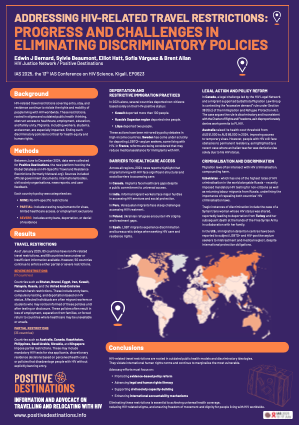
   Click on the image to download the poster

In 2024, Positive Destinations documented several cases of deportation based solely on HIV status: Kuwait deported over 100 people, Russia’s Dagestan region deported nine, and Libya deported two. Such practices are increasingly being challenged by legal action. In Canada, for example, a court case led by the HIV Legal Network contests the “excessive demand” clause of immigration law, arguing it violates the country’s Charter of Rights and Freedoms.

However, policy reform has been uneven. Australia raised its health cost threshold for visa eligibility, slightly easing access to temporary stays, but permanent residency remains elusive for many people with HIV. A recent case saw an Italian teacher denied residency due solely to his HIV-positive status.

The study also underscores how HIV-related migration barriers often intersect with other forms of criminalisation and discrimination. In Uzbekistan and Russia, HIV criminalisation laws are paired with mandatory HIV testing for migrants. In the U.S., HIV-positive and LGBTQ+ asylum seekers continue to face mistreatment in detention centres. And in a tragic case in Turkey, a Syrian trans woman was reportedly deported after her HIV status was disclosed and later killed upon return.

The authors of the study call for urgent action: “Eliminating these harmful policies is essential to ending AIDS, achieving universal health coverage, and upholding the dignity and rights of people living with HIV everywhere,” said Bernard.

Positive Destinations, which hosts the updated Global Database on HIV-Specific Travel and Residence Restrictions, is available at www.positivedestinations.info


EP0623 Addressing HIV-related travel restrictions: Progress and challenges in eliminating discriminatory policies by Edwin J Bernard, Sylvie Beaumont, Elliot Hatt, and Sofía Várguez was presented at IAS2025 by Brent Allan at the 13th IAS Conference on HIV Science, Kigali, Rwanda.

US: LGBTQ migrants with HIV face systemic failures and neglect in U.S. custody

Queer, Undocumented and HIV Positive

The current political climate is making immigrants feel unwelcome in America.

Immigration continues to be a hot-button issue in the United States. Whether they are seeking asylum from a violent region of the world or coming here for a better life for your family, immigrants (specifically non-white immigrants) face a host of challenges.

LGBTQ immigrants living with HIV, face downright Sisyphean challenges. Undocumented people can’t access any health services without paying out of pocket, which can be monumentally expensive. Even if they are welcomed at a clinic, it’s possible that no one there will be able to speak their language or understand their culture. And currently, there’s the added risk that Immigration and Customs Enforcement (ICE) officers may be staking out the place.

If an LGBTQ person and/or a person living with HIV is taken to jail, it’s very likely that they’ll suffer abuse. A 2024 study published by Immigration Equality, the National Immigrant Justice Center (NIJC) and Human Rights First reports that ICE and Customs and Border Patrol (CBP) agents at detention centers regularly abuse queer people and people living with HIV who are in their custody.

The study reported that one third of the participants experienced sexual, physical and mental abuse and sexual harassment, while nearly all reported incidents of verbal abuse and threats of violence. A quarter of the participants in the study reported being separated from loved ones, whether a partner, a spouse or sibling, and half of those in the study were kept in solitary confinement. Many had to scramble to find legal representation and sometimes were denied access to their attorney.

Most detainees also stated that they were given inadequate medical care or denied care altogether. Of the detainees living with HIV, most reported neglect or denial of HIV care. Nearly half reported suffering mental health problems, including panic attacks, flashbacks and self-harm. More than half stated that their HIV status, gender identity, sexual orientation, medical or other confidential information was disclosed without their consent.

More disturbing is the fact that many of those immigrants came here seeking amnesty, fleeing violence or other harsh ramifications in their homeland for simply being queer or because they’re living with HIV.

People living with HIV who are trying to emigrate to the United States cannot be denied entry based on their HIV status. (In 2010, President Obama lifted the “HIV ban” that had been in effect for 22 years.) Also, no one can be denied entry solely based on their sexual or gender identity.

As U.S. HIV and LGBTQ communities strive to keep healthy and safe, they must also remember those who need extra protection and care. Our arms must be big enough to hold fast to those who are extra vulnerable.

Spain: Stigmatisation and bureaucratic barriers for LGBT migrants trying to exercise their right to health in Madrid.

Translated with Google translate. For original article in Spanish, please scroll down. 

“I have been treated like garbage”: when discrimination against LGTBI migrants also creeps into health.

The COGAM collective denounces the stigmatization and bureaucratic barriers that these people face when trying to exercise their right to health in Madrid. ‘Infobae’ talks to a young Venezuelan who has applied for asylum in Spain.

The LGTBI collective continues to be the subject of harassment and violence around the world, a particularly complicated situation in some Latin American countries, where they live in a reality marked by homicides, attacks and discrimination. This is what happened in Venezuela to K.C., a 33-year-old homosexual man who suffered a rape “perpetrated by a policeman” in 2016 from which he is still trying to recover. Due to that aggression for which he contracted HIV and that caused him a state of tension and permanent fear, he decided to leave and settle in Colombia, where he lived until July last year, when he moved to Spain. The reason why K.C. (fictitious name) left this second country is because he met one of his aggressors and was not willing to live in fear.

K.C. claims to have felt stigmatized both “for being Latino and for his HIV diagnosis.” “The doctors don’t listen to me and make me feel like I’m stealing the medical care that should be for Spaniards. I’ve been treated like trash and I only go to the health center when I have an emergency because I don’t want to feel humiliated,” he says. In addition, he mentions wrong diagnoses and inadequate treatments that, far from improving his condition, have aggravated his health: “I know I accessed health care, but at what cost?” he asks himself.
The only time he has been properly cared for, he says, was when he went to the Sandoval medical center, the only one in Madrid specialized in the prevention, diagnosis and treatment of sexually transmitted infections. This young man also assures that in Spain is where he has really “been aware of his skin color,” because he lives episodes of racism every day, especially when he goes to the supermarket or when he travels by subway.

COGAM’s complaint

Like K.C., there are many LGTBI+ migrants for whom access to public health continues to be a challenge in the region, as denounced by the Collective of lesbians, gays, transsexuals and bisexuals of Madrid (COGAM), which criticizes “discrimination, stigmatization and bureaucratic barriers that these people face daily when trying to exercise their fundamental right to health.” The difficulties, they assure, not only respond to the lack of administrative regularization, but also “to the dehumanizing treatment and the lack of empathy in primary care centers and hospitals,” as this is reflected in some of the testimonies collected by the organization, which show “stigmatization by nationality, sexual orientation, gender identity and serological status“.

This is the case of Nicolás Henríquez, a 28-year-old Chilean, who denounces the lack of access to preventive treatments such as the pre-exposure prophylaxis pill or PrEP, which is taken to reduce the chances of contracting HIV infection, due to bureaucratic delays: “I wanted to start PrEP, but they didn’t give me an appointment until five months later. I was finally diagnosed with HIV, something that I could perhaps avoid if I had been treated before,” he says.

The situation is also complicated for Vitória Ribeiro, a 27-year-old Brazilian student, because the private insurance required for her visa, she explains, “is very expensive and inefficient,” so that if something happens to her outside of business hours, “she cannot receive help.” “This generates constant concern and anxiety in me.”

For all this, from COGAM they demand that the Madrid health authorities guarantee “real and universal access to public health for all people, regardless of their migratory status or identity,” as well as combating stigma and discrimination through awareness programs and training of medical personnel.

Another of the collective’s claims is the specific training for health personnel in terms of LGTBI+ diversity and care for migrants and they ask that access to preventive and specific treatments, such as PrEP and antiretrovirals, be facilitated, “without bureaucratic obstacles.” The health system, they conclude, “must be a safe space where anyone receives dignified and quality care.”


“Me han tratado como basura”: cuando la discriminación hacia las personas migrantes LGTBI también se cuela en la sanidad.

El colectivo COGAM denuncia la estigmatización y barreras burocráticas a las que se enfrentan estas personas al intentar ejercer su derecho a la salud en Madrid. ‘Infobae’ habla con un joven venezolano que ha solicitado asilo en España.

El colectivo LGTBI sigue siendo objeto de acoso y violencia en todo el mundo, una situación especialmente complicada en algunos países de América Latina, donde viven una realidad marcada por homicidios, ataques y discriminación. Así le ocurrió en Venezuela a K.C., un hombre homosexual de 33 años que sufrió una violación “perpetrada por un policía” en 2016 de la que aún trata de recuperarse. Debido a esa agresión por la que contrajo VIH y que le provocó un estado de tensión y miedo permanente, decidió marcharse e instalarse en Colombia, donde vivió hasta julio del año pasado, cuando se trasladó a España. El motivo por el que K.C. (nombre ficticio) se marchó de este segundo país es porque se encontró con uno de sus agresores y no estaba dispuesto a vivir atemorizado.

En Madrid, donde reside desde hace ocho meses y ha solicitado asilo por razones humanitarias, se encuentra más seguro, pero también ha atravesado enormes dificultades para acceder a la sanidad pública, barreras que acaban afectando a su bienestar físico y emocional, perpetuando situaciones de desigualdad y vulnerabilidad.

“El primer choque que tuve en la consulta es que me hablaron de forma muy despectiva cuando solo quería asesorarme, porque aún no sabía cómo funcionaban las cosas acá. Una doctora me preguntó cuál era mi nacionalidad, cuando en realidad no era un dato relevante, pero me dio a entender que éramos las personas extranjeras quienes traíamos las enfermedades a España”, explica a Infobae este joven. “Ser migrante no significa que no tengamos derechos”, critica.

K.C. asegura haberse sentido estigmatizado tanto “por ser latino como por su diagnóstico de VIH”. “Los médicos no me escuchan y me hacen sentir como si estuviera robando la atención médica que debería ser para españoles. Me han tratado como una basura y ya solo acudo al centro de salud cuando tengo una urgencia porque no quiero sentirme humillado”, relata. Además, menciona diagnósticos erróneos y tratamientos inadecuados que, lejos de mejorar su estado, han agravado su salud: “Sé que accedí a la sanidad, pero ¿a qué costo?”, se pregunta.

La única vez que le han atendido adecuadamente, sostiene, fue cuando acudió al centro médico Sandoval, el único en Madrid especializado en la prevención, diagnóstico y tratamiento de las infecciones de transmisión sexual. Este joven también asegura que en España es donde realmente “ha sido consciente de su color de piel”, porque vive a diario episodios de racismo, especialmente cuando va al supermercado o cuando viaja en metro.

Denuncia de COGAM

Al igual que K.C., son muchas las personas migrantes LGTBI+ para las que el acceso a la sanidad pública continúa siendo un desafío en la región, tal y como ha denunciado el Colectivo de lesbianas, gais, transexuales y bisexuales de Madrid (COGAM), que critica “la discriminación, estigmatización y barreras burocráticasque enfrentan estas personas a diario al intentar ejercer su derecho fundamental a la salud”. Las dificultades, aseguran, no solo responden a la falta de regularización administrativa, sino también “al trato deshumanizante y la falta de empatía en centros de atención primaria y hospitales”, pues así lo reflejan algunos de los testimonios que ha recogido la organización, que evidencian “estigmatización por nacionalidad, orientación sexual, identidad de género y estado serológico“.

Es el caso de Nicolás Henríquez, chileno de 28 años, denuncia la falta de acceso a tratamientos preventivos como la pastilla de profilaxis preexposición o PrEP, que se toma para reducir las posibilidades de contraer la infección por VIH, debido a retrasos burocráticos: “Quise iniciar la PrEP, pero no me dieron cita hasta cinco meses después. Finalmente fui diagnosticado con VIH, algo que quizá pude evitar si me hubieran atendido antes”, relata.

La situación también es complicada para Vitória Ribeiro, estudiante brasileña de 27 años, pues el seguro privado exigido para su visado, explica, “es muy caro y poco eficiente”, de forma que si le ocurre algo fuera del horario de atención, “no puede recibir ayuda”. “Esto me genera una constante preocupación y ansiedad”.

Por todo ello, desde COGAM reclaman a las autoridades sanitarias madrileñas que garanticen “un acceso real y universal a la sanidad pública para todas las personas, independientemente de su estatus migratorio o identidad”, así como combatir el estigma y la discriminación a través de programas de sensibilización y formación del personal médico.

Otro de los reclamos del colectivo es la formación específica para el personal sanitario en materia de diversidad LGTBI+ y atención a personas migrantes y piden que se facilite el acceso a tratamientos preventivos y específicos, como la PrEP y los antirretrovirales, “sin trabas burocráticas”. El sistema sanitario, concluyen, “debe ser un espacio seguro donde cualquier persona reciba atención digna y de calidad”.

Ireland: Four guest speakers discuss their journey as LGBTQ+ migrants living with HIV at community event

Queer migrants living with HIV in Ireland platformed in World AIDS Day event

Four guest speakers joined Poz Vibe hosts Robbie Lawlor and Veda to discuss their journey as LGBTQ+ migrants living with HIV.

To mark World AIDS Day, GCN and Poz Vibe teamed up to present ‘Poz World Panel’, a live podcast event aimed at platforming the voices of people living with HIV in Ireland. To showcase the diversity of the community and push back against the rising far-right and racist rhetoric, four guest speakers joined Poz Vibe hosts Robbie Lawlor and Veda to discuss their journey as LGBTQ+ migrants living with HIV.

Taking place at Edmund Burke Theatre on December 1, ‘Poz World Panel’ was the biggest World AIDS Day event to ever happen at Trinity College Dublin. To mark the occasion, TCD lit up the front of its historic buildings in red for the first time in a powerful display of solidarity and support.

The event kicked off at 6pm with a special set by queer DJ Manwelli, who welcomed people in and set the mood ahead of the live podcast. Before the discussion with the guests began, Poz Vibe co-host Veda invited a fifth speaker, who chose to remain anonymous, to address the audience.

The speaker told participants about their journey as an asylum seeker and what migrants in Direct Provision still face nowadays. They appealed to the audience to show up for people who are stuck waiting for a work permit and don’t know where to start to build a new life in a foreign country.

Taking the mic after them, Veda spoke about how the stigma against HIV impacted her life and pushed her to remain 10 years in the closet. The activist also talked about the Irish Names Quilt, which was created to honour those who died in Ireland from AIDS and HIV-related illnesses.

The Quilt was created by the Quilt Group, a group of women whom Veda visited recently, saying that when she went there she found the “communtity she’s been trying to build”, a community where HIV Positive people can live free of stigma and shame.

Joining Veda, Robbie Lawlor talked about Ireland’s history of emigration, highlighting the hypocrisy of people who today employ racist rhetoric against immigrants. Robbie also shared his own story of being denied visas to move abroad when he was 21 due to his HIV status.

The two hosts then invited their four guest speakers to share their stories. The first to take the mic was Prateek Bhardwaj, who spoke about living with HIV publicly for the very first time at the World AIDS Day event. He discussed the difficulties of accessing HIV medication in India and how this pushed him to move to Ireland, where everyone can access treatment for free.

After his account, the audience was treated to a short film created by Venezuelan actor and activist Luis Noguera Benitez. Through mixed media videos, Luis narrated his story of finding out his HIV status while he was still in Venezuela and coming out to his mother only one day before moving to Ireland.

The third speaker was Christopher Freibott, who moved to Ireland from a small town in Bavaria, Germany, in 2014. He spoke about how finding out he was living with HIV impacted his private and sexual life and the difficulty of opening up to the ones close to him.

Finally, Phellipe Lutterbeck opened up about living with HIV for the first time in public, sharing his experience of coming out and losing some friends due to their own prejudice. He also spoke about finding a community in Ireland and the massive impact that the Poz Vibe Tribe had on his life.

The World AIDS event concluded with a Q&A, when the audience asked questions about how to make Ireland a more welcoming space for people living with HIV.

Proudly supported by Trinity LGBTQ+ Staff Network, the ‘Poz World Panel: A World AIDS Day live Podcast’ event was a fundraiser for GCN, with some of the proceeds going to Poz Vibe.

Follwoing the event, GCN’s Manager Stefano Pappalardo said: “We were thrilled to have hosted this important community event to mark World AIDS Day in conjunction with Poz Vibe.

“Despite the progress made over the years, stigma remains a persistent barrier to open conversations, equal treatment, and support for those living with HIV.
Events like these are crucial in uniting our community, challenging harmful narratives, empowering individuals, and breaking down the stigma that still surrounds HIV.

“A massive thank you to our gorgeous hosts Veda and Robbie Lawlor, everyone at Trinity LGBTQ+ Staff Network for all their support, the wonderful speakers for sharing their stories and everyone who came along. Your presence made this event truly meaningful.”

US: Queer asylum seekers face uphill battle in U.S. immigration system

Think Immigration: Breaking Down Barriers – Improving Asylum Laws for Queer Migrants

AILA welcomes this blog post from Diversity, Equity, and Inclusion Committee Law Student Scholarship recipient Abby Leigh, part of a series intended to highlight the important ways in which diversity, equity, and inclusion inform immigration law and policy. More information about AILA’s DEI Committee and its important work is available on AILA’s website.

In more than 70 countries, some aspect of being lesbian, gay, bisexual, transgender, or queer (LGBTQIA+) is a crime. Many LGBTQIA+ people face harassment, discrimination, and violence that force them to flee. As U.S. immigration law evolved, sexual orientation and gender identity became a valid basis for an asylum claim. However, these asylum laws were still developed through the lens of straight relationships and cisgender perspectives.  As a result, asylum laws in the United States significantly disadvantage queer migrants, particularly transgender and non-binary individuals.

To start, a lack of an explicit acknowledgement that LGBTQIA+ is a protected ground within asylum means otherwise valid claims can fall through the cracks.  Sexual orientation and gender identity are not specifically enumerated as protected grounds for asylum, though they do often qualify as members of a Protected Social Group. Due to the lack of explicit inclusion, LGBTQIA+ asylum seekers often do not realize their sexual orientation/gender identity are grounds for asylum and are hesitant to speak up for fear they will experience the same persecution from which they fled. The one-year filing restriction on asylum claims and other expedited procedural constraints only make matters worse, as applicants with valid claims may not have sufficient time to file after learning they have a valid claim. To help remedy this problem, sexual orientation and gender identity should be explicitly adopted into the definition of refugee, and asylum officers should have an obligation to communicate this to applicants.

Beyond definitional limitations, the lack of culturally sensitive “credibility” determinations for asylum leaves the door open to improper judgment and mischaracterization. Because asylum is discretionary, adjudicators heavily rely on their own biases to determine whether an applicant’s described persecution is credible, often discounting queer identities that fall outside of what would be familiar to mainstream – often white – Americans.  The expectation of white Western gender and sexuality performance is not only demeaning, but it also narrows the likelihood of eliciting valid asylum claims.

Furthermore, studies demonstrate that immigration adjudicators conflate sex with sexuality, routinely discrediting applicants without sexual or romantic histories. As a result, asylum practitioners are often forced to limit and contextualize their description of persecution to fit within the confines of white Western culture. Adverse credibility findings are further exacerbated by applicants’ hesitancy to discuss their sexual orientation/gender identity with an asylum officer, especially if they are unaware that their identity forms the basis of a valid asylum claim. Thus, additional leeway should be granted for minor inconsistencies between asylum applications and an applicant’s testimony. The evidentiary standard of corroboration should also be relaxed, particularly for applicants who were forced to conceal their identities in their country of origin and may be hesitant to reveal their true identities once in the United States. Furthermore, sexual orientation, gender identity, sex assigned at birth data, and HIV status should be integrated into U.S. registration and data management systems that process asylum claims. Demographic questions should be subject to change throughout the asylum process without negative repercussions for the applicant.

Decision-makers are hesitant to grant asylum claims that allege violence similar to what is experienced domestically because it disrupts the illusion that the United States is the “good guy.” This leaves applicants walking a strategic tightrope, forced to perform their gender/sexuality in a manner satisfactory to the American adjudicator. Similarly, the theory of the case requires casting the applicant as a “good” or “deserving” gay, a narrative that juxtaposes the unspoken converse of a “bad” or “less-deserving” gay.

There is a need for more research and publicly available data, as federal agencies do not publish statistics on asylum claims based on sexual orientation, gender identity, or HIV status. As U.S. State Department country conditions reports are heavily considered in determining asylum (and often contain no information about the LGBTQIA+ community or those living with HIV), decision-makers should examine country-specific laws, policies, and cultural attitudes towards each subpopulation of the LGBTQIA+ community as well as those living with HIV when relevant. Immigration judges should also proactively submit evidence from credible sources sua sponte, especially for pro se litigants or when U.S. State Department reports lack proper evidence. Finally, because most immigration officers and immigration judge’s ideas about LGBTQIA+ identity are based on U.S. norms and stereotypes, all immigration officials must receive queer-sensitive interview training.

Research shows that the process of applying for asylum can by itself have “deleterious effects on LGBTQI+ persons, and immigration policies harm them based on the compounding effects of their intersectional identities.” It is important to address the challenges faced by queer migrants in the asylum process, including the need to “come out” in a way that is “credible” and “legible” to asylum adjudicators, as well as harmful stereotypes that question the validity and realness of these identities. Until our laws move beyond the existing cis-heteronormative legal structure, they cannot offer LGBTQIA+ asylum seekers a meaningful chance to claim protection and live up to America’s promise of safety for those fleeing persecution.

Sweden: 96% of LGBTQI+ asylum seekers in Sweden rejected, violating legal protections

Asylum-seeking LGBTQI+ individuals deported on illegal grounds

Migration authorities are rejecting and deporting LGBTQI+ asylum seekers in violation of Swedish and international law. This is revealed by an extensive report by RFSL. “A legal scandal that continues in silence, behind confidentiality and secrecy,” says Aino Gröndahl, asylum law specialist at RFSL.

Despite the Swedish Migration Agency having taken several actions since RFSL’s last legal investigation in 2020, the situation for LGBTQI+ individuals seeking asylum in Sweden has not improved. A staggering 96 percent of the decisions and judgments reviewed in the new investigation were rejections, a higher percentage than the data RFSL’s asylum law specialist reviewed in 2020. The latest report also shows that illegal demands in SOGIESC asylum cases persist. This results in LGBTQI+ asylum seekers, who are entitled to protection in Sweden, being deported to countries where they risk persecution, torture, and the death penalty.

“Sweden continues to deport LGBTQI+ individuals on illegal grounds. It is a legal scandal that occurs in silence, behind confidentiality and secrecy. A shame for a country that claims to be a rule-of-law state,” says Aino Gröndahl, asylum lawyer at RFSL.

Stop the deportations of asylum-seeking LGBTQI+ individuals if safe and fair assessments cannot be guaranteed

RFSL is now calling for a decision and enforcement halt until safe and fair investigations, reviews, and assessments consistent with current law are guaranteed in SOGIESC asylum cases.

“The government must now ensure that the asylum process for LGBTQI+ individuals follows Swedish and international law. Until then, RFSL wants all illegal rejections and deportations of LGBTQI+ individuals to be stopped,” says Peter Sidlund Ponkala, Chairman of RFSL.

Summary of the Report

In the report “Rejection motivations in SOGIESC asylum cases in Sweden” RFSL has reviewed the Migration Agency’s assessments. This involves 1,360 decisions and judgments in SOGIESC asylum cases between November 2020 and May 2023. The report is authored by Aino Gröndahl, asylum lawyer at RFSL.

The report shows that:

  • The Migration Agency assessments of SOGIESC asylum cases violate Swedish and international law.
  • The Migration Agency continues to reject and deport asylum seekers on illegal grounds to countries that persecute and also apply the death penalty to LGBTQI+ individuals.
  • A full 96 percent of the decisions and judgments reviewed in the new report were rejections. This is a higher percentage than in the data RFSL’s asylum law specialist reviewed in 2020.
  • The right to an individual review and objective assessment is not met in SOGIESC asylum cases.
  • Discretionary requirements still occur, meaning that asylum seekers are required to have hidden their SOGIESC status in their home country to avoid persecution. This is despite discretion requirements having been prohibited in Swedish law for nearly two decades and in international law for over a decade.
  • Requirements for internal emotional processes and risk considerations in credibility and reliability assessments are solely based on stereotypes and prejudices about SOGIESC individuals. This violates, among other things, EU law and UNHCR guidelines.
  • The Migration Agency often demands that SOGIESC asylum seekers display negative emotions such as shame. This means that Swedish authorities condition the right to protection on LGBTQI+ individuals showing self-hatred to appear credible.

RFSL’s recommendations to the government

  • Halt decision-making and deportations until safe and fair investigations, reviews, and assessments consistent with current law are guaranteed in SOGIESC asylum cases.
  • Promptly appoint the investigation promised in the Tidö Agreement to review the legal safety in SOGIESC asylum cases.
  • Provide clear instructions and requirements to the Migration Agency for quality assurance in the investigation, review, and assessment of SOGIESC asylum cases.
  • Task the Migration Agency with continuously training all operational staff in the investigation, review, and assessment of protection needs based on sexual orientation, gender identity, and gender expression.
  • Task the Migration Agency with compiling statistics on SOGIESC asylum cases and the grounds on which an asylum case should be granted or rejected.

EU’s directive for people vulnerable to sexual discrimination is not always implemented

As countries tighten anti-gay laws, more and more LGBTQ+ migrants seek safety and asylum in Europe

RIETI, Italy (AP) — Ella Anthony knew it was time to leave her native Nigeria when she escaped an abusive, forced marriage only to face angry relatives who threatened to turn her in to police because she was gay.

Since Nigeria criminalizes same-sex relationships, Anthony fled a possible prison term and headed with her partner to Libya in 2014 and then Italy, where they both won asylum. Their claim? That they had a well-founded fear of anti-LGBTQ+ persecution back home.

While many of the hundreds of thousands of migrants who arrive in Italy from Africa and the Mideast are escaping war, conflict and poverty, an increasing number are fleeing possible prison terms and death sentences in their home countries because of their sexual orientation or gender identity, advocates say.

And despite huge obstacles to win asylum on LGBTQ+ grounds, Anthony and her partner, Doris Ezuruike Chinonso. are proof that it can be done, even if the challenges remain significant for so-called “rainbow refugees” like them.

“Certainly life here in Italy isn’t 100% what we want. But let’s say it’s 80% better than in my country,” Chinonso, 34, said with Anthony by her side at their home in Rieti, north of Rome. In Nigeria, “if you’re lucky you end up prison. If you’re not lucky, they kill you,” she said.

“Here you can live as you like,” she said.

Most European countries don’t keep statistics on the number of migrants who claim anti-LGBTQ+ persecution as a reason for seeking refugee protection under international law. But non-governmental organizations that track the phenomenon say the numbers are rising as countries pass or toughen anti-homosexuality laws — a trend being highlighted on Friday’s observance of the International Day Against Homophobia, Biphobia and Transphobia.

To date, more than 60 countries have anti-LGBTQ+ laws on the books, most of them in Africa, the Middle East and parts of Asia.

“The ultimate result is people trying to flee these countries to find safe haven elsewhere,” said Kimahli Powell, chief executive of Rainbow Railroad, which provides financial, legal and logistical support to LGBTQ+ people needing asylum assistance.

In an interview, Powell said his organization had received about 15,000 requests for assistance last year, up from some 9,500 the year before. One-tenth of those 2023 requests, or about 1,500, came from Uganda, which passed an anti-homosexuality lawthat year that allows the death penalty for “aggravated homosexuality,” and up to 14 years in prison for “attempted aggravated homosexuality.”

Nigeria also criminalizes consensual same-sex relations between adults and the public display of affection between same-sex couples, as well as restricting the work of groups that advocate for gay people and their rights, according to Human Rights Watch. In regions of Nigeria where Sharia law is in force, LGBTQ+ people can face up to 14 years in prison or the death penalty.

Anthony, 37, said it was precisely the threat of prison that compelled her to leave. She said her family had sold her into marriage, but that she left the relationship because her husband repeatedly abused her. When she returned home, her brother and uncles threatened to turn her into police because she was gay. The fear and alienation drove her first to attempt suicide, and then take up a trafficker’s offer to pay for passage to Europe.

“At a certain point, I couldn’t take all these sufferings,” Anthony said through tears. “When this man told me that I should abandon the village, I immediately accepted.”

After arriving in Libya, Anthony and Chinonso paid traffickers for the risky boat trip across the Mediterranean Sea to Italy, where they both claimed asylum as a member of a group – LGBTQ+ people – who faced persecution in Nigeria. According to refugee norms, applicants for asylum can be granted international protection based on being a “member of a particular social group.”

But the process is by no means easy, straightforward or guaranteed. Privacy concerns limit the types of questions about sexual orientation that migrants can be asked during the asylum interview process. Social taboos and a reluctance to openly identify as gay or transgender mean some migrants might not volunteer the information immediately. Ignorance on the part of asylum interviewers about anti-gay laws in countries of origin can result in unsuccessful claims, according to the EU Agency for Asylum, which helps EU countries implement asylum norms.

As a result, no comprehensive data exists about how many migrants seek or win asylum in the EU on LGBTQ+ grounds. Based on estimates reported by NGOs working with would-be refugees, the numbers in individual EU countries ranged from two to three in Poland in 2016 to 500 in Finland from 2015-2017 and 80 in Italy from 2012-2017, according to a 2017 report by the EU Agency for Fundamental Rights.