New Zealand: New research reveals how HIV criminalisation is experienced in Aotearoa

HIV decriminalisation in Aotearoa: Survey findings

For the first time in Aotearoa New Zealand, we have national evidence on how HIV criminalisation is experienced by people living with HIV.

This research captures the voices of 247 people from diverse communities across the country. It documents how criminal law, public health processes, stigma, and modern HIV science intersect in real life. The project was undertaken collaboratively by Positive Women Inc, Burnett Foundation Aotearoa, Body Positive, and Toitū te Ao, reflecting the shared commitment of all four organisations to amplifying community experiences and informing meaningful change.

The findings highlight the need for greater clarity, alignment with contemporary science, and thoughtful public conversation.

About the research

This study explores:

  • Awareness and understanding of criminal and public health law
  • Attitudes toward HIV criminalisation
  • The lived impact of legal uncertainty
  • The role of stigma in shaping legal and social outcomes
  • Recommendations informed by participant experience

Participants represented a wide range of ages, genders, sexualities, ethnicities, migration histories, and lengths of time living with HIV.

This research centers lived experience while grounding analysis in contemporary HIV science, including the evidence behind U=U (Undetectable = Untransmittable).

Key findings

1. Preference for public health management

Most participants would prefer public health manage their HIV transmission rather than the police – because HIV is a health issue, not a crime.

2. Attitudes are nuanced

Participants held diverse and layered views about criminalisation. Support was often linked to cases of intentional harm, while broader criminalisation raised concerns about fairness, stigma, and unintended consequences.

3. Impact extends beyond prosecutions

Even where prosecutions are rare, the possibility of criminalisation shapes behaviour, disclosure practices, relationships, and wellbeing.

4. Stigma remains central

Legal frameworks do not exist in isolation. Participants described how stigma around HIV influences both public perception and perceived legal risk.

Why this matters

Effective HIV responses must reflect:

  • Modern treatment science
  • Public health best practice
  • Human rights principles
  • The lived experience of people living with HIV

Clear, evidence-informed discussion is essential to ensuring legal and policy settings support – rather than undermine – public health outcomes.

Recommendations

The report identifies areas for consideration, including:

  • Clearer, accessible legal guidance
  • Greater alignment between law and contemporary HIV science
  • Stigma reduction through public education
  • Meaningful involvement of people living with HIV in future policy conversations

What happens next

Positive Women Inc, Burnett Foundation Aotearoa, Body Positive, and Toitū te Ao will:

  • Share these findings across health, legal, and policy sectors
  • Engage stakeholders in informed discussion
  • Continue centering lived experience in advocacy and education
  • Support accurate public understanding of HIV and the law

This report is a foundation for evidence-based dialogue in Aotearoa.

For media enquiries, contact Kirk Serpes at kirk.serpes@burnettfoundation.org.nz

Read the full report here

US: Report from the Williams Institute examines how HIV stigma contributes to HIV criminalisation

HIV stigma is pervasive and increasing among US adults

This study uses data from the nationally representative General Social Survey to assess the prevalence of HIV stigma in the U.S. and examine the ways HIV stigma contributes to the criminalisation of people living with HIV.

The full brief can be downloaded here: https://williamsinstitute.law.ucla.edu/wp-content/uploads/HIV-Stigma-Feb-2026.pdf

No-cost legal clinics available for NYC immigrants

If you are an immigrant in NYC, free legal clinics are available to help you. At these clinics, you can speak with a lawyer or a supervised law student at no cost. Many clinics help people regardless of immigration status and offer services in multiple languages. Clinics can help with immigration cases, housing issues, work problems, family matters, and other legal questions.

Pro-bono lawyers may have a full case load or have specific requirements for the clients they are able to see at this time. As an alternative, you can consider visiting a legal clinic which may have more opportunities advise you on your legal issue.

Most of these clinics will require an appointment, so you will need to email or call in advance.

If you are not sure where to begin, you can call the NYC Immigration Legal Support Hotline at 800-354-0365, Monday through Friday from 9 a.m. to 6 p.m. The hotline is run by the NYC Mayor’s Office of Immigrant Affairsand can help you find the right legal clinic for your situation.

Free, confidential help is available, and asking for help will not affect your immigration status.

Here are free legal clinics in New York City where you can get free legal advice, access to representation, or referrals.

Asian American Bar Association of New York

Partnering with local community organizations, the Asian American Bar Association of New York runs free monthly legal clinics in Manhattan, Brooklyn, and Flushing. People can check the Pro Bono & Community Service Committee (PBCS) calendar for details about each scheduled clinic. Interpreters are available.

  • Queens pro bono clinic: First Wednesday of the month from 6:30 to 8 p.m. at AAFE One Flushing Community Center (133-29 41st Avenue, 2nd Floor, Flushing)
  • Manhattan pro bono clinic: Third Wednesday of the month from 6:30 to 8 p.m. at AAFE Community Center (111 Norfolk Street, Manhattan)
  • Brooklyn pro bono clinic: Held bi-monthly on the second Saturday of the month from 12:30 to 2:30 p.m. at CPC Brooklyn Community Services (4101 8th Avenue, Brooklyn)

City Council Member Susan Zhuang’s office

Susan Zhuang’s office offers free legal clinics every Friday at 6514 20th Avenue in Brooklyn. People can call (718) 307-7151 or email District43@council.nyc.gov to make an appointment.

Legal Services NYC

Legal Services NYC runs clinics and study groups to help low-income clients. It has offices in Manhattan, Brooklyn, Queens, and Staten Island. People can call the citywide intake line at (917) 661-4500, Monday through Friday from 9:30 a.m. to 4:00 p.m., to get scheduled for a local clinic.

LGBT Bar NY

LGBT Bar NY offers free drop-in legal clinics for the LGBTQ community. The clinic is held on Tuesday evenings from 6 to 8 p.m. at 208 West 13th Street in Manhattan. No appointment is needed, but people should arrive before 5:45 p.m. to make sure they can be helped.

New York Legal Assistance Group (NYLAG)

NYLAG runs free legal counseling, including help with immigration issues. It is based in Lower Manhattan and also offers mobile clinics across New York City. People can check their mobile legal help calendar for regular clinic days and locations.

Urban Justice Center

The Urban Justice Center offers free legal clinics at City Council Amanda Farías’s district office (778 Castle Avenue, Bronx). These are held on the second and last Monday of every month from 10 a.m. to 4 p.m. You must call (718) 792-1140 to make an appointment.

Need family law help? You can make an appointment at the family law clinic, which is held every Wednesday at the Urban Justice Center (40 Rector Street, 9th Floor, Manhattan) from 10 a.m. to 4 p.m. You must call (833) 321-4387 to make an appointment.

If you can’t make it to the Manhattan office, you can also request a virtual appointment for family lawyers. Make an appointment by emailing cprisco@council.nyc.gov.

In addition, the Urban Justice Center offers even more clinics that cover public benefits, homeless issues, and landlord-tenant problems across New York City. Learn more about those clinics here. 

New global data reveals rising HIV criminalisation amid stalling legal reforms

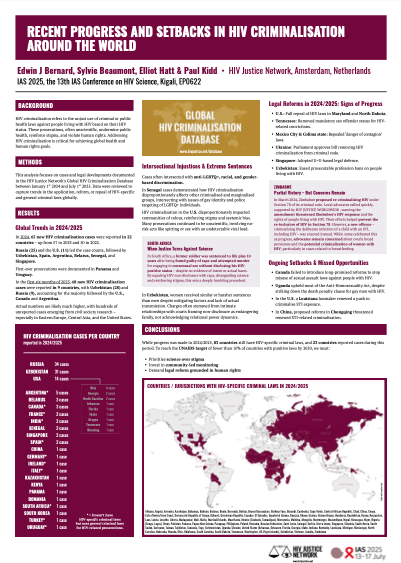
The HIV Justice Network published new data this week showing a troubling rise in the number of people criminalised for HIV non-disclosure, potential or perceived exposure, or unintentional transmission in 2024 and the first half of 2025. As legal reforms appear to be stalling, discriminatory prosecutions, harsh sentences, and misuse of outdated laws continue to impact people with HIV and the HIV response.

The figures, presented at the 13h IAS Conference on HIV Science (IAS 2025) in Kigali, Rwanda, are drawn from the Global HIV Criminalisation Database. The database documents criminal cases and legal developments involving HIV-specific or general criminal laws worldwide.

In 2024, at least 65 HIV criminalisation cases were reported across 22 countries – up from 57 in 2023 and 50 in 2022. Russia (25 cases) and the United States (11) led the global tally, followed by Uzbekistan, Spain, Argentina, Belarus, Senegal, and Singapore. For the first time, prosecutions were documented in Panama and Uruguay.

The upward trend continued into 2025, with 48 cases reported in just the first six months. Uzbekistan (28) and Russia (9) again accounted for the majority, alongside new cases in the U.S., Canada, and Argentina. However, the actual number of cases is likely much higher, particularly in Eastern Europe, Central Asia, and the United States, where civil society organisations report many cases go undocumented.

“These cases show that HIV criminalisation remains a global crisis,” said Edwin J. Bernard, Executive Director of the HIV Justice Network. “Far too often, people living with HIV are prosecuted not for causing harm, but simply for living with a health condition – often in ways that are unscientific, discriminatory, and deeply unjust.”

                 Download the poster by clicking on the image

The report highlights the intersection of HIV criminalisation with racism, homophobia, gender-based discrimination, and systemic inequality. In Senegal, for example, prosecutions have disproportionately targeted LGBTQ+ individuals. In the U.S., criminal laws continue to be weaponised against communities of colour, even in cases involving no risk of transmission – such as spitting, or sex with an undetectable viral load.

One of the most alarming cases occurred in South Africa, where a former soldier was sentenced to life plus ten years for rape and attempted murder after failing to disclose his HIV status to a consenting partner – despite no evidence of intent or actual transmission. Advocates warn that such cases equate HIV non-disclosure with sexual violence and undermine decades of public health and human rights gains.

Yet, amidst the setbacks, 2024/2025 also brought some signs of hope. Maryland and North Dakota fully repealed their HIV-specific laws, while Tennessee removed mandatory sex offender registration for HIV-related convictions. Mexico City and Colima repealed vague “danger of contagion” laws, and Ukraine’s parliament voted to remove HIV from its criminal code.

In Zimbabwe, community activism helped block a proposal to re-criminalise HIV transmission. However, a new law was introduced criminalising the deliberate transmission of STIs to children, including HIV – raising fears it could be used against mothers living with HIV, particularly in breastfeeding cases.

Despite these advances, HIV criminalisation remains widespread. A total of 83 countries still have HIV-specific laws, and 23 countries reported prosecutions in this period using either HIV-specific or general laws. The HIV Justice Network warns that without urgent action, the world is unlikely to meet UNAIDS’ target of reducing punitive laws to below 10% of countries by 2030.

“The path forward must be rooted in science, rights, and community leadership,” Bernard said. “We must end laws that punish people for their status, and instead build legal systems that support health, dignity, and justice.”


EPO622 Recent progress and setbacks in HIV criminalisation around the world by Edwin J Bernard, Sylvie Beaumont, and Elliot Hatt was presented at IAS 2025 by Paul Kidd at 13th IAS Conference on HIV Science in Kigali, Rwanda.


New case study and documentary examines how Zimbabwe repealed its HIV criminalisation law

Today, the HIV Justice Network (HJN), supported by the International AIDS Society (IAS), released a video documentary, “It is Time!” – How Zimbabwe Decriminalised HIV, along with a case study report examining Zimbabwe’s successful repeal of its HIV-specific criminal law.

The report, Reforming the Criminal Law in Zimbabwe: A Case Study, explores how advocates, legal experts, and community leaders worked together to repeal Section 79 of Zimbabwe’s Criminal Code, which criminalised HIV non-disclosure, exposure, or transmission. It outlines key strategies used in the campaign and lessons for other countries seeking to end HIV criminalisation.

The 24-minute documentary “It is Time!” brings this story to life through interviews with those involved in the multi-year effort. It also explores how advocates responded when a new law threatened to reintroduce HIV criminalisation.

Zimbabwe’s experience highlights several key strategies:

  • Coalition-building: Bringing together civil society, legal experts, and policymakers strengthened the advocacy effort.
  • Public health and human rights messaging: Advocates demonstrated how criminalisation undermined Zimbabwe’s HIV response.
  • Scientific evidence: Expert testimony helped policymakers understand the realities of HIV transmission.
  • Legislative strategy: Repealing Section 79 as part of a broader legal reform helped ensure success.

The documentary “It is Time!” is now available on the HIV Justice Network YouTube channel.

Reforming the Criminal Law in Zimbabwe: A Case Study (English, pdf, 9 pages) can be downloaded here.

The documentary and case study will also be added to the HIV Criminalisation Online Course, available for free as part of the HIV Justice Academy.

The case study and video were launched during a webinar co-hosted by HJN and IAS, featuring discussions on the significance of Zimbabwe’s law reform for the global movement against HIV criminalisation from:

  • Marlène​​​​ Bras, Director of HIV Programmes at the IAS;
  • Dr Ruth Labode, former legislator, and chairperson of the Parliamentary Portfolio Committee on Health in Zimbabwe;
  • Immaculate Owomugisha, a Ugandan lawyer and human rights activist who also sits on HJN’s Supervisory Board; and
  • HJN’s Senior Policy Analyst, Alison Symington.

A recording of webinar can now be viewed in English and in French on the IAS+ website.

US: New report shows that most of Indiana’s HIV criminal laws have yet to account for decades of advances in HIV science

Indiana has six HIV criminalization laws. Most criminalize conduct that cannot transmit HIV

Indiana has six laws that criminalize people living with HIV (PLWH), spanning both the public health and criminal codes. A new report by the Williams Institute at UCLA School of Law evaluates whether these laws reflect current understandings of HIV science and criminalize conduct that poses negligible or no risk of transmitting HIV.

Results show that most of Indiana’s HIV criminal laws have yet to account for decades of advances in HIV science, and none are currently written with enough specificity to prevent criminalizing behaviors that have little to no risk of transmitting HIV.

In Indiana, HIV criminal laws make potential HIV exposure a crime under specific circumstances, such as sexual activity, blood or semen donation, or battery using bodily fluids, such as spitting. All of the laws were enacted between 1988 and 2002 before effective HIV treatment options were widely available and it was established that treating PLWH could prevent the transmission of HIV.

“Scientifically outdated laws work against public health goals regarding HIV testing, prevention, and treatment,” said lead author Nathan Cisneros, HIV Criminalization Project Director at the Williams Institute. “The criminalization of HIV could undermine Indiana’s efforts to end the HIV epidemic and reach the communities most impacted, including people of color, women, and LGBTQ people.”

Key Findings

  • None of Indiana’s laws require actual HIV transmission or the intent to transmit HIV. The laws also criminalize conduct that cannot transmit HIV, such as spitting.
  • Two laws criminalizing the donation of blood, plasma, or semen penalize conduct that does not transmit HIV. All bodily fluid donations are tested for HIV, and positive units are destroyed.
  • Two laws impose enhanced penalties for PLWH who knowingly expose another person to their bodily fluids or waste in an aggressive or malicious manner—conduct that poses no HIV transmission risk. HIV cannot be transmitted externally through contact with body fluids or waste.
  • Two laws that criminalize a person’s failure to disclose their HIV status have been partially modernized in recent years to reflect advances in HIV science. They limit criminal conduct to high-risk forms of sexual contact and needle sharing.
    • Nevertheless, these laws fail to clarify which sexual activities are considered low or no risk and whether a person who has an undetectable viral load—and therefore cannot transmit HIV through sex—is safe from prosecution.

In recent years, public health and medical experts, including the Indiana State Medical Association, have agreed that to effectively end the HIV epidemic, it is essential to update the state’s HIV criminal laws in line with current scientific understanding of HIV. A key aspect of Indiana’s plan to significantly reduce the number of new transmissions by 2030 involves prioritizing the modernization of these laws.

This report is part of a series by the Williams Institute examining HIV criminalization in Indiana.

Read the current report

US: New report published on the enforcement of HIV criminalisation in Ohio

‘Antiquated’ and unscientific laws enforced against Ohioans living with HIV: Report

Across the country, a growing coalition of advocates is pushing to repeal or update state laws that criminalize people living with HIV or AIDS.

In Ohio, six laws on the books either criminalize certain acts – including sex – for people living with HIV or substantially increase sentences for them compared to people who do not have the virus.

Most of the laws were passed decades ago, fueled by fear, absent scientific understanding about how HIV is transmitted and before advancements in HIV-related treatment were widely introduced. Laws still remain in place in 34 states.

There are no national reporting requirements that track arrests or prosecutions under the laws. Until now, it was unclear how frequently Ohio prosecutors have charged people under the laws, which also apply to people living with hepatitis or tuberculosis.

A report released today by Equality Ohio and the Ohio Health Modernization Movement (OHMM), two groups pushing for legal reform, reveals that more than half of the prosecutions over a six-year period were for acts – such as spitting or throwing bodily fluids – that were unlikely to transmit HIV. It also found a disproportionate number of people charged were Black compared to Ohio’s overall population of Black residents.

“Ohio is unique in that these antiquated laws are actually being utilized and enforced against everyday Ohioans who are living with HIV,” Kate Mozynski, an attorney with Equality Ohio and one of the co-authors of the report told the Buckeye Flame.

In 2022, about 25,000 people in Ohio had an HIV diagnosis. The rate of Black residents diagnosed with HIV was more than six times the rate of white residents.

The groups spent three years gathering information from prosecutors and courts in all 88 Ohio counties and identified 214 cases charged under the six laws. Often, the records lacked or had conflicting information on race or ethnicity, and the gender captured in law enforcement records didn’t always reflect a person’s gender identity.

That prevents researchers from fully understanding the impact that these laws are having on some of the most vulnerable populations in Ohio, including LQBTQ+ people, people experiencing incarceration and people of color, according to the report. The federal Centers for Disease Control and Prevention has warned that laws criminalizing HIV exposure are outdated and may discourage testing, increase stigma and exacerbate disparities in Black and Latino communities.

Cuyahoga County had the highest number of charges

 The report found that:

  • Prosecutions are concentrated in Ohio’s more populous counties, including Cuyahoga, Hamilton, Franklin and Lucas counties.
  • Cuyahoga County charged four times the number of people under the six laws than Franklin County, which has a higher population and more people living with HIV and AIDS. Cuyahoga County accounted for 26% of the cases identified.
  • The largest share of prosecutions involved Black men, based on recorded race and gender included in records.

A separate Marshall Project review of prosecutions under the six laws in Cuyahoga County from 2016 through 2022 examined 36 charges involving 35 defendants. That doesn’t didn’t include charges for solicitation, prostitution or loitering, which are generally misdemeanor crimes.

The cases involved 18 law enforcement agencies, including three hospital police departments and public transit police.

The Cuyahoga County Prosecutor’s office, which decides whether to prosecute felony cases under Ohio’s laws, said these charges are determined on a “case-by-case basis” after considering input from victims, according to Lexi Bauer, communications manager. Bauer noted that the majority of the “harassment by bodily fluid” charges in recent years were related to hepatitis and not HIV.

Ohio penalties among the harshest

Ohio’s laws remain among the harshest when it comes to HIV criminalization, not just based on the conduct that is criminalized but also the penalties, said Jada Hicks, staff attorney for The Center for HIV Law and Policy.

In Ohio, people living with HIV (or viral hepatitis or tuberculosis) can be charged whether or not they:

  • Engaged in sex practices or other acts that could transmit the virus.
  • Transmitted HIV.
  • Used protection, such as condoms and/or dental dams.
  • Had an undetectable level of virus in their blood and were unable to transmit HIV.

Most of the charges examined in the report fall under two Ohio laws.

One law makes it a crime for a person living with HIV (or hepatitis or tuberculosis) to “harass” someone with their bodily fluids. That would include spitting or throwing urine, feces or blood at another person.

Under the other law, a person can be charged with felonious assault if they have sex with another person without telling them that they are living with HIV.

The penalties for failing to disclose HIV status in Ohio are stiff regardless of whether the virus was actually transmitted or whether it was even possible for a person to transmit the virus. Possible sentences for individuals living with HIV can be anywhere from two to 29 times longer than those for Ohioans who are HIV-negative.

Ohio is also one of six states that require individuals convicted under one of these statutes to register as a sex offender.

“Ohio’s HIV laws don’t require actual transmission or even the intent to transmit,” said Nathan Cisneros, a researcher with the Williams Institute, which does legal and public policy research on sexual orientation and gender identity. “Conduct that couldn’t transmit HIV – like spitting and biting, loitering while having a conversation about sex work – can land you in prison.”

The Williams Institute also published a report today that looked at arrests under Ohio’s six laws over two decades and felony prosecutions in Cuyahoga County from 2009 to 2022. Researchers identified at least 530 separate allegations under the six laws since 2000. Having consensual sex without disclosing an HIV-positive status made up nearly half of the total cases. Incidents related to sex work and bodily fluid exposure each accounted for nearly one-fifth of the total.

Changing legal landscape

Thirteen states have either repealed or modernized their HIV laws, according to the Center for HIV Law and Policy, including Illinois in 2021 and New Jersey in 2022.

Ohio advocates have been at the forefront of efforts to challenge the laws as discriminatory. In 2022, the Center for HIV Law and Policy filed a complaint with the Department of Justice on behalf of people living with HIV in Ohio and Tennessee.

In December, the DOJ notified Tennessee it was violating the Americans with Disabilities Act (ADA) by enforcing the state law that increases penalties for people convicted of prostitution if they also have HIV. On Feb. 15, the Justice Department filed charges against the state in federal court..

Combing state records for HIV-related charges

OHMM researchers gathered information from county-level online court records and local county clerk and prosecutors’ offices in Ohio’s 88 counties for a six-year period ending in 2020. The project identified 214 cases prosecuted under the six laws.

Behind each one of the cases, there is a “real, everyday Ohioan who happens to have a medical condition,” Mozynski said.

Where in Ohio are people being charged?

The highest concentration of charges are in the state’s larger metropolitan areas.

  • 26% in Cuyahoga County (Cleveland)
  • 12% in Hamilton County (Cincinnati)
  • 7% in Lucas County (Toledo)
  • 7% in Franklin County (Columbus)
  • Montgomery (Dayton) and Warren (Lebanon) counties, about 5% each.

What charges are most common?

More than half of the cases identified were for the charge of “harassment with a bodily substance,” which carries with it a penalty of up to 5 years in prison and a $10,000 fine. Cases with this charge are often related to acts against law enforcement or corrections officers or healthcare workers.

Charges don’t distinguish between bodily fluids that can transmit HIV, such as blood, and those that do not, such as saliva, urine or feces. People can also be charged if they are living with hepatitis, regardless of whether it is transmitted.

Prosecutors also don’t have to prove whether a person is capable of transmitting the virus or determine whether it is scientifically impossible to transmit the virusdue to prescription-drug treatments that have reduced the presence of the virus in a person’s blood – called a viral load – to undetectable levels.

A third of the cases were for “felonious assault,” which carries the most severe penalty of any HIV-related charge – up to eight years of incarceration and a $15,000 fine. Each sexual act can be charged separately. It also doesn’t require that the virus be transmitted.

OHMM found no cases where people were charged with “selling or donating contaminated blood.” The Williams Institute found six arrests over a 20 year period related to blood donation.

Read the OHMM (“Enforcement of HIV Criminalization in Ohio: Analysis of Court Cases from 2014 to 2020”) report here.

Read the Williams report (“Enforcement of HIV Criminalization in Ohio HIV-related criminal incidents from 2000 to 2022”) here.
US: Report by the Williams Institute examines the enforcement of HIV criminalisation laws in Mississippi

HIV criminal laws lopsided impact on Black men in Mississippi

A new report by the Williams Institute at UCLA School of Law finds that at least 43 people in Mississippi were arrested for HIV-related crimes between 2004 and 2021. Half of all arrests in the state happened between 2017 and 2021.

The HIV epidemic and Mississippi’s HIV-related criminal laws disproportionately impact men, and Black men in particular. Men make up 49% of Mississippi’s population, 71% of people living with HIV (PLWH), and 72% of HIV-related arrests. Black men comprise 18% of the state’s population and 50% of PLWH. However, they make up 47% of HIV-related arrests.

Researchers analyzed data obtained from the Mississippi Department of Public Safety. Findings show that the enforcement of HIV criminal laws is concentrated around the state’s capital and most populous city, Jackson, and near the Gulf Coast. Almost 20% of arrests occurred in three counties: Harrison (15%), Hinds (13%), and Lamar (11%).

HIV criminalization is a term used to describe laws that either criminalize otherwise legal conduct or increase the penalties for illegal conduct based on a person’s HIV-positive status. Nearly two-thirds of U.S. states and territories currently have laws that criminalize people living with HIV.

Mississippi has two HIV criminal laws. The knowing exposure law makes it a felony to knowingly expose another person to HIV, hepatitis B, or hepatitis C and is punishable by up to 10 years in prison and/or a $10,000 fine. Mississippi’s endangerment by bodily substance law makes it a misdemeanor to attempt to expose or expose anyone at a correctional facility to bodily fluids. However, if someone knows their HIV or hepatitis status, the crime is upgraded to a felony punishable by 3 to 10 years in prison and/or a $10,000 fine.

“Mississippi’s criminal laws do not require the actual transmission of HIV, the intent to transmit, or even conduct that can lead to the transmission of HIV,” said lead study author Nathan Cisneros, HIV Criminalization Project Director at the Williams Institute. “We now have medical treatments that wholly eliminate the risk of transmitting HIV through sex, yet these advances are not reflected in Mississippi’s laws.”

Mississippi’s 2021 Ending the HIV Epidemic Plan called for reform of the state’s HIV criminal laws to align with modern HIV medicine.

“HIV criminal laws perpetuate stigma and can discourage testing and treatment,” said co-author Brad Sears, Founding Executive Director at the Williams Institute. “That’s why many national and state organizations, including the American Medical Association, have called for a repeal of these laws.”

This report is part of a series of reports examining the ongoing impact of state HIV criminalization laws on people living with HIV.

Read the report

US: Williams Institute publishes new report on the enforcement of HIV Criminalization in Maryland

Williams Institute report: Black people account for 82 percent of HIV criminal cases in Md.

report the Williams Institute released on Thursday notes Black people account for 82 percent of HIV-related criminal cases in Maryland.

The report notes Black people account for 30 percent of Maryland’s population, and 71 percent of people living with HIV in the state. The Williams Institute report also indicates Black men account for 14 percent of Maryland’s population and 44 percent of people living with HIV in the state, but comprise 68 percent of people accused in HIV-related criminal cases.

The report indicates at least 104 cases and at least 148 charges of “knowingly transferring HIV to another” in Maryland from 2000-2020. Three of the 104 cases, according to the report, “alleged only attempted ‘knowing transferring HIV to another.’”

Sixty-nine percent of “enforcement of HIV criminal laws” in Maryland happened in three jurisdictions: Baltimore City (32 percent), Montgomery County (19 percent) and Prince George’s County (18 percent.)

“Maryland’s law was enacted in 1989 at the height of the AIDS crisis before we had effective treatments for HIV,” said Williams Institute Criminalization Project Director Nathan Cisneros, who is the study’s lead author. “We now have medical treatments that wholly eliminate the risk of transmitting HIV through sex, yet these advances are not reflected in Maryland law despite several reform attempts in recent years.”

Section 18-601.1 of Maryland’s Health Code states “an individual who has the human immunodeficiency virus (HIV) may not knowingly transfer or attempt to transfer the human immunodeficiency virus to another individual.” Anyone “who violates the provisions of this section is guilty of a misdemeanor and on conviction” could face a fine of up to $2,500 and/or up to three years in prison.

The Williams Institute based its report on data it obtained from the Maryland State Administrative Office of the Courts.

Download the full report

What do our HIV Justice Academy graduates think of the HIV Criminalisation Online Course?

The HIV Criminalisation Online Course is the centrepiece of our free online learning hub, the HIV Justice Academy, which launched just over a year ago.

More than 500 HIV justice advocates from around the world have since enrolled in the HIV Criminalisation Online Course. Those who have completed the course – and told us their thoughts in the end-of-course survey – are extremely positive about the experience, finding it relevant, interesting, and engaging. They especially liked the video content and personal testimonies which they tell us brought the issues to life. And we heard from both beginners and experts alike that the course was pitched right for them – no mean feat!

“Although I have been working on HIV discrimination for years, it was spectacular to refresh the memory,” wrote one. “The course met my expectations fully…now I really feel strongly equipped to continue doing my community work,” said another. “The course took a holistic approach to explaining HIV criminalisation. It lends legal, scientific, and social perspective, it also went further to touching on how I could be an advocate,” said a third.


One recent Academy graduate is HIV advocate and HIV criminalisation survivor, Lashanda Salinas, from the US state of Tennessee. She told us that the HIV Criminalisation Online Course “helped me learn things that I didn’t know, including how people are criminalised in other countries.” She also tells us that she found the course’s comprehensive Glossary and the Academy’s Resource Library “amazing and helpful”.

Like all the advocacy tools and resources contained within the HIV Justice Academy, the HIV Criminalisation Online Course is free to all, and available in English, French, Russian and Spanish.

The course can be done at your own pace, and you will receive a certificate of completion once you have passed the end-of-course test. 

We’re delighted that Lashanda and all the other graduates of the HIV Justice Academy’s HIV Criminalisation Online Course have learned new information and gained new skills as we work together to achieve HIV justice.

Do you know someone who might benefit from the HIV Criminalisation Online Course, or the other resources in the HIV Justice Academy – our Action Toolkits and Resource Library? Why not share this link with them today: academy.hivjustice.net