UK: Law Commission considers HIV criminalisation in great depth, but recommends no change for HIV/STI prosecutions in England & Wales, pending a wider review

Following a scoping consultation which ran from autumn 2014 to spring 2015, the Law Commission (of England and Wales) has now published its report containing their final recommendations to the UK Government.

It recommends the adoption of a modified version of a 1998 draft Bill to replace the outdated Offences Against the Person Act 1861.

However, whereas the 1998 Bill only criminalised intentional disease transmission, their recommendation is to keep the existing law relating to HIV and other serious diseases ((based on Dica and Konzani and clarified through prosecutorial policy and guidelines) which criminalises reckless as well as intentional disease transmission, pending a wider review.

Both in the scoping consultation paper and in this report, we have considered the criminalisation of disease transmission at great length. Many consultees supported fundamental reform of the law in this area. However, we conclude that the issues were more complex than time or space allowed without delaying the main aim of reforming the law of offences against the person. For this reason, we suggest modifications to the draft Bill to preserve the present position pending a wider review involving more input from healthcare professionals and bodies.

The full report, (chapter six: ‘transmission of disease’ is excerpted in full below), includes a detailed discussion of their proposals and the responses of 35 concerned stakeholders (most of them experts in law, public health and human rights. The HIV Justice Network was one of them, and our opinions are quoted throughout.)

The entire report is of interest not just to those working on this issue in England & Wales, but globally.  It rehearses, in great detail, nearly all of the arguments for and against HIV (and other STI) prosecutions, and finds that “there is a strong body of opinion, especially in the medical profession and groups concerned with HIV and sexually transmissible infections, that the transmission of these diseases should never be criminal unless done intentionally.”

The report helpfully summarises the five main arguments against overly broad HIV criminalisation:

(1)  an offence of reckless transmission encourages people to choose not to be tested, so as not to have the awareness of risk that might constitute recklessness;

(2)  it discourages openness with (and by) medical professionals, because they may have to give evidence against their patients;

(3)  it encourages people to think that disclosure of HIV status is always a duty, and that if a potential partner has not mentioned his or her status then he or she is not infected;

(4)  because of the difficulty of proving transmission, the existence of the offence leads to very wide-ranging and intrusive investigations affecting a great many people, out of all proportion to the small number who will be found deserving of prosecution; and

(5)  the whole topic of HIV/AIDS is affected by an atmosphere of fear (often irrationally so), and there is still an undesirable stigma against people.

Nevertheless, although the report states that “it would be preferable to revert to the law as it stood in 1998” when prosecutions were not possible and to use the draft 1998 Bill as it stands (which would only criminalise the intentional transmisison of disease), it comes to a more conservative conclusion.

The discussion of this issue has almost exclusively concerned the transmission of disease by consensual sexual intercourse, and the transmission of HIV in particular. (Also, most of the evidence for the harmful effects of criminalisation is drawn from countries where there are specific offences concerned with HIV and STIs, and may not be relevant to the use of general offences of causing injury.) The same reasoning may well not apply to other diseases and other means of transmitting them, but the draft Bill excludes disease as a whole.

For these reasons, on the evidence we have we do not feel justified in recommending a change to the position in existing law, in which the reckless transmission of disease is in principle included in an offence of causing harm. If there is to be a change, this should follow a wider review which compares the position in different countries and gives full consideration to the transmission of diseases other than by sexual means.

Of note, and of global relevance, following a great deal of discussion (and a broad range of consultation responses) regarding whether not to create an HIV/STI-specific law and/or broaden the scope of the current law to include non-disclosure and/or potential or perceived exposure, the Law Commission is clear.

We do not recommend the creation of specific offences concerned with disease transmission, either in relation to disease in general or in relation to HIV and STIs in particular: this too would require a wider review of all the available evidence. Nor do we recommend an offence of putting a person in danger of contracting a disease, or an offence of failing to disclose an infection to a sexual partner.

Law Commission Scoping Report: TRANSMISSION OF DISEASE (November 2015)

New IAPAC guidelines to achieving 90-90-90 targets recommend ending HIV criminalisation

New guidelines from the International Association of Providers of AIDS Care (IAPAC) are the first to highlight that HIV criminalisation is a critical barrier to optimising the HIV care continuum.

Currently only half of people living with HIV globally are aware of their status. Of the remaining 50% many are not yet engaged in care, receiving antiretroviral therapy (ART) in a timely manner or – the ultimate goal of HIV treatment and prevention – achieving sustained viral suppression.

These new guidelines are the first to include HIV criminalisation as one of eight key critical barriers that prevent people living with HIV from enjoying both the therapeutic and preventive effects of ART.

Screenshot 2015-11-06 11.49.50In many settings, optimizing the HIV care environment may be the most important action to ensure that there are meaningful increases in the number of people who are tested for HIV, linked to care, started on ART if diagnosed to be HIV positive, and assisted to achieve and maintain long-term viral suppression. Overcoming the legal, social, environmental, and structural barriers that limit access to the full range of services across the HIV care continuum requires multistakeholder engagement, diversified and inclusive strategies, and innovative approaches. Addressing laws that criminalize the conduct of key populations and supporting interventions that reduce HIV-related stigma and discrimination are also critically important. People living with HIV also require support through peer counseling, education, and navigation mechanisms, and their self-management skills reinforced by strengthening HIV literacy across the continuum of care.

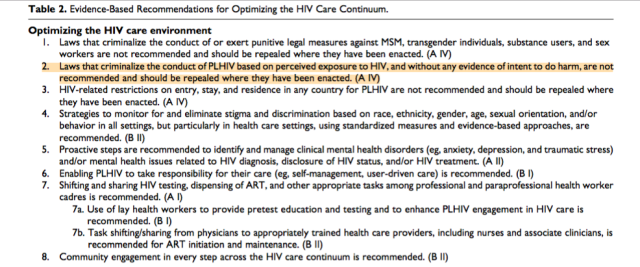
The full HIV criminalisation recommendation (Recommendation 2) is below.

  • Recommendation 2: Laws that criminalize the conduct of PLHIV based on perceived exposure to HIV, and without any evidence of intent to do harm, are not recommended and should be repealed where they have been enacted. (A IV)

Numerous countries have enacted laws that criminalize behaviors associated with HIV exposure, many of which pose a low or negligible HIV transmission risk. No differences in behavior have been noted between settings that enact such laws and those that do not. Many of these laws do not take into account measures that reduce HIV transmissibility, including condom use, and were enacted before the preventive benefit of ART or antiretroviral (ARV)-based preexposure prophylaxis (PrEP) was fully characterized. Most PLHIV who know their status take steps to prevent transmitting HIV to others.HIV-specific laws thus primarily exacerbate HIV-related stigma and decrease HIV service uptake.

IAPAC Guidelines for Optimizing the HIV Care Continuum for Adults and Adolescents

Canada: New film explores the impact of using sexual assault law to prosecute HIV non-disclosure

This week sees the release of an important new short film from the Canadian HIV/AIDS Legal Network.

Consent: HIV non-disclosure and sexual assault law interrogates whether criminalising HIV non-disclosure does what the Supreme Court of Canada believes it does – protect sexual autonomy and dignity – or whether, in fact, it does injustice both to individuals charged and to the Canadian criminal justice system’s approach to sexual violence.

Produced together with Goldelox Productions, with whom the Legal Network also collaborated on their powerful 2012 documentary’ Positive Women: Exposing Injustice, this 28-minute film features eight experts in HIV, sexual assault and law whose commentary raises many questions about HIV-related legal developments in Canada.

At a time when society seems to be taking the prevalence of sexual

violence and rape culture more seriously, this film dares to ask some

difficult questions about its limits in the law. The law of sexual

assault is intended to protect women’s sexual autonomy, equality

and dignity, yet as applied with respect to alleged HIV non-disclosure,

these values are not necessarily being advanced. Through expert

testimonies, Consent shines a light on the systemic obstacles women

face in disclosing their HIV status, points to the dangerous health

and human rights outcomes of applying such a harsh charge as

aggravated sexual assault to HIV non-disclosure, and makes the

argument that the law needs to better protect those who are living

with and vulnerable to HIV. Consent demonstrates that advocacy

efforts opposing the overly broad criminalization of HIV non-disclosure

must address the use of sexual assault law and that such efforts must

do so alongside feminist allies.

From: http://www.consentfilm.org/about-the-film/

The Canadian HIV/AIDS Legal Network has for some time been exploring the implications of using sexual assault law to prosecute HIV non-disclosure cases, given the marked differences between the types of conduct that are typically referred to as sexual assault (including rape) and HIV non-disclosure cases.

In April 2014, the Legal Network convened leading feminist scholars, front-line workers, activists and legal experts for a ground-breaking dialogue on the (mis)use of sexual assault laws in cases of HIV non-disclosure. Consent: HIV non-disclosure and sexual assault law was filmed during this convening.

Their analysis demonstrates that the use of sexual assault law in the HIV non-disclosure context – where the sexual activity is consensual other than the non-disclosure – is a poor fit and can ultimately have a detrimental impact on sexual assault law as a tool to advance gender equality and renounce gender-based violence.

The Consent website ( in English / in French ) also lists future screenings across Canada, which will be accompanied by panels and workshops, as part of an ongoing strategy to build up allies among women’s rights advocates for the longer-term work.

A discussion guide will also soon be available.

US: Positive Justice Project Update – September 2015

After the release of the updated National HIV/AIDS Strategy in July 2015, CHLP, the National LGBT Task Force, the National Center for Transgender Rights and other partners in the LGBTHIV Criminal Justice Working Group’s HIV Criminalization subgroup, drafted recommendations for needed action steps to tackle 1) broad public ignorance about

Australia: Academic article explores the prevention impact of treatment on criminal 'exposure' laws and prosecutions

Evidence that treating people with HIV early in infection prevents transmission to sexual partners has reframed HIV prevention paradigms. The resulting emphasis on HIV testing as part of prevention strategies has rekindled the debate as to whether laws that criminalise HIV transmission are counterproductive to the human rights-based public health response. It also raises normative questions about what constitutes ‘safe(r) sex’ if a person with HIV has undetectable viral load, which has significant implications for sexual practice and health promotion. This paper discusses a recent high-profile Australian case where HIV transmission or exposure has been prosecuted, and considers how the interpretation of law in these instances impacts on HIV prevention paradigms. In addition, we consider the implications of an evolving medical understanding of HIV transmission, and particularly the ability to determine infectiousness through viral load tests, for laws that relate to HIV exposure (as distinct from transmission) offences. We conclude that defensible laws must relate to appreciable risk. Given the evidence that the transmissibility of HIV is reduced to negligible level where viral load is suppressed, this needs to be recognised in the framing, implementation and enforcement of the law. In addition, normative concepts of ‘safe(r) sex’ need to be expanded to include sex that is ‘protected’ by means of the positive person being virally suppressed. In jurisdictions where use of a condom has previously mitigated the duty of the person with HIV to disclose to a partner, this might logically also apply to sex that is ‘protected’ by undetectable viral load.

US: ‘Turn It Up!’ an innovative resource for prisoners with HIV needs your help reaching Kickstarter goal

Sero is a national network of people with HIV and allies fighting HIV-related stigma, discrimination and criminalization by engaging and empowering ourselves and others with HIV to speak and advocate, conduct original research, document the experiences of those criminalized, educate communities and work in partnership with others to mobilize for change.

They particularly work to support and strengthen networks of people with HIV, especially those representing key populations, to bring their voice and insight to the discussion and development of policy, delivery of services and the media.

They have received many letters from people with HIV and/or hepatitis who are currently in prison, many on charges arising from their HIV or hepatitis status. Cindy Stine, Sero’s Prisoner’s Network co-ordinator, responds to these inquiries, provides research assistance and sometimes is able to help find legal counsel or other needed resources.

From this informal and growing network, it soon became clear that many people who are incarcerated have unique knowledge about effective strategies to maintain good health and access healthcare while behind bars.

Last September, Sero gathered a group of people who have been incarcerated or work with those who are, as well as HIV and hepatitis experts.

They spent time brainstorming how they could facilitate the sharing of advice, insights and tips from people who are in prisons or jails concerning how they stay as healthy as possible.

That led to the creation of Turn It Up! a new print resource guide for people with HIV and/or hepatitis who are incarcerated, as well as those newly-released from prison or jail and their friends and families.

Written and edited in large part by people who have themselves been incarcerated and/or have HIV and/or hepatitis, Turn It Up! will help those serving time navigate healthcare and stay as healthy as possible.

Laura Whitehorn and Suzy Martin, two longtime and prison reform activists, editors and HIV experts, are co-editing Turn It Up! They are both former editors at POZ magazine and Suzy works closely with Prison Health News.

To produce Turn It Up!, they worked with more than two dozen others, including contributors from prisons and jails in a dozen states, bringing an authentic, passionate and informed voice to the pages of Turn It Up!

The challenge now is to get it distributed to those who need it the most. Sero have launched a modest Kickstarter campaign, that includes this video explaining the project, which they hope will raise at least $5,000 to help with distribution costs.

Support the Kickstarter campaign here.

UNAIDS Reference Group on HIV and Human Rights updates statement on HIV testing to include the “key trend” of “prolific unjust criminal laws and prosecutions”

The UNAIDS Reference Group on HIV and Human Rights has updated its statement on HIV testing  — which continues to emphasise that human rights, including the right to informed consent and confidentiality, not be sacrifced in the pursuit of 90-90-90 treatment targets — in the light of “three key trends that have emerged since the last statement regarding HIV testing was issued by the UNAIDS Reference Group (in 2007).”

One of these is “prolific unjust criminal laws and prosecutions, including the criminalization of HIV non-disclosure, exposure, and transmission.” The other two involve the recognition that HIV treatment is also prevention, and policies that aim to “end the AIDS epidemic as a public health threat by 2030.”

This statement is an important policy document that can be used to argue that public health goals and human rights goals are not mutually exclusive.

The Reference Group was established in 2002 to advise the Joint United Nations Programme on HIV/AIDS (UNAIDS) on all matters relating to HIV and human rights. It is also fully endorsed by by the Global Fund to Fight AIDS, Tuberculosis and Malaria Human Rights Reference Group.

This statement is issued at a time when UNAIDS and the Global Fund are renewing their strategies for 2016–2021 and 2017–2021, respectively.

To support these processes, the Reference Groups offer the following three key messages:

1. There is an ongoing, urgent need to increase access to HIV testing and counselling, as testing rates remain low in many settings. The Reference Groups support such efforts unequivocally and encourage the provision of multiple HIV testing settings and modalities, in particular those that integrate HIV testing with other services.

2. Simply increasing the number of people tested, and/or the number of times people test, is not enough, for many reasons. Much greater efforts need to be devoted to removing barriers to testing or marginalized and criminalized populations, and to link those tested with prevention and treatment services and successfully keep them in treatment.

3. Public health objectives and human rights principles are not mutually exclusive. HIV testing that violates human rights is not the solution. A “fast-track” response to HIV depends on the articulation of testing and counselling models that drastically increase use of HIV testing, prevention, treatment, and support services, and does so in ways that foster human rights protection, reduce stigma and discrimination, and encourage the sustained and supported engagement of those directly affected by HIV.

The section on HIV criminalisation is quoted below.

The criminalization of HIV non-disclosure, exposure, and transmission is not a new phenomenon, but the vigour with which governments have pursued criminal responses to alleged HIV exposures — at the same time as our understanding of HIV prevention and treatment has greatly advanced, and despite evidence that criminalization is not an effective public health response — causes considerable concern to HIV and human right advocates. In the last decade, many countries have enacted HIV-specifc laws that allow for overly broad criminalization of HIV non-disclosure, exposure, and transmission. This impetus seems to be “driven by the wish to respond to concerns about the ongoing rapid spread of HIV in many countries, coupled by what is perceived to be a failure of existing HIV prevention efforts.” In some instances, particularly in Africa, these laws have come about as a response to women being infected with HIV through sexual violence, or by partners who had not disclosed their HIV status.

Emerging evidence confrms the multiple implications of the criminalization of HIV non-disclosure, exposure, and transmission for HIV testing and counselling. For example, HIV criminalization can have the effect of deterring some people from getting tested and finding out their HIV status. The possibility of prosecution, alongside the intense stigma fuelled by criminalization, is good reason for some to withhold information from service providers or to avoid prevention services, HIV testing, and/or treatment. Indeed, in jurisdictions with HIV-specific criminal laws, HIV testing counsellors are often obliged to caution people that getting an HIV test will expose them to criminal liability if they find out they are HIV-positive and continue having sex. They may also be forced to provide evidence of a person’s HIV status in a criminal trial. This creates distrust in relationships between people living with HIV and their health care providers, interfering with the delivery of quality health care and frustrating efforts to encourage people to come forward for testing.

The full statement, with references, can be downloaded here and is embedded below.

HIV TESTING AND COUNSELLING: New technologies, increased urgency, same human rights