African leaders call on Senegal’s President to suspend arrests targeting LGBT+ people in Senegal

Open letter to Bassirou Diomaye Faye

The recent adoption of measures tightening criminal penalties against homosexuals is causing serious concern. A climate of fear, hatred and violence has taken hold in the country. Is this really what ‘left-wing Pan-Africanism’ is all about?

Mr President,

We are writing this letter to you in a spirit of solidarity and dialogue. It is written by women and men of African origin, living both on the continent and in the diaspora, who are deeply committed to the future of Senegal and, beyond that, to the future of the pan-African project.

When you came to power, your election sparked considerable hope, far beyond the borders of Senegal and the continent. Many saw you as the embodiment of political renewal, that of a new generation, championing the values of justice, dignity and sovereignty. You presented yourself as inspired by a ‘left-wing pan-Africanism’, thereby arousing enthusiasm and expectation among those who aspire to a freer, fairer and more united Africa.

Unfortunately, as far as we are concerned, this hope has been overshadowed in recent weeks.

The recent adoption of provisions tightening the criminalisation of homosexuals, along with the resulting social climate, is causing deep concern. The consequences are already visible and dramatic. A young man, perceived as homosexual – rightly or wrongly – was stabbed in the street. Others have been beaten, imprisoned, or rejected by their families and communities. Still others are now seeking to flee their own country, the country they loved. At the same time, people living with HIV, including heterosexuals, no longer dare to go to health centres for testing or treatment, for fear of being stigmatised and arrested – something that has happened on more than one occasion. The organisations that used to support those most at risk can no longer do so. This situation risks exacerbating the spread of the epidemic and increasing morbidity and mortality in Senegal.

A climate of fear, hatred and violence has taken hold in the country. Is this really what ‘left-wing Pan-Africanism’ is all about?

As we understand it, Pan-Africanism is based on the inclusion of all Africans, both on the continent and in the diaspora. It is a project of unity, solidarity and shared dignity. As for left-wing Pan-Africanism, in our view, it aims all the more to emancipate all Africans, not to lock up consenting adults who are harming no one. Moreover, globally, it is rather at the opposite end of the political spectrum—and particularly on the far right—that discriminatory agendas are deployed, whether against Black people, women or homosexuals.

The emancipatory Pan-Africanism that we espouse has been powerfully embodied by major historical figures. Nelson Mandela and Desmond Tutu, both Nobel Peace Prize laureates, consistently fought against discrimination based on sexual orientation. Jesse Jackson, with his Rainbow Coalition, included gay and lesbian people in his struggle for equality. Angela Davis, for her part, has always championed an intersectional view of these struggles, linking the fights against racism, sexism, capitalism and discrimination based on sexual orientation.

Furthermore, several African countries have recently moved towards greater recognition of rights: Botswana, Mozambique, Gabon and Angola have decriminalised homosexuality in recent years. These choices show that, within Africa itself, there are diverse paths forward, and that no inevitability condemns the continent to repression.

We wish to make this clear: this is not about condemning Senegal, nor about denying its sovereignty, which must be respected. But Senegal is a signatory to the African Charter on Human and Peoples’ Rights and the United Nations Charter, which enshrine, in particular, the right to privacy and the principle of non-discrimination. So why does Senegal refuse to honour its own African and international commitments?

Some claim that homosexuality is alien to Africa. This idea does not stand up to scrutiny. All African historians and ethnologists know this. In many African languages, including Wolof, terms have long existed to describe realities related to homosexuality, proof that it is neither new nor imported. In Senegal, the goorjigeens had a place in society. What will become of them? On the other hand, the laws that repress them are, for the most part, a legacy of colonisation. Whether it be the French-inspired penal codes or the ‘sodomy laws’ introduced by the British Empire during the reign of Queen Victoria, these provisions were imposed from outside. And the foreign forces pushing Senegal to prosecute homosexual and transgender people, and even to ban any calm debate on the issue, are very diverse.

As for the religious argument, it too calls for caution. We believe that some people confuse faith with the law. Faith is a matter of the most fundamental individual freedom and must be respected. But civil law cannot simply be a transposition of religious doctrine. Article 1 of the Constitution proclaims that ‘the Republic of Senegal is secular, democratic and social’. Senegal is a democracy, renowned for its pluralism; it has never been a theocracy based on Sharia law. Such a shift would pose risks not only to sexual minorities, but also to women, non-Muslims, and, more broadly, to all civil liberties.

Senegalese Islam used to be a tolerant form of Islam. Today, is a fundamentalist form of Islam taking hold in the country? Senegal’s image on the international stage is already being affected. Several studies show that discrimination hinders development. Senegal needs all its children.

Today, in certain regions of Africa, we are witnessing the rise of fundamentalist and violent movements across various religious traditions. These movements undermine societies and threaten African unity by spreading ideologies of hatred, division and exclusion.

In the face of this, we feel it is urgent to reaffirm another path: that of dialogue.

We are all part of the same pan-African family. And as in any family, disagreements may arise. But it is through discussion, whether under the baobab tree or elsewhere, that these disagreements can be resolved. It is in this spirit that we write to you today.

We wish to invite the Senegalese authorities to open a respectful and constructive dialogue on these issues. In the meantime, however, we call for a moratorium on arrests and the enforcement of sentences in order to ease tensions and allow for collective reflection. We also hope that the March 2010 law on HIV/AIDS will be respected, particularly Article 12, as testing must be carried out freely and voluntarily, and results must remain confidential.

Mr President, it is our hope that Senegal will continue to be a beacon for Africa, not only through its political stability, but also through its commitment to human dignity.

Please accept, Mr President, the assurance of our highest consideration and our pan-African solidarity.

Signatories:

-Alice Nkom, lawyer, member of the UN Permanent Forum on People of African Descent

-Doudou Diène, former UN Special Rapporteur on new forms of discrimination

-Victorin Lurel, Senator for Guadeloupe, former minister

-Marcelin Nadeau, Member of Parliament for Martinique

-Olivier Serva, Member of the National Assembly for Guadeloupe

-Annah Bikouloulou, Deputy Mayor of Paris, responsible for equality, human rights and the fight against discrimination

-Nouriati Djambae, Member of the Bouches-du-Rhône Departmental Council

-Jean-Jacob Bicep, former Member of the European Parliament, member of the Human Rights Committee

-Dominique Sopo, President of SOS Racisme

-Achille Mbembé, philosopher

-Jean-Claude Barny, filmmaker

-Eva Doumbia, director, writer

-Brian Scott Eagle, founder of the Josephine Baker Museum,

-Matthieu Niango, essayist, writer

-Brahim Naït-Balk, radio presenter, football coach

-Jo Amaranthe, co-founder of Black Pride

-Fabrice Nguena, human rights defender, author

-Carlos Idibouo, human rights defender

-Félicité Esther Zeifman, barrister at the Paris Bar

-Brice Nzamba, barrister at the Paris Bar

-Nadia Chonville, writer

-Brice Armien Boudré, co-president of Kap Caraïbe

-Jeanne-Marie Rugira, PhD, professor and researcher at UQAR

-David Andrew, writer, poet, human rights defender

-Jérémy Clamy-Edroux, former professional rugby player, engineer and lecturer

-Emma Onekekou, communications specialist, writer

-Agée Lomo, senior lecturer

Sabine CHYL, human rights activist

-Blaise Ndala, writer, lawyer


Collectif d’universitaires, politiques, écrivains, avocats d’origine africaine

Lettre ouverte à Bassirou Diomaye Faye

L’adoption récente de dispositions renforçant la pénalisation des personnes homosexuelles suscite une vive inquiétude. Un climat de peur, de haine et de violence s’est installé dans le pays. Est-ce vraiment cela, le « panafricanisme de gauche » ?

Monsieur le président,

Nous vous adressons cette lettre dans un esprit de fraternité et de dialogue. Elle est portée par des femmes et des hommes d’origine africaine, vivant sur le continent comme dans la diaspora, et profondément attachés à l’avenir du Sénégal et, au-delà, à celui du projet panafricain.

Lorsque vous êtes arrivé au pouvoir, votre élection a suscité un espoir considérable, bien au-delà des frontières du Sénégal et du continent. Beaucoup ont vu en vous l’incarnation d’un renouveau politique, celui d’une nouvelle génération, porteuse de valeurs de justice, de dignité et de souveraineté. Vous vous êtes présenté comme étant inspiré par un « panafricanisme de gauche », suscitant ainsi enthousiasme et attente parmi celles et ceux qui aspirent à une Afrique plus libre, plus juste et plus unie.

Malheureusement, pour ce qui nous concerne, cet espoir a été assombri ces dernières semaines.

L’adoption récente de dispositions renforçant la pénalisation des personnes homosexuelles, ainsi que le climat social qui en découle, suscitent une vive inquiétude. Les conséquences sont déjà visibles et dramatiques. Un jeune homme, perçu comme homosexuel – à tort ou à raison – a été poignardé en pleine rue. D’autres ont été battus, emprisonnés, ou rejetés par leur famille et leur communauté. D’autres encore cherchent maintenant à fuir leur propre pays, le pays qu’ils aimaient. Dans le même temps, des personnes vivant avec le VIH, y compris hétérosexuelles, n’osent plus se rendre dans les centres de santé pour se faire dépister ou soigner, par peur d’être stigmatisées et arrêtées, ce qui est arrivé plus d’une fois. Les associations qui accompagnaient les personnes les plus exposées ne peuvent plus le faire. Cette situation risque d’aggraver la propagation de l’épidémie et d’accroître la morbidité et mortalité au Sénégal.

Un climat de peur, de haine et de violence s’est installé dans le pays. Est-ce vraiment cela, le « panafricanisme de gauche » ?

Tel que nous le comprenons, le panafricanisme repose sur l’inclusion de tous les Africains, du continent comme de la diaspora. Il s’agit d’un projet d’unité, de solidarité et de dignité partagée. Quant au panafricanisme de gauche, selon nous, il entend a fortiori émanciper tous les Africains, et non enfermer en prison des adultes consentants qui ne nuisent à personne. Au demeurant, dans le monde, c’est plutôt à l’opposé du spectre politique, et notamment à l’extrême-droite, que se déploient les agendas discriminatoires, que ce soit contre les noirs, contre les femmes ou contre les personnes homosexuelles.

Le panafricanisme émancipateur qui est le nôtre a été incarné avec force par des figures historiques majeures. Nelson Mandela et Desmond Tutu, tous deux Prix Nobel de la paix, ont constamment lutté contre les discriminations liées à l’orientation sexuelle. Jesse Jackson, avec sa Rainbow Coalition, avait inclus les personnes gaies et lesbiennes dans son combat pour l’égalité. Angela Davis, quant à elle, a toujours défendu une vision intersectionnelle des luttes, articulant les combats contre le racisme, le sexisme, le capitalisme et les discriminations liées à l’orientation sexuelle.

Par ailleurs, plusieurs pays africains ont récemment évolué dans le sens d’une plus grande reconnaissance des droits : Botswana, Mozambique, Gabon, ou encore Angola ont dépénalisé l’homosexualité ces dernières années. Ces choix montrent qu’il existe, en Afrique même, des trajectoires diverses, et qu’aucune fatalité ne condamne le continent à la répression.

Nous tenons à le dire clairement : il ne s’agit pas ici de condamner le Sénégal, ni de nier sa souveraineté, qui doit être respectée. Mais le Sénégal est signataire de la Charte africaine des droits de l’homme et des peuples et de la Charte des Nations unies, qui consacrent notamment le respect de la vie privée et le principe de non-discrimination. Dès lors, pourquoi le Sénégal refuse-t-il de respecter ses propres engagement africains et internationaux ?

Certains affirment que l’homosexualité serait étrangère à l’Afrique. Cette idée ne résiste pas à l’analyse. Tous les historiens et ethnologues africains le savent. Dans de nombreuses langues africaines, y compris en wolof, des termes existent depuis longtemps pour désigner des réalités liées à l’homosexualité, preuve qu’elle n’est ni nouvelle ni importée. Au Sénégal les goorjigeensavaient une place dans la société. Que vont-ils devenir ? En revanche, les lois qui les répriment sont, pour l’essentiel, héritées de la colonisation. Qu’il s’agisse des codes pénaux d’inspiration française ou des « sodomy laws » introduites par l’Empire britannique à l’époque de la Reine Victoria, ces dispositions ont été imposées de l’extérieur. Et les forces étrangères qui poussent le Sénégal à poursuivre les personnes homosexuelles et transgenre, et même à interdire tout débat serein sur la question, sont très diverses.

Quant à l’argument religieux, il appelle également à la prudence. Nous pensons que certains confondent la foi et la loi. La foi relève de la liberté individuelle la plus fondamentale, et doit être respectée. Mais la loi civile ne saurait être la simple transposition d’une doctrine religieuse. L’article premier de la constitution proclame que « la République du Sénégal est laïque, démocratique et sociale ». Le Sénégal est une démocratie, reconnue pour son pluralisme ; il n’a jamais été une théocratie, fondée sur la charia. Une telle évolution ferait peser des risques non seulement sur les minorités sexuelles, mais aussi sur les femmes, les non-musulmans, et, plus largement, sur toutes les libertés publiques.

L’islam sénégalais était un islam tolérant. Aujourd’hui, est-ce un islam intégriste qui est en train de s’imposer dans le pays ? L’image du Sénégal en est déjà affectée sur la scène internationale. Plusieurs études montrent que les discriminations portent atteinte au développement. Le Sénégal a besoin de tous ses enfants.

Aujourd’hui, dans certaines régions d’Afrique, on observe la montée de courants fondamentalistes et violents, dans différentes traditions religieuses. Ces mouvements fragilisent les sociétés et menacent l’unité africaine en diffusant des idéologies de haine, de division et d’exclusion.

Face à cela, il nous semble urgent de réaffirmer un autre chemin : celui du dialogue.

Nous faisons toutes et tous partie d’une même famille panafricaine. Et comme dans toute famille, des désaccords peuvent exister. Mais c’est par la palabre, sous le baobab ou ailleurs, que ces désaccords peuvent être discutés. C’est dans cet esprit que nous vous écrivons aujourd’hui.

Nous souhaitons inviter les autorités sénégalaises à ouvrir un dialogue respectueux et constructif sur ces questions. Mais en attendant, nous appelons à l’instauration d’un moratoire sur les arrestations et l’application des peines afin d’apaiser les tensions et de permettre une réflexion collective. Nous souhaitons aussi que la loi de mars 2010, relative au VIH-Sida, soit respectée, et notamment son article 12, car les tests doivent être effectués de façon libre et volontaire, et les résultats doivent rester confidentiels.

Monsieur le président, nous formons le vœu que le Sénégal, continue d’être un phare pour l’Afrique, non seulement par sa stabilité politique, mais aussi par son engagement en faveur de la dignité humaine.

Veuillez agréer, Monsieur le président, l’expression de notre haute considération et de notre attachement panafricain.

Signataires :

-Alice Nkom, avocate, membre du Forum Permanent de l’ONU pour les personnes d’ascendance africaine

-Doudou Diène, ancien rapporteur spécial de l’ONU pour les nouvelles formes de discrimination

-Victorin Lurel, sénateur de la Guadeloupe, ancien ministre

-Marcelin Nadeau, député de la Martinique

-Olivier Serva, député de la Guadeloupe

-Annah Bikouloulou, adjointe au maire de Paris, chargée de l’égalité, des droits humains et de la lutte contre les discriminations

-Nouriati Djambae, conseillère départementale des Bouches du Rhône

-Jean-Jacob Bicep, ancien député européen, membre de la commission des droits humains

-Dominique Sopo, président de SOS Racisme

-Achille Mbembé, philosophe

-Jean-Claude Barny, cinéaste

-Eva Doumbia, metteuse en scène, écrivaine

-Brian Scott Eagle, fondateur du musée Joséphine Baker,

-Matthieu Niango, essayiste, écrivain

-Brahim Naït-Balk, animateur radio, entraîneur de football

-Jo Amaranthe, co-fondateur de la Black Pride

-Fabrice Nguena, défenseur des droits humains, auteur

-Carlos Idibouo, défenseur des droits humains

-Félicité Esther Zeifman, avocate au Barreau de Paris

-Brice Nzamba, avocat au Barreau de Paris

-Nadia Chonville, écrivaine

-Brice Armien Boudré, co-président de Kap Caraïbe

-Jeanne-Marie Rugira, Ph.D professeure-chercheure à l’UQAR

-David Andrew, écrivain, poète, défenseur des droits humains

-Jérémy Clamy-Edroux, ex-joueur professionnel de rugby, ingénieur et conférencier

-Emma Onekekou, communicante, écrivaine

-Agée Lomo, maître de conférences

Sabine CHYL, activiste pour les droits humains

-Blaise Ndala, écrivain, juriste
Senegal: Rising homophobia drives patients away from HIV care and prevention services

Senegal’s LGBTQ+ community lives in fear as fight against AIDS faces setback
The country has regularly seen homophobic protest fueling assaults and public denunciations. Within this climate, organizations working to fight HIV worry that individuals will turn away from vital care and prevention services.
On February 20, Ousmane gathered a few belongings and fled his home. “Since then,” the Senegalese man said, speaking under a pseudonym, “I’ve been living in hiding, in a city I can’t name. I’m petrified. People in my neighborhood found out things about my life. They know I’m gay.” If word spreads, the man in his 30s went on, “I risk being beaten and arrested, or arrested and then beaten. I don’t see any solution other than leaving for another country as soon as I can.”
Denunciations, extortion and assaults: Over the past several weeks, people who are gay or who are suspected of being gay have faced a surge of hostility across Senegal, a country that has already been marked by regular homophobic mobilizations over the past decade.
Violence against LGBTQ+ people has escalated dramatically following the arrests in February of 14 suspected members of a pedocriminal ring targeting young boys; two days earlier, 12 men, including local media figures, were accused of homosexuality. The two cases are entirely unrelated.
Several media outlets, relying on evidence gathered by police, published the HIV status of some defendants in both cases, fueling “the conflation, already present at times in Senegal, between homosexuality and pedophilia, homosexuality and HIV positivity,” said Marane Kane, a French-Senegalese consultant and a specialist in gender issues based in France. “Since then, there has been a surge in reports of assaults, and people are living in hiding,” she stressed.

Calls for hatred

According to Free Sénégal, a support network for LGBTQ+ people, about 30 arrests have taken place since then in Dakar, Touba and Saint-Louis. “I’m afraid of everyone’s gaze. I feel like I could be denounced at any moment. I don’t eat, I don’t sleep,” explained a young man.
Prime Minister Ousmane Sonko responded to the media frenzy and, reiterating a promise made three years ago, announced on Tuesday, February 24, that he had submitted a bill to toughen sentences targeting “acts against nature” – a term that includes same-sex relations – raising the penalty to five to 10 years in prison, up from the current one to five years. The move was hailed by Mame Mactar Gueye, the influential leader of the Islamic NGO Jamra, which campaigns for the criminalization of homosexuality; his supporters, meanwhile, are demanding even harsher repression.
On TikTok and on Facebook, in videos viewed hundreds of thousands of times, influencers, including some based in Europe, have hurled condemnations at both ordinary citizens and public figures. The well-known actor Sanekh, star of the hit series Bété Bété, has been targeted. And Elimane Ndao, the Senegal correspondent for the French television channel France 24, has filed a complaint for similar reasons. To avoid being singled out, some people have even started posting proof of their HIV-negative status on social media.
Encouraged by these calls for hatred, assaults have multiplied, often taking the form of carefully planned ambushes. “He doesn’t want to talk to you, he’s too scared. I’ll tell his story for him,” said a Senegalese man living in France, describing a friend in Senegal. “He was chatting with a man on a dating app. They agreed to meet. It was a trap. He was threatened with a knife and had to hand over money to get away. Things like this happen all the time.”
The situation is alarming human rights advocates. “Gay people have become scapegoats for society. There’s the conflation with pedophilia, conspiracy theories painting them as Trojan horses for Western values, to the detriment of all local knowledge… Everything that goes wrong is blamed on them,” explained Kane. “Meanwhile, real issues like sexual violence against children are forgotten. People think they’ve done enough by cracking down on homosexuality.”

‘There’s nothing left to do but flee’

This pressure has organizations that work to fight AIDS worried that people will turn away from care and prevention services. Senegal has managed to keep HIV prevalence low (0.5% of the population in 2020). “We’re already seeing a drop in consultations. Many patients are skipping appointments, and the few who dare to come hide their identities,” said Safiatou Thiam, the executive secretary of the National Council for the Fight Against AIDS in Senegal.
After the disclosure of some citizens’ HIV status, panicked patients have asked health centers to erase their records. As for the network of community outreach workers serving at-risk populations, it has collapsed; outreach staff no longer dare ask about people’s health or try to promote prevention among a group facing such intense stigma.
In his address, Sonko insisted on the ban on sharing people’s health status. He also emphasized that the prison sentences in his bill for “promoting” so-called “acts against nature” – a provision targeting NGOs and advocacy groups that might defend the rights of gay people – should not prevent the health system from continuing its work on AIDS prevention. According to health professionals, they discreetly reached out to the government as soon as rumors emerged of a possible bill imposing harsher penalties for homosexuality.
“We can’t live in our country anymore. It’s too dangerous, there’s nothing left to do but flee,” said a young man in his 30s, his voice breaking with sobs, who spent all his savings to escape Senegal for Europe five months ago. “I can’t imagine a gay person seeking medical care in this climate.”
As for Gueye, he is showing no sign of ending his campaign. After thanking “all the TikTokers, valiant defenders of our cause,” he recently announced his intention to “tackle the scourge of lesbianism.”

Senegal: Arrests and breach of medical confidentiality trigger drop in HIV testing and treatment attendance

“Violation of medical confidentiality”: in Senegal, caregivers worried about allegations against homosexuals with HIV

In Senegal, people have been incriminated for their homosexuality and accused of HIV transmission. These arrests follow the announcement by Prime Minister Ousmane Sonko of the tightening of the law penalizing “unnatural acts”. Since these arrests, the actors in the fight against AIDS have seen a decrease in attendance at screening centers.

Arrest for homosexuality: serious cases of unnatural acts with voluntary transmission of HIV/AIDS,” headlined the Senegalese daily Les Échos, on February 9. About thirty people have been accused of transmitting HIV and incriminated for their homosexuality, which is prohibited by law. The Senegalese government has just toughened this legislation on February 24. These arrests frighten patients with the virus, who no longer go to the Dakar screening center.

Patients are afraid of being arrested and stigmatized,” explains Dr. Rassoul Diouf, at Fane Hospital, one of Senegal’s main health centers. Usually, this facility welcomes dozens of patients daily for HIV testing and monitoring. But in recent weeks, Dr. Rassoul Diouf has seen a significant drop in consultations.”The convocations for appointments are difficult to happen. We call them but there is reluctance,” he explains to TV5MONDE.

Breach of medical confidentiality

For the actors in the fight against AIDS, this disclosure constitutes a “violation of medical confidentiality“. The National AIDS Council recalls that a law in Senegal protects the identity of people with HIV.

On an ethical level, this is not normal, but even less on a legal level,” says Dr. Safiatou Thiam, executive secretary of the National Council for the fight against AIDS. “HIV has the particularity of being framed by a law that prohibits the disclosure of people’s status. We do not know how or by what process medical results ended up in the public square,” she explains to TV5MONDE.

Misinformation and confusion about HIV transmission

Actors in the fight against AIDS also deplore confusion about the modes of transmission of the virus. However, Senegal has long been cited as an example for the means put in place to fight HIV. Since the end of the 1990s, the country made treatments accessible. “At the beginning of the epidemic [of HIV, ed.], many countries refused to recognize its existence. But Senegal said: not only does HIV exist, but I will treat it,” explains Dr. Khoudia Sow, doctor and anthropologist.

When a person follows his treatment properly, he becomes undetectable and can no longer transmit the virus. On the other hand, if these people interrupt their treatment for fear of stigmatization, the risk is that in the short term new transmissions will appear,” she confides. Currently, the HIV prevalence rate in Senegal is estimated at 0.3%, one of the lowest in the region. However, if patients stop taking their treatment, for fear of stigma, this rate could increase in Senegal.

US: New Williams Institute analysis shows HIV criminalization disproportionately targets Black communities

Black Americans are disproportionately criminalized for living with HIV.

Through “heightened surveillance, arrest, and conviction,” Black Americans are more likely to be criminalized for their HIV.

Black people in the U.S. aren’t just more likely to have HIV — they’re more likely to be criminalized for it.

Black Americans accounted for about 38 percent of new HIV diagnoses and 39 percent of people living with HIV in 2023, according to a report from the Williams Institute, despite making up around 12 percent of the population.

Black women had the highest HIV diagnosis rate at 19.6 per 100,000, which is about 11 times the rate for white women at 1.8 per 100,000. Black boys and men ages 13 to 24 accounted for 47 percent of all new diagnoses among youth, while white boys and men made up just three percent.

Even with higher rates of infection, Black Americans are less likely to be on medications that treat HIV, with just 64 percent receiving care and 53 percent virally suppressed. They are also less likely to have health insurance, as 12.3 percent of Black adults ages 19 to 64 did not have health insurance in 2024, compared to 6.8 percent of white adults.

Black Americans are more likely to be criminalized for their HIV as well, as they are often subjected to “heightened surveillance, arrest, and conviction within the criminal legal system,” according to the report. In 64 percent of states analyzed, they faced higher rates of arrest than their share of people living with HIV. For example, Black people in California were 6 percent of the state population and 18 percent of people living with HIV, but 39 percent of HIV-related arrests.

They’re also more likely to face harsh post-conviction penalties like sex offender registration. In Tennessee, Black people were 17 percent of the state’s population and 55 percent of people living with HIV, but 74 percent of people on the sex offender registry with an HIV-related conviction.

“Most HIV criminal laws were enacted before effective HIV treatment and prevention tools became widely available,” said Nathan Cisneros, director of the HIV Criminalization Project at the Williams Institute. “In recent years, there has been a push to reform or repeal these laws as policymakers and the public increasingly recognize that these laws can discourage testing, increase stigma, and deepen disparities — especially for Black Americans.”

Canada: Google refuses to suppress name-based search results in dismissed HIV criminalisation case

Google wants to keep HIV status of underage Canadian in search results

Canada’s data protection authority wants to enforce a version of the “right to be forgotten” that is reduced to a specific risk. Google is not playing along.

Google refuses to accept the Canadian version of the“right to be forgotten“, even though it is significantly reduced and better protected against abuse than the European version. Google’s refusal poses a problem for the monarchy’s weak data protection authority. The starting point of the dispute is media reports found via Google’s search engine about the arrest and prosecution of an HIV-positive, underage person, probably over a decade ago.

The person was once accused of not disclosing their HIV status prior to sexual contact. Canadian media reported on this, citing the person’s full name and sexual orientation. The data protection authority does not consider the reports to be a violation of the law.

However, the charges against the minor were quickly dropped because the results of the investigation showed that the person had never posed a risk to the health of others. Canada’s federal prosecutor generally does not prosecute cases where there was no realistic risk of infection. But if you enter the person’s name into Google’s search engine, you will still find the media reports about the arrest and charges for the alleged sexual offense at the top.

The consequences for the person are dire: physical attacks, difficulties finding work, social ostracism. She would like hyperlinks to outdated media reports to no longer appear in Google’s search results when her name is entered. When Google refused, the complainant turned to the Office of the Privacy Commissioner of Canada in 2017.

The Office opened proceedings, but Google claimed that the authority was not allowed to investigate the search engine. It was used for journalistic purposes, for which the Canadian federal data protection law PEPIDA provides an exception. The authority went to court and won a declaration at both first (2021) and second instance (2023) that “every part” of the search engine is covered by the Canadian federal privacy law PEPIDA, especially as the search does not exclusively serve journalistic purposes.

Nevertheless, Google still refuses to suppress the hyperlinks to the media reports when a person’s name is entered. The authority is by no means demanding that the media reports be deleted from the index altogether. They may continue to be linked when other search terms are entered, but this should no longer happen when the name of the person concerned is entered. To this end, the data protection authority refers to a central rubber paragraph of the law (PEPIDA paragraph 5 section 3): “An organization may collect, use or disclose personal information only for purposes that a reasonable person would consider are appropriate in the circumstances.” (E.g.: Organizations may collect, use and disclose personal information only for purposes that a reasonable person would consider appropriate in the circumstances).

Under certain limited conditions, it follows that search results may be unlawful: If the search results are likely to cause significant harm to an individual, and this outweighs the public interest in the search results when the individual’s name is entered.

In this particular case, this public interest, if any, was low because the person in question was not a person of public interest and the media reports revolved around highly sensitive information about private life, not public activities or working life. Furthermore, the charges were quickly suspended; according to current guidelines, they would hardly ever have been brought.

Although there is public discourse about criminal sanctions for undisclosed HIV status, the public can find the specific media reports via thematic search terms; the ability to find them via a person’s name does not contribute significantly to the discourse.

Most of the linked articles would report incompletely and misleadingly, as they do not mention the subsequent resting of the charges. They also fail to mention the federal and provincial guidelines for not pressing charges without risk of infection. Without this context, readers could gain a false impression, which could seriously harm the person named. In general, the articles were published many years ago, which also reduces the public interest in linking to them.

By continuing to disseminate the links after entering the person’s name, Google permanently violated the cited legal provision. However, the Canadian Federal Data Protection Agency can neither impose fines nor impose conditions; it is limited to recommendations. Google does not want to implement these.

“Individuals have the right under Canadian privacy law to have information about themselves removed from online search results after entering their name in certain circumstances where there is a significant risk of harm that outweighs the public interest in that information being made available through such a search,” says Canada’s Privacy Commissioner Philippe Dufresne. His authority will “consider all available options to ensure Google’s compliance with the law.” What this will look like remains to be seen.

The Canadian data protection authority’s access to a “right to be forgotten” has the advantage over the European model of less potential for abuse. Legal web content is not to be deleted from the search index as a matter of principle; rather, the focus is on protecting those affected. Anyone searching specifically for such content should not be able to easily find content that is dangerous for those affected, while other search terms will continue to lead to the target. The fact that a person’s name is also listed there has little effect on people who are largely unknown.

In the European model, the webpage as a whole is regularly filtered out of the search results, regardless of the search term. This leads to abuse if user comments are published on the same webpage. Anyone who doesn’t like a media report, for example, writes a “drunk” post underneath it. The poster is soon “embarrassed”, which is why he requests the search engines to suppress the webpage. The search engines have to obey. The operators of the affected website never find out about the delisting, which the European “affected party” has enforced without a court ruling.

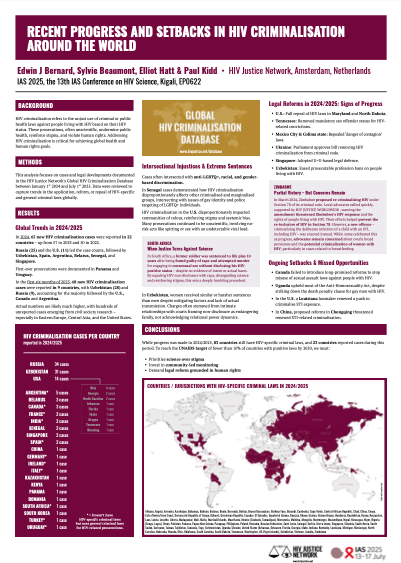
New global data reveals rising HIV criminalisation amid stalling legal reforms

The HIV Justice Network published new data this week showing a troubling rise in the number of people criminalised for HIV non-disclosure, potential or perceived exposure, or unintentional transmission in 2024 and the first half of 2025. As legal reforms appear to be stalling, discriminatory prosecutions, harsh sentences, and misuse of outdated laws continue to impact people with HIV and the HIV response.

The figures, presented at the 13h IAS Conference on HIV Science (IAS 2025) in Kigali, Rwanda, are drawn from the Global HIV Criminalisation Database. The database documents criminal cases and legal developments involving HIV-specific or general criminal laws worldwide.

In 2024, at least 65 HIV criminalisation cases were reported across 22 countries – up from 57 in 2023 and 50 in 2022. Russia (25 cases) and the United States (11) led the global tally, followed by Uzbekistan, Spain, Argentina, Belarus, Senegal, and Singapore. For the first time, prosecutions were documented in Panama and Uruguay.

The upward trend continued into 2025, with 48 cases reported in just the first six months. Uzbekistan (28) and Russia (9) again accounted for the majority, alongside new cases in the U.S., Canada, and Argentina. However, the actual number of cases is likely much higher, particularly in Eastern Europe, Central Asia, and the United States, where civil society organisations report many cases go undocumented.

“These cases show that HIV criminalisation remains a global crisis,” said Edwin J. Bernard, Executive Director of the HIV Justice Network. “Far too often, people living with HIV are prosecuted not for causing harm, but simply for living with a health condition – often in ways that are unscientific, discriminatory, and deeply unjust.”

                 Download the poster by clicking on the image

The report highlights the intersection of HIV criminalisation with racism, homophobia, gender-based discrimination, and systemic inequality. In Senegal, for example, prosecutions have disproportionately targeted LGBTQ+ individuals. In the U.S., criminal laws continue to be weaponised against communities of colour, even in cases involving no risk of transmission – such as spitting, or sex with an undetectable viral load.

One of the most alarming cases occurred in South Africa, where a former soldier was sentenced to life plus ten years for rape and attempted murder after failing to disclose his HIV status to a consenting partner – despite no evidence of intent or actual transmission. Advocates warn that such cases equate HIV non-disclosure with sexual violence and undermine decades of public health and human rights gains.

Yet, amidst the setbacks, 2024/2025 also brought some signs of hope. Maryland and North Dakota fully repealed their HIV-specific laws, while Tennessee removed mandatory sex offender registration for HIV-related convictions. Mexico City and Colima repealed vague “danger of contagion” laws, and Ukraine’s parliament voted to remove HIV from its criminal code.

In Zimbabwe, community activism helped block a proposal to re-criminalise HIV transmission. However, a new law was introduced criminalising the deliberate transmission of STIs to children, including HIV – raising fears it could be used against mothers living with HIV, particularly in breastfeeding cases.

Despite these advances, HIV criminalisation remains widespread. A total of 83 countries still have HIV-specific laws, and 23 countries reported prosecutions in this period using either HIV-specific or general laws. The HIV Justice Network warns that without urgent action, the world is unlikely to meet UNAIDS’ target of reducing punitive laws to below 10% of countries by 2030.

“The path forward must be rooted in science, rights, and community leadership,” Bernard said. “We must end laws that punish people for their status, and instead build legal systems that support health, dignity, and justice.”


EPO622 Recent progress and setbacks in HIV criminalisation around the world by Edwin J Bernard, Sylvie Beaumont, and Elliot Hatt was presented at IAS 2025 by Paul Kidd at 13th IAS Conference on HIV Science in Kigali, Rwanda.


Mexico: HIV criminalisation in Tamaulipas fuels fear and discrimination

Activists in Tamaulipas denounce that criminalisation of HIV is an obstacle to health and human rights

Translated with Deepl. For original article in Spanish, please scroll down.

Cd. Victoria, Tamaulipas.- People living with HIV in the state of Tamaulipas face not only the challenge of their health condition, but also the threat of criminalisation. Furthermore, Article 203 of the state penal code allows anyone to report another person for ‘risk of contagion’, which generates fear, discrimination and hinders prevention and early detection efforts.
Celso Pérez Ruiz, president of the civil association ‘Tendremos Alas’ (We Will Have Wings), denounced that this legislation discourages citizens from getting tested for HIV, as the fear of being singled out and prosecuted outweighs the need to know their health status.
‘In Tamaulipas, people living with HIV continue to be criminalised, and the current policy of prevention and early detection cannot move forward precisely because there is a law that criminalises them; so who is going to want to get tested for HIV under the fear of being reported if they test positive?’
He recalled that despite the fact that the Supreme Court of Justice of the Nation and the National Human Rights Commission have declared the law unconstitutional, the state has refused to repeal it.
In the last legislative session, Morena deputy Magaly de Andar presented an initiative to eliminate this article, but in her current term she has not followed up on it, leaving thousands of Tamaulipas residents in a situation of legal vulnerability.
This is not just a legal issue, it is a human rights issue. The criminalisation of HIV perpetuates stigma, alienates those living with HIV from health services and prevents them from exercising their right to a dignified life free from discrimination. It is time for Tamaulipas to move towards fairer and more humane legislation.
‘Article 203 of the Tamaulipas state criminal code criminalises people living with HIV, regardless of their sexual orientation or gender identity. All Tamaulipas residents living with the virus are under the premise that they can be reported by anyone for the risk of contagion,’ said Celso Pérez Ruiz.


Cd. Victoria, Tamaulipas.- En el estado de Tamaulipas viven con VIH enfrentan no solo el desafío de su condición de salud, sino también la amenaza de criminalización; además, el artículo 203 del código penal estatal permite que cualquier persona denuncie a otra por «peligro de contagio», lo que genera miedo, discriminación y obstaculiza los esfuerzos de prevención y detección oportuna.
Celso Pérez Ruiz, presidente de la asociación civil “Tendremos Alas”, denunció que esta legislación disuade a los ciudadanos de hacerse pruebas de VIH, pues el temor a ser señalados y perseguidos legalmente pesa más que la necesidad de conocer su estado de salud.
“En Tamaulipas se sigue criminalizando a las personas que viven con VIH, y la actual política de prevención y detección oportuna no puede avanzar precisamente porque hay una ley que criminaliza; entonces qué persona va a querer hacerse una prueba de VIH bajo el temor de que sea boletinada en caso de dar positivo”.
Recordó que a pesar de que la Suprema Corte de Justicia de la Nación y la Comisión Nacional de los Derechos Humanos han declarado la norma como inconstitucional, el estado se ha resistido a derogarla.
En la pasada legislatura, la diputada de Morena Magaly de Andar presentó una iniciativa para eliminar este artículo, pero en su actual gestión no le ha dado seguimiento, dejando a miles de tamaulipecos en una situación de vulnerabilidad legal.
Este no es solo un tema legal, es una cuestión de derechos humanos. La criminalización del VIH perpetúa el estigma, aleja a quienes lo viven de los servicios de salud y les impide ejercer su derecho a una vida digna y libre de discriminación. Es hora de que Tamaulipas avance hacia una legislación más justa y humana.
“El artículo 203 del código penal del estado de Tamaulipas criminaliza a las personas que viven con VIH, más allá de su orientación sexual o de identidad de género. Todos los tamaulipecos que vivan con el virus están bajo la premisa de que pueden ser denunciados por peligro de contagio por cualquier persona”, refirió Celso Pérez Ruiz.

Angola: Angola set to introduce new legislation against HIV/AIDS discrimination

Translated from Portuguese with Google translate. Scroll down for original article.

The National Institute for the Fight Against AIDS assures that the country will soon know a new legislation on the discrimination of people living with AIDS.

According to the Deputy Director General of the Institute, José Carlos Van-Dúnem, the bill is already in the Angolan parliament.

Meanwhile, tomorrow, March 1, the world marks the day of the zero discrimination project for people living with AIDS.

The National Institute for the Fight against AIDS will make the carnival party a time to widely disseminate the UNAIDS recommendation.


Angola vai em breve conhecer uma nova legislação sobre a discriminação da pessoa vivendo com sida

O Instituto Nacional da Luta Contra a SIDA, assegura que o país vai em breve conhecer uma nova legislação sobre a discriminação da pessoa vivendo com SIDA.

De acordo com o Director Geral Adjunto do Instituto, José Carlos Van-Dúnem, a proposta de lei já está no parlamento angolano.

Enquanto isso, amanhã, 1 de março, o mundo assinala o dia do projecto zero discriminação da pessoa vivendo com SIDA.

O Instituto Nacional de Luta contra a SIDA, vai fazer da festa do carnaval momento para divulgar em grande a recomendação da ONU-SIDA.

Spain: Landmark ruling in Spain recognises HIV-based discrimination for the first time

Groundbreaking ruling in Spain recognises HIV discrimination

Translated from Spanish with Deepl.com – Scroll down for original article

  • Cesida, the Legal Clinic of the University of Alcalá and the Fernando Pombo Foundation have achieved an important ruling that recognises for the first time discrimination based on the HIV status of a person.
  • The legal standing in court of social organisations such as CESIDA paves the way for greater protection of the rights of vulnerable people.

Cesida (the Spanish HIV/AIDS Coordinating Committee), the Legal Clinic of the University of Alcalá and the Fernando Pombo Foundation have obtained a pioneering court ruling on equality and non-discrimination based on HIV status in Spain. The case concerned discrimination suffered by a person with HIV in the administrative sphere. Specifically, a resolution of the Directorate General of Traffic (DGT) has been declared null and void on the grounds that it was discriminatory, as it reduced the validity of a citizen’s driving licence by half solely because he or she is living with HIV, without any justification and without following the established procedure.

The Citizens’ Anti-AIDS Commission of Navarre has accompanied “Pedro” throughout the process, providing support and advice from the outset. Their work, like that of other organisations that work directly with people with HIV, is essential to guarantee the defence of the rights of people with HIV and to offer the necessary support in these situations of discrimination. At CESIDA we would like to thank them for their commitment and that of all the organisations that fight against stigma and inequality every day.

Active legitimisation of social organisations

The case shows how social organisations such as CESIDA can better defend people in vulnerable situations under Law 15/2022 of 12 July, which is comprehensive for equal treatment and non-discrimination.

Oliver Marcos, general secretary of CESIDA, declared: ‘This ruling is a crucial step in the defence of the rights of people with HIV. There is still much to be done, but we are firmly committed to continuing to fight against the stigmatisation and discrimination suffered by people with HIV in our society.’

The active legitimisation of social organisations is a key channel for those who, due to their vulnerable situation, do not want to or cannot appear in a judicial process. Social organisations assume their legal representation by exercising their right to effective judicial protection without the affected person having to be part of the process, their authorisation being sufficient. In this way, the role of the third sector is reinforced when the organisations have among their aims the defence and promotion of human rights, without extending the scope to abstract or media defences without real content.

In this case, the person who felt that their right to equal treatment had been violated consulted the DGT’s decision with CESIDA. Three students, tutored by two professors, from the Legal Clinic of the University of Alcalá, which has collaborated with CESIDA for many years, considered that this could be a case of direct discrimination based on serological status. The Legal Clinic of the UAH then contacted the Fernando Pombo Foundation, which promotes and coordinates pro bono legal advice projects to improve the rule of law. The Fernando Pombo Foundation considered that this was a strategic issue for the achievement of its aims and also involved a team of pro bono lawyers from the law firm Gómez-Acebo & Pombo, and together they planned the legal strategy.

Ana Higuera, director of the Fernando Pombo Foundation, emphasises that ‘for us, participating in the defence of this case has been a stimulus for our mission. The admission of the claim by CESIDA, without the need for individual visibility of the person with HIV, represents a key advance in the legal approach to avoiding discrimination that, although not always visible, is real. Furthermore, the judgement’s analysis of how the discrimination occurred is clear and direct, which I consider essential to raise awareness of real situations of discrimination and differentiate them from others in which differential treatment is appropriate. In this sense, I believe that the judgement is educational and useful’.

This is one of the first cases in which, in accordance with Law 15/2022, the legitimacy of an association constituted for the purpose of defending human rights is recognised to combat a situation of discrimination in the field of public law.

The sentence: discrimination based on serological status in the renewal of a driving licence

On 24 October 2022, the DGT (Directorate General of Traffic) informed Pedro (not his real name) that his driving licence had been renewed for half the normal period (5 years instead of 10) and the only apparent reason was that he had disclosed during the medical check-up that he had HIV and was taking the corresponding antiretroviral treatment, without this affecting his ability to drive in any way.

Although the limitation on renewal may not be very relevant, the interest of the case lies in the recurrence with which situations similar to this one occur every day in the lives of people with HIV, who continue to be stigmatised despite advances in the treatment and prevention of transmission of the virus thanks to the efficacy and safety of antiretroviral drugs. Faced with this decision by the DGT, Pedro authorised CESIDA to lodge an appeal, which was possible thanks to the provisions of article 29 of Law 15/2022, which introduces the active legitimation of social entities with certain requirements.

Once the evidence had been presented and the arguments put forward by the team of pro bono lawyers from the law firm Gómez-Acebo & Pombo defending CESIDA’s claim, the Administrative Court ruled in favour of CESIDA and annulled the DGT’s decision on the grounds that it was discriminatory. This ruling is a pioneering pronouncement in our country. It literally says:

‘But discrimination occurs in several ways. The applicant is discriminated against when the procedure established in article 44.3 of the General Drivers Regulations is not followed. The applicant is discriminated against when, on appeal, the provision established in section 13 of Annex IV itself is not taken into account, according to which ‘except if the interested party accompanies a favourable medical opinion’, a report that appears on page 10 of the administrative file indicating that ‘the influence of Dovato on the ability to drive and use machines is nil or insignificant (see technical data sheet)’. The applicant is discriminated against when the decision adopted is a flat-out one, as evidenced by the fact that the administrative file begins with the applicant’s complaint, which is classified as an appeal, with no record of any previous action.

The renewal applicant is treated differently, as the established general rule (renewal for a period of ten years) does not apply to him. It is done because he is HIV positive, without any justification and without following the procedure that, in any case, would be established for this purpose.’

After the sentence was handed down, the DGT has already sent Pedro his new driving licence for the general period, without exceptions, having also notified the finality of the sentence a few days ago.

A precedent against discrimination based on serological status

Miguel Ángel Ramiro, coordinator of the Legal Clinic of the University of Alcalá, emphasised that ‘This case sets an important precedent in Spain as it is a pioneering ruling against discrimination based on HIV status, as well as for the recognition of the standing of social organisations’. And he added: ‘The participation of our students in this process has been key. Not only have they learned about applicable legal norms and procedural issues, but they have also contributed to the fight for equality and social justice, a fundamental aspect in the training of future professionals.’

Oliver Marcos, general secretary of Cesida, emphasised: ‘We encourage people with HIV to turn to associations when they feel their rights have been violated, showing that in this way changes are achieved. In addition, we place special emphasis on the fact that public administrations should be the guarantors of equality and avoid this type of discrimination in any area within their competence.’


Sentencia pionera en España reconoce la discriminación por el VIH

  • Cesida, la Clínica Legal de la Universidad de Alcalá y la Fundación Fernando Pombo logran una importante sentencia que reconoce por primera vez la discriminación por razón del estado serológico de una persona con el VIH.
  • La legitimación activa ante los tribunales de entidades sociales como CESIDA abre el camino a una mayor protección de los derechos de las personas en situación de vulnerabilidad.

Cesida (Coordinadora Estatal de VIH y sida), la Clínica Legal de la Universidad de Alcalá y la Fundación Fernando Pombo han obtenido un pronunciamiento judicial pionero en materia de igualdad y no discriminación por razón del estado serológico en España. El proceso ha enjuiciado la discriminación sufrida por una persona con el VIH en el ámbito administrativo. En concreto, se ha declarado la nulidad de una resolución de la Dirección General de Tráfico (DGT) por entender que la misma era discriminatoria ya que reducía la vigencia del permiso de conducción de un ciudadano a la mitad únicamente porque vive con el VIH, sin motivación alguna y con ausencia del procedimiento que, en todo caso, está establecido para ello.

La Comisión Ciudadana Antisida de Navarra ha acompañado a «Pedro» durante todo el proceso, brindándole apoyo y asesoramiento desde el primer momento. Su labor, al igual que la de otras entidades que trabajan directamente con personas con el VIH, es esencial para garantizar la defensa de los derechos de las personas con el VIH y ofrecer el respaldo necesario ante estas situaciones de discriminación. Desde CESIDA queremos agradecer su compromiso y el de todas las organizaciones que día a día luchan contra el estigma y la desigualdad.

Legitimación activa de las entidades sociales

El caso muestra cómo las organizaciones del ámbito social como CESIDA pueden defender mejor a personas en situación de vulnerabilidad en virtud de la Ley 15/2022, de 12 de julio, integral para la igualdad de trato y la no discriminación.

Oliver Marcos, secretario general de CESIDA, declaró: “Esta sentencia es un paso crucial en la defensa de los derechos de las personas con el VIH. Aún queda mucho por hacer, pero tenemos el firme compromiso de seguir luchando contra la estigmatización y la discriminación que sufrimos las personas con la infección por el VIH en nuestra sociedad.”

La legitimación activa de las entidades sociales resulta una vía clave para aquellas personas que por estar en una situación de vulnerabilidad no quieren o no pueden personarse en un proceso judicial. Las organizaciones sociales asumen su representación legal ejerciendo su derecho a la tutela judicial efectiva sin que la persona afectada tenga que formar parte del proceso, bastando su autorización. De este modo, se refuerza el papel del tercer sector cuando las organizaciones tengan entre sus fines la defensa y promoción de los derechos humanos, sin que se amplíen los ámbitos a defensas abstractas o mediáticas sin contenido real.

En este caso, la persona que sintió vulnerado su derecho a la igualdad de trato consultó con CESIDA la decisión de la DGT. Tres estudiantes, tutorizados por dos profesores, de la Clínica Legal de la Universidad de Alcalá, que colabora desde hace muchos años con CESIDA, consideraron que podría tratarse de un supuesto de discriminación directa por razón del estado serológico. La Clínica Legal de la UAH contactó entonces con la Fundación Fernando Pombo, que impulsa y coordina proyectos de asesoramiento jurídico pro bono para mejorar el Estado de Derecho. La Fundación Fernando Pombo consideró que se trataba de un tema estratégico para la consecución de sus fines e involucró también un equipo de abogados pro bono del despacho Gómez-Acebo & Pombo, y juntos planificaron la estrategia jurídica.

Ana Higuera, directora de la Fundación Fernando Pombo, destaca que “para nosotros participar en la defensa de este caso ha sido un estímulo para nuestra misión. La admisión de la reclamación por CESIDA, sin necesidad de una visibilidad individual de la persona con el VIH, representa un avance clave en el enfoque jurídico para evitar discriminaciones que, aunque no siempre son visibles, son reales. Además, el análisis que realiza la sentencia sobre cómo se ha producido la discriminación es claro y directo, lo que considero fundamental para concienciar sobre situaciones reales de discriminación y diferenciarlas de otras en las que el trato diferenciado es adecuado. En este sentido, creo que la sentencia es pedagógica y útil”.

Se trata de uno de los primeros casos que, conforme a la Ley 15/2022, se reconoce la legitimación de una asociación constituida con el fin de defender los derechos humanos para combatir una situación de discriminación en el ámbito del Derecho público.

La sentencia: discriminación por estado serológico en la renovación del permiso de conducir

El 24 de octubre de 2022 la DGT comunicó a Pedro (nombre ficticio) la renovación de su permiso de conducción reducida a la mitad de tiempo (5 años en lugar de 10) y la única razón aparente fue que éste comunicó en la revisión médica que tenía el VIH y tomaba el correspondiente tratamiento antirretroviral, sin que esto afectará en modo alguno a su capacidad de conducir.

Aunque la limitación de la renovación pudiera resultar poco relevante, el interés del caso está en la recurrencia con que situaciones similares a ésta se producen todos los días en la vida de las personas con el VIH, que siguen siendo estigmatizadas a pesar de los avances en el tratamiento y la prevención de la transmisión del virus gracias a la eficacia y seguridad de los fármacos antirretrovirales. Ante esta decisión de la DGT, Pedro autorizó a CESIDA a interponer un recurso contencioso-administrativo, lo que pudo hacerse gracias a la previsión del artículo 29 de la Ley 15/2022 que introduce la legitimación activa de las entidades sociales con ciertos requisitos.

Una vez practicada la prueba y expuestos los argumentos por el equipo de abogados pro bono del despacho Gómez-Acebo & Pombo que defendían la pretensión de CESIDA, el Juzgado de lo contencioso-administrativo falló en favor de CESIDA y ha anulado la resolución de la DGT por entender que la misma es discriminatoria. Esta sentencia es un pronunciamiento pionero en nuestro país. Textualmente dice:

“Pero es que la discriminación se produce de varias maneras. Se discrimina al solicitante al no seguirse el procedimiento establecido en el artículo 44.3 del Reglamento General de Conductores. Se discrimina al solicitante cuando en vía de recurso no se tiene en cuenta la previsión establecida en el propio apartado 13 del Anexo IV conforme a la que “excepto si el interesado acompaña un dictamen facultativo favorable”, informe que consta en el folio 10 del expediente administrativo en el que se indica que “la influencia del Dovato sobre la capacidad de conducir y utilizar máquinas es nula o insignificante (consultar ficha técnica)”. Se discrimina al solicitante cuando la decisión adoptada lo es de plano, como acredita el que el expediente administrativo se inicia con la reclamación del solicitante que se califica como recurso de alzada, sin que conste ninguna actuación previa.

Se trata de forma diferente al solicitante de la renovación, al que no se aplica la norma general establecida (renovación por plazo de diez años), se hace por su condición de seropositivo, sin motivación alguna y con ausencia del procedimiento que, en todo caso, estaría establecido para ello.”

Después de recibirse la sentencia, la DGT ya ha enviado a Pedro su nuevo permiso de conducir por el período general, sin excepciones, habiéndose, además notificado la firmeza de la sentencia hace unos días.

Un precedente contra la discriminación por razón del estado serológico

Miguel Ángel Ramiro, coordinador de la Clínica Legal de la Universidad de Alcalá, recalcó “Este caso sienta un precedente importante en España al ser un pronunciamiento pionero contra la discriminación por razón del estado serológico; así como para el reconocimiento de la legitimación activa de las entidades sociales”. Y añadió: “La participación de nuestros estudiantes en este proceso ha sido clave. No solo han aprendido sobre normas jurídicas aplicables y cuestiones procedimentales, sino que también han contribuido a la lucha por la igualdad y la justicia social, un aspecto fundamental en la formación de futuros profesionales.”

Oliver Marcos, secretario general de Cesida, enfatizó: “Animamos a las personas con el VIH a acudir a las asociaciones cuando sientan vulnerados sus derechos, evidenciando que de esta manera se logran cambios. Además, hacemos especial hincapié en que las administraciones públicas deben ser las garantes de la igualdad y evitar este tipo de discriminación en cualquier ámbito de su competencia.”