Livestream: HIV IS NOT A CRIME III National Training Academy: Plenary 2 – Meaningful Involvement of People with HIV (MIPA), Leadership and Accountability (HJN, 2018)
Facilitated by Naina Khanna Positive Women’s Network – USA CALIFORNIA With Andrew Spieldenner US PLHIV Caucus CALIFORNIA Barb Cardell Colorado Mod Squad COLORADO Arianna Lint Arianna’s Center FLORIDA Malcom Reid THRIVE SS GEORGIA
Side show interviews with Maxx Boykin Black AIDS Institute CALIFORNIA Waheedah Shabazz-El Positive Women’s Network – USA PENNSYLVANIA Laurel Sprague Activist MICHIGAN Laela Wilding Elizabeth Taylor AIDS Foundation CALIFORNIA
Livestream: HIV IS NOT A CRIME III National Training Academy: Plenary 1a – Survivors and California (HJN, 2018)
Introduction by Allison Nichol SERO Project WASHINGTON DC
Part 1: Criminalization Survivors’ Panel Facilitated by Robert Suttle SERO Projekt NEW YORK With Ariel Sabillon Student FLORIDA Monique Howell HIV criminalization survivor SOUTH CAROLINA Ken Pinkela SERO Project NEW YORK Kerry Thomas SERO Project IDAHO
Part 2: Forging the Path to Victory in California Facilitated by Naina Khanna Positive Women’s Network – USA CALIFORNIA With Craig Pulsipher APLA CALIFORNIA Arneta Rogers Positive Women’s Network – USA CALIFORNIA Scott Scholtes Lambda Legal ILLINOIS
Side show interviews with Edwin J Bernard HIV Justice Network UK and Venita Ray Southern AIDS Coalition TEXAS
Livestream: HIV IS NOT A CRIME III National Training Academy: Opening Session (HJN, 2018)
Facilitated by Tami Taught SERO Project IOWA With Melissa Williams Director of the Native American Indian Affairs and Commission INDIANA Carrie Foote HIV Modernization Movement INDIANA Mark Hughes HIV Modernization Movement INDIANA Sean Strub SERO Project PENNSYLVANIA Naina Khanna Positive Women’s Network – USA CALIFORNIA Waheedah Shabazz-El Positive Women’s Network – USA PENNSYLVANIA Arneta Rogers Positive Women’s Network – USA CALIFORNIA Stacy Jennings BULI participant SOUTH CAROLINA Cindy Stine SERO Project PENNSYLVANIA Robert Suttle SERO Project NEW YORK Edwin J Bernard HIV Justice Network UK Ken Pinkela SERO Project NEW YORK
Paul Kidd ASHM 2018 Lecture: HIV, Consent and the Criminal Law (Australia, 2018)
Synopsis
What is the role of the criminal law in relation to HIV medicine? Medical practitioners and other health care workers provide testing, diagnosis, counsel and care – but the use of the criminal law to prosecute people with HIV means health professionals may also find themselves entangled in a criminal investigation. What should we tell patients about their rights and responsibilities when it comes to HIV transmission or exposure? Taking medical and legal notions of consent as its starting point, this presentation will explore the complex and problematic impacts of HIV criminalisation on medical practice and the lives of people living with HIV, discuss the unrealised potential for the criminal law to be a healing process, and provide some guidance for practitioners who need to balance their roles as health providers with the legalities of HIV transmission and exposure.
Biography
Paul Kidd is an activist, writer and commentator with a particular interest in LGBTI law reform and legal issues affecting people living with blood-borne viruses. He was the founding chair of the Victorian HIV Legal Working Group, is a past President of Living Positive Victoria, has served on the boards of the Victorian AIDS Council, Hepatitis Victoria and the Equality Project, and is a member of the Victorian Government LGBTI Justice Working Group. He holds an honours degree in law from La Trobe Law School and is currently a trainee lawyer with Fitzroy Legal Service. Paul is currently a Supervisory Board member of the HIV Justice Network.
Mexico: Supreme Court finds Veracruz law criminalising ‘wilful transmission’ of HIV and STIs to be unconstitutional
The full ruling is not yet available, but according to a news story published yesterday in 24 Horas.
…it was pointed out that the criminal offense is “highly inaccurate” because it does not establish what or what is a serious illness, besides it is not possible to verify the fraud in the transmission [and] that although the measure pursued the legitimate aim of protecting the right to health, especially for women and girls, the measure did not exceed the analysis of need because it was not ideal and optimal for the protection of that purpose, especially as [Veracruz] already criminalised the ‘willful putting at risk of contagion of serious illnesses’…
The Minister President of the Court, Luis María Aguilar Morales, took up the recommendations of the Joint United Nations Program on HIV / AIDS and the Oslo Declaration on HIV Criminalisation, regarding the criminalization of HIV, and argued that this article left to the will of the investigating authority to decide which diseases will be considered as serious and which will not, going against the principle of legality, which implies that the crimes cannot be indeterminate or ambiguous.
In this case, the President said, the article did not establish whether STIs are only those considered serious or any, regardless of their severity. In turn, the justices determined that the resolution has a retroactive effect, that is, that those persons tried under the offense established by this article, the resolutions are invalidated.
Background
On August 4, 2015, the Congress of the State of Veracruz approved an amendment to Article 158 of the Criminal Code in order to add the term Sexually Transmitted Infections, which included HIV and HPV.
It provided for a penalty ranging from 6 months to 5 years in prison and a fine of up to 50 days of salary for anyone who “willfully” infects another person with a disease via sexual transmission.
The amendment, proposed by the deputy Mónica Robles Barajas of the Green Ecologist Party of Mexico, said the legislation was aimed at protecting women who can be infected by their husbands. “It’s hard for a woman to tell her husband to use a condom,” she said in an interview with the Spanish-language online news site Animal Político.
On February 16, 2016, the National Human Rights Commission responded to the request of the Multisectoral Group on HIV / AIDS and STIs of the state of Veracruz and other civil society organizations, and filed an action of unconstitutionality against the reform in the Supreme Court of Justice of the Nation, which it said does not fulfill its objective of preventing the transmission of sexual infections to women and girls, but rather creates discrimination of people living with HIV and other STIs.
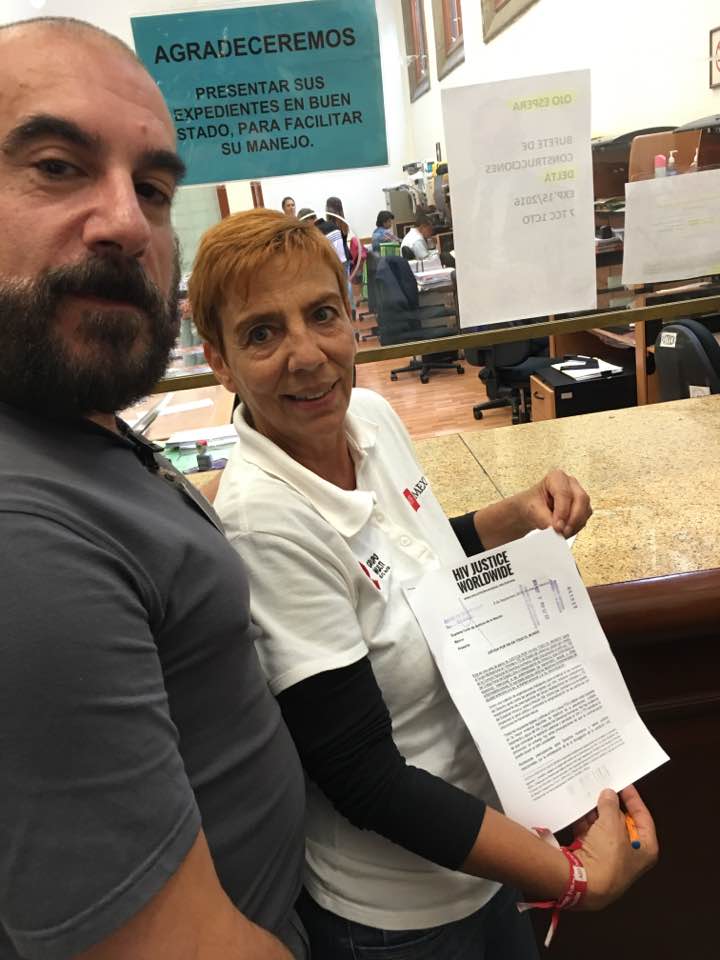
In October 2016, following a press conference at the National Commission on Human Rights (pictured above) that generated a great deal of media coverage, including a TV report, HIV JUSTICE WORLDWIDE delivered a letter to the Mexican Supreme Court highlighting that a law such as that of Veracruz does not protect women against HIV but rather increases their risk and places women living with HIV, especially those in positions vulnerable and abusive relationships, at disproportionate risk of both proseuction and violence.
We applaud the declaration of the Supreme Court of Justice of the Nation, which gives us the reason for the unconstitutionality request, shared with the National Commission of Human Rights; For this reason, we suggest to the deputies of the Congresses of the State that before legislating, they should be trained in the subject and that they do not forget that their obligation is to defend Human Rights, not to violate them.
Finally, the Mexican Network against the Criminalization of HIV recognizes that there are still many ways to go and many battles to fight, but we can not stop celebrating this important achievement.
Edwin Bernard (HIV JUSTICE WORLDWIDE) and Patricia Ponce (Grupo Multisectorial Veracruz) presenting the letter to Supreme Court of the Nation, Mexico City.
Read the English text of the HIV JUSTICE WORLWIDE amicus letter below.
HIV JUSTICE WORLDWIDE
This is a letter of support from HIV JUSTICE WORLDWIDE[1] to Grupo Multi VIH de Veracruz / National Commission of Human Rightswho are challenging Article 158 of Penal Code of the Free and Independent State of Veracruz that criminalises ‘intentional’ exposure to sexually transmitted infections or other serious diseases, on the grounds that this law violates a number of fundamental rights: equality before the law; personal freedom; and non-discrimination.
As a coalition of organisations working to end the overly broad use of criminal laws against people living with HIV, we respectfully share Grupo Multi VIH de Veracruz’s concerns around Article 158 which potentially stigmatises people with sexually transmitted diseases and criminalises ‘intentional’ exposure to sexually transmitted infections (potentially including HIV) or other serious diseases.
All legal and policy responses to HIV (and other STIs) should be based on the best available evidence, the objectives of HIV prevention, care, treatment and support, and respect for human rights. There is no evidence that criminalising HIV ‘exposure’ has HIV prevention benefits. However, there are serious concerns that the trend towards criminalisation is causing considerable harm.
Numerous human rights and public health concerns associated with the criminalisation of HIV non-disclosure and/or potential or perceived exposure and/or transmission have led the Joint United Nations Programme on HIV/ AIDS (UNAIDS) and the United Nations Development Programme (UNDP),[2] the UN Special Rapporteur on the right to health,[3] the Global Commission on HIV and the Law[4] and the the World Health Organization[5], to urge governments to limit the use of the criminal law to extremely rare cases of intentional transmission of HIV (i.e., where a person knows his or her HIV-positive status, acts with the intention to transmit HIV, and does in fact transmit it). They have also recommended that prosecutions [for intentional transmission] “be pursued with care and require a high standard of evidence and proof.” [6]
In 2013, UNAIDS produced a comprehensive Guidance Note to assist lawmakers understand critical legal, scientific and medical issues relating to the use of the law in this way.[7] In particular, UNAIDS guidance stipulates that:
“[I]ntent to transmit HIV cannot be presumed or solely derived from knowledge of positive HIV status and/or non-disclosure of that status.
Intent to transmit HIV cannot be presumed or solely derived from engaging in unprotected sex, having a baby without taking steps to prevent mother-to-child transmission of HIV, or by sharing drug injection equipment.
Proof of intent to transmit HIV in the context of HIV non-disclosure, exposure or transmission should at least involve (i) knowledge of positive HIV status, (ii) deliberate action that poses a significant risk of transmission, and (iii) proof that the action is done for the purpose of infecting someone else.
Active deception regarding positive HIV-status can be considered an element in establishing intent to transmit HIV, but it should not be dispositive on the issue. The context and circumstances in which the alleged deception occurred—including the mental state of the person living with HIV and the reasons for the alleged deception— should be taken into consideration when determining whether intent to transmit HIV has been proven to the required criminal law standard.”
Moreover, where criminal liability is extended to cases that do not involve actual transmission of HIV (contrary to the position urged by UNAIDS and other experts), such liability should, at the very bare minimum, be limited to acts involving a “significant risk” of HIV transmission. In particular, UNAIDS guidance contains explicit recommendations against prosecutions in cases where a condom was used, where other forms of safer sex were practiced (including oral sex and non-penetrative sex), or where the person living with HIV was on effective HIV treatment or had a low viral load. Being under treatment or using other forms of protections not only show an absence of malicious intent but also dramatically reduces the risks of transmission to a level close to zero. Indeed, a person under effective antiretroviral therapy poses – at most – a negligible risk of transmission[8] and is therefore no different from someone who is HIV-negative.
Moreover, there is growing body of evidence[9] that such laws that actually or effective criminalise HIV non-disclosure, potential or perceived exposure, or transmission, negatively impact the human rights of people living with HIV due to:
selective and/or arbitrary investigations/prosecutions that has a disproportionate impact on racial and sexual minorities, and on women.
confusion and fear over obligations under the law;
the use of threats of allegations triggering prosecution as a means of abuse or retaliation against a current or former partner;
improper and insensitive police investigations that can result in inappropriate disclosure, leading to high levels of distress and in some instances, to loss of employment and housing, social ostracism, deportation (and hence also possibly loss of access to adequate medical care in some instances) for migrants living with HIV in some cases;
limited access to justice, including as a result of inadequately informed and competent legal representation;
sentencing and penalties that are often vastly disproportionate to any potential or realised harm, including lengthy terms of imprisonment, lifetime or years-long designation as a sex offender (with all the negative consequences for employment, housing, social stigma, etc.);
stigmatising media reporting, including names, addresses and photographs of people with HIV, including those not yet found guilty of any crime but merely subject to allegations.
In addition, there is no evidence that criminalising HIV (or other sexually transmitted infections) help protect women and girls from infections.
Women are often the first in a relationship to know their HIV status due to routine HIV testing during pregnancy, and are less likely to be able to safely disclose their HIV-positive status to their partner as a result of inequality in power relations, economic dependency, and high levels of gender-based violence within relationships.[10]
Such a law does nothing to protect women from the coercion or violence that effectively increases the risk of HIV transmission. On the contrary, such laws place women living with HIV, especially those in vulnerable positions and abusive relationships, at increased risks of both prosecution and violence.
Some evidence suggests that fear of prosecution may deter people, especially those from communities highly vulnerable to acquiring HIV, from getting tested and knowing their status, because many laws only apply for those who are aware of their positive HIV status.[11] HIV criminalisation can also deter access to care and treatment, undermining counselling and the relationship between people living with HIV and healthcare professionals because medical records can be used as evidence in court.[12]
Finally, there is evidence[13] of an additional negative public health impact of such laws in terms of:
increasing HIV-related stigma, which has an adverse effect on a person’s willingness to learn about, or discuss, HIV; and
undermining the importance of personal knowledge and responsibility (correlative to degree of sexual autonomy) as a key component of an HIV prevention package, when instead prevention of HIV within a consensual sexual relationship is – and should be perceived as – a shared responsibility.
We hope that the Mexico Supreme Court of Justice takes our concerns and all of this evidence into account when considering the Constitutional Challenge.
Yours faithfully,
Edwin J Bernard, Global Co-ordinator, HIV Justice Network
on behalf of all HIV JUSTICE WORLDWIDE partners: AIDS and Rights Alliance for Southern Africa (ARASA); Canadian HIV/AIDS Legal Network; Global Network of People Living with HIV (GNP+); HIV Justice Network; International Community of Women Living with HIV (ICW); Positive Women’s Network – USA (PWN-USA); and Sero Project (SERO).
[1] HIV JUSTICE WORLDWIDE is an initiative made up of global, regional, and national civil society organisations working together to end overly broad HIV criminalisation. The founding partners are: AIDS and Rights Alliance for Southern Africa (ARASA); Canadian HIV/AIDS Legal Network; Global Network of People Living with HIV (GNP+); HIV Justice Network; International Community of Women Living with HIV (ICW); Positive Women’s Network – USA (PWN-USA); and Sero Project (SERO). The initiative is also supported by Amnesty International, the International HIV/AIDS Alliance, UNAIDS and UNDP.
[2] UNAIDS. Policy Brief: Criminalisation of HIV Transmission, August 2008; UNAIDS. Ending overly-broad criminalisation of HIV non-disclosure, exposure and transmission: Critical scientific, medical and legal considerations, May 2013.
[3] Anand Grover. Report of the Special Rapporteur on the right of everyone to the enjoyment of the highest attainable standard of physical and mental health, June 2010.
[4] Global Commission on HIV and the Law. HIV and the Law: Risks, Rights & Health, July 2012.
[5] WHO. Sexual health, human rights and the law. June 2015.
[6] Global Commission on HIV and the Law. HIV and the Law: Risks, Rights & Health, July 2012.
[7] UNAIDS. Ending overly-broad criminalisation of HIV non-disclosure, exposure and transmission: Critical scientific, medical and legal considerations, May 2013.
[8] A.J. Rodger et al., “Sexual activity without condoms and risk of HIV transmission in serodifferent couples when the HIV-positive partner is using suppressive antiretroviral therapy,” JAMA 316, 2 (12 July 2016): pp. 171–181.
[10] Athena Network. 10 Reasons Why Criminalization of HIV Exposure or Transmission Harms Women. 2009.
[11] O’Byrne P et al. HIV criminal prosecutions and public health: an examination of the empirical research. Med Humanities 2013;39:85-90 doi:10.1136/medhum-2013-010366
This playlist contains recordings of a training for lawyers on strategic litigation, legal defense and advocacy on HIV and TB justice from 20-23 February 2018 in Johannesburg, South Africa by the Southern Africa Litigation Centre (SALC), HIV Justice Worldwide, the Joint United Nations Programme on HIV/AIDS (UNAIDS), the Stop TB Partnership, the AIDS and Rights Alliance for Southern Africa (ARASA), and the Kenya Legal & Ethical Issues Network on HIV and AIDS (KELIN). The training was funded under the Africa Regional Grant on HIV: Removing Legal Barriers. Resources and more information on the training are available here: http://www.southernafricalitigationce… With thanks to Nicholas Feustel of Georgetown Media.
African Commission launches report providing framework for an African human rights-based response to HIV
News release: Human Rights organisations applaud African Commission’s launch of HIV report
SALC : STAFF WRITER
Abidjan, Côte d’Ivoire – On this International Human Rights Day, regional human rights organisations commend the African Commission on Human and Peoples’ Rights (ACHPR) on the adoption and launch of the summary version of the Report on the Law and Human Rights in the African Human Rights System: Key Challenges and Opportunities during ICASA 2017 in Abidjan, Côte d’Ivoire.
The Report was developed by the Commission’s Committee on the Protection of the Rights of People Living with HIV and Those at Risk, Vulnerable to and Affected by HIV (HIV Committee) through a process of extensive consultation and engagement with experts and civil society over a period of two years. This report is the first of its kind. It provides a framework for an African human rights-based response to HIV. It illustrates what human rights law demands of States in the context of HIV, and describes both barriers and good practices for effective rights-based responses. As a body vested with the broad mandate for the protection and promotion of human rights in Africa, it is significant that the Commission is recognising HIV as an urgent and significant human rights concern.
In trying to push for an end to the HIV epidemic, some States in the region continue to propose and implement coercive and punitive solutions that violate human rights. While there have been great strides in new biomedical interventions in the HIV response, the Commission’s Report is a reminder that the end of HIV will not be achieved without human rights at the heart of the response.
“The Commission is a critical instrument for enforcing human rights in Africa. We commend the Commission for its leadership in ensuring that human rights are at the centre of the HIV response. The advancements in medicines for HIV and models of care cannot be of any use unless people’s human rights are respected and structural barriers to accessing HIV care and treatment are removed,” said Michaela Clayton, Director of the AIDS and Rights Alliance for Southern Africa (ARASA).
“Through the Report, the Commission affirms the obligation of States to promote non-discrimination particularly, discrimination based on sexual orientation and gender identity; and to address the systemic violations of the rights of key populations and marginalised groups in particular, the right to health which exacerbates vulnerability to HIV ,” says Humphrey Ndondo, Executive Director of the African Men for Sexual Health and Rights (AMSHeR).
“We hope that the Report will guide the Commission, States, and other stakeholders, in their decision making,” said Kaajal Ramjathan-Keogh, Executive Director of the Southern Africa Litigation Centre. “We call on States to engage with this important Report, and take note of both the barriers and good practices described.”
International Human Rights Day, marked on 10 December, must serve as a reminder of the importance of human rights when addressing HIV. It is a day where society should not only celebrate human rights, but keep in mind the long road ahead and the continuing human rights challenges that must be addressed if we are to end AIDS as a public health threat.
ENDS
For more info:
Lesley Odendal, Communications Lead, AIDS and Rights Alliance for Southern Africa (ARASA): communications@arasa.info, +27 72 960 8991
Annabel Raw, Southern Africa Litigation Centre (SALC): annabelr@salc.org.za, +27 10 596 8538
See www.achpr.org for more about the African Commission on Human and Peoples’ Rights (ACHPR) and the report.
Mexico: First Spanish language ‘HIV is Not A Crime’ meeting leads to new Network and impressive early results
In October 2017 the first Spanish-language ‘HIV Is Not A Crime’ meeting took place in Mexico City, supported by the HIV JUSTICE WORLDWIDE coalition.
The two-day meeting brought together people living with HIV, activists, lawyers, human rights defenders, and academics from across Mexico – alongside HIV JUSTICE WORLDWIDE partners CNET+ (Belize), Sero Project (USA), and the HIV Justice Network – to discuss the current state of HIV criminalisation nationally, regionally and globally.
As well as learning about HIV criminalisation around the world; the global movement to end HIV criminalisation; and the importance of the leadership of Networks of People Living with HIV, participants discussed reform initiatives in the three states where specific problematic laws exist (Veracruz) or were recently proposed (and Quintana Roo and San Luis Potosí).
In 2015, the Congress of Veracruz approved a reform of the Penal Code in order to add to the crime “of contagion” the term “sexually transmitted infections” (STI), among which are HIV and HPV, to “try to prevent the transmission of such infections, mainly to (vulnerable) women and girls.” The penalty includes six months to five years in prison and a fine of up to 50 days minimum wage for anyone who “maliciously” infects another person with an STI.
In San Luis Potosí, the governor, Juan Manuel Carreras López, proposed reforms to the Criminal Code, including the creation of article 182 bis, to punish “the person knowing that he is a carrier of a sexually transmitted disease. ..) endangers the health of another person through sexual intercourse “. Thanks to quick action by local activists, the proposed reforms did not pass.
In Quintana Roo, last year Congresswoman Laura Beristain proposed reforming Article 113 of the Criminal Code to punish anyone who transmits HIV with up to 25 years in prison. A few weeks ago, following a meeting with activists including those who attend the ‘HIV is not a crime meeting’, she committed to dropping the proposal.
In addition to these HIV-specific laws, the meeting heard that 30 the 32 states that make up the Mexican Republic have a public health law that sanctions exposure to sexually transmitted infections. Only the states of Aguascalientes and San Luis Potosí do not have this law.
Among the key points in the Declaration, they note that the Mexican State is required to assume the commitment to guarantee an integrated response to HIV (prevention, timely diagnosis and comprehensive attention) and stresses that it is not the task of the judicial authorities to develop and implement measures to prevent transmission of HIV.
The declaration also emphasises that the criminalisation of HIV exposure through “risk or danger of HIV infection” and other public health statutes that appear in the laws of individual Mexican states are generating more harm than good in terms of impact on public health, in addition to preventing the guarantee of respect for the human rights of people with HIV.
MEDIA RELEASE: Civil society statement on the criminalisation of HIV at the 61st Ordinary Session of the African Commission on Human and People’s Rights
6 November 2017
BANJUL, The Gambia—Civil society organisations working on HIV and human rights, delivered a statement at the 61st Ordinary Session of the African Commission on Human and People’s Rights condemning the disturbing trend of the enactment of repressive HIV specific laws which often contain provisions that criminalise HIV, transmission, non-disclosure and exposure. These laws also often provide for compulsory HIV testing, disclosure of HIV status and involuntary partner notification.
“These provisions are overly broad and disregard the best available scientific evidence. They fail to pass the human rights test of necessity, proportionality and reasonableness; rather, they have the effect of exacerbating stigma, discrimination and prejudice against people living with HIV. These measures undermine both an effective public health response to the HIV epidemic, as well as the human rights of people living with HIV,” said Michaela Clayton, Director of the AIDS and Rights Alliance for Southern Africa (ARASA).
In sub-Saharan Africa, while there were no HIV-specific criminal laws at the start of the 21st century, 31 countries have since then enacted overly broad or vague HIV-specific criminal statutes. These laws and policies provide, inter alia, for the criminalisation of HIV transmission, exposure and non-disclosure despite the fact that in all of these countries there are existing penal provisions which can be invoked in those rare cases of intentional HIV transmission. The number of prosecutions continues to rise at an alarming rate in countries where HIV specific criminal laws have been promulgated. To date, prosecutions have been documented in 16 countries.[1]
“We are concerned that the current advancements in the HIV response in Africa are being threatened by the misguided use of criminal sanctions by States, to – as they argue – ‘control the spread of the HIV epidemic’. These laws, policies and practices violate the rights of people living with HIV and of all healthcare users to informed consent, bodily integrity, dignity, freedom from inhuman and degrading treatment, and fair trial rights, amongst others. The protection of these rights is specifically provided for in Article 4 (bodily integrity), Article 5 (dignity), Article 7 (fair trial), and Article 16 (right to health) of the African Charter,” said Kaajal Ramjathan-Keogh, Executive Director of the Southern Africa Litigation Centre.
Women living with HIV face surveillance and state control in terms of their reproduction, family planning, childbirth, child feeding, and child raising choices. In many contexts, HIV criminalisation laws, policies, and practices have a disproportionately punitive effect on women, as evidenced by recent cases. For example, in Malawi a woman living with HIV was prosecuted for breastfeeding. In addition, there are numerous examples of prosecutions of people living with HIV in Zimbabwe, Uganda, and Nigeria, particularly women. In our patriarchal societies, it is women who already disproportionately face the burden of the HIV epidemic due to their inability to negotiate protective sexual intercourse in relationships, and are often the first to be tested for HIV.
“We, however, would like to recognise the positive developments made by some African countries due to consistent advocacy on the part of civil society. Two countries have strongly rejected HIV criminalisation: Mauritius in 2007 and Comoros in 2014. Furthermore, Mozambique revised its HIV law in 2014 to remove HIV criminalisation, and in Kenya the High Court has ruled that section 24 of HIV Prevention and Control Act 2006, which forced people with HIV to disclose their status to any ‘sexual contacts’, was found to contravene the Kenyan constitution that guarantees the right to privacy,” said Victor Mhango, Executive Director of the Centre for Human Rights Education, Advice and Assistance (CHREAA).
As HIV and human rights organisations we call on the African Commission on Human and People’s Rights to take leadership in protecting the rights of people living with and affected by HIV, including women living with HIV by:
Encouraging and reminding member states about their obligations under the African Charter and the Maputo Protocol, including Resolutions adopted by the Commission;
Reminding states of their duties and mandates to protect and promote the rights of people living with and affected by HIV, including women and girls who are vulnerable to HIV, by prioritising the urgent needs for access to justice and the upholding of the rights to bodily integrity, autonomy, and health;
Calling on states to repeal laws that unjustly criminalise HIV transmission, exposure, and non-disclosure.
This session aimed at philanthropic funders discussed the growing global movement to end HIV criminalization – overly broad and/or vague criminal laws, that unjustly regulate, control, and/or punish people living with HIV solely based on their HIV status. The panel’s participants exemplify the uniqueness of the Robert Carr Fund model of incentivizing collaborative and joint efforts of networks across movements – who join into consortia of, for example, people living with HIV and human rights defenders/lawyers – and the model of linking activities at global, regional and national levels, which catalyzes a more aligned and impactful effect in resisting and fighting HIV criminalization.
Moderator: Sergey Votyagov, Robert Carr Fund for Civil Society Networks (RCF)
Introduction: Luisa Cabal, Joint United Nations Programme on HIV/AIDS (UNAIDS)
Panelists:
• Edwin Bernard, HIV Justice Network (HJN)
• Laurel Sprague, Global Network of People Living with HIV (GNP+)
• Lynette Mabote, AIDS and Rights Alliance for Southern Africa (ARASA)
You can select your preferred language from the 'Select Language' menu at the top of the page.
Continue
We use cookies to ensure that we give you the best experience on our website. By continuing to use our site, you are agreeing to our use of cookies. You can change your cookie settings at any time if you want. Find out more in our Privacy & Cookie Policy.