UNAIDS “extremely concerned” by new COVID-19 laws that target people living with or vulnerable to HIV

This week, echoing the concerns of the HIV JUSTICE WORLDWIDE Steering Committee, amongst others, UNAIDS issued a strongly worded press release condemning governments for abusing the current state of emergency over the COVID-19 pandemic for overreaching their powers and enacting laws that target people who are living with, or vulnerable, to HIV.

“In times of crisis, emergency powers and agility are crucial; however, they cannot come at the cost of the rights of the most vulnerable,” said Winnie Byanyima, Executive Director of UNAIDS. “Checks and balances that are the cornerstone of the rule of law must be exercised in order to prevent misuse of such powers. If not, we may see a reversal of much of the progress made in human rights, the right to health and the AIDS response.”

Notably, UNAIDS singles out EU member states, Hungary and Poland.

In Hungary, a new bill has been introduced to remove the right of people to change their gender and name on official documents in order to ensure conformity with their gender identity, in clear breach of international human rights to legal recognition of gender identity.

In Poland, a fast-tracked amendment to the criminal law that increases the penalties for HIV exposure, non-disclosure and transmission to at least six months in prison and up to eight years in prison has been passed—a clear contravention of international human rights obligations to remove HIV-specific criminal laws.

In addition, UNAIDS condemns overly zealous policing that is especially targeting key populations already stigmatised, marginalised, and criminalised.

UNAIDS is also concerned by reports from a number of countries of police brutality in enforcing measures, using physical violence and harassment and targeting marginalized groups, including sex workers, people who use drugs and people who are homeless. The use of criminal law and violence to enforce movement restrictions is disproportionate and not evidence-informed. Such tactics have been known to be implemented in a discriminatory manner and have a disproportionate effect on the most vulnerable: people who for whatever reason cannot stay at home, do not have a home or need to work for reasons of survival.

They single out Uganda where “23 people connected with a shelter for providing services for the LGBTI community have been arrested—19 have been charged with a negligent act likely to spread infection or disease. Those 19 are being held in prison without access to a court, legal representation or medication.”

They also highlight Kenya as a model of cjvil society rapid response to human rights concerns following the release of an advisory note “calling for a focus on community engagement and what works for prevention and treatment rather than disproportionate and coercive approaches.”

The statement concludes:

While some rights may be limited during an emergency in order to protect public health and safety, such restrictions must be for a legitimate aim—in this case, to contain the COVID-19 pandemic. They must be proportionate to that aim, necessary, non-arbitrary, evidence-informed and lawful. Each order/law or action by law enforcement must also be reviewable by a court of law. Law enforcement powers must likewise be narrowly defined, proportionate and necessary.

UNAIDS urges all countries to ensure that any emergency laws and powers are limited to a reasonable period of time and renewable only through appropriate parliamentary and participatory processes. Strict limits on the use of police powers must be provided, along with independent oversight of police action and remedies through an accountability mechanism. Restrictions on rights relating to non-discrimination on the basis of HIV status, sexual and reproductive health, freedom of speech and gender identity detailed above do not assist with the COVID-19 response and are therefore not for a legitimate purpose. UNAIDS calls on countries to repeal any laws put in place that cannot be said to be for the legitimate aim of responding to or controlling the COVID-19 pandemic.

UNAIDS recently produced a new guidance document that draws on key lessons from the response to the HIV epidemic: Rights in the time of COVID-19: lessons from HIV for an effective, community-led response.   

HIV JUSTICE WORLDWIDE Steering Committee
Statement on COVID-19 Criminalisation

Communicable diseases are public health issues, not criminal issues: what we have learnt from the HIV response

Measures that are respectful of human rights and the empowering of communities are more effective than punishment and imprisonment.

As the world struggles with a new global pandemic, law- and policymakers are taking drastic measures in an attempt to minimise the spread of SARS-CoV-2, the virus that causes COVID-19. The situation continues to evolve rapidly and, as it does so, our liberties are being limited in unprecedented ways.

We remind law- and policymakers that each and every limitation of rights should satisfy the five criteria of the Siracusa Principles, as well as be of a limited duration and subject to review and appeal. These principles are:

  • The restriction is provided for and carried out in accordance with the law;
  • The restriction is in the interest of a legitimate objective of general interest;
  • The restriction is strictly necessary in a democratic society to achieve the objective;
  • There are no less intrusive and restrictive means available to reach the same objective;
  • The restriction is based on scientific evidence and not drafted or imposed arbitrarily, that is in an unreasonable or otherwise discriminatory manner.

We also warn law- and policymakers against the temptation to use the criminal law or other unjustified and disproportionate repressive measures in relation to COVID-19. These measures can be expected to have a devastating impact on the most vulnerable in society, including those who are homeless and/or living in poverty, as well as individuals from marginalised and already stigmatised or criminalised communities – especially where no economic and social support is provided to allow people to protect themselves and others, including through self-isolation.

As a global coalition campaigning to abolish criminal and similar laws, policies and practices that regulate, control and punish people living with HIV based on their HIV-positive status, we know the deleterious consequences of the criminalisation of diseases on both human rights and public health.

Criminalisation disproportionately impacts the most marginalised, stigmatised and the already criminalised people and communities in society.


Criminalisation is not an evidence-based response to public health issues. In fact, the use of the criminal law most often undermines public health by creating barriers to prevention, testing, care, and treatment – for example, people may not disclose their status or access treatment for fear of being criminalised.  It can also lead to ill-informed ‘trial’ by social and news media, and to a myriad of human rights violations, from arbitrary arrests and detentions to unfair trials (or no trials at all under new emergency measures) and harsh prison sentences. This can also lead to the spread of infections and communicable diseases in prisons and is of particular relevance in the context of COVID-19, which reveals, once again, the need to address overcrowding and other poor healthcare and sanitation conditions that are all too common in prisons and other closed settings.

Our experience has taught us that hastily drafted laws, as well as law enforcement, driven by fear and panic, are unlikely to be guided by the best available scientific and medical evidence – especially where such science is unclear, complex and evolving. Given the context of a virus that can easily be transmitted by casual contact and where proof of actual exposure or transmission is not possible, we believe that the criminal justice system is unlikely to uphold principles of legal and judicial fairness, including the key criminal law principles of legality, foreseeability, intent, causality, proportionality and proof.

The human rights of those involved in criminal cases related to COVID-19 are at risk of being ignored or violated.


We therefore urge law- and policymakers, the media, and communities at large, to keep human rights front and centre as we collectively respond to a new public health crisis in a climate of fear and uncertainty. It is more critical than ever to commit to, and respect, human rights principles; ground public health measures in scientific evidence; and establish partnerships, trust, and co-operation between law- and policymakers and communities.

The HIV JUSTICE WORLDWIDE Steering Committee, comprising: AIDS Action Europe; AIDS and Rights Alliance for Southern Africa (ARASA); Canadian HIV/AIDS Legal Network; Global Network of People Living with HIV (GNP+); HIV Justice Network;  International Community of Women Living with HIV (ICW); Positive Women’s Network – USA; Sero Project; and Southern Africa Litigation Centre.


Additional references

Last week, a group of human rights experts at the United Nations warned governments against the abuse of emergency measures to suppress human rights:

“While we recognize the severity of the current health crisis and acknowledge that the use of emergency powers is allowed by international law in response to significant threats, we urgently remind States that any emergency responses to the coronavirus must be proportionate, necessary and non-discriminatory,” the experts said. “Restrictions should be narrowly tailored and should be the least intrusive means to protect public health.” Also, authorities must seek to return life to normal and must avoid excessive use of emergency powers to indefinitely regulate day-to-day life.”

UNAIDS also issued guidance last week that included a number of recommendations, including recommending that States “avoid the use of criminal laws when encouraging behaviours to slow the spread of the epidemic”, noting that empowering and enabling people and communities to protect themselves and others will have a greater overall effect.

And, as described in a recent open letter by more than 800 public health and legal experts in the United States providing recommendations to government officials: “Voluntary self-isolation measures [combined with education, widespread screening, and universal access to treatment] are more likely to induce cooperation and protect public trust than coercive measures and are more likely to prevent attempts to avoid contact with the healthcare system.”

US: New report by the Williams Institute finds that Florida’s HIV criminal laws undermine pubic health efforts

Florida’s HIV criminal laws undermine public health efforts

For Immediate Release
March 12, 2020

Media Contact
Rachel Dowd
dowd@law.ucla.edu
(310) 206-8982 (office) | (310) 855-2696 (cell)

The laws deter testing, disclosure, and other HIV prevention strategies

Florida’s HIV criminal laws may undermine the state’s public health efforts by deterring people from seeking HIV testing and treatment, stigmatizing those with HIV, and disproportionately affecting the communities most impacted by HIV, including people of color, women, LGBTQ people, and the formerly incarcerated, according to a new report by the Williams Institute at UCLA School of Law.

HIV criminalization is a term used to describe laws that either criminalize otherwise legal conduct or that increase the penalties for illegal conduct based upon a person’s HIV-positive status. Florida has four HIV-specific criminal laws.

Using data from the Criminal Justice Information Services at the Florida Department of Law Enforcement, researchers found that from 1986 to 2017, there were 266 convictions under Florida’s HIV criminal laws—approximately eight convictions per year.

None of the convictions required intent to transmit HIV as an element of the crime, and none required actual transmission of HIV.

“HIV is treatable, preventable, and harder to transmit than was thought in the early years of the AIDS epidemic when Florida’s HIV criminal laws were passed,” said lead author Brad Sears, the David Sanders Distinguished Scholar of Law and Policy at the Williams Institute. “Enforcement of these laws disproportionately stigmatizes the very communities Florida needs to engage to combat HIV.”

This research was generously funded by a grant from the Elton John AIDS Foundation.

Read the report

Kristin Bergtore Sandvik explores how the criminalisation of infectious diseases can hinder global health interventions

Governing global health emergencies: the role of criminalization

The point of departure for this blog is the apparent frequency of criminalization strategies in early government responses to the Coronavirus. While much attention has been given to the securitization of global health responses – also in the case of Corona – less systematic focus has been given to the partial criminalization of infectious diseases as a strategy of global health governance.

As the scope of the Corona outbreak is broadening, the number of countries deploying criminalization measures is also rapidly increasing. China has introduced harsh regulations to deal with the Coronavirus, including ‘medical-related crimes’ involving harassment and violence against medical personnel, refusal to submit to quarantine and obstructing dead body management. Singapore and Hong Kong have criminalized the breach of travel restrictions and misleading authorities or spreading false rumours.   Taiwan plans sentencing the violation of quarantines. Iran will flog or jail people who spread false rumours. A Russian prankster is facing jail-time for Corona ‘hooliganism’. In the US, prospective quarantine violators from the infamous cruise ship Diamond Princess were facing fines or jail time. Beyond governments’ need to be seen doing something in the face of public panic across the Global East and the Global North, how should we think about this propensity to reach for penal measures?

How we explain disease and whom we blame are highly symptomatic of who we are and how we organize our relations with others, in particular the practices and life forms of marginalized elements of society. This will also likely be the legacy of Corona. Moreover, current global health responses to infectious diseases remain bound up with both colonial-era and historical command-and control trajectories of response and needs to be understood in context.

In this blog, I map out three categories of criminalization.  My assumption is that the Corona response will likely involve all three in some form or other. I take the broad conceptualizations of criminalization in circulation in legal, policy and media discourse as the starting point: this includes criminal law sanctions  and administrative and disciplinary sanctions as well as popular perceptions of the uses of penal power and social ‘criminalization-talk’.  The idea is that criminalization can be understood as a strategic tool with multiple constitutive uses in the global health field.  

In the following, I outline three different things that criminalization ‘does’ in the global health field, which may serve as a resource for thinking about how criminalization will shape approaches to the Corona virus.

First, I am interested in the direct and indirect criminalization of health care delivery through the criminalization of individuals infected with or suspected of being infected with specific infectious diseases. The problem with this approach is that it risks aggravating humanitarian suffering because it is either premised on criminalizing the practices and attributes of groups that are already in a marginal position, or that with infection, patients immediately become  socially or economically ‘marginalized’ which allows for criminal interventions. This category of criminalization covers transmission, exposure, interaction with ‘vulnerable groups’ (such as children), failure to disclose or simply physical movement. It relies significantly on the mobilization of othering and of metaphors of fear.  The global health response may also be undermined through the de facto criminalization of individuals by way of the use of compulsory health powers such as surveillance, contact tracing, compulsory examination and treatment, regulation of public meeting places, quarantines and forced isolation of individuals.

These regimes might be so repressive as to have severe humanitarian impact on the populations concerned. Human suffering here does not emanate from the inability to offer health care but from the human rights violations arising from how fear and stigma fuel criminalization of ‘vulnerable/deviant/threat groups (such as drug users, those with precarious migration status, sex workers and the LGBTI population) and how criminalization in turn produces further deviance and marginalization.  A characteristic of early phases of epidemics is that certain groups are singled out as risky and characterized as dangerous, allowing for repressive public health interventions.

At the same time, fear of harassment, arrest and detention may deter people from using health services.  A ‘deviant’ social status combined with health status may lead to discrimination and ill-treatment by health care providers. Criminalization is linked to high levels of harassment and violence, reported by lesbian, gay, transgender people and sex workers around the world (see here and here). Notably, in the context of HIV/AIDS, criminalization, and quarantine and individual responsibility for disclosure have been considered as key tools to halt or limit transmission, despite innovations in treatment that radically transform the nature and lethality of HIV/AIDS. Globally, prosecutions for non‐disclosure, exposure or transmission of HIV frequently relate to sexual activity, biting, or spitting. At least 68 countries have laws that specifically criminalize HIV non‐disclosure, exposure, or transmission. Thirty‐three countries are known to have applied other criminal law provisions in similar cases.

For the fast-moving but relatively low-mortality Corona-virus, these lessons indicate that a marginalized social status can contribute to exacerbating transmission and constitute a barrier to adequate health care, potentially increasing mortality.

Secondly, criminalization and repressive public health measures and discriminatory barriers are also a complicating factor during emergencies caused by other factors. As seen in the context of Ebola, general violence as well as violence against health care workers undermines efforts to end outbreaks. Humanitarian emergencies confront public health systems with often overwhelming challenges. In the midst of this, criminalization of individuals who are infected or perceived as risky or dangerous further compromises the ability to address preexisting epidemics and hamper transmission, thus exacerbating the impact of the overall impact of the crisis. 

Third, in situations when the disease itself is the emergency, criminalization and the attendant practice of quarantines directly hampers efforts. Historically, quarantines have been used for a wide range of diseases including venereal disease, tuberculosis, scarlet fever, leprosy and cholera. Quarantines are co-constructed through the longstanding tradition of framing infectious disease through criminalization, whereby stigma, medicalization and incarceration have worked together to produce colonial bodies construed as racial and sexual threats to national security (see here and here). Quarantine was a widely employed tool against Ebola in Sierra Leone and Liberia.  As noted  by commentators, according to the logic underlying quarantines ‘subjects marked as abnormal, diseased, criminal, or illicit should be isolated for their own betterment and for the collective good’. While resistance becomes a proof of deviance and of the necessity of segregation, in the case of Ebola, quarantines may compel fearful communities to hide suspected cases. In the contemporary context, with an international human rights framework on health suggesting that rights-based approaches to disease prevention and mitigation should be foregrounded,  problematic tradeoffs between criminalization-oriented public health measures and fundamental rights and liberties are likely to proliferate, as illustrated by the US government’s budding ‘war on Corona’.

This blog has provided an initial map of how criminalization may shape the Corona response. In sum, when criminalization is pegged directly onto suffering human bodies, criminalization hinders global health interventions in three ways. Criminalization might be so repressive that it has severe health-related impacts on the populations concerned. Criminalization also undermines and exacerbates challenges already faced by the public health infrastructure during an emergency. Finally, the repercussions of criminalization are most impactful in situations when the disease itself is the humanitarian crisis and where criminalization directly hampers efforts to contain and mitigate epidemics.

France: HIV organisations mobilise to halt sensationalism of news coverage in police violence case

Spit and HIV: the violence of words

Automatic translation via Deepl.com. For original article in French, please scroll down.

Spit and HIV: the violence of words

Following the release of an amateur video in which a police officer stopped and violently beat a demonstrator, a spokesperson for the police union Alliance, in defence of the officer involved, claimed that the person stopped spat blood in the officer’s face and said, “I have AIDS, you’re going to die. Since then, the victim has denied living with HIV and having threatened the police officers with “contamination” by spitting on them.

The case has swelled up in some media outlets, which have taken up the police unionist’s explanations without deflating the sensationalism surrounding the “danger” of spitting on an HIV-positive person.

Faced with this, many of his AIDS activists and associations of people living with HIV intervened to put the facts in their place, regardless of the position of responsibility that existed during the arrest. “The rapidity of news coverage regularly implies approximations or, worse, leaving room for false beliefs. This is particularly true with regard to HIV/AIDS. But to allow false ideas to be conveyed is to feed the serophobia that plays into the hands of the epidemic,” explains AIDES in its press release published in emergency on 20 January.

On Twitter, the president of Act Up-Paris, Marc-Antoine Bartoli, is moved and says that “aggression or “the attack on AIDS does not exist”. A few weeks ago Act Up New York had to deal with a similar case. It is important to remember that people who test positive for HIV have access to treatment that makes their viral load undetectable and cannot transmit HIV. First fact. The second is that, first and foremost, “the modes of contamination are sexual secretions, breast milk, blood. Saliva does not transmit HIV. Moreover, HIV has very low resistance to the open air. After five to ten seconds in the open air, a drop of blood no longer contains the virus,” AIDES recalls.

These simple indications would have deflated a Serophobic line of defence from the outset, continuing to play on irrational fears. “It is everyone’s responsibility to recall this information as soon as necessary. Without this, stigmatization and false beliefs will not be able to stop,” continues AIDES. And the media have their role to play in informing. This is what Fred Colby, a gay activist who is openly HIV-positive and committed to AIDES, is calling for: “People living with HIV are not walking viruses. People living with HIV are not walking viruses. The media needs to think before they publish this kind of thing or qualify it by talking about treatment and undetectable viral load. Without this prerequisite, this spitting case is likely to come back in the news, without any lessons being learned from the previous one. Again to the detriment of HIV-positive people.


Crachat et VIH : la violence des maux

À la suite de la diffusion d’une vidéo amateur, dans laquelle un policier interpelle et frappe violemment un manifestant, le porte-parole du syndicat de policiers Alliance affirmait, pour la défense de l’officier mis en cause, que la personne interpellée aurait craché du sang au visage du policier en disant : « J’ai le sida, tu vas crever ». Depuis, la victime réfute vivre avec le VIH et avoir menacé les policiers de « contamination » en leur crachant dessus. L’affaire a enflé dans certains médias, qui ont repris à leur compte les explications du syndicaliste de la police, sans pour autant dégonfler le sensationnalisme autour du « danger » d’un crachat d’une personne séropositive au VIH. Face à cela, de nombreux-ses militants-es de la lutte contre le sida et des associations de personnes vivant avec sont intervenus pour remettre les faits à leur place, peu importe la position sur les responsabilités en cours durant l’arrestation. « La rapidité de traitement de l’actualité implique régulièrement des approximations ou pire, de laisser la place à de fausses croyances. C’est particulièrement vrai concernant le VIH/sida. Or, laissez véhiculer de fausses idées, c’est nourrir la sérophobie qui fait le jeu de l’épidémie », explique AIDES dans son communiqué publié en urgence, le 20 janvier. Sur Twitter, le président d’Act Up-Paris, Marc-Antoine Bartoli, s’émeut et indique que « l’agression ou « l’attaque au sida n’existe pas ». Il y a quelques semaines Act up New-York a eu à faire à un cas similaire. Il est important de rappeler que les personnes dépistées séropositives ont accès à un traitement qui rend leur charge virale indétectable et ne peuvent pas transmette le VIH. Premier fait. Le second, c’est qu’avant toute chose, « les modes de contamination sont les sécrétions sexuelles, le lait maternel, le sang. La salive ne transmet pas le VIH. De plus, le VIH a une très faible résistance à l’air libre. Après cinq à dix secondes à l’air libre, une goutte de sang ne contient plus de virus », rappelle AIDES. Ces simples indications auraient permis de dégonfler d’emblée une ligne de défense sérophobe, continuant de jouer sur les peurs irrationnelles. « Il est de la responsabilité de toutes et tous de rappeler dès que nécessaires ces informations. Sans cela, les stigmatisations et fausses croyances ne pourront pas cesser », continue AIDES. Et les médias ont leur rôle d’information à jouer. C’est ce que réclame Fred Colby, activiste gay, ouvertement séropositif et engagé à AIDES: « Les personnes vivant avec le VIH ne sont pas des virus ambulants. Il faut que les médias réfléchissent avant de publier ce genre de choses ou nuancent en parlant du traitement et de la charge virale indétectable ». Sans ce préalable, cette affaire du crachat risque de revenir dans l’actualité, sans qu’aucune leçon ne soit tirée de la précédente. Au détriment, encore, des personnes séropositives.

Canada: Alexander McClelland’s looks at the lives of people who were criminalized due to alleged HIV non-disclosure

How HIV-positive LGBTQ2 people are criminalized in Canada

Three harrowing stories of HIV non-disclosure cases

From 2016 to 2019, Alexander McClelland, a researcher and Banting Postdoctoral Fellow at the University of Ottawa, spoke to 16 people across the country about their experience with Canada’s legal system and HIV non-disclosure laws. In Canada, those who do not disclose that they are HIV-positive to a sexual partner can face sexual assault charges, and if prosecuted, are mandated to appear on sexual offender registries.

Since 1989, more than 200 Canadians have been criminally prosecuted for HIV non-disclosure; in most of those cases, HIV was not transmitted, and many involve situations in which transmission was not possible—whether because their viral load was undetectable or because they used condoms. Despite reforms over the years, many HIV-positive folks remain vulnerable to criminalization.

The culmination of McClelland’s research is a new booklet, The Criminalization of HIV Non-Disclosure: Experiences of People Living with HIV in CanadaIn it, McClelland features interviews with nine Canadians who were criminalized for their HIV status. They are all recent cases, with the earliest stemming back to 2000 and the latest in 2015. Below are three of those stories.

Matteo: “They didn’t know what undetectable meant”

When I met him, Matteo was still under curfew as part of the conditions of his release. His parents were his sureties—he was mandated to live with them in the suburbs. A gay white man in his early 20s, Matteo was still in college, and only allowed out of his parents’ house to attend school for the day. He only recently found out his HIV-positive status. In fact, we met on the one-year anniversary of his diagnosis. He told me about how he had used hook-up applications like Grindr and Scruff. He met a guy that way, and they had sex.

Matteo did not tell the guy his status. He had been told by his doctor that since he was virally undetectable it was impossible for him to transmit HIV. Matteo concluded that he only had to disclose his status if there was a risk of transmission: “I thought if I was taking medication I didn’t have to disclose. Apparently, that is not the case.” A few weeks later, he was at work and the police came to arrest him. Matteo was arrested in front of his staff, coworkers and customers. “I felt really shitty, like I, like I had just robbed a liquor store,” he says. “They [the police] said, ‘You know why we are here. You are being charged and arrested.’

He ended up educating the detectives on the risk factors for transmission. Fundamentally, the police tasked with arresting Matteo did not know the current science behind the actual risks of HIV transmission. The police then released his picture, biometric details including his height, weight, eye and hair colour, any visible identifying marks, the charges filed against him, and his HIV-positive status. They also released a picture of Matteo as part of a public safety warning, asking his past sexual partners to come forward. The warning was widely covered in the media. As a result, it was also shared online, including on Facebook, targeting Matteo’s profile. One such negative post read, “If we still had the lash in Canada for punishment, this would be a case for its proper application.”

While talking at his place, Matteo told me more about what it was like to live under curfew at his parents’ house and the other conditions of his release. He felt constantly surveilled, isolated and depressed. He pulled out a piece of paper and read to me the more than 20 conditions of his release. Among the many conditions, he was barred from socializing in the gay community or going out to participate in social events. The condition that most bothered him was that he was mandated to contact authorities 24 hours before any potential sexual conduct, providing them with the name and contact information of the person. The police would then directly verify that the person knew Matteo’s HIV-positive status and that they consented to sex with him. “Like, who is going to want to do that? How am I going to meet anyone?” He felt extremely isolated and lonely.

Cynthia: “If I had not called the police, I would not have this charge hanging over my head”

I met Cynthia in her neighbourhood on the outskirts of a large Canadian urban centre. She told me about her move to Canada a few years earlier from a South American country. She felt that living as a transsexual woman in her home country was impossible. She feared that had she remained, she would have faced life-threatening violence.

Since moving to Canada, Cynthia had been working as a sex worker. She told me she generally had clients she liked, and she worked out of her home. She was warm and engaged when talking to me. In her late 30s, Cynthia was well-dressed and had a gentle demeanour. As we sat together drinking tea, she began telling me about how she was threatened with a charge of aggravated sexual assault. She was on anti-HIV medications, was undetectable and regularly used condoms with her clients. She knew that she was protecting them and also herself.

One of her regulars came over one night more intoxicated than was typical for him. He pulled a knife on Cynthia and raped her, holding the knife to her neck. He did not use a condom. She was terrified and called the police afterwards. During the police investigation, Cynthia told police about her HIV-positive status. Later, when speaking with the man who raped her, the police told him that he could press charges against Cynthia. She had previously not disclosed her status to the man, thinking that the use of a condom and being undetectable was more than sufficient. A few weeks later, she received a letter from a detective, stating that she was under investigation and they were considering pressing criminal charges of aggravated sexual assault. She was scared and didn’t know what to do. The man knew where she lived and had been violent toward her, and now she was potentially facing criminal charges. She told me that because she was a sex worker, her rape and assault were not being further pursued by the police. But now she was under threat of a charge of aggravated sexual assault for not disclosing her HIV status to her rapist.

After receiving the letter about the investigation from the authorities, Cynthia felt constantly surveilled, scared and worried. Moreover, now that he knew she was HIV-positive, the client who assaulted her began stalking and harassing her. She was terrified in her own neighbourhood, isolating herself and rarely venturing out. She deactivated her social media accounts because he also began posting messages, harassing her and her friends online. She was extremely fearful in her own neighbourhood but also scared to call the police again. “If I had not called them, I would not have this charge hanging over my head,” she says. She felt as though she was under constant watch, but with no means to protect herself. She knew the police were not going to help her and was worried she would face additional violence from her former client.

George: “This rape charge and HIV was worse than being a murderer in their eyes”

I met George in his apartment. He is a warm and gregarious white gay man in his late 50s, with a self-described long history of problematic prescription drug use, gambling and mental health issues. When George began a specific relationship around 10 years earlier, he initially did not tell his boyfriend about his HIV-positive status. At the time, he told me, he was himself uncertain about how HIV was transmitted. He told me that he was often depressed and in denial about aspects of his life. One day, a few months after his own diagnosis, George told me that his boyfriend came home with an HIV-positive test result from the clinic after a routine sexually transmitted infection screen. George then finally told his boyfriend his status in a letter: “There is a possibility that you may have gotten it from me, and I’m very deeply sorry for not disclosing [it to you].” His boyfriend went into a rage and went to police.

A few days later, he received a text message from his boyfriend that he was at the police station giving them his story. George immediately went to the station. “The next thing I knew, they were taking me into custody, and they said, ‘You have the right to call a lawyer,’ and they told me that ‘you are being arrested for sexual assault.’” George told me that a constable initially told him, “You’ve never had a criminal charge before. You will probably just have to stay overnight and tomorrow we’ll get your bail sorted.” But, a few hours later, the same constable came to see him and told him his charges had been elevated to attempted murder: “‘You aren’t going anywhere,’ she says, and she was right.” Due to the severity of the charge, George was denied bail even though he had no previous criminal record.

Due to the fear, shame and anxiety he experienced, George decided to plead guilty. He had never been incarcerated. The Crown Prosecutor asked for 10 years. George’s lawyer told George to plea, that he had no case because he had admitted his crimes. If he pleaded out, he would be sentenced to a lot less time incarcerated. He listened to his lawyer.

While incarcerated, George was placed in the general population with men facing all types of charges. He started facing verbal and physical harassment. Prisoners began calling him a rapist and asked why he took medication. After days of harassment, he was brutally assaulted by other prisoners. Those assaulting him said they knew he was trying to spread HIV. George said the guards watched and did nothing. (Under an institutional directive, prisoners’ charges and health status should remain confidential, and the only people with access to the information are guards.)

While in protective custody, George remained unsafe and was beaten again and again: “I went into the protective custody wing, and there are all kinds of sex offenders there and murderers and everything else like that. And when I got there, they found out my charge. So, they beat the shit out of me as well. I never fought a day in my life. I have never lifted a hand to anybody… I was on an isolated range for violent murderers and would still get harassed. You know, this rape charge and HIV was worse than being a murderer in their eyes.”

He told me that other sex offenders and murderers were left alone. But he was continually attacked for having HIV combined with a “dirty charge”—that is, aggravated sexual assault. One day, George was being harassed by another prisoner when a guard intervened. George told me he felt the guard had it out for him, and he was scared of the guard who had said demeaning things to him in the past. After the altercation with the other prisoner, George started to have a panic attack. While hyperventilating, that same guard forced George to strip naked and made him lay down on the cold concrete floor, holding him down on the floor with his boot. The guard pushed his boot into George’s chest hard and said, “I don’t touch anyone with AIDS,” as a nurse arrived to sedate George, sticking a syringe in his arm.

Ultimately, he served the rest of his sentence in administrative segregation, where he only had a concrete floor with no bed until night time. He was given just one sheet of paper and a pencil to occupy his time while locked down alone in a cell. He served approximately one year in those conditions.

US: Reporter fired for pushing misleading information in story about man who allegedly spat at Port Authority Officer

WCBS Fires Reporter for Pushing False HIV Fears in Arrest Story

TV outlet, Port Authority police union linked suspect’s alleged spitting to infection risk.

CBS New York confirmed to Gay City News that it has fired a reporter who stoked fear and pushed misinformation about HIV transmission in a story about the arrest of a man who allegedly spit at a Port Authority police officer.

CBS New York has fired a reporter they say was responsible for pushing insensitive and misleading narratives about HIV/ AIDS in a story that blew up on social media on December 8 and 9, a spokesperson confirmed to Gay City News.

As reported by Gay City News, the local CBS affiliate in New York published an article and social media posts implying that an HIV-positive man who allegedly spit on a Port Authority police officer was somehow putting the cop at risk for the virus, despite the fact that HIV cannot be transmitted by saliva.

The reporter described the alleged spitting incident as an “HIV ATTACK” in a tweet, and wrote in the article that the “suspect admitted they spit into an officer’s mouth knowing they had HIV.”

“This online story should not have been published,” CBS New York wrote to Gay City News in a written statement. “It does not meet our journalistic standards, nor does it reflect our core values. The person who wrote and published the story and social media post failed to review the copy with our news managers. This individual is no longer employed by CBS New York.”

A CBS New York spokesperson declined comment when asked, for purposes of transparency, who was fired. The article in question did not have a byline, though the name of one reporter, Tony Aiello, was listed under the “filed under” section of the article and drew attention from some folks on social media who believed he was behind the story. The spokesperson said he was not the reporter who was fired.

However, the other key piece of the story — that the Port Authority Police Benevolent Association (PAPBA) also pushed false claims about HIV and shared the suspect’s HIV status with CBS — remains unresolved. A union spokesperson interviewed by Gay City News on December 9 tried framing the man who allegedly spit on the officer as someone who tried using his HIV status as some sort of weapon.

“The problem is when a person with an infectious disease has a weapon, we have a problem with that,” said PAPBA public information officer Bob Egbert. “A guy who knowingly has an infectious disease — that’s a problem.”

The union has not apologized or retracted any comments, raising the likelihood that advocates who have strongly condemned the news story and the PAPBA comments will continue raising concerns and the controversy will continue to metastasize.

The stigmatization and misinformation infuriated the LGBTQ community and local advocacy organizations who reacted with shock and outrage toward CBS New York and the PAPBA when the article and tweets surfaced. On the afternoon of December 9, ACT UP NY, Bailey House, Gay Men’s Health Crisis, Housing Works, and VOCAL-NY were among those who vowed to raise their concerns in a demonstration at CBS headquarters in Manhattan on December 10.

Human rights are key to ending the epidemics

OPINION: End epidemics by breaking down human rights barriers to health

Access to healthcare is a right, not a luxury. We have an historic opportunity to rid the world of HIV, TB and malaria. Let’s seize that opportunity.

Peter Sands is the executive director of The Global Fund to Fight AIDS, Tuberculosis and Malaria and Antonio Zappulla is the chief executive of the Thomson Reuters Foundation.

Among the many challenges involved in improving health services, one is both pervasive and largely hidden. Human rights-related barriers to health, some explicit, others expressed in behaviours and norms, prevent millions of people from access to lifesaving prevention and treatment.

Think of a girl who is forced to get married at 15 and needs her husband’s permission to undergo an HIV test, or to get a bed net to protect herself and her children from malaria. Or a gay man who is beaten up by police and charged with sodomy when he secretly visits the home of a community health care worker to obtain condoms. Or a group of miners working 14 hours a day deep in a mine without ventilation and health insurance despite widespread tuberculosis.

Money alone cannot ensure and protect basic human rights for people most at risk from infectious diseases.

If the media stokes the appetite for a witch hunt against LGBT+ people or condones violence against women, how will society behave? If laws allow abuse and discrimination to be justified, how can social justice be achieved?

Stigma, ignorance, prejudice and lack of opportunities are some of the toughest road blocks to remove. But the combined power of the law and the media can make a difference.

Fair and balanced news coverage is critical in informing public opinion. Respect for human rights is essential to ensure access to health services. Combined, they become the key to unlocking systemic change.

In sub-Saharan Africa, women and girls are twice as likely to be HIV-positive compared to young men. Contributing factors include gender inequality, violence and limited access to education. Meanwhile, men who have sex with men, people who inject drugs, sex workers and transgender people often lack access to health programmes. The root cause? Social taboos, punitive laws and fear of arrest.

Framing health as a human right creates an obligation on states to ensure accessible, acceptable and affordable health care of appropriate quality. But this conception of health as a human right is not shared around the world. You have only to look, for example, at how HIV non-disclosure, exposure and transmission is still criminalized in 86 jurisdictions worldwide.

We will never end the epidemics of HIV, TB and malaria –  which killed 3 million people in 2017 alone – unless we dismantle social and human rights barriers to health services.

Everyone has a right to healthcare, encompassing dignity and respect. Not only is this a basic human right, but it is critical to fostering social stability and boosting economic growth. It is predicted that drug-resistant TB will cost the global economy approximately US$17 trillion by 2050 if progress is not made fast enough.

The Global Fund and the Thomson Reuters Foundation are joining forces to combine the power of an international health financing organization with global media and legal expertise, to help break down barriers to health services.

Each year, the Global Fund mobilizes and invests more than US$4 billion to support health programs run by local experts in more than 100 countries. Through its “Breaking Down Barriers” Initiative, the Global Fund is working with countries to reduce human rights-related barriers to health services: to ensure that everybody, including the most marginalized, also have access to prevention, treatment and care services; to see that health care workers are trained not to discriminate against, turn away, or fear people living with HIV or TB; to ensure that police are sensitized to support LGBT people to access prevention and treatment, rather than subject them to extortion, arbitrary arrest and violence; and to inform women, girls and others most affected by disease and violence about their rights and access to legal support. In the last three years, over US$120 million have gone to these and other programs to reduce stigma and discrimination and increase access to justice, an unprecedented investment in human rights as a critical component of our efforts to end HIV, TB, and malaria.

But more needs to be done. In its new partnership with the Global Fund, the Thomson Reuters Foundation will facilitate legal services and support for civil society partners in key countries, including development of “know your rights” training, capacity-building for health practitioners, services providers and their clients, plus guidance for NGOs and civil society groups working in challenging social contexts. The Thomson Reuters Foundation will also train journalists on human rights and health issues, and support awareness-raising on human rights-related barriers to health. Our hope is that by combining forces, we can achieve real impact.

Access to healthcare is a right, not a luxury. We have an historic opportunity to rid the world of HIV, TB and malaria. Let’s seize that opportunity.

On Human Rights Day, please endorse the EECA Statement against HIV Criminalization

Today, December 10, 2019, Human Rights Day, National and Regional Networks and Civil Society Organizations on HIV Criminalization in the EECA Region are asking you to support the movement against HIV criminalization by endorsing the following Statement.

Download a pdf of the Statement in English or Russian.

Endorse the Statement in English here.  EПодпишите заявление на русском языке здесь.

On November 25-26, 2019, the “Decriminalization of HIV transmission in the EECA region: the role of civil society and advocacy tools” meeting was held in Minsk, Belarus, by the Eurasian Women’s Network on AIDS (EWNA), the Global Network of People Living with HIV (GNP+) and CO “100 PERCENT LIFE”. Activists representing national, regional and international networks discussed the current situation with HIV criminalization in the EECA region and options available to strengthen the movement in order to counter that HIV criminalization in the EECA region.

HIV criminalization is a global issue that undermines human rights and impedes the development of public health and, as a result, weakens the efforts to eradicate the HIV epidemic. An analysis of recent HIV criminalization cases shows that they do not reflect the demographics of local epidemics, and the likelihood of persecution is compounded by discrimination against marginalized groups on the basic of drug use, ethnicity, gender identity, immigration status, sex work and sexuality.

The Global Commission on HIV and the Law, the United Nations Development Program (UNDP) and the Joint United Nations Program on AIDS (UNAIDS), among others, declare that any use of criminal law against people living with HIV should be strictly limited to exceptional cases of intentional and malicious HIV transmission to another person and only where real harm occurred. However, the law and law enforcement practice go beyond this limitation in many countries.

According to HIV Justice Worldwide, Europe and Central Asia is the region with the second highest number of laws criminalizing HIV exposure, non-disclosure and transmission. 18 of the 19 countries where such laws have been adopted are in the EECA region. Many of them allow criminal prosecution for actions that do not pose a risk of HIV or pose a low risk only. These laws do not recognize condom use or low viral load as a means of protection against prosecution. They criminalize oral sex, individual breastfeeding cases, as well as bites, scratches, bites, or spitting. Such laws were developed in the times when efficient ARV therapy was not yet available and the HIV diagnosis was equated with a death sentence. The implementation of such laws is most often informed by myths, misconceptions on HIV transmission ways, and stigma against people living with HIV and vulnerable communities.

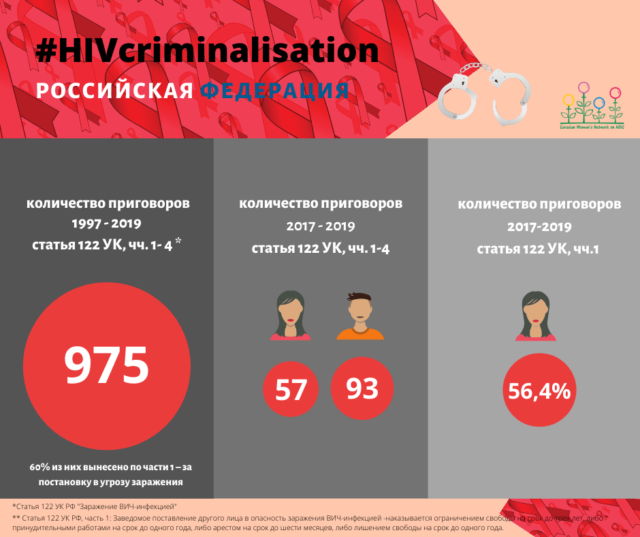
The laws of the EECA countries criminalizing the HIV transmission vary in their severity and in specific sanctions. The Russian Federation and Belarus are global and regional leaders in terms of the number of criminal cases related to HIV6. In Uzbekistan, a person living with HIV can be prosecuted regardless of whether his/her partner wants to initiate a criminal case. In 2019, a punishment was introduced in the law in Tajikistan for those who refuse to receive HIV therapy7. In many EECA countries, the punishment for any crime involving an HIV-positive person is exacerbated by the positive HIV status.

Concerned by the fact that prosecutions are not always informed by the best available scientific and medical evidence, 20 of the world’s leading HIV scientists have presented the Expert consensus statement on the science of HIV in the context of criminal law.

The criminalization of HIV transmission is a growing human rights issue in Eastern Europe and Central Asia. This fact is also confirmed by the first regional report, prepared in 2017 using the data of the communities of women living with HIV. The study was organized and conducted by EWNA with the support of GNP+ and HIV Justice Worldwide.

The study has shown that HIV criminalization is a gender issue10. The stories and cases documented in the report and other recently conducted studies illustrate that women are more likely to be persecuted, as they are often the first to become aware of their status through regular HIV testing during pregnancy, but they are less likely to safely disclose their HIV positive status to their partner due to gender inequality in the family, economic dependence and high levels of violence. In addition, women living with HIV are less likely to receive adequate legal assistance and to have competent representation in court. In their stories, women talk about violence, threats, and blackmail associated with their HIV-positive status. The laws adopted were designed to protect women from HIV. Unfortunately, this is not the case in the reality as HIV criminalization makes women more vulnerable to violence and structural disparities. HIV criminalization increases the vulnerability of women to deprivation of parental rights, property loss, and poverty.

EECA activists make essential efforts to advocate for the decriminalization of HIV infection. Thus, the active advocacy work conducted by the community of people living with HIV pushed Belarus to adopt an important legislative amendment: the HIV-positive partner should be exempt from criminal liability if he or she has timely warned the HIV-negative partner about HIV and the latter has voluntarily agreed to take actions, which created a risk of infection. However this step alone is not sufficient to solve the issue of HIV criminalization.

We call attention of the EECA countries to the fact that in a society with low stigma and discrimination, people are more likely to be voluntarily tested for HIV and, learning about their status, begin ARV treatment.

We urge communities of people living with HIV and other criminalized and marginalized communities, in particular sex workers, LGBT people, people who use drugs, to unite and take a consolidated position to counter HIV criminalization, presenting a united front against HIV stigma and discrimination embedded in the law.

We urge governments and parliamentarians to use general law to prevent HIV transmission in the harm to health context and, instead of applying criminal law in any cases other than actual infection transmission by malicious intent, take steps to encourage people to be tested, take ARV treatment, communicate their HIV status and have safe sex without fear of stigma, discrimination and violence. This can be achieved by adopting and applying anti-discrimination laws and organizing public information campaigns to dispel myths about HIV, as such campaigns are evidence-based and are led by people living with HIV.

We urge prosecution agencies and prosecutors, to use scientific evidence and evidence-based medicine, in particular the evidence included in the Expert consensus statement on the science of HIV in the context of criminal law, in pre-trial and trial proceedings, in order to limit or prevent abuse of criminal prosecution in cases of allegations of HIV transmission or exposure or in cases of non-disclosure of HIV status.

We urge the media to stop demonizing people living with HIV, presenting us as criminals and as sources of infection. We request the media to consider HIV related issues from the perspective of human rights and use facts and evidence-based medicine while covering such issues.

We encourage donors to invest in communities and advocates opposing HIV criminalization, which undermines human rights and public health.

South Africa: African migrants face dual challenge of navigating HIV care and social stigma

The social management of HIV: African migrants in South Africa

HIV is the most common chronic illness in South Africa. One in every five is infected and one in every 13 takes antiretroviral drugs daily. Managing HIV medically has become more of a part of normal life.

Amid this public health emergency, some 2.5 million foreign-born African immigrants live in South Africa. They largely come from countries with the highest HIV prevalence rates in the world, such as Lesotho. Yet their access to health care and services is limited, because they are vulnerable in various ways. Though entitled to inclusion and care in South Africa, they may face deportation, xenophobia, exploitation, language barriers, cultural estrangement and social isolation.

In spite of these challenges, migrants do manage HIV medically. But we do not really know how they manage socially in communities where the stigma of the disease affects all dimensions of life. HIV is often referred to today as a “manageable” chronic illness, but it is not just a medical condition. It is also very much a social condition as living with HIV comprises both clinical features of care and experiences of stigma and social angst.

Understanding how migrants manage this social dimension of their condition matters because it shapes the landscapes and outcomes of their care. It directly influences when and where people seek treatment, and how well they adhere to it if they do. This in turn affects critical issues such as drug resistance and prevention of transmission.

In a recent journal article, I unravel complexities of stigma and perceptions of HIV in Mozambican migrant communities. My research exposes layers and shades of stigma across different social networks and locations, which influence how HIV is managed socially. It shows how an individual’s HIV status determines how other community members are regarded and interacted with in daily life.

Perceptual contrasts

Nowhere in South Africa is the migrant population as dense as in inner-city Johannesburg. In their urban enclaves, community members inevitably lead lives entwined with those of people receiving care for HIV, whether aware of their infection or not.

HIV is spoken of here in ways that acknowledge, perpetuate and replicate stigma. For instance, Mozambicans may allude to HIV as “stepping on the mine”, as “being poisoned” or as “getting stung”. Open conversation about HIV is avoided, which in turn creates an anxiety that motivates secrecy. This is so because disclosure of HIV serostatus may put social life at risk.

I explore perceptions of HIV among two groups of Mozambican migrants in Johannesburg: one consisting of patients receiving care for HIV in a hospital; and the other of community members unaware of their own serostatus.

The contrast between how these two groups perceive of each other is staggering. The patients apprehensively conceal their status for fear of what others might think of them. But these others express mostly empathy and understanding for their condition.

I identify two reasons for such stark perceptual contrasts. The first lies in a transformation of identity, which results in a division between an “us” and a “them”, between the HIV-positive and the HIV-negative.

This process creates a schism between “patienthood” and “personhood”. When a person tests positive for HIV, fears of physical death in the future transform into fears of social disruption in the present. Loneliness and isolation then result from the person keeping her HIV status secret.

As the identity of a community member shifts from personhood to patienthood, as she receives counselling and care, she comes to associate disclosure with her own (and others’) social death. Her serostatus then becomes a secret in her life, while her notion of others’ perceptions of HIV becomes confined to the realm of the suspected and nervously anticipated. Expecting social misfortunes should others learn of her status, she opts for concealment as a strategy of survival in the community.

Secondly, I find that stigma is tied to location, because of the ways in which location is tied to social networks. In different social networks such as family at home, friends, work colleagues, acquaintances in the community or the nightlife, the stakes of disclosure vary considerably.

For instance, one focal point of stigma is the local HIV clinic. It is supposed to care for its patients, but at the same time it also estranges them, because others might recognise them there and so become antagonists rather than fellow patients.

In fact, Mozambicans largely prefer to avoid clinics in South Africa and go home to Mozambique for treatment. The stakes of disclosure, involving livelihoods, partners and identities, are far too high to risk being seen receiving care in South Africa. Disclosure may be less hurtful in certain locations where social networks are more sympathetic.

This may further complicate the therapeutic journey of migrants in terms of costs, retention in treatment or simply having to explain away the true purpose of one’s absence.

Medicalised, not socialised

HIV may have become easier to manage medically, but stigma continues to cause distress and remains severely challenging to manage. This is also a challenge for health care provision, as it sways choices of when and where to seek care: a South African clinic, for example, or a distant, socially safer treatment option.

HIV may have been medicalised, yes, but not socialised.