A large majority of gay men in the UK with HIV describe having one or more problems with sex, an analysis of a survey originally published in 2009 reveals. Amongst other problems, the analysis of the 2009 What do you need?
US: Sero Project to present new data on harm of HIV criminalisation to Presidential Advisory Council on HIV/AIDS (PACHA)
Tomorrow, Thursday October 25th, the Sero Project, a human rights organisation comprised of people living with HIV who seek to end inappropriate criminal prosecutions for HIV non-disclosure or for potential or perceived HIV exposure or transmission, will present new data to the Presidential Advisory Council on HIV/AIDS (PACHA) showing the harm of HIV criminalisation.
Preliminary data from the Sero Project’s national criminalisation survey were presented at the International AIDS Conference in Washington, D.C. last July. Among the latest survey findings to be released on Thursday:
● 46 percent of respondents reported that they were not clear about what is required under state laws to protect themselves from prosecution. Another 32 percent were only somewhat clear about the legal requirements.
● 59 percent of young gay, bisexual, and other men who have sex with men (MSM) of color reported that they were not clear about what behaviors related to HIV-positive status put them at risk for arrest, compared to 48 percent of all other men.
● Despite the fact that female respondents were the most likely to indicate complete clarity, only slightly more than 1 in 4 women (26%) said they felt completely clear about what behaviors put them at risk for arrest.
● 49 percent of male respondents, 46 percent of female respondents, and over 57 percent of transgender respondents said that it was “very” or “somewhat” reasonable for people to refuse to take an HIV test for fear of prosecution resulting from a positive test.
● 42 percent of male and female respondents, and 47 percent of transgender respondents, said that it was “very” or “somewhat” reasonable for PLHIV to refuse treatment for fear of prosecution resulting from others discovering their HIV status.
● A full 24 percent of respondents reported knowing at least one person who declined to take an HIV test for fear of prosecution.
● 10 percent of young gay, bisexual, or other MSM living with HIV, and 13 percent of transgender PLHIV, said that they might advise someone to avoid HIV testing because of the possibility of prosecution.
Notes Sero’s executive director, Sean Strub: “We need stronger leadership from PACHA and the federal government to stop the creation of a viral underclass in the law. Most efforts to combat stigma and discrimination are long and arduous and take many years; but by repealing HIV criminalisation statutes, government can take a big step all at once. We need our federal government’s effort to reflect the urgency the criminalisation crisis requires.”
In addition, five survivors of HIV criminalisation prosecutions from around the United States will speak to the panel, as well as the mother and sister of a sixth person prosecuted. “We believe this is the first time any official forum of the federal government has heard directly from a group of people with HIV who have been criminalised,” says Strub. “They are helping to make history and Sero is proud to have brought them to Washington for this important meeting.”
The entire Sero Project press release is republished below.
NEW DATA ON HARM OF HIV CRIMINALIZATION TO BE PRESENTED, SURVIVORS OF CRIMINALIZATION PROSECUTIONS TO SPEAK TO PRESIDENTIAL AIDS COUNCIL
WHAT: On Thursday, October 25, at the Washington Marriott at Metro Center (775 12th St NW), The Sero Project, a human rights organization comprised of people with HIV who seek to end inappropriate criminal prosecutions of people living with HIV (PLHIV) for non-disclosure of their HIV status or for potential or perceived HIV exposure or transmission, will present to the Presidential Advisory Council on HIV/AIDS (PACHA).
Sero will reveal highlights of findings from their survey of over 2,000 people living with HIV (PLHIV) and 800 people from affected communities in the U.S., illustrating how the impact of HIV criminalization drives stigma, discourages HIV testing, disclosure and access to treatment, and disproportionately impacts young people, as well as gay, bisexual and other men who have sex with men (MSM) of color. At the PACHA meeting, Sero will screen HIV Is Not a Crimea short film about the harm criminalization does to PLHIV and HIV prevention.
Five survivors of HIV criminalization prosecutions from around the country (Louisiana, South Carolina, Arkansas, Iowa, and Washington) will speak to the panel, as well as the mother and sister of a sixth person prosecuted. Those charged faced prosecution, incarceration, and/or required sex offender registration for not disclosing their HIV positive status to a partner. None were accused of transmitting HIV.
Sero’s survey was conducted under the direction of principal investigator Laurel Sprague, with the oversight of the institutional review board (IRB) at Eastern Michigan University. Sprague is the regional coordinator for the North American chapter of the Global Network of People with HIV and Sero’s research director, and has herself lived with HIV for more than 20 years.
Sero’s survey shows a profoundly disabling legal environment for people with HIV in the U.S., with many PLHIV uncertain about what is required of them in terms of disclosure and uncertain what behaviors put them at risk of arrest. Many PLHIV and members of affected communities believe that fear of prosecution makes it reasonable for people to refuse to get tested for HIV, disclose their status or access treatment. Nearly a quarter report knowing one or more people who told them that they did not want to get tested for fear of being criminalized.
Among the survey findings to be released on Thursday:
● 46 percent of respondents reported that they were not clear about what is required under state laws to protect themselves from prosecution. Another 32 percent were only somewhat clear about the legal requirements.
● 59 percent of young gay, bisexual, and other men who have sex with men (MSM) of color reported that they were not clear about what behaviors related to HIV-positive status put them at risk for arrest, compared to 48 percent of all other men.
● Despite the fact that female respondents were the most likely to indicate complete clarity, only slightly more than 1 in 4 women (26%) said they felt completely clear about what behaviors put them at risk for arrest.
● 49 percent of male respondents, 46 percent of female respondents, and over 57 percent of transgender respondents said that it was “very” or “somewhat” reasonable for people to refuse to take an HIV test for fear of prosecution resulting from a positive test.
● 42 percent of male and female respondents, and 47 percent of transgender respondents, said that it was “very” or “somewhat” reasonable for PLHIV to refuse treatment for fear of prosecution resulting from others discovering their HIV status.
● A full 24 percent of respondents reported knowing at least one person who declined to take an HIV test for fear of prosecution.
● 10 percent of young gay, bisexual, or other MSM living with HIV, and 13 percent of transgender PLHIV, said that they might advise someone to avoid HIV testing because of the possibility of prosecution.
Sean Strub, Sero’s executive director, said: “We need stronger leadership from PACHA and the federal government to stop the creation of a viral underclass in the law. Most efforts to combat stigma and discrimination are long and arduous and take many years; but by repealing HIV criminalization statutes, government can take a big step all at once. We need our federal government’s effort to reflect the urgency the criminalization crisis requires.”
Continued Strub: “We believe this is the first time any official forum of the federal government has heard directly from a group of people with HIV who have been criminalized. They are helping to make history and Sero is proud to have brought them to Washington for this important meeting.”
Said Monique Moree, Sero Advisory Board member, director of Monique’s Hope for Cure Outreach Service in Holly Hill, SC, and a criminalization survivor: “Criminalization is wrong and it hurts women. A lot of women can’t disclose because it invites violence, or because it jeopardizes their housing, employment, family situation or custody of their children. I told my boyfriend he had to use a condom; that’s how I said I had HIV. But I got prosecuted anyway.
“Even though the charges were eventually dropped, they made me feel like a criminal even though I knew I wasn’t. We are treated like monsters instead of human beings. If someone maliciously and intentionally harms someone else, then there should be consequences, but those circumstances are rare and to put everyone with HIV who can’t prove they disclosed in the same category is wrong. HIV criminalization needs to change.”
Said Laurel Sprague, Sero’s Research Director: “There is a clear mismatch between the intention to reduce HIV transmission and deaths and the laws that criminalize HIV non-disclosure or exposure. Instead of working to create a social and legal environment within which people can safely disclose, the laws make people living with HIV deeply vulnerable to violations by the legal system and by partners or former partners. The laws send a message that people living with HIV cannot be trusted to make the right decisions about disclosure on their own and that legal coercion is required. Yet the responses given by people living with HIV to describe their motivations for disclosing their status to a partner indicate that they choose to disclose for fundamentally moral reasons, not because of the existence of the law.”
WHEN/WHERE
October 25, 2012
9:30 to 5:00 pm
Late morning (TBD): Screening of HIV is Not a Crime late morning
3:30 PM: HIV criminalization survivors to speak
Meeting of the Presidential Advisory Council on HIV/AIDS (PACHA)
Washington Marriott
775 12th Street NW
Washington, DC 20005
WHO:
Sean Strub, Executive Director and founder of Sero. Strub is a writer and long-time activist who has lived with HIV for more than 30 years. He founded POZ Magazine, co-chairs the North American regional affiliate of the Global Network of People Living with HIV (GNP+/NA) and co-founded and is a member of the Positive Justice Project. He has been engaged in HIV-related stigma, discrimination, criminalization and empowerment issues since the earliest days of the epidemic.
Laurel Sprague, Research Director of Sero. Laurel Sprague is Sero’s Research Director and works with grassroots and community-based organizations to conduct qualitative and quantitative program evaluation to support participatory, community-based research projects. She has provided technical assistance to local, national, and global organizations and to networks of people living with HIV throughout the US and Canada, as well as in Sub-Saharan Africa, Central and Eastern Europe, and Central Asia. She teaches in the Department of Political Science at Eastern Michigan University and is a PhD candidate at Wayne State University in Detroit, Michigan. Her research focuses on the resiliency and capability of HIV-positive people, particularly when faced with HIV stigma and discrimination, criminalization, human rights abuses. She is the Regional Coordinator for GNP+NA and has lived with HIV for 20+ years.
In addition, the presentation will feature testimony from the following individuals, all of whom have been prosecuted as a result of HIV criminalization, despite not being accused of transmitting HIV:
● Nick Rhoades, an Iowan, used a condom, had an undetectable viral load and was convicted on a non-disclosure charge and sentenced to 25 years in prison. Advocates helped get the judge to reconsider the sentence and he was released after a year, but is subject to lifetime sex offender registration. Lambda Legal Defense is representing him in an appeal to the Iowa Supreme Court.
● Robert Suttle served six months in a Louisiana prison and is required to register as a sex offender for 15 years. He was in a contentious relationship; after it ended, the former partner pressed charges against Robert for not initially disclosing his HIV-positive status. Robert is the assistant director of the Sero Project and has worked as an HIV prevention outreach worker, focused on African American MSM.
● Monique Moree, of South Carolina, was in the Army and pregnant when she found out she was positive. When the Army found out she had a relationship with another soldier, they prosecuted her, despite the other soldier reporting that she told him to use a condom. She faced up to 12 years; although the charges were dropped, Monique had to leave the Army.
● Edward Casto, of Washington State, was born with HIV and was recently released from prison after serving a year and nine-months on an HIV-related charge.
● Mark Hunter and his brother, Michael, were born with hemophilia and acquired HIV as children from blood products. Michael died of AIDS in the early 90s; Mark was prosecuted after he and his fiancee broke up. He served 2 1/2 years in an Arkansas prison. He is represented at the PACHA meeting by his mother, Hazel, and his sister, Faith.
● Donald Bogardus was charged with non-disclosure in Iowa and is presently on a pre-trial release program. He faces up 25 years in prison and lifetime sex offender registration.
About The Sero Project
Sero is a not-for-profit human rights organization comprised of people with HIV who promote the empowerment of people with HIV, combat HIV-related stigma, discrimination and criminalization and advocate for sound public health and HIV prevention policies based on science and epidemiology rather than ignorance and fear.
Sero’s HIV criminalization work includes research, raising awareness and outreach to people with HIV who have been criminalized to create a network of advocates to speak first-hand about the effects of criminalization on their lives. Sero seeks to build a grassroots movement to mobilize the advocacy necessary to end HIV criminalization and promote a human rights-based approach to end the HIV epidemic. Sero is a member of the Positive Justice Project, a national collaboration of activists, professionals and policy leaders combating HIV criminalization, and the HIV Justice Network, a global network of anti-criminalization advocates.
Sero is supported by the Elton John AIDS Foundation, Broadway Cares/Equity Fights AIDS, the H. van Ameringen Foundation and the Global Forum on MSM & HIV.
For more information, see www.seroproject.com.
Video: Seminar on HIV Criminalisation, Berlin, 20 September 2012 (EATG/DAH/IPPF/HIV in Europe)
This international conference on the criminalisation of HIV non-disclosure, potential or perceived HIV exposure and non-intentional HIV transmission took place at the Rotes Rathaus in Berlin on 20th September 2012. HIV advocates, law and human rights experts and other concerned stakeholders – including parliamentarians, prosecutors, clinicians and representatives of UNAIDS and UNDP – shared information regarding the current legal situation in Europe and Central Asia and explored ways to ensure a more appropriate, rational, fair and just response.
Video produced by Nicholas Feustel, georgetown media, for the HIV Justice Network.
Europe is second only to North America as the region with the most convictions. In recent years, some countries such as Denmark, Norway and Switzerland have started to revise their legislation. “These are encouraging signs“, says Edwin Bernard, project leader of the seminar, co-ordinator of the international HIV Justice Network and a member of the European AIDS Treatment Group. “In contrast, we are very concerned about developments in countries like Romania, which recently enacted an HIV-specific criminal law, or in Belgium, where new legal precedents were created allowing prosecutions for the first time. We are also hearing news about absurd and problematic trials for perceived HIV exposure in Austria. The conference was designed to help advocates move forward in these particularly repressive countries.”
|
|
|
Professor Matthew Weait presents his initial analysis of advocacy against HIV criminalisation in Scandinavian and Nordic countries |
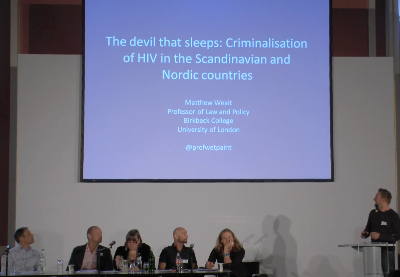
The conference took place on the occasion of the twentieth anniversary of the European AIDS Treatment Group (EATG). The meeting was co-organised with Deutsche AIDS-Hilfe (DAH), the International Planned Parenthood Federation (IPPF), and HIV in Europe, a multi-stakeholder initiative exchange on activities to improve early diagnosis and earlier care of HIV across Europe.
- Watch the video on the HIV Justice Network Vimeo site here.
- Download the agenda here.
- Download the concept note here.
- The meeting report is available here.
UNDP report looks at links between sex work, HIV and the law
New UN report takes a stark look at links between sex work, HIV and the law in Asia and the Pacific 18 October, Bangkok — Nearly all countries of Asia and the Pacific criminalize some aspects of sex work.
Canada: Study finds HIV criminalisation creates uncertainty, fear, and vulnerability
Last week’s devastating ruling of the Supreme Court of Canada was quick to dismiss evidence that that HIV criminalisation was damaging to public health.
“The only ‘evidence’ was studies presented by interveners suggesting that criminalization ‘probably’ acts as a deterrent to HIV testing,” wrote Chief Justice McLachlin. “The conclusions in these studies are tentative and the studies were not placed in evidence and not tested by cross-examination. They fail to provide an adequate basis to justify judicial reversal of the accepted place of the criminal law in this domain.”
And yet a few weeks earlier, a Canadian study was published that highlights exactly how the criminalisation of HIV non-disclosure is damaging public health. It may not be possible to prove that it deters testing, but it certainly creates all kinds of problems for people living with, and at risk of, HIV.
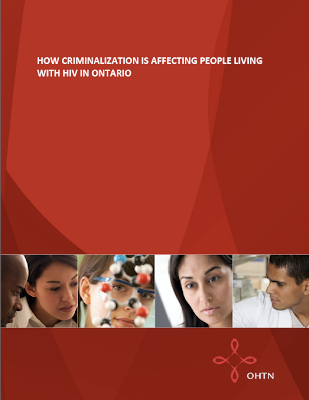
The lead author of the study, How criminalization is affecting people living with HIV in Ontario is Professor Barry D. Adam, University Professor of Sociology at the University of Windsor, Ontario, and Senior Scientist and Director of Prevention Research at the Ontario HIV Treatment Network, Canada.
 |
|
Download the report here |
Drawing on results from the Ontario HIV Treatment Network Cohort Study, the Positive Places Healthy Places Cohort Study, and in-depth interviews with 122 HIV-positive people, the report examines how people living with HIV in Ontario perceive the law and the legal obligation to disclose their HIV-positive status to prospective sexual partners, as well as their perceptions of the changing public climate affected by the increasing prominence of criminal discourses applied to HIV.
The report shows how the criminal justice system and media coverage have created a climate of anxiety (though not all feel equally affected), affected views on when disclosure is (and is not) necessary, shaped messages from health professionals, and affected disclosure practices. The legal and media framing of HIV as a responsibility to disclose potentially undermines HIV prevention messaging and places ever greater numbers of people living with HIV in jeopardy.
Most study participants believed that disclosure of HIV-positive status should not be a legal requirement if protected sex is practiced. There was no significant variation in opinion by age, gender, sexual orientation, or ethnicity, but more educated respondents showed less punitive views.
The study’s primary finding is that that HIV criminalisation has unfairly shifted the burden of proof so that people living with HIV are held to be guilty until proven innocent and that:
- People with HIV are now caught in a difficult he-said/(s)he-said situation of having to justify their actions;
- disgruntled partners now have a legal weapon to wield against them regardless of the facts; and
- the onus now falls on women whose male partners could ignore their wishes regarding safer sex.
In terms of general impact, many respondents reported a heightened sense of uncertainty, fear, or vulnerability, but others felt that the climate of acceptance is still better than in the early days of the epidemic, or that the prosecution of the high profile cases is justified and these people are giving all people with HIV a bad name.
To set the scene, in its introduction the report provides an extremely well-written exposition of why criminalisation HIV non-disclosure is problematic from a human rights, as well as a public health perspective. An edited version, below, provides you with a flavour of the insights.
The relationship between disclosure and HIV risk is complex at best… While some studies have found an association between disclosure and condom use, more have found no relationship…Disclosure poses a range of challenges in everyday social situations. The demand to disclose essentially requires HIV-positive people to place themselves in a situation to be rejected or stigmatized, a situation exacerbated in a climate of rising prosecution and media attention…
Ultimately reliance on disclosure makes sense as an HIV prevention measure only if both partners are certain of their serostatus, though epidemiologists point out that significant percentages of people who are HIV-positive do not know they are. In Canada, an estimated 26 percent of people infected with HIV are unaware of this fact. Indeed some researchers contend that transmission by those unaware of their infection accounts for a significant portion of new infections. Criminal prosecutions for non-disclosure encourage at-risk persons to rely on prospective sex partners to disclose their HIV status, if positive, and to assume that there is no or minimal risk in the absence of positive serostatus disclosure, evident in complainants’ testimony at trial in such cases. Serostatus disclosure laws may thus foster a false sense of security among HIV-negative persons who may default to forgoing safer sex unless notified of their partners’ HIV-positive status. Reliance on disclosure, then, is a shaky foundation for HIV avoidance. By absolving people of responsibility for practising safer sex, it may even increase vulnerability to infection.
Disclosure, then, is often challenging to accomplish in everyday life and the research evidence shows that disclosure is far from reliable as a method of avoiding HIV. The accumulation and consolidation of a body of legal doctrine that rests primarily on an obligation to disclose by those who know they are HIV-positive raises a number of problems in the pursuit of effective public policy in HIV prevention. There is, then, a need to test the presuppositions underlying the legal obligation to disclose as an HIV prevention strategy and to examine the real effects of criminalizing non-disclosure on people living with HIV.
Towards the end of the report, the authors discuss the impact of criminalisation of HIV non-disclosure on public health. Again an edited version, below, provides you with a flavour of the insights.
In Canada in recent years, the state has been shifting resources from social services to law enforcement… In HIV, the prosecutorial arm of the state has expanded while support for ASOs and for HIV prevention has become increasingly tenuous. The move on the part of some attorneys general to press for more punitive solutions to HIV prevention has many pitfalls and unintended consequences that amount, in the long run, to a public policy with poor prospects for meaningful reduction in HIV transmission combined with real damage to the lives and well-being of [people living with HIV]. Indeed obsessive focus on disclosure may create the conditions of accelerated transmission if people abandon safe sex in favour of disclosure as the preferred method of HIV avoidance…
Criminalization, whether minimal or expansive in punitive scope, has little potential to slow the advance of the HIV epidemic and has considerable potential to undermine prevention efforts currently under way….At the same time, increasing reliance on the criminal justice system to enforce a principle of universal disclosure of HIV-positive status, regardless of the likelihood of transmission, presses [people living with HIV] into an untenable double bind: they must place themselves into the risky position of heightening the possibility of rejection, stigmatization, and prosecution. Double binds can scarcely be the foundation for realistic public policy or consistent practice among [people living with HIV]. Only decriminalization and destigmatization would begin to create the conditions to make disclosure of sero-status safe. But perhaps more importantly, disclosure has been shown to be an unreliable method of reducing HIV transmission. Obscured by the criminalization debates is the fact that protected sex, especially in a situation where treatment has succeeded in attaining an undetectable viral load in the HIV-positive partner, continues to be a much more reliable method of avoiding HIV (as well as several other sexually transmitted infections).
It is interesting to note that the Supreme Court has, at least, recognised this last observation. However, the reality of the ruling is that it states very clearly that disclosure alone is enough to negate criminal liability (notwithstanding difficulties of proving that this occurred). It also very worringly undermines safer sex messaging by stating that condoms alone (or low viral load alone) are not ‘safe’ enough.
The study concludes with the following recommendations:
- Among police and prosecutors to employ consistent evidence-informed principles in the laying of charges (i.e. by developing prosecutorial and police guidelines)
- Among journalists to employ a rigorous decision-making matrix that strictly minimizes the publication of the identity of people living with HIV, and
- In public health and AIDS service organisations to develop a consistent counseling policy that does not mistake universal disclosure for prevention but rather focuses on how best to engage the sexual cultures of at risk populations to advance safer sex practice.
Professor Scott Burris writes about over-criminalsiation, appears in video summarising Carol Galletly's study
By Scott Burris The concept of “overcriminalization” is gaining traction across the political spectrum. The Heritage Foundation, which has a website devoted to the phenomenon, defines it as “the trend in America – and particularly in Congress – to use the criminal law to ‘solve’ every problem, punish every mistake (instead of making proper use of civil penalties), and coerce Americans into conforming their behavior to satisfy social engineering objectives.”
US: Study finds criminalising alleged HIV non-disclosure an ineffective HIV prevention tool
A recent study published in the American Journal of Public Health by the leading US researcher into the impacts of HIV criminalisation, Carol Galletly J.D. and Ph.D., of the Center for AIDS Intervention Research at the Medical College of Wisconsin, has concluded that a New Jersey law requiring individuals with HIV to disclose their HIV-positive status to their sexual partners does not appear to be an effective HIV prevention intervention.
In the article ‘New Jersey’s HIV Exposure Law and the HIV-Related Attitudes, Beliefs, and Sexual and Seropositive Status Disclosure Behaviors of a Sample of Persons Living with HIV’, Galletly and colleagues surveyed 479 HIV-positive New Jersey residents between March and October 2010 about the New Jersey law that requires HIV-positive individuals to disclose their status to sexual partners.
N.J. Stat. Ann. § 2C: 34-5
A person is guilty of a crime of the third degree if, knowing that he or she is infected with HIV, he or she commits an act of sexual penetration without the informed consent of the other person.
The study found that the law does not seem to be effective as an HIV prevention tool. Although 51 percent of study participants reported knowledge of the law, there was no difference between those aware and unaware of the law in terms of HIV disclosure, risky sex, and condom use. In fact, most of the participants reported complying with the letter of the law for the previous year regardless of whether they were aware of the law or not.
 |
| Study abstract |
An article by the CDC at thebody.com summarises additional findings on HIV-related stigma and perceptions of responsibility for HIV prevention.
Knowledge of the law was not associated with negative outcomes for HIV-infected study participants. Persons aware of the law did not report greater social hostility toward persons with HIV or experience more discomfort with HIV-status disclosure or more HIV-related stigma. On the other hand, those who were not aware of the law perceived more social hostility toward HIV-infected persons, experienced greater HIV-related stigma, and were less comfortable with HIV-status disclosure.
The 479 study participants, who were aged 19 to 66 years, were 45 percent female and were approximately 66 percent African American, 16 percent Hispanic, and 13 percent Caucasian. When the researchers questioned them about responsibility for HIV prevention, 90 percent believed that an HIV-infected person bore at least half of the responsibility for ensuring that their seronegative partners did not contract the disease through sex, and 34 percent felt the HIV-infected person had the full responsibility.
Given that there were no differences in behaviours or attitudes towards HIV disclosure, safer sex or responsibility for HIV prevention between those aware of the law or not, and the very high risk of human rights violations and miscarriages of justice in the application of HIV disclosure laws, the study’s findings strongly suggest that HIV-specific criminal statutes criminalising HIV non-disclosure without consideration of actual risk and harm, and proof of a suitably culpable state of mind are bad laws that should be repealed.
Medical College of Wisconsin Study Finds Awareness of New Jersey HIV Exposure Law is Not Associated With Reduced Sexual Risk Behavior
Researchers at the Medical College of Wisconsin (MCW) surveyed HIV-infected persons in New Jersey between March 22, 2010 and October 6, 2010 on the New Jersey law that requires HIV-positive individuals to disclose their status to sexual partners. Carol Galletly, J.D.
Plenary Session 2: Seminar on HIV Criminalisation, Berlin, 20 September 2012 (EATG/DAH/IPPF/HIV in Europe)
Introduction by Co-chairs, Ton Coenen (HIV in Europe) and Lisa Power (Terrence Higgins Trust)
– Louis Gay (Norwegian HIV Patient Network): From accused to activist
– Kim Fangen (Norwegian Law Commission): Reforming the ‘HIV paragraph’ in Norway – lessons learned
– Matthew Weait (Professor of Law and Policy, Birkbeck College, University of London): Nordic advocacy research project – lessons learned
– Carsten Schatz (Board Member, DAH): DAH Position Paper – content and lessons learned
– Lucy Stackpool Moore (IPPF, London), Marielle Nakunzi (RFSU, Sweden) & Kevin Osborne (IPPF, London): ‘Criminalise Hate, Not HIV’: IPPF’s media strategy and advocacy approaches and lessons learned from Sweden
– Q&A / discussion
Video produced by Nicholas Feustel, georgetown media, for the HIV Justice Network
"Should HIV Be Jailed? HIV Criminal Exposure Statutes and Their Effects" by Arianne Stein
Publication Title Washington University Global Studies Law Review Recommended Citation Arianne Stein, Should HIV Be Jailed? HIV Criminal Exposure Statutes and Their Effects in the United States and South Africa, 3 Wash. U. Glob. Stud. L. Rev. 177 (2004), http://digitalcommons.law.wustl.edu/globalstudies/vol3/iss1/7