New Zealand: Despite spitting not transmitting HIV, prison officers are tested every 3 months for a full year if coming into contact with spit

Corrections officer spat in face by prisoner waiting months for test results

A Corrections officer who was spat in the face by a prisoner during the Covid-19 lockdown has spent months waiting to find out if he now has a serious disease.

Under the Corrections Act, any officer who comes in to contact with a prisoner’s bodily fluids must undergo a year of testing for infections like HIV and hepatitis, before getting a clean bill of health.

The Corrections Association has asked for a law change that would force any prisoner who spits or throws bodily fluids to be tested as well.

On 25 March two Corrections officers were spat in the face while restraining a prisoner.

One of the officers told RNZ they had the prisoner’s saliva in their eyes and mouths and were then threatened by him.

The prisoner told them “I hope you get coronavirus and your kids and wives get it too and hope they die”, the officer said.

“This was very concerning as it was at the height of the coronavirus threat in New Zealand and there was the likely possibility of contracting other viruses.”

He was then sent to the doctor for tests and told he would not know if he had hepatitis until a second blood test three months later.

The officer said he would need one year of three monthly tests before HIV could be ruled out.

He said he was worried about catching a serious illness and waiting so long to find out was taking a huge toll.

“My wife and kids refrain from hugging me and I use my same plate, cup, and cutlery every meal.

“I must clean everything I use thoroughly to help reduce the possible transmission.”

The officer is still waiting for the all clear.

However, the New Zealand Aids Foundation says saliva is not an effective route of transmission of HIV and studies have shown HIV cannot be transmitted through spitting.

Corrections Association president Alan Whitley said the long delay for answers weighed heavily on the staff.

“It gives them 12 months of uncertainty about what’s happening with their health and whether they could have caught anything from the prisoner.

“It puts an enormous amount of stress on them.

“They’re sitting there not knowing whether they’ve got anything but if they have got something, is it contagious? What sort of treatment can I get? Can they get any treatment if they don’t know what I’ve got can there be a broad spectrum treatment. Is it the right thing to do?

“All sorts of things run through their mind,” he said.

In May, he asked the minister of corrections to make an amendment to the Corrections Act to make any prisoner who assaults an officer with bodily fluid to also be tested for possible infections.

“What it would mean is that the prisoner could be tested and the results of the tests released to the staff member for their doctor.

“Now, if there’s nothing, if it shows nothing, there’s a little bit of a comfort that they may not have picked anything up, they’ll still need to go through the same testing, but the understanding is there that the likelihood is low.

“If the prisoner has got something, then they can discuss that with the medical professional and he can or she can make a decision on what type of treatment they should undergo.”

However, the minister, Kelvin Davis, said changing the Corrections Act could be a breach of the Bill of Rights and would not provide a result any faster.

Any assaults on Corrections staff were completely unacceptable and he expected them to be responded to very seriously and the perpetrators held to account, he said.

“Changing the Corrections Act to introduce compulsory testing is unlikely to deter a person from spitting in the heat of the moment.

“Including a power in the Act to test a person by force is also likely to increase risk to staff, as it would require further close contact with the perpetrator.”

National Party corrections spokesperson Simeon Brown didn’t agree.

He said prison officers should not have to go through a year of uncertainty.

“I think prisoners are in prison.

“They essentially give up certain aspects of the human rights when they’re there and they are being held there to protect the rest of society from them.

“At the end of the day, this is about ensuring that corrections officers who are on the frontlines working to keep us safe are also protected from any diseases or illnesses they may pick up from prisoners.”

Brown said National would support a law change because Corrections officers deserved to have confidence the system would back them up.


How is the Expert Consensus Statement bringing science to justice?

Two years ago this month saw the launch of the Expert consensus statement on the science of HIV in the context of criminal law (Expert Consensus Statement) at a press conference during AIDS2018 in Amsterdam, published in the Journal of the International AIDS Society (JIAS), and translated into French, Russian and Spanish.

Authored by 20 of the world’s leading HIV scientists, and endorsed by more than 70 additional expert scientists, as well as IAPAC, IAS and UNAIDS, the Expert Consensus Statement described current evidence on HIV transmission, treatment effectiveness and forensics so that HIV-related science may be better understood in criminal law contexts.

The Expert Consensus Statement was the end result of a multi-year process developed by a partnership comprising the International AIDS Society (IAS), the International Association of Providers of AIDS Care (IAPAC), the Joint United Nations Programme on HIV/AIDS (UNAIDS) and the HIV JUSTICE WORLDWIDE Steering Committee.

The HIV Justice Network has now published an interim scoping report, written by HJN’s Senior Policy Analyst Sally Cameron, that explores the impact of the Expert Consensus Statement in the two years since its publication.  It is now available in English and French (see bottom of page for download links).

The report concludes that the Expert Consensus Statement is meeting both its primary aim (to support defence arguments in HIV criminalisation cases) and its secondary aim (supporting lobbying for law and policy reform) in many jurisdictions. But it also found that the process of developing and promoting the content of the Expert Consensus Statement has delivered additional benefits that further support advocacy efforts to end HIV criminalisation.

In summary, the Expert Consensus Statement is being used to:

  • Assist HIV criminalisation defence arguments and strategic litigation, changing courts’ understanding of transmission risks associated with HIV and the effectiveness of modern treatments.
  • Shape advocacy for law and policy reform, including mobilising stakeholders to lobby for reform, delivering law and policy reform, improving legal and judicial practice, facilitating community advocates’ access to government and judicial bodies, and gaining support from public health bodies and customary and religious leaders.
  • Inform scientific and medical thinking, including being cited in many peer reviewed articles and in scientific and medical press, being hosted on the sites of scientific/medical/academic organisations, and being ranked the #1 JIAS article to date.
  • Develop stronger relationships that cross silos and advance capacity, enabling efficient and informal communications between partners to rapidly move projects forward, with Expert Consensus Statement authors supporting community organisations by assisting in defence cases, answering ad hoc questions and co-authoring abstracts, presentations and articles.
  • Disseminate accurate, positive messages about people living HIV and the issue of HIV criminalisation, including facilitating keynote addresses and presentations at notable conferences and meetings, and generating global mainstream, community and social media. Ultimately, interest in the Expert Consensus Statement has elevated the global conversation about HIV criminalisation, with co-ordinated messaging translating into a powerful positive narrative in many sites.


France: HIV organisations mobilise to halt sensationalism of news coverage in police violence case

Spit and HIV: the violence of words

Automatic translation via Deepl.com. For original article in French, please scroll down.

Spit and HIV: the violence of words

Following the release of an amateur video in which a police officer stopped and violently beat a demonstrator, a spokesperson for the police union Alliance, in defence of the officer involved, claimed that the person stopped spat blood in the officer’s face and said, “I have AIDS, you’re going to die. Since then, the victim has denied living with HIV and having threatened the police officers with “contamination” by spitting on them.

The case has swelled up in some media outlets, which have taken up the police unionist’s explanations without deflating the sensationalism surrounding the “danger” of spitting on an HIV-positive person.

Faced with this, many of his AIDS activists and associations of people living with HIV intervened to put the facts in their place, regardless of the position of responsibility that existed during the arrest. “The rapidity of news coverage regularly implies approximations or, worse, leaving room for false beliefs. This is particularly true with regard to HIV/AIDS. But to allow false ideas to be conveyed is to feed the serophobia that plays into the hands of the epidemic,” explains AIDES in its press release published in emergency on 20 January.

On Twitter, the president of Act Up-Paris, Marc-Antoine Bartoli, is moved and says that “aggression or “the attack on AIDS does not exist”. A few weeks ago Act Up New York had to deal with a similar case. It is important to remember that people who test positive for HIV have access to treatment that makes their viral load undetectable and cannot transmit HIV. First fact. The second is that, first and foremost, “the modes of contamination are sexual secretions, breast milk, blood. Saliva does not transmit HIV. Moreover, HIV has very low resistance to the open air. After five to ten seconds in the open air, a drop of blood no longer contains the virus,” AIDES recalls.

These simple indications would have deflated a Serophobic line of defence from the outset, continuing to play on irrational fears. “It is everyone’s responsibility to recall this information as soon as necessary. Without this, stigmatization and false beliefs will not be able to stop,” continues AIDES. And the media have their role to play in informing. This is what Fred Colby, a gay activist who is openly HIV-positive and committed to AIDES, is calling for: “People living with HIV are not walking viruses. People living with HIV are not walking viruses. The media needs to think before they publish this kind of thing or qualify it by talking about treatment and undetectable viral load. Without this prerequisite, this spitting case is likely to come back in the news, without any lessons being learned from the previous one. Again to the detriment of HIV-positive people.


Crachat et VIH : la violence des maux

À la suite de la diffusion d’une vidéo amateur, dans laquelle un policier interpelle et frappe violemment un manifestant, le porte-parole du syndicat de policiers Alliance affirmait, pour la défense de l’officier mis en cause, que la personne interpellée aurait craché du sang au visage du policier en disant : « J’ai le sida, tu vas crever ». Depuis, la victime réfute vivre avec le VIH et avoir menacé les policiers de « contamination » en leur crachant dessus. L’affaire a enflé dans certains médias, qui ont repris à leur compte les explications du syndicaliste de la police, sans pour autant dégonfler le sensationnalisme autour du « danger » d’un crachat d’une personne séropositive au VIH. Face à cela, de nombreux-ses militants-es de la lutte contre le sida et des associations de personnes vivant avec sont intervenus pour remettre les faits à leur place, peu importe la position sur les responsabilités en cours durant l’arrestation. « La rapidité de traitement de l’actualité implique régulièrement des approximations ou pire, de laisser la place à de fausses croyances. C’est particulièrement vrai concernant le VIH/sida. Or, laissez véhiculer de fausses idées, c’est nourrir la sérophobie qui fait le jeu de l’épidémie », explique AIDES dans son communiqué publié en urgence, le 20 janvier. Sur Twitter, le président d’Act Up-Paris, Marc-Antoine Bartoli, s’émeut et indique que « l’agression ou « l’attaque au sida n’existe pas ». Il y a quelques semaines Act up New-York a eu à faire à un cas similaire. Il est important de rappeler que les personnes dépistées séropositives ont accès à un traitement qui rend leur charge virale indétectable et ne peuvent pas transmette le VIH. Premier fait. Le second, c’est qu’avant toute chose, « les modes de contamination sont les sécrétions sexuelles, le lait maternel, le sang. La salive ne transmet pas le VIH. De plus, le VIH a une très faible résistance à l’air libre. Après cinq à dix secondes à l’air libre, une goutte de sang ne contient plus de virus », rappelle AIDES. Ces simples indications auraient permis de dégonfler d’emblée une ligne de défense sérophobe, continuant de jouer sur les peurs irrationnelles. « Il est de la responsabilité de toutes et tous de rappeler dès que nécessaires ces informations. Sans cela, les stigmatisations et fausses croyances ne pourront pas cesser », continue AIDES. Et les médias ont leur rôle d’information à jouer. C’est ce que réclame Fred Colby, activiste gay, ouvertement séropositif et engagé à AIDES: « Les personnes vivant avec le VIH ne sont pas des virus ambulants. Il faut que les médias réfléchissent avant de publier ce genre de choses ou nuancent en parlant du traitement et de la charge virale indétectable ». Sans ce préalable, cette affaire du crachat risque de revenir dans l’actualité, sans qu’aucune leçon ne soit tirée de la précédente. Au détriment, encore, des personnes séropositives.

Australia: Mandatory testing laws in Western Australia are not appropriate in cases of spitting and are based on misinformation

HIV experts fear ‘spitting laws’ being misused by police

About 100 people a year have been forced to be tested for HIV in Western Australia since so-called spitting laws were introduced four years ago.

HIV advocates have called for the reversal of so-called “spitting laws”, which they say are being misused in some states and increasing stigma.  

An audit, released on Thursday, showed Western Australia had the highest rates of mandatory testing of a person whose bodily fluids come into contact with police or emergency service workers, such as through biting or spitting.

In less than four years since the laws were introduced, 377 people in WA have been forced to get tested.

While in Victoria, where a medical specialist makes the decision, no mandatory tests have been ordered.

The audit, conducted by the National Association of People with HIV Australia, recommended the laws be repealed, describing their introduction in the first place was “perplexing and problematic”.

“Although violence against emergency services workers may be increasing, risk of HIV transmission is not,” the report stated.

“If anything, effective treatments mean that the majority of people living with HIV in Australia have a low or undetectable viral load, making transmission unlikely or impossible in the types of circumstances covered by these laws.”

HIV Justice Network senior policy adviser Sally Cameron said the audit’s WA findings were alarming.

“We think it is likely that the tests are being misused. It’s unclear whether there is any ill intent or not,” Ms Cameron told SBS News.

Ms Cameron stressed that they did not condone violence in any circumstance, particularly against emergency service personnel.

“For us, this isn’t an issue of us and them, our priority is that people are not unduly stressed by fear of HIV. That people do not go through stress and trauma when in fact there is no risk,” she said.

She called for better training of police officers and judicial oversight of decisions to force someone to be tested.

“This isn’t about saying they should be able to do whatever they want. The issue is whether it’s appropriate to do something as invasive as a blood test when in fact that there is no risk that anything’s concerned.”

Australasian Society for HIV, Viral Hepatitis and Sexual Health Medicine policy director Scott McGill said the so-called spitting laws were based on misinformation about the risk of transmission.

“Unfortunately our laws and policy are not only behind the curve in terms of that evidence, but also going in the wrong direction,” he told SBS News. 

“If we keep going down this path… we’re going to inadvertently fuel stigma, fuel fear which really means people won’t come forward for testing and treatment, will be fearful of what some of the consequences are and increases anxiety on both sides of the equation.”

At the time the laws were passed, then-police minister Liza Harvey told the ABC they were overdue and would help protect police officers.

She said the testing would assist in the diagnosis, clinical management and treatment of the exposed police officer. 

In April, the alleged violent assault of a police officer in Sydney, who was spat at and bitten, reignited debate about mandatory testing laws.  

NSW is one of only two jurisdictions in Australia that hasn’t introduced  in response to concerns about rising assaults on police and emergency service workers. 

President of the Police Association of NSW Tony King told 10 Daily the officer faced months of uncertainty as she waited for the results of an infectious diseases test.  

“This officer like many others will now have to change their lifestyle for fear of passing on possible infection. Can you imagine explaining to your own child why you can’t give them a kiss goodnight?” he said in April. 

But HIV experts said such claims were myths based on misinformation.  

“The likelihood of anything actually happening is extraordinarily low and we don’t have any recorded events of occupational exposure,” Mr McGill said. 

US: Charges of HIV exposure for spitting, despite absence of risks, prove that Georgia needs to modernise its HIV laws

HIV-positive man’s arrest for spitting called ‘plain and simple discrimination’

A 31-year-old man in Rome, Ga., was charged with exposing police officers to HIV after allegedly spitting on them, which HIV activists said highlights why the state needs to fix its HIV laws.

Authorities said JS was swearing at people and making obscene gestures near the intersection of Maple Road and Park Road on Aug. 25, according to the Marietta Daily Journal. S allegedly spat on officers after being apprehended by the Floyd County Police Department.

S was charged with criminal trespass, two misdemeanor counts of disorderly conduct, three misdemeanor counts of willful obstruction of police officers and three felony counts of assault on police officers by someone with HIV, according to the Floyd County Sheriff’s Office. He is being held without bond in the Floyd County Jail.

HIV cannot be transmitted by spitting, according to the Centers for Disease Control & Prevention. S’s arrest highlights why Georgia needs to modernize its HIV laws, according to Nina Martinez of the Georgia HIV Justice Coalition.

“In 2019, it’s not breaking news that saliva does not transmit HIV,” she told Project Q Atlanta. “And yet, the punishment for a person living with HIV who spits on a police officer is potentially 20 times greater than that for someone not living with HIV who commits the same offense. This is state-sanctioned discrimination, plain and simple.”

Malcolm Reid, another member of the Georgia HIV Justice Coalition, agreed with Martinez.

“Although we don’t know much about this specific case, we do know that there is no chance of HIV transmission through spit,” he said. “This proves once again that the laws in Georgia need to catch up to science. HIV is not a crime.”

Georgia is one of some three-dozen states that criminalize a lack of HIV disclosure. Activists and lawmakers have tried for years to modernize state law by decriminalizing HIV. 

A Republican lawmaker introduced an HIV decriminalization bill on the final day of this year’s legislative session. It will be back in the 2020 session in January.

An Athens man was arrested in July after allegedly having sex with a woman without informing her he had HIV. He was charged with reckless conduct by a person with HIV. He remains in Athens-Clarke County Jail nearly two months later on a $3,000 bond, according to the Clarke County Sheriff’s Office.

A gay Atlanta man was arrested for HIV exposure in South Carolina in 2015. He claimed he disclosed his status before having sex with the alleged victim. The charges were later dropped.

The Global Network of People Living with HIV (GNP+) and the HIV Justice Network (HJN) condemn dismissal of appeal in Singapore HIV criminalisation case

The Global Network of People Living with HIV (GNP+) and the HIV Justice Network (HJN) condemn dismissal of appeal in Singapore HIV criminalisation case

The Global Network of People Living with HIV (GNP+) and the HIV Justice Network (HJN) condemn the dismissal of the appeal by a Singaporean man living with HIV who was convicted to two years’ imprisonment for not disclosing his status to his sexual partner and for not communicating the risk of HIV transmission to his sexual partner. We are particularly concerned that the judgement has emphasised the lack of explaining the risk of HIV transmission as the main reason for dismissing the appeal.

“HIV prevention is a shared responsibility and therefore not the sole responsibility of people living with HIV. If more people are sensitised to the rights of people living with HIV, including their sexual rights, and were aware of the mechanisms of HIV transmission there would be far less stigma and discrimination towards people living with HIV. Furthermore, HIV criminalisation creates a bad public health environment where people living with HIV have fears in disclosing their status, which lead to delay in engaging in care and treatment,” said Rico Gustav, Executive Director of GNP+.

According to the Infectious Diseases Act in 2016 of Singapore, Section 23 (1) a person who knows that he has HIV Infection shall not engage in any sexual activity with another person unless, before the sexual activity takes place — (a) he has informed that other person of the risk of contracting HIV Infection from him; and (b) that other person has voluntarily agreed to accept that risk.

“HIV is the only disease singled out as a transmittable disease in the Infectious Diseases Act,” said Edwin Bernard, Global Co-ordinator of the HIV Justice Network. “Not only does this perpetuate stigma, it also creates a false sense of security, suggesting that only people with diagnosed HIV can transmit HIV, when many new infections come from those who are undiagnosed. Ironically, a law such as this one that places such an onerous burden on people with diagnosed HIV, is only likely to make HIV testing, and open and honest discussions around HIV, less likely.”

Furthermore, the facts of the case reported in the judgement suggest that there was no effective HIV risk during any sexual activity, regardless of whether or not disclosure – and acceptance of risk – was established beyond reasonable doubt. Condoms were used early in the relationship, and subsequently when condoms were not used, the unjustly convicted man had a very low viral load.

As expressed in the Expert Consensus Statement on the Science of HIV in the context of criminal law, HIV criminalisation laws and prosecutions have not always been guided by the best available scientific and medical evidence, have not evolved to reflect advancements in knowledge of HIV and its treatment, and can be influenced by persistent societal stigma and fear associated with HIV. HIV continues to be singled out, with prosecutions occurring in cases where no harm was intended; where HIV transmission did not occur, was not possible or was extremely unlikely; and where transmission was neither alleged nor proven.

GNP+ and HJN not only strongly condemn this legislation and the dismissal of appeal of this case, but all kinds of HIV criminalisation, which often entails legislation that is applied in a manner inconsistent with contemporary medical and scientific evidence and includes overstating both the risk of HIV transmission and also the potential for harm to a person’s health and wellbeing. Such limited understanding of current HIV science reinforces stigma and may lead to human rights violation and undermines efforts to address the HIV epidemic.

HIV_LeadershipCMYK

HJN Logo Rectangle

France: Highest Court confirms that people living with HIV with an undetectable viral load can never be prosecuted as the risk of transmission is nul

Source TETU, Published 20/03/2019 – Google translation, for article in French please scroll down.

Can a person living with HIV be prosecuted if she is under treatment? The Court of Cassation (French Highest Court) delivers a landmark decision.

In a decision handed down on 5 March, the Court of Cassation ruled that it was impossible to prosecute an HIV-positive man on treatment who had sex without a condom and without informing his partner of his HIV status.

That’s a first. In a decision handed down on 5 March, the Court of Cassation recognised the preventive nature of HIV treatment. Thus, any person whose viral load is undetectable, who has sex without a condom with another person without the latter being aware of the HIV status of his or her partner, cannot be prosecuted.

In this case, a woman who had sex with a man who was HIV-positive and undergoing treatment sued the man on the grounds that he had not previously informed her of his HIV status. The partner was not infected. However, the man was prosecuted on the grounds of “administration of a harmful substance”, i.e. alleged exposure to the virus.

Non-harmful bodily fluids

The investigating judge did not give rise to prosecution. A decision from which the civil party has appealed. But the woman was once again dismissed. According to the Court of Appeal, it has been proven that the “HIV viral load” was “constantly undetectable since 3 September 2001”. The man was “strictly and permanently compliant with the treatment, so that his HIV status was only potential but not current”.

And the judges of the Court of Appeal ruled: “The carrier’s bodily fluids cannot be considered harmful on the date of the alleged acts”.

A significant reminder from the judges, who stated that it takes “a detectable viral load in an infected person for him/her to infect any partner”.

A purely mathematical margin of error

Moreover, the judges of the Court of Appeal acknowledged that there was indeed a margin of error, but that it was purely mathematical. Thus, they conceive of the idea of the “non-zero risk” of HIV transmission by a person undergoing treatment. A risk they call “very small” since it is about one in 10,000. And according to them, this margin of error does not make it possible to condemn the carrier of the virus.

The civil party has appealed to the Supreme Court. The High Court dismissed the appeal, aligning itself with the judges of first instance.


Peut-on poursuivre une personne séropositive sous traitement ? La Cour de cassation rend un arrêt historique

Dans un arrêt rendu le 5 mars dernier, la Cour de cassation a affirmé qu’il était impossible de poursuivre un homme séropositif sous traitement, ayant eu des relations sexuelles sans préservatif et sans informer sa partenaire de son statut sérologique.

C’est une première. La Cour de cassation a reconnu, dans un arrêt rendu le 5 mars dernier, le caractère préventif du traitement contre le VIH. Ainsi, ne saurait être poursuivie toute personne dont la charge virale est indétectable, qui aurait des relations sexuelles sans préservatif avec une autre personne sans que celle-ci ne soit au courant du statut sérologique de sa/son partenaire.

Dans cette affaire, une femme ayant eu des relations sexuelles avec un homme, porteur du VIH et sous traitement, a engagé des poursuites contre ce dernier au motif qu’il ne l’avait pas prévenue au préalable de son statut sérologique. Sa partenaire n’a pas été contaminée. Pourtant, l’homme était poursuivi au motif « d’administration d’une substance nuisible », c’est-à-dire à une prétendue exposition au virus.

Des fluides corporels non nuisibles

Le juge d’instruction n’a pas donné lieu aux poursuites. Une décision de laquelle la partie civile a fait appel. Mais la femme s’est fait une nouvelle fois débouter. Selon la Cour d’appel, il a été prouvé que « la charge virale de VIH » était « constamment indétectable depuis le 3 septembre 2001 ». L’homme a fait « compliance stricte et permanente au traitement, de sorte que la séropositivité n’était plus que potentielle mais non actuelle ».

Et les juges de la Cour d’appel de statuer : « Les fluides corporels du porteur ne sauraient être tenus pour nuisibles à la date des agissements qui lui sont reprochés ».

Un rappel non négligeable des juges, qui affirment qu’il faut « une charge virale détectable chez une personne infectée pour qu’elle puisse contaminer quelque partenaire ».

Une marge d’erreur purement mathématique

Par ailleurs, les juges de la Cour d’appel ont reconnu qu’il existait bel et bien une marge d’erreur, mais qu’elle était purement mathématique. Ainsi, ils conçoivent l’idée du « risque non nul » de la transmission du VIH par une personne sous traitement. Un risque qu’ils qualifient d’ »infime » puisqu’il est d’environ un sur 10.000. Et selon eux, cette marge d’erreur ne permet pas de condamner le porteur du virus.

La partie civile s’est pourvue en cassation. La haute juridiction a rejeté le pourvoi, s’alignant sur les juges de première instance.


Canada: Review undertaken as part of government’s examination of HIV nondisclosure laws confirms risk of sexual transmission when viral load is suppressed is virtually zero

Risk of sexual transmission of human immunodeficiency virus with antiretroviral therapy, suppressed viral load and condom use: a systematic review

Abstract

Background: The Public Health Agency of Canada reviewed sexual transmission of HIV between serodiscordant partners to support examination of the criminal justice system response to HIV nondisclosure by the Department of Justice of Canada. We sought to determine HIV transmission risk when an HIV-positive partner takes antiretroviral therapy, has a suppressed viral load or uses condoms.

Methods: We conducted an overview and systematic review update by searching MEDLINE and other databases (Jan. 1, 2007, to Mar. 13, 2017; and Nov. 1, 2012, to Apr. 27, 2017, respectively). We considered reviews and studies about absolute risk of sexual transmission of HIV between serodiscordant partners to be eligible for inclusion. We used A Measurement Tool to Assess Systematic Reviews (AMSTAR) for review quality, Quality in Prognosis Studies (QUIPS) instrument for study risk of bias and then the Grading of Recommendations, Assessment, Development and Evaluation (GRADE) approach to assess the quality of evidence across studies. We calculated HIV incidence per 100 person-years with 95% confidence intervals (CIs). We assigned risk categories according to potential for and evidence of HIV transmission.

Results: We identified 12 reviews. We selected 1 review to estimate risk of HIV transmission for condom use without antiretroviral therapy (1.14 transmissions/100 person-years, 95% CI 0.56–2.04; low risk). We identified 11 studies with 23 transmissions over 10 511 person-years with antiretroviral therapy (0.22 transmissions/ 100 person-years, 95% CI 0.14–0.33; low risk). We found no transmissions with antiretroviral therapy and a viral load of less than 200 copies/mL across consecutive measurements 4 to 6 months apart (0.00 transmissions/100 person-years, 95% CI 0.00–0.28; negligible risk regardless of condom use).

For full study see: http://www.cmaj.ca/content/190/46/E1350

Bringing Science to Justice: End HIV Criminalisation Now

News Release

Networks of people living with HIV and human rights and legal organisations worldwide welcome the Expert Consensus Statement on the Science of HIV in the Context of Criminal Law

Amsterdam, July 25, 2018 — Today, 20 of the world’s leading HIV scientists released a ground-breaking Expert Consensus Statement providing their conclusive opinion on the low-to-no possibility of a person living with HIV transmitting the virus in various situations, including the per-act transmission likelihood, or lack thereof, for different sexual acts. This Statement was further endorsed by the International AIDS Society (IAS), the International Association of Providers of AIDS Care (IAPAC), the Joint United Nations Programme on HIV/AIDS (UNAIDS) and 70 additional experts from 46 countries around the world.

The Expert Consensus Statement was written to both assist scientific experts considering individual criminal cases, and also to urge governments and criminal justice system actors to ensure that any application of the criminal law in cases related to HIV is informed by scientific evidence rather than stigma and fear. The Statement was published in the peer-reviewed Journal of the International AIDS Society (JIAS) and launched at a critical moment during the 22nd International AIDS Conference, now underway.

“As long-time activists who have been clamouring for a common, expert understanding of the current science around HIV, we are delighted with the content and widespread support for this Statement,” said Edwin J Bernard, Global Co-ordinator of the HIV Justice Network, secretariat to the HIV JUSTICE WORLDWIDE campaign. “Eminent, award-winning scientists from all regions of the world have come together to provide a clarion call for HIV justice, providing us with an important new advocacy tool for an HIV criminalisation-free world.”

The Statement provides the first globally-relevant expert opinion regarding individual HIV transmission dynamics (i.e., the ‘possibility’ of transmission), long-term impact of chronic HIV infection (i.e., the ‘harm’ of HIV), and the application of phylogenetic analysis (i.e., whether or not this can be used as definitive ‘proof’ of who infected whom). Based on a detailed analysis of scientific and medical research, it describes the possibility of HIV transmission related to a specific act during sexual activity, biting or spitting as ranging from low to no possibility. It also clearly states that HIV is a chronic, manageable health condition in the context of access to treatment, and that while phylogenetic results can exonerate a defendant when the results exclude them as the source of a complainant’s HIV infection, they cannot conclusively prove that one person infected another.

“Around the world, we are seeing prosecutions against people living with HIV who had no intent to cause harm. Many did not transmit HIV and indeed posed no actual risk of transmission,” said Cécile Kazatchkine, Senior Policy Analyst with the Canadian HIV/AIDS Legal Network, a member and key partner organisation of the HIV JUSTICE WORLDWIDE campaign. “These prosecutions are unjust, and today’s Expert Consensus Statement confirms that the law is going much too far.”

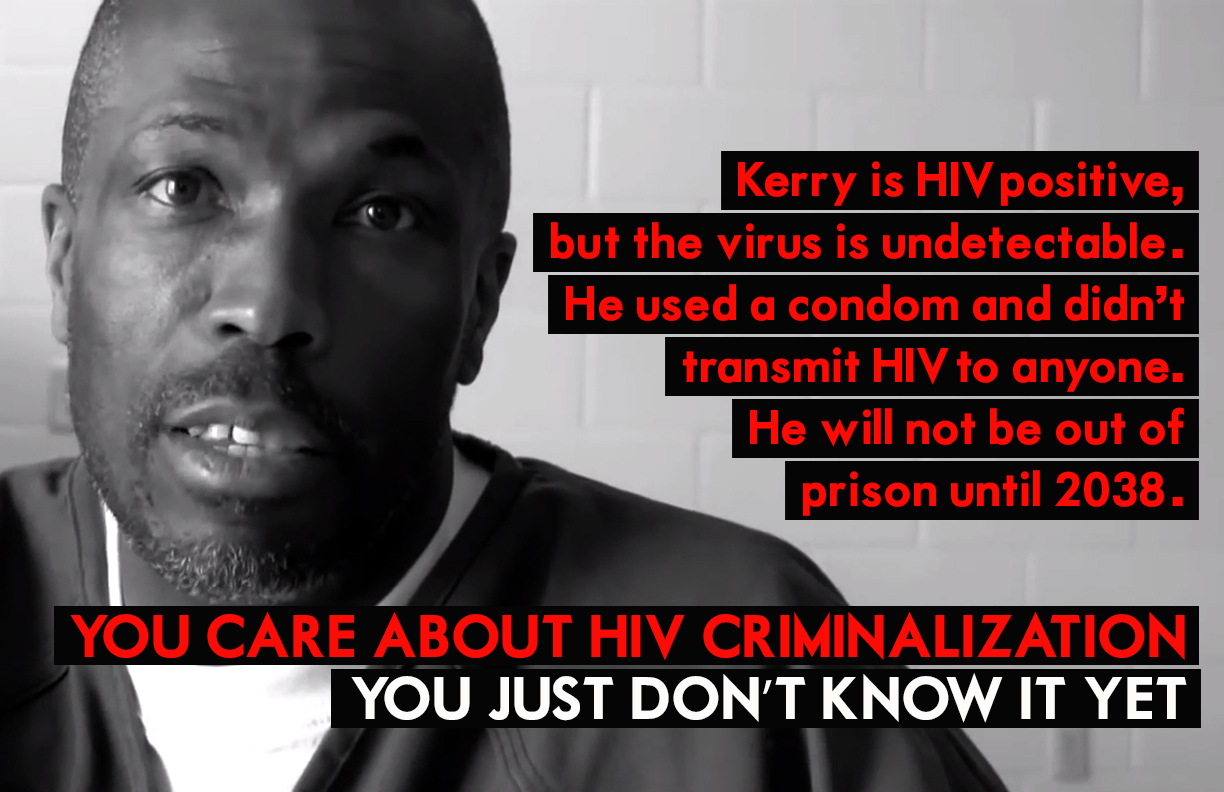
Countless people living with HIV around the world are currently languishing in prisons having been found guilty of HIV-related ‘crimes’ that, according the Expert Consensus Statement, do not align with current science. One of those is Sero Project Board Member, Kerry Thomas from Idaho, who says: “I practiced all the things I knew to be essential to protect my sexual partner: working closely with my doctor, having an undetectable viral load, and using condoms.  But in terms of the law, all that mattered was whether or not I disclosed. I am now serving a 30-year sentence.”

FINAL_KERRY_NOT-A-CRIME-POSTERWhile today’s Statement is extremely important, it is also crucial to recognise that we cannot end HIV criminalisation through science alone. Due to the numerous human rights and public health concerns associated with HIV criminalisation, UNAIDS, the Global Commission on HIV and the Law, the UN Committee on the Elimination of Discrimination against Women, and the UN Special Rapporteur on the Right to Health, among others, have all urged governments worldwide to limit the use of the criminal law to cases of intentional HIV transmission. (These are extremely rare cases wherein a person knows their HIV-positive status, acts with the intention to transmit HIV, and does in fact transmit the virus.)

We must also never lose sight of the intersectional ways that — due to factors such as race, gender, economic or legal residency status, among others — access to HIV treatment and/or viral load testing, and ability to negotiate condom use are more limited for some people than others. These are also the same people who are less likely to encounter fair treatment in court, within the medical system, or in the media.

“Instead of protecting women, HIV criminalisation places women living with HIV at increased risk of violence, abuse and prosecution,” says Michaela Clayton, Executive Director of the AIDS and Rights Alliance for Southern Africa (ARASA). “The scientific community has spoken, and now the criminal justice system, law and policymakers must also consider the impact of prosecutions on the human rights of people living with HIV, including women living with HIV, to prevent miscarriages of justice and positively impact the HIV response.”

HIV criminalisation is a pervasive illustration of systemic discrimination against people living with HIV who continue to be stigmatised and discriminated against on the basis of their status. We applaud this Statement and hope it will help end HIV criminalisation by challenging all-too-common mis-conceptions about the consequences of living with the virus, and how it is and is not transmitted. It is indeed time to bring science to HIV justice.

To read the full Expert Consensus Statement, which is also available in French, Spanish and Russian in the Supplementary Materials, please visit the Journal of the International AIDS Society at https://onlinelibrary.wiley.com/doi/full/10.1002/jia2.25161

VIsit the HIV JUSTICE WORLDWIDE website to read a short summary of the Expert Consensus statement here: http://www.hivjusticeworldwide.org/en/expert-statement/

To understand more about the context of the Expert Consensus Statement go to: http://www.hivjusticeworldwide.org/en/expert-statement-faq/

HIV JUSTICE WORLDWIDE is a growing, global movement to shape the discourse on HIV criminalisation as well as share information and resources, network, build capacity, mobilise advocacy, and cultivate a community of transparency and collaboration. It is run by a Steering Committee of ten partners AIDS Action Europe, AIDS-Free World, AIDS and Rights Alliance for Southern Africa (ARASA), Canadian HIV/AIDS Legal Network, Global Network of People Living with HIV (GNP+), HIV Justice Network, International Community of Women Living with HIV (ICW), Southern Africa Litigation Centre (SALC), Sero Project, and Positive Women’s Network – USA (PWN-USA) and currently comprises more than 80 member organisations internationally.

UK: Avon & Somerset police withdraw untrue claims that HIV could be contracted through spitting

Police finally change false HIV claims after being accused of ‘preying on people’s prejudices’ 

Avon and Somerset Police falsely claimed that HIV could be transferred through saliva

Bristol’s police force has finally changed untrue claims it made about HIV, eight months after it was accused of “preying on people’s prejudices.”

Avon and Somerset Police announced last November that it would be rolling out controversial spit hoods to be used on suspects to protect officers.

But during the announcement, the force made untrue claims that HIV could be contracted through spitting, causing outrage amongst campaign groups.

The force did apologise for “any offence caused” to anyone living with HIV, but then repeated the claim that Human Immunodeficiency Virus (HIV) can be transferred through spit.

Now eight months after police made the claim, Avon and Somerset Constabulary has now confirmed that HIV will not be used as a reason to introduce spit guards after national guidance was changed.

Assistant Chief Constable Steve Cullen said: “I’d like to thank both charities and our communities for the advice and feedback they gave us following our announcement last year.

“We apologised unreservedly at the time if we caused any offence to people living with HIV.

“It has never been our intention to reinforce stigma. Every day we work to reduce stigma and discrimination experienced by communities and individuals who are victims of hate crime in all its guises.”

In January, 2018 Bristol Live reported that Avon and Somerset Police said the false claims about the transfer of HIV were taken from national guidlines.

The Bristol wing of the HIV advocacy group ACTup! Launched a petition calling for the force to retract the statement.

A spokesperson for the group said officers deserve not to be spat at while working and the group is not calling for the recall of spit hoods but raised issues with the “poorly researched” press announcement.

ACC Cullen added: “Our aim has never been to focus attention on people living with health conditions, but to target people who use spit as a weapon.

“We assured our communities we would seek to ensure that we learn from this and would share our learnings across the police service, providing clarity and direction.

“We also invited Brigstowe to help support our training for officers and staff

“I’m delighted that this has now been done.”

The National Police Chiefs Council, which issues guidance to police forces across the UK, said in January the advice on spit guards has not changed since it published a report in March 2017, but specific guidance on HIV was sent to police forces after feedback was received by Avon and Somerset.

The police chiefs’ council guidance on spit guards released in March last year said the national picture for blood-borne viruses like HIV affecting officers was “unclear “.

HIV is found in many bodily fluids of a sufferer including semen, vaginal and anal fluids, blood and breast milk.

The disease is most commonly contracted through unprotected sex and the sharing of needles. NHS England states HIV cannot be contracted through saliva.

Spit hoods made of mesh are shaped like a plastic bag and are put over the heads of suspects who had threatened to spit, have attempted to spit or have spat before.