Mexico: Lack of national ID number leaves HIV positive migrants without medication

Migrants with HIV are left without treatment for not having CURP, AC denounces in Tijuana

Baltazar Lujano, a member of Al Otro Lado, urged health authorities to exercise greater discretion.

Foreign migrants are left without access to antiretroviral drugs because they do not have a CURP (Unique Population Registry Code), said Bridget Baltazar Lujano, coordinator of the programme for the LGBTIQ+ community at the organisation Al Otro Lado.
The activist reported that there are cases of people living with HIV who arrive in the city without medication and spend days or weeks without treatment because of this requirement.

There are people who have been living with HIV for years and arrive here without medication, and regaining access to this drug is a real challenge, she said.

Baltazar Lujano urged health authorities to be more flexible, as they do not authorise the delivery of these drugs if people do not have regular immigration status that allows them to have a CURP.

‘Being without medication for a day, two days, three days can have an impact. It is not a medicine that can be obtained in a pharmacy, only the State Secretariat has access to it,’ she said.

He stressed that this problem has worsened since the implementation of IMSS Bienestar, as the digital requirements have excluded people in a context of mobility who have not been able to establish themselves regularly in the entity because the process can take months.

‘There is a very serious violation of people’s rights to access healthcare. They are asking for documents that people do not have and are not looking for a solution,’ he said.

The coordinator of the programme for the LGBTIQ+ community at Al Otro Lado pointed out that migrants from Colombia, Venezuela, Honduras, Nicaragua, Guatemala, El Salvador and Russia are currently arriving in the city.

He mentioned that another problem facing the LGBTIQ+ migrant community is the severe difficulty in finding safe and adequate places to live, as the lack of specialised shelters and discrimination increase their vulnerability.

This problem has always existed, but now it is more complex because people are staying here, he concluded.


Baltazar Lujano, integrante de Al Otro Lado, urgió qué debe haber más criterio por parte de las autoridades sanitarias.

Migrantes extranjeros se quedan sin acceso a medicamentos antirretrovirales por no contar con CURP, expuso la coordinadora del programa para la comunidad LGBTIQ+ de la organización Al Otro Lado, Bridget Baltazar Lujano.

La activista acusó que hay casos de personas viviendo con VIH que llegan sin medicamento a la ciudad y pasan días o semanas sin tratamiento por la falta de este requisito.

Hay personas que llegan viviendo con VIH por años y llegan aquí sin medicamento, y volver a acceder a este fármaco es todo un retoexpresó.

Baltazar Lujano, urgió qué debe haber más criterio por parte de las autoridades sanitarias, que no autorizan la entrega de estos medicamentos si no cuentan con un estatus migratorio regular que les permita tener el CURP.

“Estar sin medicamento un día, dos días, tres días puede afectar. No es un medicamento que se pueda conseguir en una farmacia, solo la Secretaría del Estado tiene acceso”, comentó.

Recalcó que este problema se agravó tras la implementación de IMSS Bienestar, ya que los requisitos digitales han excluido a las personas en contexto de movilidad que no han logrado establecerse regularmente en la entidad debido a que el proceso puede tomar meses.

“Hay una falta muy grande a los derechos de las personas de poder acceder a la salud. Están pidiendo documentos que las personas no tienen y no están buscando una solución”, manifestó.

La coordinadora del programa para la comunidad LGBTIQ+ de Al Otro Lado, precisó que actualmente a la ciudad están llegando migrantes provenientes de Colombia, Venezuela, Honduras, Nicaragua, Guatemala, El Salvador y Rusia.

Mencionó que otro problema que enfrenta la comunidad LGBTIQ+ migrante, son severas dificultades para encontrar espacios seguros y adecuados donde vivir, ya que la falta de albergues especializados y la discriminación elevan la vulnerabilidad.

“Esta problemática siempre ha existido, pero ahora es más compleja porque las personas se están quedando aquí” concluyó.
Peru: Ombudsman urges national authorities to guarantee full health access for all people living with HIV

Translated with Google Translate – For original article in Spanish, please scroll down

Ombudsman urges the Peruvian State to guarantee access to health services for people living with HIV in Peru

  • On World AIDS Day, the importance of health education is recalled to prevent the disease, ensure timely diagnosis and access to antiretroviral treatments (ARTs); and to avoid any form of discrimination and stigma.

In commemorating World AIDS Day, the Ombudsman’s Office highlights the importance of the Peruvian State ensuring adequate health care to more than one hundred thousand citizens who would currently live with the HIV virus in our country, with a human rights approach that guarantees access to antiretroviral drugs and eliminates any form of stigma or discrimination; as well, to ensure the implementation of public health policies at all levels of government.

According to global figures, it is estimated that as of February of this year the number of HIV infections in Peru was around 110,000 people, which includes highly vulnerable populations such as sex workers, population deprived of liberty, indigenous people and migrants, among others, who face greater obstacles to access timely and quality health services.

Faced with this, the Ombudsman’s Office urges national authorities, such as the Ministry of Health and EsSalud, as well as regional health directorates or managements, to guarantee the continuous supply of antiretroviral treatments and diagnostic tests. As part of the requirements for health organizations, it is also requested to implement effective mechanisms aimed at avoiding any form of discrimination in health services, as well as ensuring the timely affiliation to Comprehensive Health Insurance (SIS) of all people who require it, without unjustified barriers.

It should be noted that the development of each of these actions must be based on a human rights approach that recognizes that all people, without distinction, have the right to access to timely, quality and discrimination-free health services. In this sense, the Ombudsman’s Office develops permanent supervisory actions that aim to identify barriers, delays and shortages of antiretrovirals, as well as to monitor that there are no discriminatory practices in health services and promote immediate corrections in the face of any violation of rights.

These actions, however, must be articulated with other sectors such as the Ministry of Education and educational management units at the national level to develop constant educational activities as a preventive measure to reduce the transmission of the virus among the population.

The Ombudsman’s Office reaffirms its commitment to the protection of the right to health and equality of all people living with HIV in Peru, we renew our vigilant work so that each policy or health service contributes to a more humane, equitable and respectful national response of the dignity of people. The protection of people living with HIV cannot depend on the situation, but on sustained public policies, strengthened health leadership and affirmative actions aimed at the most exposed populations.


Defensoría del Pueblo exhorta al Estado peruano a garantizar acceso a servicios de salud a las personas que viven con VIH en el Perú

  • En el Día Mundial de la Lucha contra el SIDA, se recuerda la importancia de la educación en salud para prevenir la enfermedad, garantizar el diagnóstico oportuno y el acceso a tratamientos antirretrovirales (TAR); asimismo, evitar cualquier forma de discriminación y estigma.

Al conmemorarse el Día Mundial de la Lucha contra el SIDA, la Defensoría del Pueblo destaca la importancia de que el Estado Peruano asegure una atención en salud adecuada a más de cien mil ciudadanos que vivirían actualmente con el virus del VIH en nuestro país, con un enfoque de derechos humanos que garantice el acceso a medicamentos antiretrovirales y se elimine cualquier forma de estigma o discriminación; así también, que asegure la implementación de las políticas públicas sanitarias en todos los niveles de gobierno.

De acuerdo a cifras globales, se estima que a febrero de este año la cifra de contagios por VIH en el Perú era de alrededor de 110 000 personas, que comprende a poblaciones altamente vulnerables como trabajadores sexuales, población privada de la libertad, personas indígenas y migrantes, entre otros, quienes enfrentan mayores obstáculos para acceder a servicios de salud oportunos y de calidad.

Frente a ello, la Defensoría del Pueblo exhorta a las autoridades nacionales, como el Ministerio de Salud y EsSalud, así como a las direcciones o gerencias regionales de salud, a garantizar el abastecimiento continuo de tratamientos antirretrovirales y pruebas de diagnóstico. Como parte de los requerimientos a los organismos de salud, se pide también implementar mecanismos efectivos dirigidos a evitar cualquier forma de discriminación en los servicios de salud, así como asegurar la afiliación oportuna al Seguro Integral de Salud (SIS) de todas las personas que lo requieran, sin barreras injustificadas.

Cabe precisar que el desarrollo de cada una de estas acciones debe sustentarse en un enfoque de derechos humanos que reconozca que todas las personas, sin distinción, tienen derecho a acceder a servicios de salud oportunos, de calidad y libres de discriminación. En ese sentido, la Defensoría del Pueblo desarrolla acciones de supervisión permanentes que tienen como objetivo identificar barreras, retrasos y desabastecimiento de antirretrovirales, así como vigilar que no existan prácticas discriminatorias en servicios de salud y promover correcciones inmediatas ante cualquier vulneración de derechos.

Estas acciones, sin embargo, deben ser articuladas con otros sectores como el Ministerio de Educación y las unidades de gestión educativas a nivel nacional para desarrollar actividades educativas constantes como medida preventiva para disminuir los transmisión del virus entre la población.

La Defensoría del Pueblo reafirma su compromiso con la protección del derecho a la salud y la igualdad de todas las personas que viven con VIH en el Perú, renovamos nuestra labor vigilante para que cada política o servicio sanitario contribuya a una respuesta nacional más humana, equitativa y respetuosa de la dignidad de las personas. La protección de las personas que viven con VIH no puede depender de la coyuntura, sino de políticas públicas sostenidas, rectoría sanitaria fortalecida y acciones afirmativas dirigidas a las poblaciones más expuestas.

Colombia: Constitutional Court affirms right to continuous HIV care for vulnerable migrants

Translated with Google translate – Scroll down for original article in Spanish

Court demands comprehensive and barrier-free care for migrants on the street with HIV

2025 Ruling T-415 requires the elimination of barriers and guaranteeing health care for homeless migrants with HIV and comorbidities.

The Constitutional Court ordered to guarantee comprehensive, continuous and unadministrative care to homeless migrants who face HIV, associated diseases, mental health and drug dependence. In Judgment T-415 of 2025, the Third Review Chamber concluded that responsible authorities violated fundamental rights by not managing in a timely manner the services ordered by specialists for a Venezuelan citizen in a situation of extreme vulnerability. The ruling establishes a reinforced standard of protection and details immediate obligations for the competent entities.

Constitutional Court sets a reinforced standard of health protection

The sentence originates from the guardianship presented by “Manuela” in favor of Josué, a homeless Venezuelan migrant diagnosed with HIV, tuberculosis, hepatitis C, seborrheic dermatitis, severe mental health effects and drug addiction problems.

The Third Review Chamber, composed of Magistrate Lina Marcela Escobar Martínez (rapporteur), and Magistrates Vladimir Fernández Andrade and Jorge Enrique Ibáñez Najar, determined that the entities involved violated the patient’s rights to life, equality, human dignity, health and social security.

The ruling recalls that article 100 of the Constitution guarantees foreign people the same civil rights as Colombian citizens, while article 4 establishes their duty to comply with the Constitution and the laws. In the face of extreme vulnerability scenarios, state attention must be guided by the principles of human rights, intersectional approach, pro persona, solidarity and human dignity.

Diagnosis and therapeutic continuity: essential pillars of the right to health

The Court reiterated that the right to diagnosis is an integral part of the fundamental right to health. For this right to be guaranteed, three essential components must be met:

  1. Adequate identification of the patient’s condition,
  2. Evaluation and follow-up by the specialist,
  3. Prescription and continuity of treatment.

In the case analyzed, the lack of timely authorizations prevented the continuity of specialized services ordered by treating doctors, which deepened the vulnerability of the patient. The corporation recalled that opportunity and continuity are mandatory principles of the health service, and that administrative barriers cannot be interposed when the life or integrity of the patient is compromised.

Mental health and drug dependence: non-negotiable components of care

The Court pointed out that mental health is an integral part of the fundamental right to health, so Josué had the right to access the psychiatric and toxicology care ordered by his attending physician.

Likewise, he specified that people in a street situation, due to low therapeutic adherence and the complexity of their needs, must receive a’rmative actions that facilitate access to rehabilitation treatments, with or without hospitalization, according to the medical order.

These a’rmative actions as indicated in the legal glossary included in the bulletin – exist to level the conditions of those who have faced historical barriers that prevent them from exercising their rights on equal terms.

Institutional shortcomings: violation of rights due to lack of timely management

The Third Chamber concluded that the entities responsible for the case were unaware of the condition of subject of special constitutional protection of the patient by not managing in a timely manner all the services ordered by the specialists.

The Court stressed that Joshua’s situation represented exceptional and borderline circumstances, requiring an intersectional approach and a comprehensive understanding based on the pro-person, solidarity and human dignity principles.

Denying or delaying services prescribed by dealing professionals, the corporation said, contradicts the constitutional jurisprudence that protects people with multiple conditions of vulnerability.

Orders and measures of immediate compliance

Judgment T-415 of 2025 establishes precise orders to ensure the patient’s effective access to services:

1. Entities responsible for social care

The Court ordered a new classification interview, ensuring that the patient is not excluded from the “street dweller” category, a condition that determines reinforced protection measures and guarantees access to differentiated care routes.

2. Territorial health authorities

The ruling instructed the competent entity to immediately and comprehensively authorize all the services ordered by the specialists regarding their diagnoses related to mental health and drug dependence.
This includes evaluations, therapeutic interventions, prescriptions and follow-ups defined by the treating clinical team.

All these procedures must be carried out without administrative barriers, in accordance with the principles of opportunity and continuity that govern the fundamental right to health.

New obligations for health authorities after Judgment T-415

The ruling of the Constitutional Court, sets guidelines that must be observed by the entities in charge of caring for people in extreme vulnerability:

  • Express recognition of homeless migrants as a population of special constitutional protection.
  • Effective guarantee of the right to diagnosis, specialized assessment and continuity of treatment.
  • Elimination of administrative barriers that prevent the attention ordered by specialists.
  • Application of affirmative actions to facilitate therapeutic adherence and access to comprehensive treatment in mental health and drug dependence.
  • Institutional responses articulated between social and health sectors to avoid interruptions in care.

This precedent reinforces the State’s responsibilities regarding the protection of people with multiple vulnerabilities, especially when they are at risk of life and require urgent intervention.


Corte exige atención integral y sin barreras para migrantes en calle con VIH

Fallo T-415 de 2025 obliga a eliminar barreras y garantizar atención en salud para migrantes habitantes de calle con VIH y comorbilidades.

La Corte Constitucional ordenó garantizar atención integral, continua y sin barreras administrativas a personas migrantes en habitanza de calle que enfrentan VIH, enfermedades asociadas, afectaciones en su salud mental y farmacodependencia. En la Sentencia T-415 de 2025, la Sala Tercera de Revisión concluyó que autoridades responsables vulneraron derechos fundamentales al no gestionar de manera oportuna los servicios ordenados por especialistas para un ciudadano venezolano en situación de extrema vulnerabilidad. El fallo fija un estándar reforzado de protección y detalla obligaciones inmediatas para las entidades competentes.

Corte Constitucional fija un estándar reforzado de protección sanitaria

La sentencia se origina en la tutela presentada por “Manuela” en favor de Josué, un migrante venezolano habitante de calle diagnosticado con VIH, tuberculosis, hepatitis C, dermatitis seborreica, afectaciones severas en su salud mental y problemas de farmacodependencia.

La Sala Tercera de Revisión, integrada por la magistrada Lina Marcela Escobar Martínez (ponente), y los magistrados Vladimir Fernández Andrade y Jorge Enrique Ibáñez Najar, determinó que las entidades involucradas vulneraron los derechos a la vida, igualdad, dignidad humana, salud y seguridad social del paciente.

El fallo recuerda que el artículo 100 de la Constitución garantiza a las personas extranjeras los mismos derechos civiles que a los ciudadanos colombianos, mientras que el artículo 4 establece su deber de acatar la Constitución y las leyes. Ante escenarios de vulnerabilidad extrema, la atención estatal debe guiarse por los principios de derechos humanos, enfoque interseccional, pro persona, solidaridad y dignidad humana.

Diagnóstico y continuidad terapéutica: pilares esenciales del derecho a la salud

La Corte reiteró que el derecho al diagnóstico es parte integral del derecho fundamental a la salud. Para que este derecho sea garantizado, deben cumplirse tres componentes esenciales:

1. Identificación adecuada de la condición del paciente,

2. Valoración y seguimiento por parte del especialista,

3. Prescripción y continuidad del tratamiento.

En el caso analizado, la falta de autorizaciones oportunas impidió la continuidad de servicios especializados ordenados por médicos tratantes, lo que profundizó la vulnerabilidad del paciente. La corporación recordó que la oportunidad y la continuidad son principios obligatorios del servicio de salud, y que las barreras administrativas no pueden interponerse cuando está comprometida la vida o la integridad del paciente.

Salud mental y farmacodependencia: componentes innegociables de la atención

La Corte señaló que la salud mental es una parte integrante del derecho fundamental a la salud, por lo que Josué tenía derecho a acceder a las atenciones por psiquiatría y toxicología ordenadas por su médico tratante.

Así mismo, precisó que las personas en situación de calle, debido a la baja adherencia terapéutica y a la complejidad de sus necesidades, deben recibir acciones afirmativas que faciliten el acceso a tratamientos de rehabilitación, con o sin internado, según la orden médica.

Estas acciones afirmativas según lo indicado en el glosario jurídico incluido en el boletín— existen para nivelar condiciones de quienes han enfrentado barreras históricas que les impiden ejercer sus derechos en igualdad de condiciones.

Falencias institucionales: vulneración de derechos por falta de gestión oportuna

La Sala Tercera concluyó que las entidades responsables del caso desconocieron la condición de sujeto de especial protección constitucional del paciente al no gestionar de manera oportuna la totalidad de los servicios ordenados por los especialistas.

La Corte destacó que la situación de Josué representaba circunstancias excepcionales y límite, exigiendo un enfoque interseccional y una comprensión integral basada en los principios propersona, solidaridad y dignidad humana.

Negar o retrasar servicios prescritos por profesionales tratantes, indicó la corporación, contradice la jurisprudencia constitucional que protege a personas con múltiples condiciones de vulnerabilidad.

Órdenes y medidas de cumplimiento inmediato

La Sentencia T-415 de 2025 establece órdenes precisas para garantizar el acceso efectivo del paciente a los servicios:

1. Entidades responsables de atención social

La Corte ordenó realizar una nueva entrevista de clasificación, asegurando que el paciente no sea excluido de la categoría “habitante de calle”, condición que determina medidas de protección reforzada y garantiza el acceso a rutas de atención diferenciadas.

2. Autoridades territoriales de salud

El fallo instruyó a la entidad competente a autorizar de manera inmediata e integral todos los servicios ordenados por los especialistas respecto de sus diagnósticos relacionados con salud mental y farmacodependencia.
Esto incluye valoraciones, intervenciones terapéuticas, prescripciones y seguimientos definidos por el equipo clínico tratante.

Todas estas gestiones deben adelantarse sin barreras administrativas, conforme a los principios de oportunidad y continuidad que rigen el derecho fundamental a la salud.

Nuevas obligaciones para autoridades de salud tras la Sentencia T-415

El pronunciamiento de la Corte Constitucional, fija lineamientos que deberán observar las entidades encargadas de atender a personas en extrema vulnerabilidad:

  • Reconocimiento expreso de los migrantes habitantes de calle como población de especial protección constitucional.
  • Garantía efectiva del derecho al diagnóstico, valoración especializada y continuidad del tratamiento.
  • Eliminación de barreras administrativas que impidan la atención ordenada por especialistas.
  • Aplicación de acciones afirmativas para facilitar adherencia terapéutica y acceso a tratamiento integral en salud mental y farmacodependencia.
  • Respuestas institucionales articuladas entre sectores sociales y sanitarios para evitar interrupciones en la atención.

Este precedente refuerza las responsabilidades del Estado respecto a la protección de personas con múltiples vulnerabilidades, especialmente cuando se encuentran en riesgo vital y requieren intervenciones urgentes.


South Africa: Court declares anti-migrant actions against health and education access illegal

Anti-migrant group ordered to stop blocking foreigners from South African healthcare

A South African court has ordered an anti-migrant group to stop blocking foreign nationals from accessing public health facilities and schools, saying such actions are illegal.

Operation Dudula has been picketing hospitals and clinics in Gauteng and KwaZulu-Natal provinces, checking identity cards and stopping anyone who is not South African from entering. This has since extended to schools.

But the high court in Johannesburg has ordered the group to stop “intimidating, harassing [or] interfering with access” to these facilities, following a case brought by rights groups.

South Africa is home to about 2.4 million migrants, just less than 4% of the population, according to official figures.

Most come from neighbouring countries such as Lesotho, Zimbabwe and Mozambique, which have a history of providing migrant labour to their wealthy neighbour.

Xenophobia has long been an issue in South Africa, which has been accompanied by occasional outbursts of deadly violence, and anti-migrant sentiment has become a key political talking-point.

Judge Leicester Adams, handing down judgment on Tuesday, also barred Operation Dudula from making statements that can be construed as hate speech, “unlawfully evicting foreign nationals from their homes… [or] from their trading stalls” and instigating others to do so.

“Dudula” means to remove something by force in the Zulu language.

He also barred law enforcement from conducting “warrant-less searches” in foreigners’ private spaces and said they must have “reasonable suspicion” that a person was in the country unlawfully before asking them to identify themselves.

South African police came under scrutiny after human rights organisations accused them of failing to act against Operation Dudula or protect the public from their unlawful conduct.

Several Operation Dudula members were arrested for blocking the entrances of public health facilities in August. They were later released with a warning.

The organisation says it is disappointed by the ruling and intends to appeal against it, according to South African online publication News24.

Kopanang Africa Against Xenophobia, one of the organisations that took the case to court, said the “judgment provides critical protection for those targeted by xenophobic attacks”.

“In a country founded on the rejection of apartheid, we cannot allow ourselves to be subjected to the xenophobic hate promoted by Operation Dudula,” the human rights organisation said in a statement.

Kopanang said there would be proactive monitoring at schools and clinics to ensure compliance with the order and that it would hold the police accountable for enforcing it.

“Should the police fail in their duty to enforce the order… we are prepared to report their inaction to formal oversight bodies,” the organisation told the BBC.

South Africa’s Health Minister Dr Aaron Motsoaledi said the ruling “was to be expected” as it echoed the government’s stance that no-one should be denied access to healthcare, irrespective of their legal status.

Dr Motsoaledi met Operation Dudula leaders in August, at the height of their protests at health facilities, and criticised their methods.

“I told them [at the time] that whatever concerns they have, some of which might be legitimate by the way, they are [using] the wrong method,” he told local broadcaster 702 on Tuesday.

One of the demands the group had for the minister when they met was that anyone without documentation be turned away at healthcare facilities but Dr Motsoaledi said this would be difficult as 11% of South Africans do not have national ID cards.

The minister also criticised South Africa’s neighbours for not doing more to help reduce the pressure on the country’s overburdened healthcare system, suggesting this was being worsened by the influx of migrants.

“It is South Africa which is suffering, not them. In fact, many of them are relieved,” he said.

European studies reveal systemic gaps in HIV care for migrants

EACS 2025: Are Europe’s migrants acquiring HIV after arrival?

More than 60% of HIV diagnoses among migrants in Switzerland occur after arrival, with some groups waiting up to 6 years before detection; findings that expose significant gaps in the country’s prevention and screening strategies.

A new analysis of the Swiss HIV Cohort Study shows that among 1713 migrants diagnosed between 2010 and 2024, 62.1% were diagnosed post-migration. This challenges the longstanding assumption that most infections occur before arrival from high-prevalence regions and aligns with another recent analysis estimating that about 30% of migrants acquire HIV after migration, underscoring ongoing risk in host countries despite prevention programs.

Presenting the 15‑year analysis at the European AIDS Clinical Society (EACS) 2025 Annual Meeting, PhD researcher Jessy J. Duran Ramirez of University Hospital Zurich, Zurich, reported that migrants now account for 49% of new HIV diagnoses in Switzerland — a share that has risen steadily even as rates in other European populations stabilize or decline.

“Despite the overall decrease and stagnation in new HIV diagnoses, migrants remain disproportionately affected,” Duran Ramirez said.

Delayed Diagnosis Patterns Emerge

Among the study’s key findings were notable diagnostic delays across migrant populations. Compared with 5 years for men who have sex with men (MSM) and just 2 years for female heterosexuals, male heterosexuals from migrant populations wait a median of 6 years from immigration to HIV diagnosis.

Key Statistics from 3490 participants (2010-2024):

  • 1777 Swiss nationals; 1713 migrants
  • 62.1% of migrant diagnoses occurred post-migration
  • Median age at diagnosis: 38 years (migrants) vs 44 years (Swiss nationals)
  • CD4 count at diagnosis: 339 cells/µL (migrants) vs 404 cells/µL (Swiss nationals)

Migrants from Asia experienced the longest delays overall, with a median of 12 years from immigration to diagnosis.

These delays resulted in significantly lower CD4 counts at diagnosis compared with Swiss nationals, indicating more advanced disease progression.

The demographic profile of post-migration diagnoses also differed markedly from that of Swiss nationals. Women accounted for 27% of migrant diagnoses vs only 11% among Swiss nationals, while MSM represented 43% of migrant cases compared with 63% of Swiss cases.

Cultural and Structural Barriers

Jürgen Rockstroh, MD, head of the HIV outpatient clinic at the University of Bonn, Bonn, Germany, identified multiple obstacles preventing effective screening among migrant populations across Europe.

“People who are migrating to Europe, or are refugees, have difficulties in accessing the healthcare system because there are language barriers, there are insurance and cost coverage barriers,” he said. “The question is, how can you reach these populations?”

He pointed to successful European models like Malta’s mobile health units, which embed HIV testing within general healthcare services, and Athens’ targeted health centers designed specifically for migrants and refugees, where peers guide others from their community to access care.

“African women, for example, are not going to go to a more gay-dominated testing space. They just don’t feel comfortable there. I think we need more targeted, market-specific checkpoints,” he explained.

Promising Innovative Approaches

The PARTAGE project in France demonstrates one effective strategy for reaching migrant men, a traditionally difficult population to engage in healthcare. By offering health checkups to expectant fathers during their partner’s pregnancy, the program achieved HIV screening rates of 95%-96% across all groups.

PARTAGE Project Results (1347 expectant fathers):

  • 63% held immigrant status; 8% without health coverage
  • HIV screening achieved in 95%-96% across all groups
  • Medical diagnoses: 18% (all participants), 22% (immigrants), and 41% (immigrants without coverage)
  • Healthcare referrals: 17% (all), 20% (immigrants), and 41% (immigrants without coverage)
  • Social support referrals: 11% (all), 17% (immigrants), and 72% (immigrants without coverage)
  • Vaccination updates: 44% (all), 52% (immigrants), and 73% (immigrants without coverage)

Pauline Penot, MD, from Centre Hospitalier André Grégoire, Montreuil, France, who led the PARTAGE study, found the intervention particularly effective among disadvantaged migrants, leading to (any) medical diagnoses and healthcare referrals in 41% of participants without health coverage.

“This is the first structured health intervention to address adult men’s health by using the symbolic event of expecting a child,” Pinot said. “It showed greater attendance, and more effects were observed among disadvantaged migrants.”

Pinot noted that migrants often arrive in Europe healthier than native populations, but their health deteriorates faster, especially among those from poorer regions. She suggested that scaling the PARTAGE model across France and other European countries could help reduce social and gender health inequalities.

Policy Implications

The Swiss data underscores an urgent need for culturally sensitive, accessible screening programs that can identify HIV infections earlier in migrant populations across Europe. With roughly one third of post-migration diagnoses occurring within the first year of arrival — a period of particular vulnerability — the window for intervention remains narrow but critical.

For Duran Ramirez, the next phase of research will focus on determining whether these post-migration diagnoses represent infections acquired after arrival or pre-existing infections that went undetected.

“Understanding the timing of HIV acquisition and diagnosis in migrant populations is essential to designing prevention strategies that reach them earlier,” she said.

The findings suggest that current European prevention infrastructure, while effective for established populations, requires significant adaptation to address the complex healthcare needs of its increasingly diverse migrant communities.

Duran Ramirez reported receiving research grants or fellowships to her institution from Gilead Sciences Switzerland Sàrl and ViiV Healthcare that were unrelated to this work. Rockstroh reported receiving honoraria for educational talks for ViiV Healthcare, Merck, and Gilead Sciences. Penot reported having no relevant financial relationships.

US: Groups of lawfully present immigrants to lose access to federally funded health coverage

1.4 Million Lawfully Present Immigrants are Expected to Lose Health Coverage due to the 2025 Tax and Budget Law

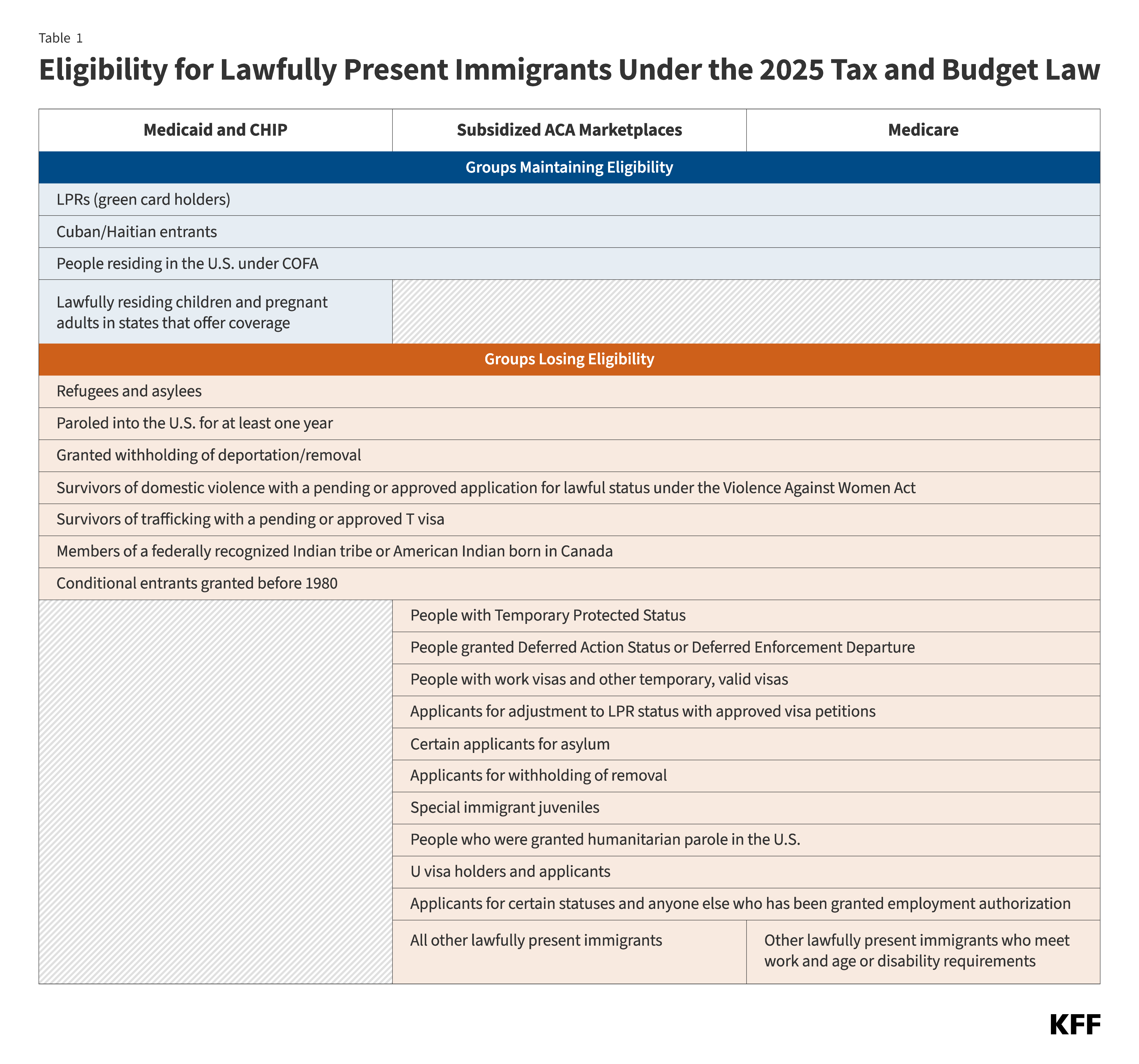
Congressional Republicans and President Trump passed the tax and budget reconciliation bill in July 2025. The new law includes significant cuts to the Medicaid program as well as eligibility restrictions for many lawfully present immigrants, including refugees and asylees, to access Medicaid and the Children’s Health Insurance Program (CHIP), subsidized Affordable Care Act (ACA) Marketplace, and Medicare coverage. Under longstanding federal policy, undocumented immigrants already are ineligible for federally funded health coverage. This policy watch outlines the groups of lawfully present immigrants that will lose access to federally funded health coverage due to the 2025 tax and budget law and the Congressional Budget Office’s (CBO’s) estimates of the increases in the number of uninsured and federal savings and revenue changes due to these provisions.

CBO estimates that the law’s restrictions on eligibility for federally funded health coverage for lawfully present immigrants will result in about 1.4 million lawfully present immigrants becoming uninsured, reduce federal spending by about $131 billion, and increase federal revenues by $4.8 billion as of 2034. Additional lawfully present immigrants are likely to lose Marketplace coverage and become uninsured due to the anticipated expiration of the enhanced subsidies for this coverage. Moreover, under Trump administration regulatory changes, the more than 530,000 Deferred Action for Childhood Arrivals (DACA) recipients are ineligible for federally funded coverage options.

Changes in Eligibility for Lawfully Present Immigrants Under the 2025 Tax and Budget Law

Medicaid and CHIP

Under prior law, to be eligible for Medicaid and CHIP, immigrants were required to have a “qualified” immigration status in addition to meeting other eligibility requirements such as income. Qualified immigrants, as defined by the 1996 Personal Responsibility and Work Opportunity Act and subsequent additions, include lawful permanent residents (LPRs or “green card” holders); refugees; individuals granted parole for at least one year; individuals granted asylum or related relief and certain abused spouses and their children or parents; certain victims of trafficking; Cuban and Haitian entrants; and citizens of the Freely Associated (COFA) nations of the Marshall Islands, Micronesia and Palau residing in U.S. states and territories. In addition, many had to wait five years after obtaining qualified status before they could enroll in Medicaid even if they met other eligibility requirements. States have an option to extend Medicaid and/or CHIP coverage to all children and/or pregnant individuals who are lawfully residing and waive the five-year wait for these groups, which 39 states plus D.C. had taken up as of January 2025. States also have the option in CHIP to provide prenatal care and pregnancy related benefits to targeted low-income children beginning from conception to end of pregnancy (FCEP) regardless of their parent’s immigration status, which 24 states plus D.C. had taken as of April 2025.

The 2025 tax and budget law will restrict Medicaid or CHIP eligibility to LPRs, Cuban and Haitian entrants, people residing in the U.S. under COFA, and lawfully residing children and pregnant immigrants in states that cover them under the Medicaid and/or CHIP option (Table 1). States also will still have the option to extend prenatal and pregnancy-related benefits to targeted low-income children from conception through the end of pregnancy through the FCEP option. These restrictions will eliminate eligibility for many other groups of lawfully present immigrants, including refugees and asylees without a green card, among others (Table 1). This provision will become effective October 1, 2026, and CBO estimates that it will reduce federal spending by $6.2 billion and lead to an additional 100,000 individuals becoming uninsured by 2034.

ACA Marketplaces

Under prior law, lawfully present immigrants have been eligible to enroll in ACA Marketplace coverage and receive premium subsidies and cost-sharing reductions, including individuals with Temporary Protected Status (TPS), those with Deferred Enforced Departure, and people on work visas. In general, Marketplace coverage is limited to individuals with incomes at or above 100% of the federal poverty level (FPL), since most of those with lower incomes would be eligible for Medicaid. However, some lawfully present immigrants with lower incomes remain ineligible for Medicaid (e.g., due to the five-year waiting period and eligibility limits to qualified immigrants). To address this gap, Marketplace eligibility was also extended to lawfully present immigrants with incomes under 100% FPL who do not qualify for Medicaid due to their immigration status, including those in the five-year waiting period for Medicaid coverage. In the years after the ACA was passed, DACA recipients were excluded from eligibility for the Marketplaces despite being lawfully present. Under regulations issued by the Biden Administration in May 2024, DACA recipients were made newly eligible for the Marketplaces and to receive subsidies to offset costs starting November 2024. However, this coverage was blocked in some states due to legal challenges, and on June 25, 2025, the Trump administration finalized a rule that once again made DACA recipients ineligible to purchase ACA Marketplace coverage as of August 25, 2025. Most states will terminate coverage for enrolled DACA recipients on September 30, 2025.

The law will also limit eligibility for subsidized ACA Marketplace coverage to lawfully present immigrants who are LPRs, Cuban and Haitian entrants, and people residing in the U.S. under COFA. (Table 1). A broader group of lawfully present immigrants will lose access to subsidized Marketplace coverage under this change, including refugees and asylees without green cards, people with TPS, and individuals on work visas, among others, beginning January 1, 2027. The CBO estimates that this provision will lead to an additional one million individuals becoming uninsured and reduce federal spending by $91.4 billion over the 2026 to 2035 time period. In addition, the provision is expected to increase federal revenue by $4.8 billion as of 2034. The law also eliminates access to subsidized Marketplace coverage for lawfully present immigrants earning less than 100% FPL who are not eligible for Medicaid due to immigration status, including those in the five-year waiting period for coverage, beginning January 1, 2026. During the 2025 open enrollment period, nearly 550,000 people with incomes under 100% FPL were enrolled in a Marketplace plan, who are likely primarily lawfully present immigrants who are ineligible for Medicaid due to immigration status. The CBO estimates that this provision will lead to an additional 200,000 individuals becoming uninsured and reduce federal spending by $27.3 billion over the 2026 to 2035 time period. In addition, the provision is expected to increase federal revenue by $176 million as of 2034.

Medicare

Lawfully present immigrants have been eligible for Medicare if they have the required work quarters and meet the disability or age requirements. Those without required work history could also purchase Medicare Part A after residing legally in the U.S. for five years continuously.

Under the new law, Medicare eligibility also will be limited to lawfully present immigrants who are LPRs, Cuban and Haitian entrants, and people residing in the U.S. under COFA, eliminating eligibility for refugees and asylees without a green card, people with TPS, and people with work visas, among others (Table 1). Current beneficiaries subject to the new restrictions will lose coverage no later than 18 months from the enactment of the legislation (January 4, 2027). The CBO estimates that this provision will lead to an additional 100,000 individuals losing coverage, with a federal spending reduction of $5.1 billion and a federal revenue decrease of $123 million as of 2034.

Colombia: HIV risks for LGBTIQ+ migrants linked to gaps in care and prevention

Translated with Google Translate. Scroll down for article in Spanish.

NGO warns of increase in HIV cases in LGBTIQ+ migrants

The lack of delivery of medicines and preservatives to health entities would increase the risk among the diverse population.

The NGO Caribe Afirmativo, which defends the rights of LGBTIQ+ people (lesbians, gay, bisexuals, intersexuals, trans and queer), warned about the increase in HIV infections (Human Immunodeficiency Virus, which can cause AIDS) among migrants belonging to this population.

The warning was issued from the Migration Summit that takes place in Riohacha (La Guajira) by Wilson Castañeda, spokesman for Caribe Afirmativo, who pointed out that the prevalence of increase occurs especially among Venezuelan migrants living in Colombia.

For Caribe Afirmativo, which works to transform prejudices, imaginaries and social and institutional practices around sexual and gender diversity, the lack of delivery of medicines and condoms in health entities would be increasing the risk among migrants who make up the diverse population.

“When specifically looking at LGTBIQ+ migrants, it was identified that there was a prevalence that for every 10 migrants living with HIV, 5 were trans people,” Castañeda explained.

For the social activist, this “shows that in the universe of migrants living with HIV, 70% are LGTBIQ+ people.” He considered that “care must be reoriented to people of gender diversity, especially in countries such as Colombia.”

Castañeda called for the State to re-improve the attention to this population living with HIV, taking into account the increase figures that not only include migrants but also the returned population.

The NGO Caribe Afirmativo specified that one of the challenges facing Colombia in the face of HIV is access to medicines, taking into account that, despite the efforts of organizations such as AHF Colombia, obtaining antiretroviral medication for Venezuelan migrants is a constant challenge.

Another challenge would be the need for health and humanitarian care programs to support the provision of services and the distribution of treatments among this population.


ONG alerta aumento de casos de VIH en migrantes LGBTIQ+

La falta de entrega de medicamentos y preservativos en las entidades de salud, estaría aumentado el riesgo entre la población diversa.

La ONG Caribe Afirmativo, que defiende los derechos de las personas LGBTIQ+ (lesbianas, gais, bisexuales, intersexuales, trans y queer), advirtió sobre el incremento de infecciones con el VIH (Virus de Inmunodeficiencia Humana, que puede ocasionar sida) entre migrantes pertenecientes a esta población.

La advertencia fue lanzada desde la Cumbre Migratoria que se desarrolla en Riohacha (La Guajira) por parte de Wilson Castañeda, vocero de Caribe Afirmativo, quien señaló que la prevalencia de aumento se da especialmente entre los migrantes venezolanos radicados Colombia.

Para Caribe Afirmativo, que trabaja en transformar los prejuicios, imaginarios y prácticas sociales e institucionales en torno a la diversidad sexual y de género, la falta de entrega de medicamentos y preservativos en las entidades de salud estarían aumentando el riesgo entre los migrantes que conforman la población diversa.

“Cuando se miraba específicamente las personas migrantes LGTBIQ+ se identificaba que había una prevalencia de que cada 10 personas migrantes viviendo con VIH, 5 eran personas trans”, explicó Castañeda.

Para el activista social, esto “deja en evidencia que en el universo de migrantes viviendo con VIH, un 70% son personas LGTBIQ+”. Consideró que “hay que reorientar la atención a personas de diversidad de género, especialmente en países como Colombia”.

Castañeda llamó a que el Estado vuelva a mejorar la atención a esta población viviendo con VIH, teniendo en cuenta las cifras de aumento que no solo incluyen personas migrantes sino, además, población retornada.

La ONG Caribe Afirmativo precisó que uno de los desafíos que afronta Colombia frente al VIH son el acceso a medicamentos teniendo en cuenta que, a pesar de los esfuerzos de organizaciones como AHF Colombia, obtener la medicación antirretroviral para migrantes venezolanos es un desafío constante.

Otro de los desafíos sería la necesidad de programas de salud y atención humanitaria para fundamentar la prestación de servicios y la distribución de tratamientos entre esta población.

[Update] Türkiye: Syrian refugee regains temporary protection after HIV-related revocation

Having spent sixt months in removal centers last year, Aabo was subjected to harassment because of his sexual orientation and HIV status, and denied access to medication for extended periods.

A Syrian refugee whose temporary protection status was revoked following an HIV diagnosis has regained his legal status in Turkey.

Ahmad Aabo, 29, who has lived in Turkey for nearly 13 years, received a temporary identification document yesterday. The document restores his access to public healthcare services until he is issued a printed identity card, expected on Sep 30.

Aabo’s temporary protection status was previously removed on the grounds that he was “carrying a contagious disease,” after he was diagnosed with HIV. The decision cut him off from life-saving retroviral medication and free healthcare services.

Aabo was held in administrative detention for about six months last year in repatriation centers in İstanbul and Adana. He said he was kept in isolation, subjected to verbal harassment because of his sexual orientation and HIV status, and denied access to medication for extended periods.

Although released in Oct 2024, his temporary protection status was not reinstated, preventing him from continuing treatment.

Amnesty International campaign

Amnesty International had launched an urgent action campaign urging Turkish authorities to restore Aabo’s temporary protection.

A petition submitted to the Presidency of Migration Management read, “Although the restriction code and related deportation order were lifted, temporary protection status has not been reinstated. As a result, Aabo cannot access treatment vital for his health. Authorities must urgently reinstate his status and ensure access to free medical care.”

A lawsuit challenging the refusal to reinstate Aabo’s temporary protection remains ongoing before the İstanbul 1st Administrative Court.

Foreigners deemed to pose a threat to public health and safety due to contagious diseases may be issued a G-78 restriction code, which bans their entry into Turkey indefinitely. (EMK/VK)

South Africa: Calls grow for reform on migrant healthcare access after healthcare blockades

SA mulls law review on migrant healthcare

Non-South Africans are not entitled to the full package of comprehensive healthcare provided to this country’s citizens, the chairperson of Parliament’s Health Portfolio Committee has said, calling for urgent legislative reform to address the mounting disruptions by Operation Dudula activists.

Dr Sibongiseni Dhlomo’s remarks come in the wake of Health Minister Aaron Motsoaledi’s warning to the vigilantes that legislation governing access to public health services will not be changed under pressure.

SowetanLIVE reports that Dhlomo was addressing committee members last Thursday after videos on social media showed Operation Dudula thugs preventing foreigners from entering clinics and some hospitals.

He added that foreign nationals are entitled only to emergency medical services – and, he remarked, government was considering certain legislation in this regard.

“Our Constitution… talks about South Africa belonging to all who live in it. That part is important and ought to be respected. But the conclusion from the National Health Insurancepublic hearings was that the country should provide emergency services to all – which means foreign nationals as well – so that is binding in terms of UN rules. But comprehensive healthcare is for South Africans,” he said.

However, he said, while migrants are not entitled to the full range of health services, Operation Dudula’s approach of stopping people from entering hospitals and clinics was not the right way to deal with the issue, and a “streamlined approach” was needed.

He said the Health Department has been “engaging the organisation and other stakeholders”, and that discussions had extended to Home Affairs, with proposals to review and possibly repeal sections of key legislation such as the South African Citizenship Act, the Refugees Act, the Identification Act and the Immigration Act.

“Some of these Acts are wide and encompassing. Maybe they should have limitations. It’s not possible for us to have unlimited resources to deal with what is there,” he said.

Govern access

The portfolio committee was seeking “a more coherent legal framework to govern access … by the undocumented patients”, he added, citing vague definitions and overlapping provisions in existing legislation as contributing to administrative confusion and public frustration.

He also noted that many South Africans themselves remain undocumented, complicating efforts to distinguish between citizens and foreign nationals, reports BusinessLIVE.

According to estimates cited by the Department of Home Affairs, around 6m South Africans still lack formal identity documentation. Dhlomo also warned that any policy response must avoid penalising citizens who fall outside the formal registry.

“Minister Motsoaledi has taken the leadership of Dudula through the various policies and pieces of legislation that govern and regulate the provision of healthcare … which are beyond our control. As a department, we have to comply,” said Health Department spokesperson Foster Mohale.

Campaign percolated for months

The vigiantes have disrupted access to migrants seeking healthcare to at least 53 clinics in KwaZulu-Natal, Limpopo, Mpumalanga, Gauteng and the Eastern Cape, and with no clear interventions in place, vulnerable groups are left scrambling for life-saving healthcare.

While the targeted disruptions by these groups are not new and have been a longstanding concern for many human rights organisations, reports of the latest campaign began surfacing as early as June this year, reports Daily Maverick.

Médecins Sans Frontières (MSF) regional advocacy co-ordinator Clair Waterhouse said her organisation had tracked 15 clinics where Dudula members had been permanently stationed.

Contrary to claims that the disruptions target only illegal foreigners, the consequences are broader. People with valid work permits, permanent residence and even South African citizens have been refused care.

“Our observation shows very strongly that for migrants, it doesn’t matter if they are documented or not. We’ve seen people with South African IDs, valid visas, even passports, being told their documents are ‘not good enough’ and ordered to leave. South Africans who forget their IDs at home are also barred. We’ve even seen children and pregnant women denied care,” said Waterhouse.

Alarming cases

MSF teams on field assessments had witnessed alarming cases. In Johannesburg, a six-month-old baby with a severe respiratory infection was turned away. In other facilities, pregnant women were denied access to antenatal care.

One of the most disturbing trends MSF documented was collusion by health staff with the anti-migrant groups.

“At two clinics, the work of these groups was actively facilitated by either clinic security or staff themselves. We’ve even heard reports of nurses saying they are grateful, because it means fewer patients. In some cases, Dudula members told us they ‘check in’ with staff every morning as if they were part of the clinic’s routine,” she said.

Daily Maverick has extensively reported on the impact of these disruptions, from mothers unable to seek post-natal care, migrant parents being unable to access life-saving healthcare for their children, and injured people without documentation being turned away from clinics by Operation Dudula members.

Lack of urgency from State

Despite repeated appeals from MSF and the Treatment Action Campaign (TAC), the Department of Health has yet to issue a robust response. MSF’s Waterhouse confirmed that organisation had written to national and provincial authorities, sharing detailed concerns and even cases of collusion, but received no reply.

“We don’t believe this is being treated with the urgency it deserves,” she said. “What little has come out has not been sufficient. Seven weeks of significant blockages at health facilities is not acceptable.”

Daily Maverick asked the Department of Health for clarity on protocols to halt the disruptions, but no response had been received by the time of publication.

The TAC believes the silence reflects a deeper governance failure.

“The existence of legislation that guarantees healthcare to all means nothing if it is not enforced. We see police standing by without intervening. We see facility managers turning a blind eye. In practice, this amounts to condoning the violations,” TAC Gauteng provincial chairperson Monwabisi Mbasa said.

In the absence of decisive government action, civil society has moved to fill the gap. The TAC, long known for its grassroots fight for access to HIV and TB treatment, is now redirecting much of its energy to assist those excluded from healthcare by the Dudula disruptions.

“In just three weeks, we’ve helped more than 28 people access medication, and the number keeps growing daily. Recently, we received a list of 200 patients who had been completely turned away. They all needed urgent support to get treatment or medication, and without intervention, their lives would have been at serious risk,” Mbasa said.

The TAC operates through a network of local branches and volunteers. When a patient is denied care, the organisation steps in to connect them with comrades closer to alternative facilities, ensuring they can safely access treatment.

“We don’t want to tamper with the health system’s data, so we link patients directly to nearby facilities,” Mbasa said. “That way, treatment continues, and their medical information remains recorded in the system.”

Pregnant women denied access to viral load testing have faced the terrifying possibility of passing HIV on to their unborn children.

No law enforcement

Meanwhile, National Police Commissioner General Fannie Masemola has said that although Operation Dudula and March and March’s actions are unlawful, there is no specialised police unit dedicated to reining in their behaviour – or their restriction on undocumented foreigners accessing healthcare services, reports The Star.

Masemola told a media briefing in Pretoria that the Public Order Policing (POP) will intervene only if public disturbances occur, marking the first time he has publicly addressed the issue.

He said the job of a POP units was to deal with crowd management and public gatherings, major events and protests – although police, including some POP officers, have been deployed to some affected clinics to restore order.

“These POP units cannot wait at a clinic just in case something happens – they have a lot of other work to do,” he said.

South Africa: MSF warns of widespread denial of healthcare to foreign nationals in South Africa

Ongoing xenophobic action puts at risk the lives of several non-South African patients.

Doctors Without Borders (MSF) is deeply concerned by the persistent and systematic physical blocking of non-South Africans from accessing healthcare, including pregnant women, people living with HIV, chronic patients and children – particularly in Gauteng and KwaZulu-Natal. 

We call for immediate action by the National Department of Health (NDoH) and relevant Provincial Departments of Health to guarantee the right of access to healthcare for all, as enshrined in the country’s Constitution and the National Health Act.

For several weeks now, anti-migrant groups, have camped outside dozens of clinics and hospitals in Gauteng, preventing non-South Africans from entering public health facilities to seek medical care, irrespective of their legal documentation status.

We also call for the appropriate health departments to work with communities to address the state of healthcare facilities and to find lasting solutions to these challenges, instead of apportioning blame on non-South Africans.

MSF launched an assessment to understand the severity of these blockages and the needs of those impacted, following reports of denial of access to care at locations across South Africa. The team visited 15 hospitals and clinics in Gauteng, where they consistently witnessed patients being turned away from more than half of these healthcare facilities by groups of between 2 and 10 people, wearing civilian clothing.

The groups are either stationed at the gate or inside facilities and are demanding identification from every person who tries to enter, turning away those they deem non-South African. From MSF’s assessment, the issue is more widespread at primary healthcare clinics (PHCs) than hospitals.

“The results of our assessment are highly distressing and unacceptable. Our team even witnessed two clinics where security staff and healthcare workers worked in collusion with these anti-migrant groups. We urge the Department of Health to immediately address healthcare facilities who are enabling or encouraging any kind of denial of healthcare,” says Claire Waterhouse, MSF Southern Africa’s Director of Operational Support Unit.

The MSF team also visited and called nearly 50 patients who indicated that they were denied access to healthcare in 24 healthcare facilities in and around Johannesburg, Durban and Tshwane. The patients, consisting primarily of late-term pregnant women and people with diabetes, hypertension and HIV, have expressed fear, panic and confusion.  Most informed us that they already struggle financially and are unable to buy medication or afford private medical care.

Some patients told MSF staff that they tried to retrieve their medical files from the clinics to enable them to seek medical care elsewhere without success, leaving them unsure of next steps. Others have no prescriptions to use to refill their medication, so they are unable to buy the medication they need from pharmacies.

Due to these blockages, many pregnant women with high-risk conditions including those with hypertension, diabetes and HIV, have remained unmonitored and untreated. Many HIV patients have gone for over two weeks without their medication, while others were left with just a few days’ supply at the time MSF staff spoke to them. Defaulting HIV treatment can have serious complications for people, as well as add to the burden on the health system by becoming sicker and requiring more intensive treatment.

“It is critical that both the National Department of Health and Provincial Departments address this problem with urgency. Clinics must be made safe for all who need them through proactive measures, including safe, effective and timely police protection where needed. We also call for the appropriate health departments to work with communities to address the state of healthcare facilities and to find lasting solutions to these challenges instead of apportioning blame on non-South Africans,” adds Waterhouse.

MSF urges the National Department of Health to immediately and unequivocally reaffirm the right of all who live in South Africa to access basic healthcare, without discrimination, and to conduct health education in communities to ensure that non-South Africans feel safe to return to facilities and that South Africans understand why this is non-negotiable.

*Thando, a 33-year-old woman, was turned away on the 14th of July from a queue inside a hospital in Gauteng Province by an anti-migrant group for being undocumented. She is a 16-week high-risk pregnant patient who is also hypertensive.

“I already knew of the situation at the hospital when I went because another girl had already told me that foreigners were being turned away. But I still decided to try. So, I got to the hospital early in the morning at 07:00. There were about 7 to 8 people in the queue already”.

She says a gentleman randomly appeared holding a South African Identity card.

“He waved it, walking around and showing us. He said that if any of us didn’t have something like what he was holding, or if a passport didn’t have a permit, we should start getting out. The nurses were there, and they started laughing, supporting him. They said we don’t pay tax, and they are tired of us. They said we can go; it will be less work for them. Only four people were left inside when the rest of us had to leave,” adds Thando.  

*Tecla, a 44-year-old domestic worker who is living with HIV and taking ARVs, along with other chronic medication, has been in South Africa since 2008. She has not been blocked yet, but her landlord has been turned away, and she sees people being chased away daily as she lives across one of the clinics.

“I have medication that lasts me until 15th of August, but I am afraid to go to the clinic for my next refill, so I have tried to check if I can get medication from a pharmacy. I cannot afford [it] as the doctor wanted R500 consultation fee, additional fees for tests to determine my CD4 count and initiate me on treatment. I have considered going back home, but I have no money,” Tecla told MSF staff.

Rose, Tecla and Thando are not alone. Thousands of non-South Africans, many of whom are extremely vulnerable, are struggling to access urgently needed and basic healthcare. South Africans who have lost or forgotten their ID documents, or those they assumed ‘did not look or sound South African’ enough, are also losing access. This is not the first time anti-migrant groups have blocked non-South Africans from accessing healthcare services.

In 2022, Operation Dudula supporters protested outside Kalafong Provincial Tertiary Hospital in Tshwane, threatening and blocking access until the government publicly condemned the xenophobic protests, emphasising that the right to access basic health services was a basic human right enshrined in the South African Constitution, regardless of nationality or documentation status.

MSF has provided free medical care to vulnerable populations such as migrants, asylum seekers and refugees in South Africa since 2007 and has continuously responded to sporadic impacts of xenophobic violence on healthcare access for vulnerable people over the years. Recently, MSF supported displaced migrants with food and non-food items such as water containers, blankets, aqua tabs, baby diapers, baby formula, porridge, sanitary towels, and other hygiene essentials following violence primarily targeting of non-South Africans in Addo, Eastern Cape.