Russia: Tougher health reporting rules for clinics and migrants advance in Russia

Translated with AI – Scroll down for article in Russian

Medical control is being tightened in Russia: migrants are waiting for tests, fines and a criminal charge for fake certificates

The State Duma Committee approved a bill that significantly tightens medical examinations for foreign citizens, writes the telegram channel Ostashko! Important.
According to the new rules, all foreigners arriving in Russia for more than 90 days must be tested for HIV and drugs within 30 days after entry, and then annually.

Previously, the terms of examinations for different categories of visitors could vary and reach 90 days. Now the violation of these requirements threatens with a fine of 25 to 50 thousand rubles, and in case of non-repayment of the amount – its doubling and mandatory expulsion by court decision.

Separately, the law introduces liability for forged medical certificates. Violators may face criminal punishment of up to 4 years in prison.

The rules for medical organizations are also changing. Now clinics are obliged to inform the Ministry of Internal Affairs and Rospotrebnadzor about the identified dangerous diseases among foreigners. Violation of the examination procedure may result in a fine of up to 1 million rubles or suspension of activities for up to 90 days. If violations are recorded in several migrants, fines will be charged for each.

———————————

В России ужесточают медконтроль: мигрантов ждут тесты, штрафы и уголовка за поддельные справки

Комитет Госдумы одобрил законопроект, который существенно ужесточает медицинские проверки для иностранных граждан, пишет телеграм-канал Осташко! Важное.
Согласно новым правилам, все иностранцы, прибывающие в Россию на срок более 90 дней, должны в течение 30 дней после въезда пройти тестирование на ВИЧ и наркотики, а затем — ежегодно.

Ранее сроки прохождения обследований у разных категорий приезжих могли различаться и достигать 90 дней. Теперь нарушение этих требований грозит штрафом от 25 до 50 тысяч рублей, а при непогашении суммы — её удвоением и обязательным выдворением по решению суда.

Отдельно закон вводит ответственность за поддельные медицинские справки. Нарушителям может грозить уголовное наказание до 4 лет лишения свободы.

Также изменяются правила для медицинских организаций. Теперь клиники обязаны информировать МВД и Роспотребнадзор о выявленных опасных заболеваниях у иностранцев. Нарушение порядка освидетельствования может обернуться штрафом до 1 миллиона рублей или приостановкой деятельности на срок до 90 суток. Если нарушения зафиксированы у нескольких мигрантов, штрафы будут начисляться за каждого.

Russia: Migrants to undergo medical examination within 30 days of entry under proposed bill

A bill on combating illegal migration and protecting the health of citizens has been submitted to the State Duma. This was announced on her VKontakte page by Irina Yarovaya, Deputy Speaker of the lower house of parliament.

The bill proposes amendments to the law ‘On the Legal Status of Foreign Citizens in the Russian Federation.’ Under current regulations, migrants must undergo a medical examination within 90 days of entering Russia. If the bill is passed, foreigners will undergo a medical examination within 30 days of entry. The authors of the initiative also propose to oblige those who have arrived in the country for more than 30 days to undergo a medical examination annually.

Foreigners will be tested for dangerous infectious diseases and HIV, as well as for drug use. Medical organisations will forward information about diseases among new arrivals to Rospotrebnadzor and the Ministry of Internal Affairs ‘for prompt deportation.’

Migrants who evade medical examinations may also be deported from Russia. The amendments also propose increasing fines for migrants who evade medical examinations by more than 12 times, to 25,000-50,000 roubles, with the possibility of deportation at the discretion of the court.

Earlier, State Duma Chairman Vyacheslav Volodin reported that administrative liability is expected to be introduced for foreign citizens who evade medical examinations.

In addition, according to the speaker of the lower house, it is expected to ‘establish increased criminal liability for the forgery of official documents certifying the absence of diseases that pose a danger to others, and their circulation.’

At the end of 2024, President Vladimir Putin signed a decree requiring illegal migrants in Russia to regularise their status or leave the country by 30 April 2025.

Among the requirements for illegal migrants who want to remain in Russia were the submission of biometric data and medical examinations for drugs, infectious diseases and human immunodeficiency virus (HIV).

In addition, migrants are required to pass a test on their knowledge of the Russian language, history and laws, as well as to pay off any outstanding debts. The decree states that those who have signed a contract with the Ministry of Defence for military service will not be deported. Previous decisions on deportation, readmission, refusal of entry into Russia, undesirability of stay and reduction of the period of temporary stay in the country will not be enforced in their regard. This provision does not apply to foreigners who pose a threat to Russia’s national security.

In February last year, a public register of illegal migrants was launched in Russia. In addition, a new procedure for their expulsion from the country came into force.


Мигрантам предложили сократить срок прохождения медобследования

Законопроект о противодействии нелегальной миграции и защите здоровья граждан внесен в Государственную думу. Об этом сообщила на своей странице во «ВКонтакте» вице-спикер нижней палаты парламента Ирина Яровая.

Проектом предлагается внести поправки в закон «О правовом положении иностранных граждан в Российской Федерации». По действующим нормам, после въезда в Россию мигранты должны пройти медобследование в течение 90 дней. Если документ примут, иностранцы будут проходить медицинское освидетельствование в течение 30 дней с момента въезда. Авторы инициативы предлагают также обязать тех, кто приехал в страну более чем на 30 дней, проходить медосвидетельствование ежегодно.

Иностранцев будут проверять на наличие опасных инфекционных заболеваний и ВИЧ, а также на употребление наркотических веществ. Медицинские организации станут передавать информацию о болезнях у приезжих в Роспотребнадзор и МВД «для оперативной высылки».

За уклонение от медобследования мигранта могут также выслать из России. Поправками в том числе предлагаетсяповысить штрафы за уклонение мигрантов от медосвидетельствования более чем в 12 раз, до 25–50 тыс. руб., с возможностью выдворения на усмотрение суда.

Ранее председатель Госдумы Вячеслав Володин сообщал, что предполагается ввести административную ответственность за уклонение иностранных граждан от медосвидетельствования.

Кроме того, по словам спикера нижней палаты, предполагается «установить повышенную уголовную ответственность за подделку официальных документов об отсутствии заболеваний, представляющих опасность для окружающих, и их оборот».

В конце 2024 года президент Владимир Путин подписал указ, по которому находящиеся в России нелегальные мигранты обязаны урегулировать свой статус или покинуть территорию страны до 30 апреля 2025-го.

Среди требований к тем нелегальным мигрантам, кто хочет остаться на территории России, были указаны сдача биометрических данных и прохождение медицинского освидетельствования на наркотики, наличие инфекционных заболеваний и вируса иммунодефицита человека (ВИЧ).

Мигранты помимо этого обязаны сдать тест на знание русского языка, истории и законов России, а также погасить имеющиеся задолженности. В указе говорится, что тех, кто заключил контракт с Минобороны на прохождение военной службы, не будут депортировать. В отношении них не будут исполнены принятые ранее решения о депортации, реадмиссии, неразрешении въезда в Россию, нежелательности пребывания и сокращении сроков временного пребывания в стране. Это положение не применяется к иностранцам, которые создают угрозу для национальной безопасности России.

В феврале прошлого года в России заработал публичный реестр нелегальных мигрантов. Кроме того, вступил в силу новый порядок их высылки из страны.

Russia: From March 2026, migrants will be required to undergo screening for hepatitis

New medical requirements are being established in Russia for foreign citizens planning to engage in labor activity. The Ministry of Health of Russia announced that starting from March 1, 2026, migrants will be required to undergo screening for acute hepatitis, as well as chronic viral hepatitis types B and C.

According to the newspaper Vedomosti, this requirement will apply to all foreign citizens entering the territory of Russia for employment, as well as to stateless persons, asylum seekers, and those applying for temporary refuge in the country.

The draft amendments to the procedure for conducting medical examinations have already been posted on the federal portal of regulatory legal acts. The explanatory note states that these changes are necessary “to improve the organizational foundations and the procedure for conducting medical examinations.”

According to the new regulation, every migrant who wishes to obtain a work permit, temporary residence permit, or permanent residence permit in Russia will have to provide a medical certificate. This rule is based on the law governing the legal status of foreign citizens in the Russian Federation.

At present, migrants are mainly tested for the presence of narcotic substances and diseases that pose a danger to others, including HIV, tuberculosis, syphilis, and leprosy. The new requirements provide for broader health monitoring.

According to officials, these measures are aimed not only at protecting public health but also at expanding opportunities for early detection and treatment of illnesses among migrants. In addition, they are intended to ensure medical safety in the labor market and to create a healthier environment.

Given that migration processes in Russia have become more active in recent years and the number of labor migrants continues to grow, the new procedure is viewed not only as a preventive measure but also as part of state policy focused on strengthening public health.

Thus, starting from 2026, every person arriving in Russia in search of work will be required to provide detailed medical information — through this, the state aims to make the labor environment more controlled and safer.

Canada: HIV Legal Network seeks to rejoin a constitutional challenge against immigration law

Returning to Federal Court in constitutional challenge of Canada’s “Excessive Demand” Regime 

On September 18, 2025, at 9:30 a.m., the Federal Court will hear the HIV Legal Network’s motion to rejoin a constitutional challenge to Canada’s “excessive demand” regime in immigration law. This hearing is a critical moment in the fight to ensure that Canada’s immigration laws respect the Charter and protect the rights of people living with HIV.

This case arises from Immigration, Refugees and Citizenship Canada’s decision to deny a work permit to an applicant based on his HIV status, citing s. 38(1)(c) of the Immigration and Refugee Protection Act. This provision bars entry or stay in Canada for people whose health needs are expected to create an “excessive demand” on public healthcare services.

The HIV Legal Network has fought against this discriminatory regime since its introduction in 2001, highlighting how it stigmatizes people living with HIV and excludes them from equal access to immigration pathways. At this hearing, the Legal Network – supported by Downtown Legal Services – will argue that it should be granted public interest standing because of its deep expertise, long record of advocacy, and unique ability to bring forward the voices and evidence of people most affected by this law.

Details

  • Hearing: September 18, 2025, 9:30 a.m. (Federal Court)
  • Case #: IMM-12720-23
  • Observation: Members of the public and media can register to observe virtually via the Federal Court website (https://www.fct-cf.ca/en/court-files-and-decisions/hearing-lists). We recommend registering at least 24 hours prior to the hearing to ensure you receive a link.

Related documents:

Motion Record of the HIV Legal Network

Memorandum of Fact and Law of the HIV Legal Network

Affidavit of Sandra Ka Hon Chu (On behalf of the HIV Legal Network)

Affidavit of Anonymized Applicant

Applicant’s Memorandum of Argument

Uzbekistan adopts law denying work permits to foreigners diagnosed with HIV or TB

Translated with Google translate. For original article in Uzbek, please scroll down.

Foreigners with HIV and tuberculosis will be banned from working in Uzbekistan

The Senate of Uzbekistan has approved a law according to which foreign citizens diagnosed with HIV/AIDS or tuberculosis will not be able to obtain a work permit in the country.

The explanatory note to the law notes that the number of citizens returning from abroad has increased. In 2024, out of 1.7 million who returned, only 25% underwent voluntary testing for HIV – the infection was detected in 1,512 people, writes Fergana.

Since the statistics only cover those who were voluntarily tested, it remains unclear how widespread infectious diseases are among those who did not take tests.

In this regard, mandatory medical examination for HIV is being introduced for citizens of Uzbekistan aged 18 to 60 years who have been abroad for more than 90 days, as well as for foreigners and stateless persons permanently residing or coming to the country for the purpose of employment.

For citizens of Uzbekistan and stateless persons permanently residing in the republic, the examination will be free of charge — at the expense of the state budget. But labor migrants and foreigners will have to pay for it themselves or at the expense of the employer.

In case of detection of HIV/AIDS or tuberculosis, foreign citizens will be officially denied the right to employment.

The law also stipulates that private employment agencies must train citizens traveling abroad in the rules of stay in the countries of employment.

The document will come into force after it is signed by the President of Uzbekistan.


Иностранцам с ВИЧ и туберкулёзом запретят работать в Узбекистане

Сенат Узбекистана одобрил закон, согласно которому иностранные граждане, у которых выявлены ВИЧ/СПИД или туберкулез, не смогут получить разрешение на трудовую деятельность в республике.

В пояснении к закону отмечается, что число граждан, возвращающихся из-за рубежа, увеличилось. В 2024 году из 1,7 млн вернувшихся лишь 25% прошли добровольное тестирование на ВИЧ — инфекция была выявлена у 1512 человек, пишет Фергана.

Так как статистика охватывает только добровольно обследованных, остается неясным, насколько широко распространены инфекционные заболевания среди тех, кто не сдавал анализы.

В связи с этим вводится обязательное медицинское обследование на ВИЧ для граждан Узбекистана в возрасте от 18 до 60 лет, которые находились за границей более 90 дней, а также для иностранцев и лиц без гражданства, постоянно проживающих или приезжающих в страну с целью трудоустройства.

Для граждан Узбекистана и лиц без гражданства, постоянно проживающих в республике, обследование будет бесплатным — за счет госбюджета. А вот трудовым мигрантам и иностранцам придется оплачивать его самостоятельно, либо за счет работодателя.

В случае выявления ВИЧ/СПИДа или туберкулеза, иностранным гражданам будет официально отказано в праве на трудоустройство.

Также законом предусмотрено, что частные агентства занятости должны обучать выезжающих за границу граждан правилам пребывания в странах трудоустройства.

Документ вступит в силу после его подписания президентом Узбекистана.


Global study reveals 50 countries still enforce HIV-related travel restrictions

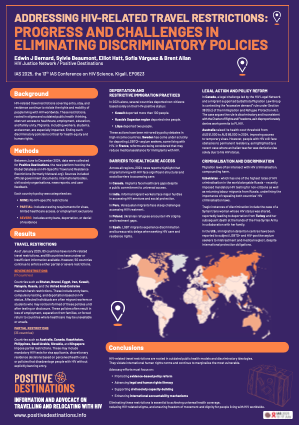
A new global study presented this week at the 13th IAS Conference on HIV Science in Kigali (IAS 2025) has revealed that 50 countries around the world continue to enforce HIV-related travel and residence restrictions, in clear violation of international human rights principles.

The data, shared by the HIV Justice Network through its new platform Positive Destinations, highlights the persistence of discriminatory laws and policies that prevent people living with HIV from freely travelling, working, studying, or settling in many parts of the world.

Despite progress – 83 countries now have no HIV-specific travel restrictions, and many others have adopted more inclusive approaches – 17 countries still impose severe measures such as outright entry bans, mandatory testing, and deportation. These include Bhutan, Brunei, Egypt, Iran, Kuwait, Malaysia, Russia, and the United Arab Emirates. Migrants and students are often disproportionately affected, with some unaware of the rules until after testing or disclosure, resulting in forced returns, loss of income, and separation from families.

Another 33 countries – including Australia, Canada, Kazakhstan, the Philippines, Saudi Arabia, and Singapore – have partial restrictions. These include requirements for HIV testing in visa applications, discretionary decisions based on perceived healthcare costs, and reduced access to essential services. Although these policies may appear neutral on the surface, they continue to disadvantage people living with HIV.

“These restrictions are rooted in outdated public health thinking and perpetuate stigma,” said Edwin J Bernard, HIV Justice Network’s Executive Director. “They obstruct access to healthcare, education, and family life, especially for migrants and refugees.”

   Click on the image to download the poster

In 2024, Positive Destinations documented several cases of deportation based solely on HIV status: Kuwait deported over 100 people, Russia’s Dagestan region deported nine, and Libya deported two. Such practices are increasingly being challenged by legal action. In Canada, for example, a court case led by the HIV Legal Network contests the “excessive demand” clause of immigration law, arguing it violates the country’s Charter of Rights and Freedoms.

However, policy reform has been uneven. Australia raised its health cost threshold for visa eligibility, slightly easing access to temporary stays, but permanent residency remains elusive for many people with HIV. A recent case saw an Italian teacher denied residency due solely to his HIV-positive status.

The study also underscores how HIV-related migration barriers often intersect with other forms of criminalisation and discrimination. In Uzbekistan and Russia, HIV criminalisation laws are paired with mandatory HIV testing for migrants. In the U.S., HIV-positive and LGBTQ+ asylum seekers continue to face mistreatment in detention centres. And in a tragic case in Turkey, a Syrian trans woman was reportedly deported after her HIV status was disclosed and later killed upon return.

The authors of the study call for urgent action: “Eliminating these harmful policies is essential to ending AIDS, achieving universal health coverage, and upholding the dignity and rights of people living with HIV everywhere,” said Bernard.

Positive Destinations, which hosts the updated Global Database on HIV-Specific Travel and Residence Restrictions, is available at www.positivedestinations.info


EP0623 Addressing HIV-related travel restrictions: Progress and challenges in eliminating discriminatory policies by Edwin J Bernard, Sylvie Beaumont, Elliot Hatt, and Sofía Várguez was presented at IAS2025 by Brent Allan at the 13th IAS Conference on HIV Science, Kigali, Rwanda.

Russia: Migrants could face mandatory health checks under Russian draft law

Russian lawmakers propose mandatory health clearance for migrants entering the country

Deputies have proposed introducing a mandatory requirement for migrants entering the Russian Federation to present a certificate proving they are free of infectious diseases, Yaroslav Nilov, Chairman of the State Duma Committee on Labor, Social Policy, and Veterans’ Affairs, said in a post on Telegram, APA reports citing TASS.

“Foreigners coming to Russia to earn money should not bring their problems with them — they should help solve ours,” he noted.

Nilov added that a corresponding draft law has been submitted to the State Duma for consideration.

The politician stated that migrants crossing the border will be required to present valid medical insurance and certificates proving they are not infected with HIV, hepatitis B and C, syphilis, or tuberculosis.

They will also have to provide test results confirming they are free of narcotic and psychotropic substances. Without these documents, they will not be allowed to cross the Russian border, he added.

Russia: Russian lawmaker seeks expanded regional powers over migrants with HIV

Translated with Deepl. Scroll down for original article in Russian.

Il Tumen proposes to expand the rights of regions in relation to migrants with HIV

The federal law should have a clause that allows the regions to take additional measures against migrants with HIV, based on the epidemiological situation.

This opinion was voiced by Deputy Chairman of the State Assembly (Il Tumen) Yuri Nikolaev during a meeting with Anna Kuznetsova, Chief Freelance Specialist in Infectious Diseases in the Federal District of the Ministry of Health of the Russian Federation.

The unstable political and economic situation in the world leads to the intensification of migration processes and a change in their direction. Legal norms regarding the status of migrants, including those living with HIV, are also changing, the participants of the meeting noted.

Over the past 10 years, many countries have abolished laws restricting the entry and residence of HIV-infected foreign citizens. However, in Russia, the rule on the ban on long-term stay and deportation of foreigners in case of detection of HIV infection in them remains.

Anna Kuznetsova highly appreciated the work of infectious disease specialists of Yakutia and the level of medical care for patients with chronic viral hepatitis.

“Yakutia is one of the disadvantaged regions of the Russian Federation in terms of the incidence of chronic viral hepatitis, and, as a result, liver cirrhosis and primary liver cancer. It is important to note that Yakut doctors have achieved significant success in the fight against this disease, coverage with modern antiviral treatment allows today to treat all patients with viral hepatitis C. It is worth noting that this is a great merit of the Republican School of Hepatologists held annually in the region, thanks to which Yakut medical specialists always keep up with the times, receiving up-to-date information from the leading hepatologists of the country. But there are moments related to the endemic nature of the situation. In Yakutia, hepatitis D, or delta hepatitis, is especially common.

According to the expert, this is a feature of the region – there is a hypothesis about the genetic, ethnic predisposition of indigenous peoples to the hepatitis D virus with the rapid formation of severe liver fibrosis. A high incidence of hepatitis D was recorded in Chukotka, in the republics of Dagestan and Tyva.


В Ил Тумэне предложили расширить права регионов в отношении мигрантов с ВИЧ

В федеральном законе должен быть пункт, позволяющий принимать дополнительные меры регионам в отношении мигрантов с ВИЧ, исходя из эпидемиологической ситуации.

Такое мнение озвучил заместитель председателя Госсобрания (Ил Тумэн) Юрий Николаев в ходе встречи с главным внештатным специалистом по инфекционным болезням в ДФО Министерства здравоохранения РФ Анной Кузнецовой.

Нестабильная политическая и экономическая ситуация в мире ведет к активизации миграционных процессов и изменению их направления. Меняются также и правовые нормы в отношении статуса мигрантов, в том числе живущих с ВИЧ, отметили участники встречи.

В течение последних 10 лет во многих странах отменили законы, ограничивающие въезд и проживание ВИЧ-инфицированных иностранных граждан. Однако в России норма о запрете на долгосрочное пребывание и депортацию иностранцев в случае выявления у них ВИЧ-инфекции сохраняется.

Анна Кузнецова высоко оценила работу инфекционистов Якутии и уровень оказания медпомощи больным хроническими вирусными гепатитами.

«Якутия является одним из неблагополучных регионов Российской Федерации по заболеваемости хроническими вирусными гепатитами, и, как следствие, циррозом печени и первичным раком печени. Важно отметить, что якутские врачи достигли значительных успехов в борьбе с этим заболеванием, охват современным противовирусным лечением позволяет сегодня лечить всех пациентов с вирусным гепатитом С. Стоит отметить, что в этом огромная заслуга ежегодно проводимой в регионе Республиканской школы гепатологов, благодаря которой якутские медицинские специалисты всегда идут в ногу со временем, получая актуальную информацию от ведущих гепатологов страны. Но есть моменты, связанные с эндемичностью ситуации. В Якутии особенно распространен гепатит D, или гепатит дельта».

По словам эксперта, это особенность региона – имеется гипотеза о генетической, этнической предрасположенности коренных народов к вирусу гепатита D с быстрым формированием тяжелого фиброза печени. Высокая заболеваемость по гепатиту D зарегистрирована еще на Чукотке, в республиках Дагестан и Тыва

Russia: New bill proposes requiring HIV-free certificates for migrant entry

Translated with Deepl, scroll down for original article in Russian.

The State Duma proposed to ban migrants from entering the Russian Federation without a certificate of absence of HIV.

The head of the State Duma Committee on Labor, Social Policy and Veterans Affairs Yaroslav Nilov developed a bill according to which migrants will be obliged to present a certificate of absence of HIV and tuberculosis when crossing the border with the Russian Federation.

“A citizen must have… medical insurance, test results confirming the absence of infection with the human immunodeficiency virus (HIV), hepatitis B and C, as well as the absence of syphilis and tuberculosis…” – says the explanatory note of the document, which was read by TASS.

If the law is passed, it will obligate migrant workers to present a test for the absence of drugs in the blood when entering the Russian Federation, made no earlier than 72 hours in advance. According to Mr. Nilov, this will reduce the burden on health care and prevent the entry of migrants with dangerous diseases.


В ГД предложили запретить мигрантам въезжать в РФ без справки об отсутствии ВИЧ

Глава комитета Госдумы по труду, социальной политике и делам ветеранов Ярослав Нилов разработал законопроект, согласно которому мигранты будут обязаны при пересечении границы с РФ предъявлять справку об отсутствии ВИЧ и туберкулеза.

«Гражданин при пересечении границы обязан иметь… медицинскую страховку, результаты анализов, подтверждающих отсутствие инфицирования вирусом иммунодефицита человека (ВИЧ), гепатита В и С, а также отсутствие заболевания сифилисом и туберкулезом…» — говорится в пояснительной записке документа, с которым ознакомился ТАСС.

Если закон примут, он обяжет трудовых мигрантов предъявлять при въезде в РФ тест на отсутствие в крови наркотиков, сделанный не ранее чем за 72 часа. По словам господина Нилова, это снизит нагрузку на здравоохранение и предотвратит въезд мигрантов с опасными заболеваниями.

Australia: Migration policies for People with HIV perpetuate criminalisation and expose them to harm

David Carter Delivers Keynote at the Australasian HIV&AIDS Conference

Health+Law’s research lead David Carter, delivered a keynote address at the recent ASHM HIV Conference in Sydney, exploring the controversial past and present of HIV criminalisation in Australia. His urgent, provocative address challenged us to consider how current legal and policy processes in migration law recreate conditions of criminalisation, producing serious health and other harms for people living with HIV. 

Talking to Health+Law researchers in an interview about legal issues, Sergio*, a man in his thirties originally from South America and living with HIV, described the experience of migration to Australia:

I didn’t have to face any court, but I [did] have to prove that I wasn’t a bad person just because I have HIV […] I [had] to prove myself to someone else, who probably is not living with HIV, that I was not a bad person, and I was a good citizen and I deserve to be here.

The migration process is a complex one – and this complexity is amplified for people living with HIV.  Sergio’s reflections express a particularly grim aspect of this process for migrants, especially those living with HIV.

Indeed, as Scientia Associate Professor David Carter, Health+Law’s research lead, argued in an invited keynote at the 2024 Australasian HIV&AIDS Conference hosted by ASHM Health in September this year, the experience of people living with HIV seeking to migrate to Australia is part of Australia’s long history of the criminalisation of HIV.  Speaking to delegates from Australia, New Zealand, Asia and the Pacific at Sydney’s International Convention Centre on Gadigal Country, David reminded the audience that criminalisation is a policy approach, that doesn’t just use the criminal law. To show this he set out five stages of criminalisation that are also evident in the migration process for those living with HIV.

First, as he explained, criminalisation characterises specific behaviour as harmful or carrying a risk of harm to the community. In this case the harm presented is, to quote Australian migration law, that a person’s HIV care represents a ‘significant cost to the Australian community or prejudice [to] the access of Australian citizens or permanent residents to health care or community services’.

Second, criminalisation creates a suspect population, made up of people thought to warrant suspicion because they come to be associated with the potential harm.

Third and fourth, this suspect population attracts surveillance from the state, with a hierarchy created within the suspect population whereby some members are subject to further and intensified surveillance.

Fifth, and finally, some members of this suspect population are subjected ‘to the most severe forms of the state’s coercive and punitive authority’, including investigation, more intensive supervision, detention or arrest, and in some cases, criminal or civil proceedings.

The criminalisation of HIV has a long and storied history, going back to the very early days of the AIDS crisis. Vocal members of HIV-affected communities, legal and human rights advocates and many others have argued strongly against criminalisation, viewing it as draconian and as an approach to public (health) policy with very negative consequences for HIV epidemics.

In Australia, arguments against HIV-specific criminal offences have been broadly successful, and yet the ‘temptation’ to criminalise – as the very first Australian National HIV Strategy described it – continues to emerge in some policy responses to HIV and other communicable diseases.

In 1987, when the authors of the first national HIV strategy were writing, they were warning against measures including compulsory universal HIV testing, the closure of gay venues, criminal penalties for HIV transmission, and limitations on the movement of HIV positive people, including forced quarantine. Today, HIV criminalisation is operating in Australian migration policy and law.

‘This contemporary criminalisation of HIV begins’, David argued, ‘like all criminalisation, with the characterisation of behaviour in terms of harm and risk of harm’. He continued, arguing that:

This characterisation of migrating while HIV positive as harmful establishes, and in-turn enlivens, the suspect population management and criminalising processes of our medical border […] This criminalising logic establishes an adversarial relationship between the person living with HIV and the state, and between them and members of the Australian community, whose access to health care it is alleged may be prejudiced by providing care for a person living with HIV who wishes to migrate.

Among the many negative effects of this process is that it can discourage migrants living with HIV from engaging in testing, treatment and HIV care. Interviews conducted by Health+Law as part of our national legal needs (LeNS) study confirm that this is happening. They show that many migrants living with HIV in jurisdictions across Australia experienced an alienating and hostile environment: a ‘threat environment so elevated’, as David described it in his keynote, that they frequently described withdrawing from HIV care and community life as a coping mechanism.

Unfolding the history of ‘unjust and unhelpful’ HIV criminalisation in Australia, David outlined how the current legal and policy conditions that prospective migrants living with HIV face in Australia today work to recreate conditions of criminalisation and expose both individuals and the community to multiple health harms.

You can read more about David’s keynote in The Medical Republic’s coverage of the conference.