Skip to content
HIV Justice Network
  • YouTube
  • Home
  • About
    • HIV Justice Network
    • Staff and Consultants
    • Supervisory Board
    • Global Advisory Panel
    • Our Policies
    • Our Funders
      • ANBI Status
  • News
    • By the HIV Justice Network
    • Curated from other sources
    • HIV JUSTICE NEWS (Newsletter)
  • Academy
  • Database
    • Overview
    • Laws and Analyses
    • Cases
    • Organisations
    • Disclaimer
  • Publications
  • Video
  • Contact Us
  • Donate
News by the HIV Justice Network

UK: Study of people with HIV in Manchester finds legal literacy lacking on criminal prosecutions

17 June 2014
England United Kingdom Social science Personal testimonies Research
  • Twitter
  • Facebook

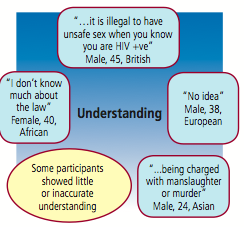
People living with HIV in Manchester appear to have little understanding of their rights and responsibilities under English law to avoid prosecution for ‘reckless’ HIV transmission, according to a study presented to the British HIV Association Conference in Liverpool earlier this year.

Matthew Phillips and Gabriel Schembri surveyed 33 individuals (85% male, 64% gay, average age 36) attending the Manchester Centre for Sexual Health. The questionnaire contained four key prompts to discuss personal understanding of the law in relation to HIV. Participants were invited to write as much or as little as they wished in response to each of the prompts.

The investigators found that many of the participants had either a flawed understanding of the law, the sentences that could be passed, or both. They also found that some participants had very strong views on the morality of HIV transmission and had a range of views on the appropriateness of prosecutions for reckless HIV transmission.

When asked if the law had ever been discussed at their HIV clinic, or where they got their information from, many answered ‘no’ or ‘none’.

Participants discussed rights and responsibilities in relationship only to themselves, with responsibilities of a person with HIV potentially varying based on duration and status of a relationship. Conspicuous by its absence was any discussion of partner responsibility in attempting to avoid acquisition of HIV.

The authors concluded that

People living with HIV sometimes have a weak grasp of how the law relates to their behaviours, which places them at greater risk of prosecution in addition to unfounded fears about what is actually prosecutable in England and Wales. Relating HIV to the law brought out a complex range of issues, ranging from technicalities of how to disclose in relationships to morality of transmission. Participants considered relationship status to be important in relation to the law rather than actual transmission risk. Using Grounded Theory to inform a hypothesis, we can hypothesise that information regarding the law in relationship to HIV transmission is not reaching those actually living with HIV. Effort must be made by clinicians and advocacy groups to ensure that PLWHA have accurate information about the circumstances under which prosecution may occur, with sensitive exploration of beliefs which may impact on this understanding.

The poster of their presentation is below. The full text is currently in press in the Journal of the Faculty of Reproductive Healthcare.

Phillips M, Schembri G. HIV Transmission and the Law- What Do People Living With HIV Understand?

.

News by the HIV Justice Network

The next phase of HIV decriminalisation: closing the translation gap

July 31, 2026

New global Guidance on HIV decriminalisation launched at AIDS 2026

July 30, 2026

New data presented at AIDS 2026 reveal renewed rise in HIV criminalisation amid global anti-rights backlash

July 29, 2026

New research identifies how healthcare systems become gateways to HIV criminalisation

July 29, 2026

HIV Justice Network at AIDS 2026: new research, practical tools and global advocacy for HIV justice

July 20, 2026

News curated from other sources

The Anti-Rights Movement is Organised. Are We?

August 3, 2026

Mexico: Campaigners press Baja California to vote on HIV law reform

LGBTQ+ collective seeks progress in reform to eliminate crime that criminalizes people with HIV in Baja California
July 29, 2026

US: Governor signs bill ending HIV-specific criminal penalties in Pennsylvania

July 26, 2026

US: Pennsylvania approves bill to end HIV sentencing enhancement

Pennsylvania House unanimously passes bill ending HIV-specific criminal penalty enhancement
July 14, 2026

US: Louisiana reform offers blueprint for ending HIV Criminalisation

Decriminalizing HIV: 3 moves that helped ETAF secure progress in Louisiana
July 10, 2026
  • YouTube
Disclaimer

This website operates as a global hub, consolidating a wide range of resources on HIV criminalisation for advocates working to abolish criminal and similar laws, policies and practices that regulate, control and punish people living with HIV based on their HIV-positive status. While we endeavour to ensure that all information is correct and up-to-date, we cannot guarantee the accuracy of laws or cases. The information contained on this site is not a substitute for legal advice. Anyone seeking clarification of the law in particular circumstances should seek legal advice. Read more

Registered office:
Stichting HIV Justice (HIV Justice Foundation), Korte Lijnbaanssteeg 1, Kamer 4007, 1012 SL Amsterdam, the Netherlands

You can select your preferred language from the 'Select Language' menu at the top of the page.

Continue

We use cookies to ensure that we give you the best experience on our website. By continuing to use our site, you are agreeing to our use of cookies. You can change your cookie settings at any time if you want. Find out more in our Privacy & Cookie Policy.

Accept Close