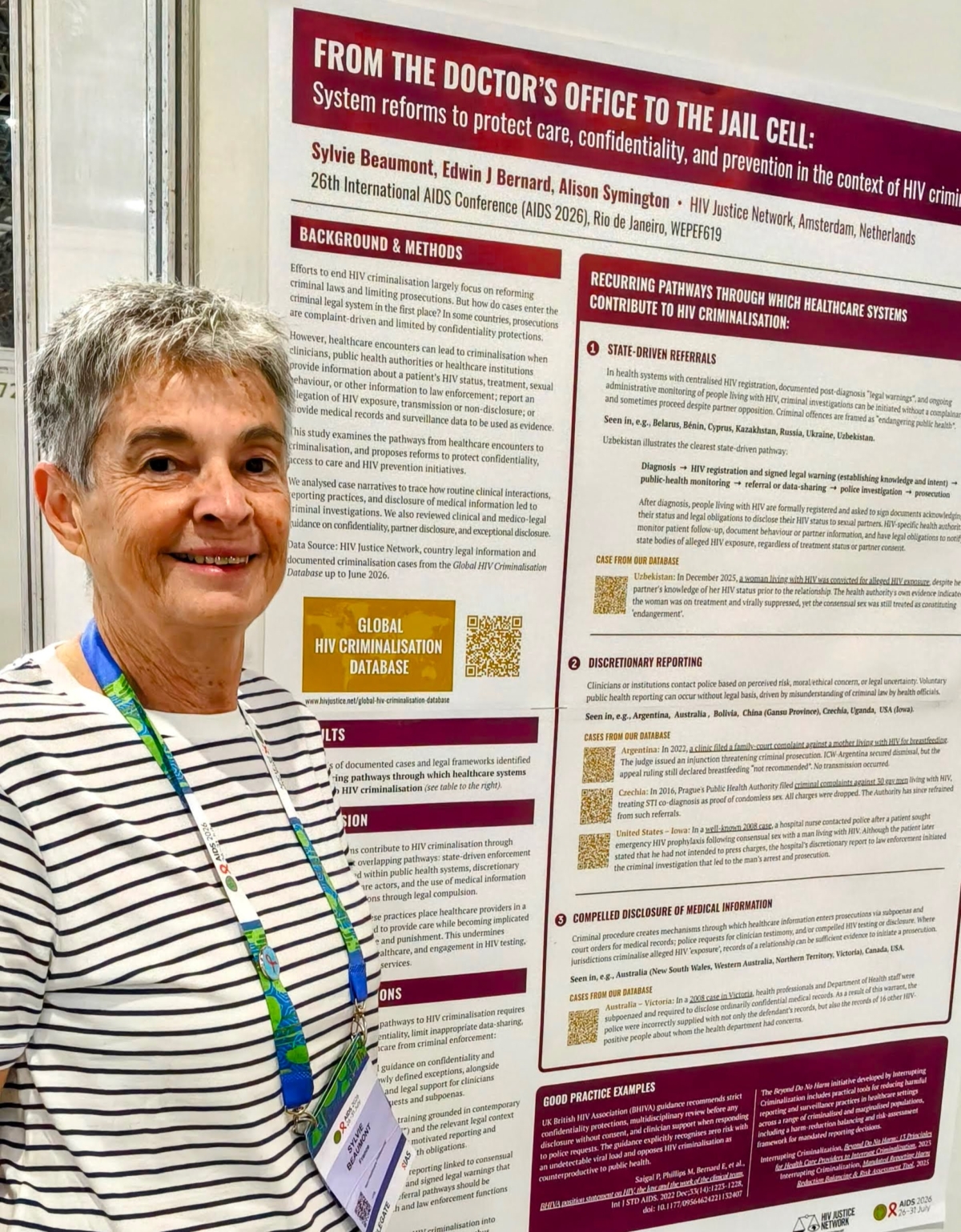
Healthcare should be a place of care, trust and confidentiality. But our new research presented at the 26th International AIDS Conference (AIDS 2026) shows that, in many countries, routine interactions with healthcare providers and public health systems instead become the starting point for criminal investigations against people living with HIV.
Our poster, From the doctor’s office to the jail cell: System reforms to protect care, confidentiality, and prevention in the context of HIV criminalisation, examines how healthcare systems contribute to HIV criminalisation and identifies practical reforms that can better protect both public health and human rights.
Most discussions about HIV criminalisation focus on criminal laws themselves. We wanted to understand something that receives far less attention: how cases reach police and prosecutors in the first place.
Drawing on documented cases from our Global HIV Criminalisation Database, alongside legal and clinical guidance from multiple countries, we identified three recurring pathways through which healthcare systems contribute to criminalisation.
The first involves state-driven referral systems. In countries with centralised HIV registration, mandatory legal warnings, and ongoing monitoring of people living with HIV, health authorities can initiate criminal investigations without any complaint from a partner. Uzbekistan provides perhaps the clearest example, where HIV diagnosis, registration and routine public health monitoring create a direct pathway to prosecution.
The second pathway is discretionary reporting by healthcare workers or institutions. Our analysis documents cases where clinicians or health authorities contacted police based on misunderstanding of the law, perceived ethical obligations or concerns about risk, even where no legal duty existed. Examples include Argentina, where a clinic reported a mother living with HIV to family court for breastfeeding, and Iowa in the United States, where a hospital’s report to police led to a criminal prosecution despite the complainant later saying they had not intended to pursue charges.
The third pathway is compelled disclosure of confidential medical information. Even where healthcare providers do not initiate investigations, criminal procedures often require disclosure of medical records, compel clinicians to testify, or force HIV testing and disclosure. In one Australian case, police warrants resulted not only in the defendant’s records being released, but also the confidential records of sixteen other people living with HIV.
These pathways place healthcare professionals in an impossible position. They are expected to provide confidential, patient-centred care while simultaneously becoming part of systems of surveillance and punishment. This undermines trust in healthcare, discourages HIV testing and treatment, and ultimately weakens public health.
Importantly, our research also highlights examples of good practice. The British HIV Association’s position statement recommends strict confidentiality protections, multidisciplinary review before any disclosure without consent, and explicitly recognises that people with an undetectable viral load pose zero risk of sexual HIV transmission. We also highlight the Beyond Do No Harm initiative developed by Interrupting Criminalization, which provides healthcare workers with practical tools to minimise unnecessary criminalisation while meeting legitimate legal obligations.
Our research also reinforce the recommendations of the HIV BASIC (Building Access to Services through Improved Care) consensus statement, which calls on healthcare professionals to avoid practices that contribute to HIV criminalisation and instead promote confidential, rights-based care.
“Our findings show that ending HIV criminalisation isn’t only about changing criminal laws,” said Sylvie Beaumont, lead author of the study. “We also need reforms that protect medical confidentiality, support healthcare workers, and clearly separate healthcare from law enforcement.”