UK: Law Commission considers HIV criminalisation in great depth, but recommends no change for HIV/STI prosecutions in England & Wales, pending a wider review

Following a scoping consultation which ran from autumn 2014 to spring 2015, the Law Commission (of England and Wales) has now published its report containing their final recommendations to the UK Government.

It recommends the adoption of a modified version of a 1998 draft Bill to replace the outdated Offences Against the Person Act 1861.

However, whereas the 1998 Bill only criminalised intentional disease transmission, their recommendation is to keep the existing law relating to HIV and other serious diseases ((based on Dica and Konzani and clarified through prosecutorial policy and guidelines) which criminalises reckless as well as intentional disease transmission, pending a wider review.

Both in the scoping consultation paper and in this report, we have considered the criminalisation of disease transmission at great length. Many consultees supported fundamental reform of the law in this area. However, we conclude that the issues were more complex than time or space allowed without delaying the main aim of reforming the law of offences against the person. For this reason, we suggest modifications to the draft Bill to preserve the present position pending a wider review involving more input from healthcare professionals and bodies.

The full report, (chapter six: ‘transmission of disease’ is excerpted in full below), includes a detailed discussion of their proposals and the responses of 35 concerned stakeholders (most of them experts in law, public health and human rights. The HIV Justice Network was one of them, and our opinions are quoted throughout.)

The entire report is of interest not just to those working on this issue in England & Wales, but globally.  It rehearses, in great detail, nearly all of the arguments for and against HIV (and other STI) prosecutions, and finds that “there is a strong body of opinion, especially in the medical profession and groups concerned with HIV and sexually transmissible infections, that the transmission of these diseases should never be criminal unless done intentionally.”

The report helpfully summarises the five main arguments against overly broad HIV criminalisation:

(1)  an offence of reckless transmission encourages people to choose not to be tested, so as not to have the awareness of risk that might constitute recklessness;

(2)  it discourages openness with (and by) medical professionals, because they may have to give evidence against their patients;

(3)  it encourages people to think that disclosure of HIV status is always a duty, and that if a potential partner has not mentioned his or her status then he or she is not infected;

(4)  because of the difficulty of proving transmission, the existence of the offence leads to very wide-ranging and intrusive investigations affecting a great many people, out of all proportion to the small number who will be found deserving of prosecution; and

(5)  the whole topic of HIV/AIDS is affected by an atmosphere of fear (often irrationally so), and there is still an undesirable stigma against people.

Nevertheless, although the report states that “it would be preferable to revert to the law as it stood in 1998” when prosecutions were not possible and to use the draft 1998 Bill as it stands (which would only criminalise the intentional transmisison of disease), it comes to a more conservative conclusion.

The discussion of this issue has almost exclusively concerned the transmission of disease by consensual sexual intercourse, and the transmission of HIV in particular. (Also, most of the evidence for the harmful effects of criminalisation is drawn from countries where there are specific offences concerned with HIV and STIs, and may not be relevant to the use of general offences of causing injury.) The same reasoning may well not apply to other diseases and other means of transmitting them, but the draft Bill excludes disease as a whole.

For these reasons, on the evidence we have we do not feel justified in recommending a change to the position in existing law, in which the reckless transmission of disease is in principle included in an offence of causing harm. If there is to be a change, this should follow a wider review which compares the position in different countries and gives full consideration to the transmission of diseases other than by sexual means.

Of note, and of global relevance, following a great deal of discussion (and a broad range of consultation responses) regarding whether not to create an HIV/STI-specific law and/or broaden the scope of the current law to include non-disclosure and/or potential or perceived exposure, the Law Commission is clear.

We do not recommend the creation of specific offences concerned with disease transmission, either in relation to disease in general or in relation to HIV and STIs in particular: this too would require a wider review of all the available evidence. Nor do we recommend an offence of putting a person in danger of contracting a disease, or an offence of failing to disclose an infection to a sexual partner.

Law Commission Scoping Report: TRANSMISSION OF DISEASE (November 2015)

New IAPAC guidelines to achieving 90-90-90 targets recommend ending HIV criminalisation

New guidelines from the International Association of Providers of AIDS Care (IAPAC) are the first to highlight that HIV criminalisation is a critical barrier to optimising the HIV care continuum.

Currently only half of people living with HIV globally are aware of their status. Of the remaining 50% many are not yet engaged in care, receiving antiretroviral therapy (ART) in a timely manner or – the ultimate goal of HIV treatment and prevention – achieving sustained viral suppression.

These new guidelines are the first to include HIV criminalisation as one of eight key critical barriers that prevent people living with HIV from enjoying both the therapeutic and preventive effects of ART.

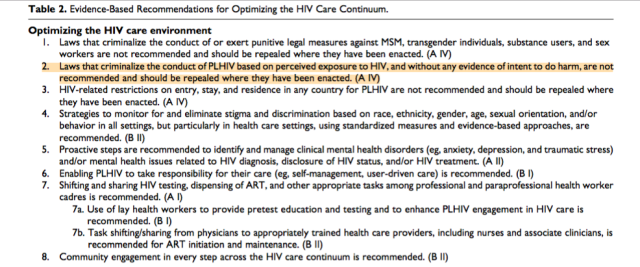
Screenshot 2015-11-06 11.49.50In many settings, optimizing the HIV care environment may be the most important action to ensure that there are meaningful increases in the number of people who are tested for HIV, linked to care, started on ART if diagnosed to be HIV positive, and assisted to achieve and maintain long-term viral suppression. Overcoming the legal, social, environmental, and structural barriers that limit access to the full range of services across the HIV care continuum requires multistakeholder engagement, diversified and inclusive strategies, and innovative approaches. Addressing laws that criminalize the conduct of key populations and supporting interventions that reduce HIV-related stigma and discrimination are also critically important. People living with HIV also require support through peer counseling, education, and navigation mechanisms, and their self-management skills reinforced by strengthening HIV literacy across the continuum of care.

The full HIV criminalisation recommendation (Recommendation 2) is below.

  • Recommendation 2: Laws that criminalize the conduct of PLHIV based on perceived exposure to HIV, and without any evidence of intent to do harm, are not recommended and should be repealed where they have been enacted. (A IV)

Numerous countries have enacted laws that criminalize behaviors associated with HIV exposure, many of which pose a low or negligible HIV transmission risk. No differences in behavior have been noted between settings that enact such laws and those that do not. Many of these laws do not take into account measures that reduce HIV transmissibility, including condom use, and were enacted before the preventive benefit of ART or antiretroviral (ARV)-based preexposure prophylaxis (PrEP) was fully characterized. Most PLHIV who know their status take steps to prevent transmitting HIV to others.HIV-specific laws thus primarily exacerbate HIV-related stigma and decrease HIV service uptake.

IAPAC Guidelines for Optimizing the HIV Care Continuum for Adults and Adolescents

Canada: Academic article explores problematic police and media practices relating to allegations of HIV non-disclosure, proposes solutions

Kyle Kirkup explores Canadian police and media practices that stigmatize people living with HIV (PLWH) and facilitate the public’s belief that HIV and PLWH are dangerous. In support, Kirkup analyzes the 2010 case of an Ottawa man living with HIV arrested for sexual assault, which involved the public release of the man’s identity, photo, sexual health, and sexual encounters in an article headlined “Have you had sex with this man?”

The ensuing discourse of gay male sexuality using tropes from the HIV epidemic in the 80s illustrates, Kirkup argues, how a lack of police and media regulation and education continue to produce a punitive and isolating environment for PLWH.

Kirkup proposes several strategies for reform, including expanding publication bans and non-disclosure legislation, changing police ethics to keep private information out of the hands of journalists, educating journalists and public officials about the medial realities of HIV transmission risk and medical prognosis, and abandoning the “aggravated sexual assault” charge based on HIV status.

Canada: New film explores the impact of using sexual assault law to prosecute HIV non-disclosure

This week sees the release of an important new short film from the Canadian HIV/AIDS Legal Network.

Consent: HIV non-disclosure and sexual assault law interrogates whether criminalising HIV non-disclosure does what the Supreme Court of Canada believes it does – protect sexual autonomy and dignity – or whether, in fact, it does injustice both to individuals charged and to the Canadian criminal justice system’s approach to sexual violence.

Produced together with Goldelox Productions, with whom the Legal Network also collaborated on their powerful 2012 documentary’ Positive Women: Exposing Injustice, this 28-minute film features eight experts in HIV, sexual assault and law whose commentary raises many questions about HIV-related legal developments in Canada.

At a time when society seems to be taking the prevalence of sexual

violence and rape culture more seriously, this film dares to ask some

difficult questions about its limits in the law. The law of sexual

assault is intended to protect women’s sexual autonomy, equality

and dignity, yet as applied with respect to alleged HIV non-disclosure,

these values are not necessarily being advanced. Through expert

testimonies, Consent shines a light on the systemic obstacles women

face in disclosing their HIV status, points to the dangerous health

and human rights outcomes of applying such a harsh charge as

aggravated sexual assault to HIV non-disclosure, and makes the

argument that the law needs to better protect those who are living

with and vulnerable to HIV. Consent demonstrates that advocacy

efforts opposing the overly broad criminalization of HIV non-disclosure

must address the use of sexual assault law and that such efforts must

do so alongside feminist allies.

From: http://www.consentfilm.org/about-the-film/

The Canadian HIV/AIDS Legal Network has for some time been exploring the implications of using sexual assault law to prosecute HIV non-disclosure cases, given the marked differences between the types of conduct that are typically referred to as sexual assault (including rape) and HIV non-disclosure cases.

In April 2014, the Legal Network convened leading feminist scholars, front-line workers, activists and legal experts for a ground-breaking dialogue on the (mis)use of sexual assault laws in cases of HIV non-disclosure. Consent: HIV non-disclosure and sexual assault law was filmed during this convening.

Their analysis demonstrates that the use of sexual assault law in the HIV non-disclosure context – where the sexual activity is consensual other than the non-disclosure – is a poor fit and can ultimately have a detrimental impact on sexual assault law as a tool to advance gender equality and renounce gender-based violence.

The Consent website ( in English / in French ) also lists future screenings across Canada, which will be accompanied by panels and workshops, as part of an ongoing strategy to build up allies among women’s rights advocates for the longer-term work.

A discussion guide will also soon be available.

Is Louisiana's 'AIDS exposure' statute outdated? Advocates say it needs an update

Richard Covington of Baton Rouge was accused earlier this year of breaking into the house of someone who apparently owed him money and then fighting the resident. During the scuffle, Covington allegedly bit the man’s arm.

Uganda: Community Health Alliance Uganda (CHAU) board chairman, Dr Stephen Watiti calls for repeal of clauses on disclosure, mandatory testing and transmission in HIV and AIDS Prevention and Control Act

Community Health Alliance Uganda (CHAU) board chairman, Dr Stephen Watiti, has called for an amendment of the 2014 HIV and AIDS Prevention and Control Act.

Watiti, who was speaking at the launch of CHAU’s 2016-2020 Strategic Plan last week in Kampala, wants clauses on disclosure, mandatory testing and intentional transmission repealed.

CHAU is one of the local non-governmental organizations (NGOs) involved in anti-HIV/Aids campaigns in the country. Enacted last year amidst protests from civil society and activists, the HIV and AIDS Prevention and Control Act criminalizes intentional transmission of HIV, enforces mandatory testing and requires spouses to disclose results to their partners, among others.

“In most of our communities if a woman tested positive and told her husband as stipulated in this law, it sparks domestic violence and stigmatization. So, my appeal is to review and scrap such clauses,” said Watiti, also plans to join elective politics in his bid to push for the aforesaid changes in parliament next year.

He also noted that it would be difficult to prove whether someone set out to intentionally infect their partners in a love affair.

“Preventing new infections should be a responsibility of both HIV positive and negative people,” Watiti argued, adding that testing should be voluntarily because making it mandatory is a violation of human rights.

His comments were directed to chief guest at the function, Dr Chris Baryomunsi, the state minister for health in charge of general duties and also MP for Kinkiizi East.

In response, Baryomunsi assured guests the parliamentary health committee would consider such appeals upon reviewing the HIV/Aids Act and also address concerns about the NGO Bill, which many civil society activists claim is intended to curtail their work.

Noting that some NGOs such as CHAU have done a good job as government partners in the battle against HIV/Aids, Baryomunsi said they would consider progressive provisions to ensure work is not stifled.

Baryomunsi explained that the law is intended to clamp down on NGOs that registered to health-related work but deviate from their mandate along the way.

Baryomunsi lauded the organization for its work of supporting people living with HIV in 20 districts including Kayunga, Luweero, Nakasongola, Mukono, Wakiso, Kamuli, Mayuge, Mityana, Gulu and Mbarara.

CHAU also provides family planning and sexual reproductive health education services.

Prison time for HIV?

Prison time for HIV? It’s possible in Veracruz

El Daily Post, August 6th 2015

New legislation passed by the Veracruz state Congress calls for up to five years in prison for “willfully” infecting another with HIV, which can lead to AIDS. The measure is fraught with legal, medical, public health and human rights problems, but supporters insist it will help protect vulnerable women.


The Veracruz state Congress has unanimously approved legislation that calls for prison time for anyone who intentionally infects another person with the HIV virus or other sexually transmitted diseases.

The amendment to the state penal code makes Veracruz the second Mexican state (after Guerrero) to criminalize the sexual transmission of illnesses. Another 11 states have sanctions in the books for infecting others with “venereal diseases,” a term and concept no longer used in the medical community.

But Veracruz has stipulated a more severe punishment than the other states — from six months to five years in prison. Guerrero also has a maximum of five years, but it’s minimum is three months.

The bill was promoted by Dep. Mónica Robles Barajas, a member of the Green Party, which is allied with the ruling Institutional Revolutionary Party. She said the legislation is aimed at protecting women who can be infected by their husbands.

“It’s hard for a woman to tell her husband to use a condom,” she said in an interview with the Spanish-language online news site Animal Político.

The legislation, however, raises serious questions, both legal and medical, as well as concerns about human rights.

The most obvious problem is the notion of “intentional” infection. Robles emphasizes that the bill is based on a “willful” passing of the virus, which she defines as a carrier having sexual relations when he or she is aware of his or her HIV infection.

But the notion of intentionality in such cases is a complicated one for prosecutors, legal experts say. The he-said/she-said factor can be a sticking point, according to Luis González Plascencia, a former head of the Mexico City human rights commission, with the accusation likely to be based on one person’s testimony.

“There could be ways to show through testimony that there was an express intention to infect,” González told Animal Político. “But that’s always going to be circumstantial.”

A likely abuse of the law, he said, is attempted revenge or blackmail. An angry spouse or other partner can, with a simple declaration, create a legal nightmare.

Even if the issue of intentionality can be overcome, the very notion of criminalizing HIV infection is controversial. AIDs and human rights experts are against it.

One of them is Ricardo Hernández Forcada, who directs the HIV-AIDS program at Mexico’s National Human Rights Commission (CNDH). International experience, he says, indicates that punitive policies accomplish little besides government intrusion into private life. (Eastern Europe and Southeast Asia are regions where laws similar to the new one in Veracurz have existed.)

A Veracruz non-governmental organization called the Multisectoral HIV/AIDS Group issued a communiqué in response to the new legislation, declaring, “Scientific evidence shows that legislation and punishment do not prevent new infections, nor do they reduce female vulnerability. Instead, they negatively affect public health as well as human rights.”

González concurred. “The only thing that’s going to happen is that there will be another crime in the penal code that won’t accomplish anything except generate fear,” he said.

The Multisectoral Group also pointed out a disconnect between the law and medical science. It’s  virtually impossible, the group says, to determine with certainty who infected whom with a sexually transmitted disease.

“Phylogenetic analyses alone cannot determine the relationship between two HIV samples,” the group said in its release. “They cannot establish the origin of an infection beyond a reasonable doubt, or how it occurred, or when it occurred.”

Robles, for her part, objects to the notion that the legislation criminalizes HIV carriers, insisting that the target is the intentional infection of another through sex. She emphasized that the aim of the new law is to protect women, who are often in a vulnerable situation.

“It’s directed much more at protecting women than homosexual groups,” she said. “There is a high incidence among women because there is no awareness of the risk they run.”

Opponents, however, see the new law as a step backward for men and women, and for public health in general, insisting that penalization comes at the expense of prevention.

“Knowing that they could be at risk of prosecution, people won’t get tested,” the CNDH’s Hernández Forcada said. “These measures inhibit people’s will to know their diagnosis.”

AFAO Policy Analyst Michael Frommer highlights the many types of anti-HIV criminalisation advocacy undertaken by the Canadian HIV/AIDS Legal Network

The 8th IAS Conference on HIV Pathogenesis, Treatment and Prevention (IAS 2015) is on in Vancouver, Canada, this week. AFAO Policy Analyst Michael Frommer reports back on the pre-conference community forum. 

Key human rights challenges, such as criminalisation of HIV transmission, were centre stage at the IAS community forum on Saturday 18 July.

Alison Symington, co-director of Research and Policy at the Canadian HIV/AIDS Legal Network (Legal Network), described the challenge of advocacy and policy work in Canada in the face of ongoing criminalisation.

Aside from the significant justice issues when charges are laid for HIV non-disclosure, exposure or transmission, she also identified the serious of issue of people threatening their partners with an allegation, when there is relationship conflict, and how this in particular affects women who may be in abusive relationships.

In Canada, as in Australia, most of the people charged to date have been male heterosexuals, with a strong racialised element – mainly Black men. Since the mid-1990s, there has been an increase in the proportion of gay men charged.

Despite the fact that men make up the majority of those charged, Alison has investigated the pernicious effects of criminalisation on women. She explained how the ‘informal’ criminalisation of HIV positive mothers works, with their sense that their parenting is being under surveillance.

She outlined a huge range of advocacy and policy activities being undertaken by the Legal Network in response.

1) Legal defence strategy and intervention

Tactics include contacting the defence lawyers of individuals who have been charged with criminalisation related offences. The Legal Network also intervenes in the formal court proceedings and provides relevant scientific evidence.

2) Campaigns and advocacy

This has involved the Legal Network’s participation in the ‘Stop the Witch Hunt’ campaign targeting prosecutors, undertaken in collaboration with the AIDS Action Now. Legal Network staff also sit in court during trials, to make clear to judges/prosecutors that the community is monitoring developments.

3) Raising awareness/education

This education work is targeted at raising understanding among judges and among the community.

4) Working with doctors/scientists

A key piece of work was the Canadian Scientist Statement on HIV transmission risk. The Legal Network organised for 70 leading scientists from across Canada to sign this document which explained clearly the actual levels of risk of HIV transmission.

5) Distinguishing between HIV non-disclosure and sexual assault

HIV non-disclosure/exposure/transmission charges in Canada are made under the Canadian criminal law as an aggravated charge using the sexual assault provisions. The Legal Network aims to work with domestic violence/feminist organisations to ensure that HIV-related jurisprudence does not circumvent the appropriate application of sexual assault laws.

6) Prosecutorial guidelines

This has been an ongoing area of work across Ontario, Quebec and British Columbia. Ontario most recently advocated for the adoption of guidelines, but without adequate community input the Government drafted guidelines were dropped. There is still a desire to pursue appropriately formulated guidelines in future.

Marama Pala (in the audience) highlighting Australia’s public

health response to MC Dazon Dixon Diallo.

The comprehensive advocacy and policy response taken by the Canadian Legal Network is extremely impressive.

With one of, if not the highest rates per capita of criminalisation in the world, it is obviously very necessary in the Canadian context.

While some circumstances differ, there are a great many ideas that may be drawn upon for responding to HIV criminalisation in the Australian context.

UNAIDS Reference Group on HIV and Human Rights updates statement on HIV testing to include the “key trend” of “prolific unjust criminal laws and prosecutions”

The UNAIDS Reference Group on HIV and Human Rights has updated its statement on HIV testing  — which continues to emphasise that human rights, including the right to informed consent and confidentiality, not be sacrifced in the pursuit of 90-90-90 treatment targets — in the light of “three key trends that have emerged since the last statement regarding HIV testing was issued by the UNAIDS Reference Group (in 2007).”

One of these is “prolific unjust criminal laws and prosecutions, including the criminalization of HIV non-disclosure, exposure, and transmission.” The other two involve the recognition that HIV treatment is also prevention, and policies that aim to “end the AIDS epidemic as a public health threat by 2030.”

This statement is an important policy document that can be used to argue that public health goals and human rights goals are not mutually exclusive.

The Reference Group was established in 2002 to advise the Joint United Nations Programme on HIV/AIDS (UNAIDS) on all matters relating to HIV and human rights. It is also fully endorsed by by the Global Fund to Fight AIDS, Tuberculosis and Malaria Human Rights Reference Group.

This statement is issued at a time when UNAIDS and the Global Fund are renewing their strategies for 2016–2021 and 2017–2021, respectively.

To support these processes, the Reference Groups offer the following three key messages:

1. There is an ongoing, urgent need to increase access to HIV testing and counselling, as testing rates remain low in many settings. The Reference Groups support such efforts unequivocally and encourage the provision of multiple HIV testing settings and modalities, in particular those that integrate HIV testing with other services.

2. Simply increasing the number of people tested, and/or the number of times people test, is not enough, for many reasons. Much greater efforts need to be devoted to removing barriers to testing or marginalized and criminalized populations, and to link those tested with prevention and treatment services and successfully keep them in treatment.

3. Public health objectives and human rights principles are not mutually exclusive. HIV testing that violates human rights is not the solution. A “fast-track” response to HIV depends on the articulation of testing and counselling models that drastically increase use of HIV testing, prevention, treatment, and support services, and does so in ways that foster human rights protection, reduce stigma and discrimination, and encourage the sustained and supported engagement of those directly affected by HIV.

The section on HIV criminalisation is quoted below.

The criminalization of HIV non-disclosure, exposure, and transmission is not a new phenomenon, but the vigour with which governments have pursued criminal responses to alleged HIV exposures — at the same time as our understanding of HIV prevention and treatment has greatly advanced, and despite evidence that criminalization is not an effective public health response — causes considerable concern to HIV and human right advocates. In the last decade, many countries have enacted HIV-specifc laws that allow for overly broad criminalization of HIV non-disclosure, exposure, and transmission. This impetus seems to be “driven by the wish to respond to concerns about the ongoing rapid spread of HIV in many countries, coupled by what is perceived to be a failure of existing HIV prevention efforts.” In some instances, particularly in Africa, these laws have come about as a response to women being infected with HIV through sexual violence, or by partners who had not disclosed their HIV status.

Emerging evidence confrms the multiple implications of the criminalization of HIV non-disclosure, exposure, and transmission for HIV testing and counselling. For example, HIV criminalization can have the effect of deterring some people from getting tested and finding out their HIV status. The possibility of prosecution, alongside the intense stigma fuelled by criminalization, is good reason for some to withhold information from service providers or to avoid prevention services, HIV testing, and/or treatment. Indeed, in jurisdictions with HIV-specific criminal laws, HIV testing counsellors are often obliged to caution people that getting an HIV test will expose them to criminal liability if they find out they are HIV-positive and continue having sex. They may also be forced to provide evidence of a person’s HIV status in a criminal trial. This creates distrust in relationships between people living with HIV and their health care providers, interfering with the delivery of quality health care and frustrating efforts to encourage people to come forward for testing.

The full statement, with references, can be downloaded here and is embedded below.

HIV TESTING AND COUNSELLING: New technologies, increased urgency, same human rights