Skip to content
HIV Justice Network
  • Facebook
  • Twitter
  • YouTube
  • Home
  • About
    • HIV Justice Network
    • Staff and Consultants
    • Supervisory Board
    • Global Advisory Panel
    • Our Policies
    • Our Funders
      • ANBI Status
  • News
    • By the HIV Justice Network
    • Curated from other sources
    • HIV JUSTICE NEWS (Newsletter)
  • Academy
  • Database
    • Overview
    • Laws and Analyses
    • Cases
    • Organisations
    • Disclaimer
  • Publications
  • Video
  • Contact Us
  • Donate
News curated from other sources

The public health implications of HIV criminalization: past, current, and future research directions

27 July 2015
Articles Social science Resources Research Public health
  • Twitter
  • Facebook
Source: Taylor & Francis

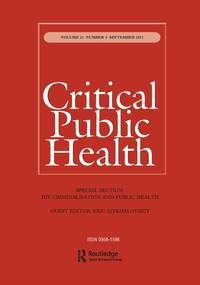
(2015). The public health implications of HIV criminalization: past, current, and future research directions. Critical Public Health: Vol. 25, Special Section: HIV Criminalisation and Public Health. Guest Editor: Eric Mykhalovskiy, pp. 373-385. doi: 10.1080/09581596.2015.1052731

This contains the following articles:

EDITORIAL

The public health implications of HIV criminalization: past, current, and future research directions

Eric Mykhalovskiy

Pages: 373-385

DOI: 10.1080/09581596.2015.1052731

RESEARCH PAPERS

HIV disclosure as practice and public policy

Barry D. Adam, Patrice Corriveau, Richard Elliott, Jason Globerman, Ken English & Sean Rourke

Pages: 386-397

DOI: 10.1080/09581596.2014.980395

Examining public health nurses’ documentary practices: the impact of criminalizing HIV non-disclosure on inscription styles

Chris Sanders

Pages: 398-409

DOI: 10.1080/09581596.2015.1019834

Keeping confidence: HIV and the criminal law from HIV service providers’ perspectives

Catherine Dodds, Matthew Weait, Adam Bourne & Siri Egede

Pages: 410-426

DOI: 10.1080/09581596.2015.1019835

Counselling anomie: clashing governmentalities of HIV criminalisation and prevention

Martin French

Pages: 427-440

DOI: 10.1080/09581596.2015.1046814

Criminalizing HIV transmission using model law: troubling best practice standardizations in the global HIV/AIDS response

Daniel Grace

Pages: 441-454

DOI: 10.1080/09581596.2015.1049121
News curated from other sources

New Zealand: Undetectable yet prosecutable, study highlights the need for law reform

Momentum for change on HIV criminalisation
February 20, 2026

Senegal: New bill further criminalises LGBT people as well as advocacy and funding with major implications for civil society

Government tightens repressive measures against ‘unnatural acts’: Advocacy now punishable by imprisonment
February 19, 2026

New Zealand: Government backs U=U, opening door to reform of HIV non-disclosure laws

Burnett Foundation Aotearoa welcomes the Government’s decision on U=U
February 16, 2026

Senegal: Following recent arrests, the National AIDS council calls for an approach based on science and human rights

The CNLS warns against judicial and social excesses
February 15, 2026

US: Ryan White’s mother calls for HIV law reform in Indiana

Decades after Ryan White, Indiana still criminalizes HIV
February 11, 2026

News by the HIV Justice Network

2025 in review: more reported cases, uneven reform

January 7, 2026

From Courtrooms to Communities:
Funding Advocacy to Sustain HIV Responses

November 12, 2025

Humanising the Law: Reflections on Two Decades of Advocacy Against HIV Criminalisation

September 26, 2025

Our 2024 Annual Report:
A Year of Progress, Challenge and Purpose

August 29, 2025

New global data reveals rising HIV criminalisation amid stalling legal reforms

July 15, 2025
  • Facebook
  • Twitter
  • YouTube
Disclaimer

This website operates as a global hub, consolidating a wide range of resources on HIV criminalisation for advocates working to abolish criminal and similar laws, policies and practices that regulate, control and punish people living with HIV based on their HIV-positive status. While we endeavour to ensure that all information is correct and up-to-date, we cannot guarantee the accuracy of laws or cases. The information contained on this site is not a substitute for legal advice. Anyone seeking clarification of the law in particular circumstances should seek legal advice. Read more

Registered office:
Stichting HIV Justice (HIV Justice Foundation), Korte Lijnbaanssteeg 1, Kamer 4007, 1012 SL Amsterdam, the Netherlands

You can select your preferred language from the 'Select Language' menu at the top of the page.

Continue

We use cookies to ensure that we give you the best experience on our website. By continuing to use our site, you are agreeing to our use of cookies. You can change your cookie settings at any time if you want. Find out more in our Privacy & Cookie Policy.

Accept Close