New Zealand: New research reveals how HIV criminalisation is experienced in Aotearoa

HIV decriminalisation in Aotearoa: Survey findings

For the first time in Aotearoa New Zealand, we have national evidence on how HIV criminalisation is experienced by people living with HIV.

This research captures the voices of 247 people from diverse communities across the country. It documents how criminal law, public health processes, stigma, and modern HIV science intersect in real life. The project was undertaken collaboratively by Positive Women Inc, Burnett Foundation Aotearoa, Body Positive, and Toitū te Ao, reflecting the shared commitment of all four organisations to amplifying community experiences and informing meaningful change.

The findings highlight the need for greater clarity, alignment with contemporary science, and thoughtful public conversation.

About the research

This study explores:

  • Awareness and understanding of criminal and public health law
  • Attitudes toward HIV criminalisation
  • The lived impact of legal uncertainty
  • The role of stigma in shaping legal and social outcomes
  • Recommendations informed by participant experience

Participants represented a wide range of ages, genders, sexualities, ethnicities, migration histories, and lengths of time living with HIV.

This research centers lived experience while grounding analysis in contemporary HIV science, including the evidence behind U=U (Undetectable = Untransmittable).

Key findings

1. Preference for public health management

Most participants would prefer public health manage their HIV transmission rather than the police – because HIV is a health issue, not a crime.

2. Attitudes are nuanced

Participants held diverse and layered views about criminalisation. Support was often linked to cases of intentional harm, while broader criminalisation raised concerns about fairness, stigma, and unintended consequences.

3. Impact extends beyond prosecutions

Even where prosecutions are rare, the possibility of criminalisation shapes behaviour, disclosure practices, relationships, and wellbeing.

4. Stigma remains central

Legal frameworks do not exist in isolation. Participants described how stigma around HIV influences both public perception and perceived legal risk.

Why this matters

Effective HIV responses must reflect:

  • Modern treatment science
  • Public health best practice
  • Human rights principles
  • The lived experience of people living with HIV

Clear, evidence-informed discussion is essential to ensuring legal and policy settings support – rather than undermine – public health outcomes.

Recommendations

The report identifies areas for consideration, including:

  • Clearer, accessible legal guidance
  • Greater alignment between law and contemporary HIV science
  • Stigma reduction through public education
  • Meaningful involvement of people living with HIV in future policy conversations

What happens next

Positive Women Inc, Burnett Foundation Aotearoa, Body Positive, and Toitū te Ao will:

  • Share these findings across health, legal, and policy sectors
  • Engage stakeholders in informed discussion
  • Continue centering lived experience in advocacy and education
  • Support accurate public understanding of HIV and the law

This report is a foundation for evidence-based dialogue in Aotearoa.

For media enquiries, contact Kirk Serpes at kirk.serpes@burnettfoundation.org.nz

Read the full report here

New Zealand: Undetectable yet prosecutable, study highlights the need for law reform

Momentum for change on HIV criminalisation

A study of people living with HIV has revealed that despite advances in HIV treatment, criminalisation continues to create uncertainty and distress, with 60% of people living with HIV fearing legal consequences and many avoiding relationships altogether.

The full study and its findings will be released at a public event on 27 February at 3 pm at the Ellen Melville Centre in Auckland, by Positive Women, Body Positive, Toitū te Ao and Burnett Foundation Aotearoa.

The study surveying 247 people living with HIV in New Zealand, highlights the urgent need for rules and practice to align with modern HIV science. Over half of participants reported anxiety about legal consequences, particularly around disclosing HIV or discussing sexual practices with healthcare service providers.

“This shows that people living with HIV want to see HIV transmission managed by Public Health authorities, and not the Police. We have one of the highest rates of HIV criminalisation per capita globally, with at least 14 prosecutions since 1993,” says Liz Gibbs CEO of Burnett Foundation Aotearoa.

“The Government’s decision to sign the U=U Call to Action at Big Gay Out 2026 is a great first step in bringing New Zealand into line with overseas best practices on how to manage HIV.”

U = U stands for Undetectable = Untransmittable (U=U). It means that a person living with HIV who is on effective treatment and maintains an undetectable viral load cannot transmit HIV to sexual partner(s).

“Currently people living with HIV may face prosecution under the Crimes Act for HIV non-disclosure to their sexual partners (unless they are using a condom), even if they are on treatment with an undetectable viral load and therefore pose zero risk of transmission,” says Gibbs.

New global data reveals rising HIV criminalisation amid stalling legal reforms

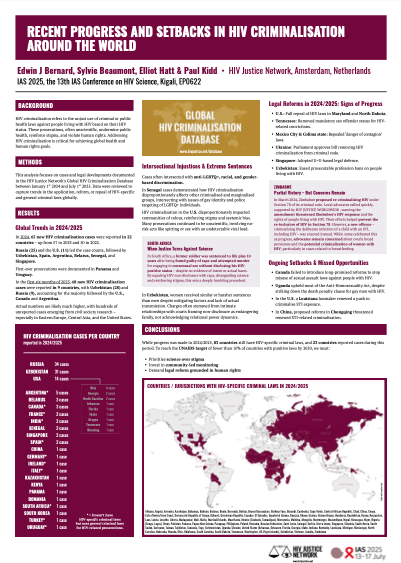
The HIV Justice Network published new data this week showing a troubling rise in the number of people criminalised for HIV non-disclosure, potential or perceived exposure, or unintentional transmission in 2024 and the first half of 2025. As legal reforms appear to be stalling, discriminatory prosecutions, harsh sentences, and misuse of outdated laws continue to impact people with HIV and the HIV response.

The figures, presented at the 13h IAS Conference on HIV Science (IAS 2025) in Kigali, Rwanda, are drawn from the Global HIV Criminalisation Database. The database documents criminal cases and legal developments involving HIV-specific or general criminal laws worldwide.

In 2024, at least 65 HIV criminalisation cases were reported across 22 countries – up from 57 in 2023 and 50 in 2022. Russia (25 cases) and the United States (11) led the global tally, followed by Uzbekistan, Spain, Argentina, Belarus, Senegal, and Singapore. For the first time, prosecutions were documented in Panama and Uruguay.

The upward trend continued into 2025, with 48 cases reported in just the first six months. Uzbekistan (28) and Russia (9) again accounted for the majority, alongside new cases in the U.S., Canada, and Argentina. However, the actual number of cases is likely much higher, particularly in Eastern Europe, Central Asia, and the United States, where civil society organisations report many cases go undocumented.

“These cases show that HIV criminalisation remains a global crisis,” said Edwin J. Bernard, Executive Director of the HIV Justice Network. “Far too often, people living with HIV are prosecuted not for causing harm, but simply for living with a health condition – often in ways that are unscientific, discriminatory, and deeply unjust.”

                 Download the poster by clicking on the image

The report highlights the intersection of HIV criminalisation with racism, homophobia, gender-based discrimination, and systemic inequality. In Senegal, for example, prosecutions have disproportionately targeted LGBTQ+ individuals. In the U.S., criminal laws continue to be weaponised against communities of colour, even in cases involving no risk of transmission – such as spitting, or sex with an undetectable viral load.

One of the most alarming cases occurred in South Africa, where a former soldier was sentenced to life plus ten years for rape and attempted murder after failing to disclose his HIV status to a consenting partner – despite no evidence of intent or actual transmission. Advocates warn that such cases equate HIV non-disclosure with sexual violence and undermine decades of public health and human rights gains.

Yet, amidst the setbacks, 2024/2025 also brought some signs of hope. Maryland and North Dakota fully repealed their HIV-specific laws, while Tennessee removed mandatory sex offender registration for HIV-related convictions. Mexico City and Colima repealed vague “danger of contagion” laws, and Ukraine’s parliament voted to remove HIV from its criminal code.

In Zimbabwe, community activism helped block a proposal to re-criminalise HIV transmission. However, a new law was introduced criminalising the deliberate transmission of STIs to children, including HIV – raising fears it could be used against mothers living with HIV, particularly in breastfeeding cases.

Despite these advances, HIV criminalisation remains widespread. A total of 83 countries still have HIV-specific laws, and 23 countries reported prosecutions in this period using either HIV-specific or general laws. The HIV Justice Network warns that without urgent action, the world is unlikely to meet UNAIDS’ target of reducing punitive laws to below 10% of countries by 2030.

“The path forward must be rooted in science, rights, and community leadership,” Bernard said. “We must end laws that punish people for their status, and instead build legal systems that support health, dignity, and justice.”


EPO622 Recent progress and setbacks in HIV criminalisation around the world by Edwin J Bernard, Sylvie Beaumont, and Elliot Hatt was presented at IAS 2025 by Paul Kidd at 13th IAS Conference on HIV Science in Kigali, Rwanda.


New case study and documentary examines how Zimbabwe repealed its HIV criminalisation law

Today, the HIV Justice Network (HJN), supported by the International AIDS Society (IAS), released a video documentary, “It is Time!” – How Zimbabwe Decriminalised HIV, along with a case study report examining Zimbabwe’s successful repeal of its HIV-specific criminal law.

The report, Reforming the Criminal Law in Zimbabwe: A Case Study, explores how advocates, legal experts, and community leaders worked together to repeal Section 79 of Zimbabwe’s Criminal Code, which criminalised HIV non-disclosure, exposure, or transmission. It outlines key strategies used in the campaign and lessons for other countries seeking to end HIV criminalisation.

The 24-minute documentary “It is Time!” brings this story to life through interviews with those involved in the multi-year effort. It also explores how advocates responded when a new law threatened to reintroduce HIV criminalisation.

Zimbabwe’s experience highlights several key strategies:

  • Coalition-building: Bringing together civil society, legal experts, and policymakers strengthened the advocacy effort.
  • Public health and human rights messaging: Advocates demonstrated how criminalisation undermined Zimbabwe’s HIV response.
  • Scientific evidence: Expert testimony helped policymakers understand the realities of HIV transmission.
  • Legislative strategy: Repealing Section 79 as part of a broader legal reform helped ensure success.

The documentary “It is Time!” is now available on the HIV Justice Network YouTube channel.

Reforming the Criminal Law in Zimbabwe: A Case Study (English, pdf, 9 pages) can be downloaded here.

The documentary and case study will also be added to the HIV Criminalisation Online Course, available for free as part of the HIV Justice Academy.

The case study and video were launched during a webinar co-hosted by HJN and IAS, featuring discussions on the significance of Zimbabwe’s law reform for the global movement against HIV criminalisation from:

  • Marlène​​​​ Bras, Director of HIV Programmes at the IAS;
  • Dr Ruth Labode, former legislator, and chairperson of the Parliamentary Portfolio Committee on Health in Zimbabwe;
  • Immaculate Owomugisha, a Ugandan lawyer and human rights activist who also sits on HJN’s Supervisory Board; and
  • HJN’s Senior Policy Analyst, Alison Symington.

A recording of webinar can now be viewed in English and in French on the IAS+ website.

IAS 2023: Five-year impact of Expert Consensus Statement – poster published today

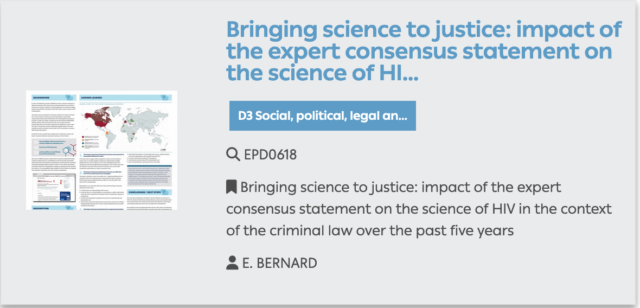
Today, 24th July, at the 12th IAS Conference on HIV Science on Brisbane, we presented our research findings on the five-year impact of the ‘Expert Consensus Statement on the Science of HIV in the Context of Criminal Law’.

Click on the image above to download the pdf of the poster

Tomorrow, 25th July, we will publish the full research report and discuss the findings on our live webshow, HIV Justice Live!

Hosted by HJN’s Executive Director, Edwin J Bernard, the show will include a discussion with the report’s lead author, HJN’s Senior Policy Analyst Alison Symington, as well as interviews with Malawian judge Zione Ntaba, Taiwan activist Fletcher Chui, and SALC lawyer Tambudzai Gonese-Manjonjo on the Statement’s impact.

We’ll also hear from some of the Expert Consensus Statement’s authors, including Françoise Barré-Sinoussi, Salim S Abdool Karim, Linda-Gail Bekker, Chris Beyrer, Adeeba Kamarulzaman, Benjamin Young, and Peter Godfrey-Faussett.

Ugandan lawyer and HJN Supervisory Board member Immaculate Owomugisha will also be joining us live from the IAS 2023 conference where she is serving as a rapporteur, to discuss the Statement’s relevance today.

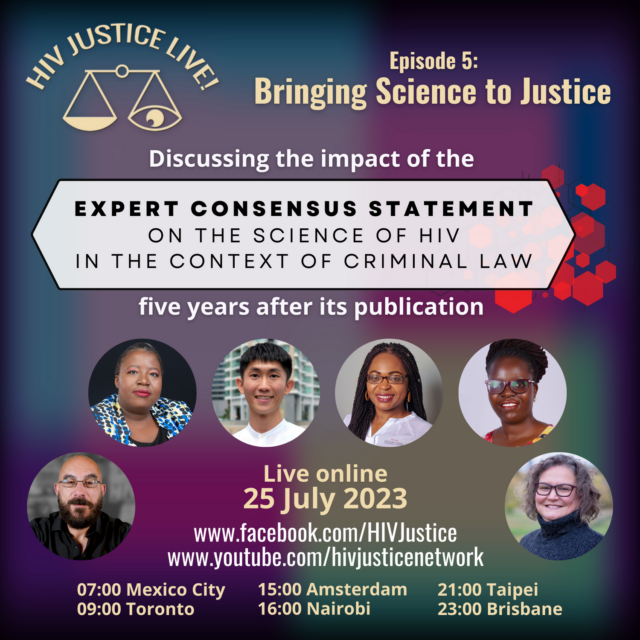
HIV Justice Live! Episode 5: Bringing Science to Justice will be live on Facebook and YouTube on Tuesday 25th July at 3pm CEST (click here for your local time).

Coming soon:
HIV Justice Live! Episode 5: Bringing Science to Justice

Five years ago, twenty of the world’s leading HIV scientists published the ‘Expert Consensus Statement on the Science of HIV in the Context of Criminal Law’ to address the misuse of HIV science in punitive laws and prosecutions against people living with HIV for acts related to sexual activity, biting, or spitting.

More than 70 scientists from 46 countries endorsed the Expert Consensus Statement prior to its publication in the Journal of the International AIDS Society (JIAS). The Statement was launched on 25th July 2018 at AIDS 2018, with the press conference generating global media coverage.

Building upon our initial 2020 scoping report, we recently undertook further extensive research to examine the impact of the Expert Consensus Statement in the five years since its publication.

On 25th July 2023 – exactly five years to the day of the original launch – we will not only be presenting our findings at the 12th IAS Conference on HIV Science (IAS 2023), we will also be launching the five-year impact report during our live webshow, HIV Justice Live!

Hosted by HJN’s Executive Director, Edwin J Bernard, the show will include a discussion with the report’s lead author, HJN’s Senior Policy Analyst Alison Symington, as well as interviews with Malawian judge Zione Ntaba, Taiwan activist Fletcher Chui, and SALC lawyer Tambudzai Gonese-Manjonjo on the Statement’s impact.

We’ll also hear from some of the Expert Consensus Statement’s authors, including Françoise Barré-Sinoussi, Salim S Abdool Karim, Linda-Gail Bekker, Chris Beyrer, Adeeba Kamarulzaman, Benjamin Young, and Peter Godfrey-Faussett.

Ugandan lawyer and HJN Supervisory Board member Immaculate Owomugisha will also be joining us live from the IAS 2023 conference in Brisbane, Australia where she is serving as a rapporteur, to discuss the Statement’s legacy and relevance today.

There will be opportunities to let us know the impact the Expert Consensus Statement has had in your advocacy and to ask questions live, so please save the date and time.

HIV Justice Live! Episode 5: Bringing Science to Justice will be live on our Facebook and YouTube pages on Tuesday 25th July at 3pm CEST (click here for your local time).