Misinformation is the real culprit in British Columbia HIV case
Police and media left out key details of HIV non-disclosure charges – By Niko Bell
The case of Brian Carlisle shows that when it comes to HIV, what you don’t know can hurt you.
Last summer, Mission RCMP reported that Carlisle, a 47-year-old marijuana activist, had been charged with three counts of aggravated sexual assault for not disclosing to his sexual partners that he has HIV. The RCMP posted Carlisle’s name and photo, asking for any other partners who might have been exposed to come forward.
At the time, the RCMP said that while they would not normally publish private medical information, “the public interest clearly outweighs the invasion of Mr Carlisle’s privacy.”
Xtra does not usually publish the names of people charged with HIV non-disclosure, but Carlisle has given permission to Xtra to publish his name and HIV status.
In the following months, three charges of aggravated sexual assault against Carlisle swelled into 12.
But the RCMP failed to mention a crucial fact: Carlisle couldn’t transmit the virus to anyone.
After studying thousands of couples over decades of research, HIV scientists around the world have reached the consensus that people with HIV who regularly take medication and achieve a suppressed viral load cannot transmit the virus through sexual contact. Like most HIV patients in British Columbia, Carlisle’s viral load was suppressed, so none of the women he had sex with were in any danger of contracting the virus.
Months after publicly disclosing his HIV status, Crown prosecutors stayed all charges against Carlisle. But it became stunningly clear that not only had the police not fully informed the public that Carlisle was uninfectious, they also hadn’t properly informed Carlisle’s alleged victims.
One woman who had sex with Carlisle told the CBC anonymously about going through PTSD, anxiety and depression, losing her job and going bankrupt because she thought she might have HIV.
Not only did the woman mistakenly think she could have contracted HIV, she also said she thought she still might become infected. Nine months after charges were laid against Carlisle, she told the CBC she still had to “wait one more year to know if I have HIV or not,” and that she was still taking HIV tests every three months to ensure the virus did not appear. She said she still avoids sexual relationships out of fear of having to disclose that she might have HIV.
This understanding of how HIV testing works is catastrophically wrong. Modern HIV testing technology, like that used by the BC Centre for Disease Control, catches 99 percent of new HIV infections only six weeks after a new infection. If even that window is too large, new technologies like RNA amplification, also used in BC, can cut the time down to only two weeks.
Even if Carlisle’s viral load had been high enough to transmit the virus, which it was not, the women he had sex with could have been given a clear bill of health only days after the RCMP knocked on their doors.
The CBC, however, did not correct the woman’s misinformation, and reported as fact that the women involved would have to undergo annual testing to make sure they do not have HIV.
Mission RCMP would not confirm at what point they discovered that Carlisle’s viral load was suppressed, or when they informed the women involved, because they say the investigation into Carlisle is still open. It’s also not clear who told the women they might be infected, or that they required yearly HIV testing.
Regardless what you think of Carlisle’s choice not to inform his sexual partners that he had HIV, and regardless whether you care about the publication of his name and HIV positive status, much of the psychological harm suffered by the women in Carlisle’s case was for nothing. Accurate medical information might have saved them months or years of anxiety, fear and isolation.
Carlisle’s case is an example of what many HIV experts say is a cycle of fear, stigma and misinformation surrounding HIV, propelled by police and prosecutors’ use of the criminal law against people who are HIV positive. Criminal prosecutions, experts say, make people less likely to seek medical help or get tested, and can increase the likelihood of new infections. One study found thathalf of the targets of HIV non-disclosure prosecutions are Black men, and nearly 40 per cent are men with male partners.
In December, a federal government report recommended that prosecutors should move away from the “blunt instrument” of the criminal law to handle HIV non-disclosure cases, and the government of Ontario announced it would stop prosecuting cases involving people with low viral loads. BC’s attorney general said in December he would also reconsider the province’s policy, but recent updates to the Crown counsel policy manual do not rule out prosecuting people whose viral load makes the virus intransmissible.
Regardless of the law, the least that the police and journalists can do is be honest and accurate about the actual risks involved in HIV cases. Carlisle’s case shows just how devastating ignorance can be.
The full ruling is not yet available, but according to a news story published yesterday in 24 Horas.
…it was pointed out that the criminal offense is “highly inaccurate” because it does not establish what or what is a serious illness, besides it is not possible to verify the fraud in the transmission [and] that although the measure pursued the legitimate aim of protecting the right to health, especially for women and girls, the measure did not exceed the analysis of need because it was not ideal and optimal for the protection of that purpose, especially as [Veracruz] already criminalised the ‘willful putting at risk of contagion of serious illnesses’…
The Minister President of the Court, Luis María Aguilar Morales, took up the recommendations of the Joint United Nations Program on HIV / AIDS and the Oslo Declaration on HIV Criminalisation, regarding the criminalization of HIV, and argued that this article left to the will of the investigating authority to decide which diseases will be considered as serious and which will not, going against the principle of legality, which implies that the crimes cannot be indeterminate or ambiguous.
In this case, the President said, the article did not establish whether STIs are only those considered serious or any, regardless of their severity. In turn, the justices determined that the resolution has a retroactive effect, that is, that those persons tried under the offense established by this article, the resolutions are invalidated.
Background
On August 4, 2015, the Congress of the State of Veracruz approved an amendment to Article 158 of the Criminal Code in order to add the term Sexually Transmitted Infections, which included HIV and HPV.
It provided for a penalty ranging from 6 months to 5 years in prison and a fine of up to 50 days of salary for anyone who “willfully” infects another person with a disease via sexual transmission.
The amendment, proposed by the deputy Mónica Robles Barajas of the Green Ecologist Party of Mexico, said the legislation was aimed at protecting women who can be infected by their husbands. “It’s hard for a woman to tell her husband to use a condom,” she said in an interview with the Spanish-language online news site Animal Político.
On February 16, 2016, the National Human Rights Commission responded to the request of the Multisectoral Group on HIV / AIDS and STIs of the state of Veracruz and other civil society organizations, and filed an action of unconstitutionality against the reform in the Supreme Court of Justice of the Nation, which it said does not fulfill its objective of preventing the transmission of sexual infections to women and girls, but rather creates discrimination of people living with HIV and other STIs.
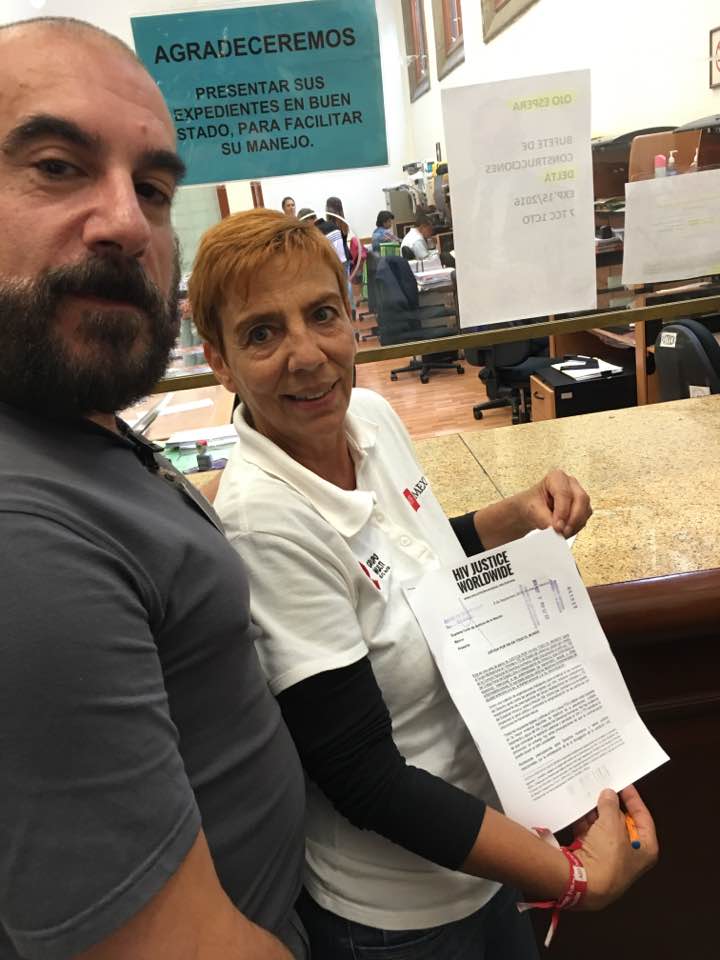
In October 2016, following a press conference at the National Commission on Human Rights (pictured above) that generated a great deal of media coverage, including a TV report, HIV JUSTICE WORLDWIDE delivered a letter to the Mexican Supreme Court highlighting that a law such as that of Veracruz does not protect women against HIV but rather increases their risk and places women living with HIV, especially those in positions vulnerable and abusive relationships, at disproportionate risk of both proseuction and violence.
We applaud the declaration of the Supreme Court of Justice of the Nation, which gives us the reason for the unconstitutionality request, shared with the National Commission of Human Rights; For this reason, we suggest to the deputies of the Congresses of the State that before legislating, they should be trained in the subject and that they do not forget that their obligation is to defend Human Rights, not to violate them.
Finally, the Mexican Network against the Criminalization of HIV recognizes that there are still many ways to go and many battles to fight, but we can not stop celebrating this important achievement.
Edwin Bernard (HIV JUSTICE WORLDWIDE) and Patricia Ponce (Grupo Multisectorial Veracruz) presenting the letter to Supreme Court of the Nation, Mexico City.
Read the English text of the HIV JUSTICE WORLWIDE amicus letter below.
HIV JUSTICE WORLDWIDE
This is a letter of support from HIV JUSTICE WORLDWIDE[1] to Grupo Multi VIH de Veracruz / National Commission of Human Rightswho are challenging Article 158 of Penal Code of the Free and Independent State of Veracruz that criminalises ‘intentional’ exposure to sexually transmitted infections or other serious diseases, on the grounds that this law violates a number of fundamental rights: equality before the law; personal freedom; and non-discrimination.
As a coalition of organisations working to end the overly broad use of criminal laws against people living with HIV, we respectfully share Grupo Multi VIH de Veracruz’s concerns around Article 158 which potentially stigmatises people with sexually transmitted diseases and criminalises ‘intentional’ exposure to sexually transmitted infections (potentially including HIV) or other serious diseases.
All legal and policy responses to HIV (and other STIs) should be based on the best available evidence, the objectives of HIV prevention, care, treatment and support, and respect for human rights. There is no evidence that criminalising HIV ‘exposure’ has HIV prevention benefits. However, there are serious concerns that the trend towards criminalisation is causing considerable harm.
Numerous human rights and public health concerns associated with the criminalisation of HIV non-disclosure and/or potential or perceived exposure and/or transmission have led the Joint United Nations Programme on HIV/ AIDS (UNAIDS) and the United Nations Development Programme (UNDP),[2] the UN Special Rapporteur on the right to health,[3] the Global Commission on HIV and the Law[4] and the the World Health Organization[5], to urge governments to limit the use of the criminal law to extremely rare cases of intentional transmission of HIV (i.e., where a person knows his or her HIV-positive status, acts with the intention to transmit HIV, and does in fact transmit it). They have also recommended that prosecutions [for intentional transmission] “be pursued with care and require a high standard of evidence and proof.” [6]
In 2013, UNAIDS produced a comprehensive Guidance Note to assist lawmakers understand critical legal, scientific and medical issues relating to the use of the law in this way.[7] In particular, UNAIDS guidance stipulates that:
“[I]ntent to transmit HIV cannot be presumed or solely derived from knowledge of positive HIV status and/or non-disclosure of that status.
Intent to transmit HIV cannot be presumed or solely derived from engaging in unprotected sex, having a baby without taking steps to prevent mother-to-child transmission of HIV, or by sharing drug injection equipment.
Proof of intent to transmit HIV in the context of HIV non-disclosure, exposure or transmission should at least involve (i) knowledge of positive HIV status, (ii) deliberate action that poses a significant risk of transmission, and (iii) proof that the action is done for the purpose of infecting someone else.
Active deception regarding positive HIV-status can be considered an element in establishing intent to transmit HIV, but it should not be dispositive on the issue. The context and circumstances in which the alleged deception occurred—including the mental state of the person living with HIV and the reasons for the alleged deception— should be taken into consideration when determining whether intent to transmit HIV has been proven to the required criminal law standard.”
Moreover, where criminal liability is extended to cases that do not involve actual transmission of HIV (contrary to the position urged by UNAIDS and other experts), such liability should, at the very bare minimum, be limited to acts involving a “significant risk” of HIV transmission. In particular, UNAIDS guidance contains explicit recommendations against prosecutions in cases where a condom was used, where other forms of safer sex were practiced (including oral sex and non-penetrative sex), or where the person living with HIV was on effective HIV treatment or had a low viral load. Being under treatment or using other forms of protections not only show an absence of malicious intent but also dramatically reduces the risks of transmission to a level close to zero. Indeed, a person under effective antiretroviral therapy poses – at most – a negligible risk of transmission[8] and is therefore no different from someone who is HIV-negative.
Moreover, there is growing body of evidence[9] that such laws that actually or effective criminalise HIV non-disclosure, potential or perceived exposure, or transmission, negatively impact the human rights of people living with HIV due to:
selective and/or arbitrary investigations/prosecutions that has a disproportionate impact on racial and sexual minorities, and on women.
confusion and fear over obligations under the law;
the use of threats of allegations triggering prosecution as a means of abuse or retaliation against a current or former partner;
improper and insensitive police investigations that can result in inappropriate disclosure, leading to high levels of distress and in some instances, to loss of employment and housing, social ostracism, deportation (and hence also possibly loss of access to adequate medical care in some instances) for migrants living with HIV in some cases;
limited access to justice, including as a result of inadequately informed and competent legal representation;
sentencing and penalties that are often vastly disproportionate to any potential or realised harm, including lengthy terms of imprisonment, lifetime or years-long designation as a sex offender (with all the negative consequences for employment, housing, social stigma, etc.);
stigmatising media reporting, including names, addresses and photographs of people with HIV, including those not yet found guilty of any crime but merely subject to allegations.
In addition, there is no evidence that criminalising HIV (or other sexually transmitted infections) help protect women and girls from infections.
Women are often the first in a relationship to know their HIV status due to routine HIV testing during pregnancy, and are less likely to be able to safely disclose their HIV-positive status to their partner as a result of inequality in power relations, economic dependency, and high levels of gender-based violence within relationships.[10]
Such a law does nothing to protect women from the coercion or violence that effectively increases the risk of HIV transmission. On the contrary, such laws place women living with HIV, especially those in vulnerable positions and abusive relationships, at increased risks of both prosecution and violence.
Some evidence suggests that fear of prosecution may deter people, especially those from communities highly vulnerable to acquiring HIV, from getting tested and knowing their status, because many laws only apply for those who are aware of their positive HIV status.[11] HIV criminalisation can also deter access to care and treatment, undermining counselling and the relationship between people living with HIV and healthcare professionals because medical records can be used as evidence in court.[12]
Finally, there is evidence[13] of an additional negative public health impact of such laws in terms of:
increasing HIV-related stigma, which has an adverse effect on a person’s willingness to learn about, or discuss, HIV; and
undermining the importance of personal knowledge and responsibility (correlative to degree of sexual autonomy) as a key component of an HIV prevention package, when instead prevention of HIV within a consensual sexual relationship is – and should be perceived as – a shared responsibility.
We hope that the Mexico Supreme Court of Justice takes our concerns and all of this evidence into account when considering the Constitutional Challenge.
Yours faithfully,
Edwin J Bernard, Global Co-ordinator, HIV Justice Network
on behalf of all HIV JUSTICE WORLDWIDE partners: AIDS and Rights Alliance for Southern Africa (ARASA); Canadian HIV/AIDS Legal Network; Global Network of People Living with HIV (GNP+); HIV Justice Network; International Community of Women Living with HIV (ICW); Positive Women’s Network – USA (PWN-USA); and Sero Project (SERO).
[1] HIV JUSTICE WORLDWIDE is an initiative made up of global, regional, and national civil society organisations working together to end overly broad HIV criminalisation. The founding partners are: AIDS and Rights Alliance for Southern Africa (ARASA); Canadian HIV/AIDS Legal Network; Global Network of People Living with HIV (GNP+); HIV Justice Network; International Community of Women Living with HIV (ICW); Positive Women’s Network – USA (PWN-USA); and Sero Project (SERO). The initiative is also supported by Amnesty International, the International HIV/AIDS Alliance, UNAIDS and UNDP.
[2] UNAIDS. Policy Brief: Criminalisation of HIV Transmission, August 2008; UNAIDS. Ending overly-broad criminalisation of HIV non-disclosure, exposure and transmission: Critical scientific, medical and legal considerations, May 2013.
[3] Anand Grover. Report of the Special Rapporteur on the right of everyone to the enjoyment of the highest attainable standard of physical and mental health, June 2010.
[4] Global Commission on HIV and the Law. HIV and the Law: Risks, Rights & Health, July 2012.
[5] WHO. Sexual health, human rights and the law. June 2015.
[6] Global Commission on HIV and the Law. HIV and the Law: Risks, Rights & Health, July 2012.
[7] UNAIDS. Ending overly-broad criminalisation of HIV non-disclosure, exposure and transmission: Critical scientific, medical and legal considerations, May 2013.
[8] A.J. Rodger et al., “Sexual activity without condoms and risk of HIV transmission in serodifferent couples when the HIV-positive partner is using suppressive antiretroviral therapy,” JAMA 316, 2 (12 July 2016): pp. 171–181.
[10] Athena Network. 10 Reasons Why Criminalization of HIV Exposure or Transmission Harms Women. 2009.
[11] O’Byrne P et al. HIV criminal prosecutions and public health: an examination of the empirical research. Med Humanities 2013;39:85-90 doi:10.1136/medhum-2013-010366
This 90 minute webinar introduced attendees to some of the concepts and practices highlighted in the Making Media Work for HIV Justice media toolkit, and featured formidable activists, journalists, communications professionals, and human rights defenders working at the intersection of media and HIV criminalisation.
New Toolkit Supports Advocates in Using Media to Fight for HIV Justice
The new resource is the latest addition to the HIV JUSTICE Toolkit, which provides resources from all over the world to assist advocates in approaching a range of advocacy targets, including lawmakers, prosecutors and judges, police, and the media.
The purpose of this critical media toolkit is to inform and equip global grassroots advocates who are engaged in media response to HIV criminalisation–and to demystify the practice of working with, and through, media to change the conversation around criminalisation.
“As advocates work to build community coalitions and consensus about the importance of limiting and ending HIV criminalisation, we need to articulate our common positions to the public and to decision-makers; thus, working with the media is critically important,” says Richard Elliott, Executive Director of the Canadian HIV/AIDS Legal Network and a member of the HIV JUSTICE WORLDWIDE Steering Committee. “Also, particularly in settings where sexual assault laws are used to criminalise people living with HIV, it is important to communicate via the media why this misuse of the criminal law is harmful to women.”
The toolkit provides an introduction to the topic of HIV criminalisation and the importance of engagement with media to change narratives around this unjust practice. The toolkit also includes reporting tips for journalists, designed to educate writers and media makers around the nuances of HIV criminalisation, and the harms of inaccurate and stigmatising coverage.
Positive Women’s Network – USA (PWN-USA), the HIV JUSTICE WORLDWIDE Steering Committee member organisation that produced the toolkit, has been working on HIV criminalisation for many years, and was an instrumental part of the coalition that brought HIV criminal law reform to the US state of California.
“With HIV rarely making front page news anymore, the highly sensationalised reporting of criminalisation cases–which most often contains little in the way of facts or science–paints a dehumanising picture of people living with HIV,” says Jennie Smith-Camejo, Communications Director for PWN-USA. “This kind of coverage can and does destroy real lives of those affected by HIV criminalisation laws, while fueling and feeding misinformation and stigma.”
The toolkit also includes a number of case studies providing examples of how media played a significant role in the outcome, or the impetus, of HIV criminalisation advocacy.
“I have been monitoring media coverage of speculations, arrests, prosecutions, and convictions of people living with HIV, and also legal and policy proposals for new laws and/or reform, for more than a decade,” notes Edwin J Bernard, Global Co-ordinator of the HIV Justice Network and a member of the HIV JUSTICE WORLDWIDE coalition. “It’s time for the injustice to end. ‘Making Media Work for HIV Justice’ is a long-overdue welcome addition to the HIV JUSTICE Toolkit, and an important step towards realising a world where people living with HIV are not singled out by the criminal justice system simply for having a virus.“
This 90 minute webinar introduced attendees to some of the concepts and practices highlighted in the toolkit, and featured formidable activists, journalists, communications professionals, and human rights defenders working at the intersection of media and HIV criminalisation.
About HIV JUSTICE WORLDWIDE
HIV JUSTICE WORLDWIDE is an initiative made up of global, regional, and national civil society organisations–most of them led by people living with HIV–who are working together to build a worldwide movement to end HIV criminalisation. All of the founding partners have worked individually and collectively on HIV criminalisation for a number of years.
HIV JUSTICE WORLDWIDE is run by a 10-member Steering Committee: AIDS Action Europe / European HIV Legal Forum; AIDS-Free World; AIDS and Rights Alliance for Southern Africa (ARASA); Canadian HIV/AIDS Legal Network; Global Network of People Living with HIV (GNP+); HIV Justice Network; International Community of Women Living with HIV (ICW); Positive Women’s Network – USA (PWN-USA); Sero Project (SERO); and Southern Africa Litigation Centre (SALC).
This playlist contains recordings of a training for lawyers on strategic litigation, legal defense and advocacy on HIV and TB justice from 20-23 February 2018 in Johannesburg, South Africa by the Southern Africa Litigation Centre (SALC), HIV Justice Worldwide, the Joint United Nations Programme on HIV/AIDS (UNAIDS), the Stop TB Partnership, the AIDS and Rights Alliance for Southern Africa (ARASA), and the Kenya Legal & Ethical Issues Network on HIV and AIDS (KELIN). The training was funded under the Africa Regional Grant on HIV: Removing Legal Barriers. Resources and more information on the training are available here: http://www.southernafricalitigationce… With thanks to Nicholas Feustel of Georgetown Media.
Webinar: PWN-USA HIV Criminalization First Responders Series: Combating Stigmatizing Reporting (PWN-USA, 2018)
The third and final webinar in the First Responder series focuses on working with the media. Hosted by Kamaria Laffrey (Sero) and featuring presentations from Carrie Foote (HIV Modernization Movement, Indiana) and Olivia G Ford (former PWN-USA Comms Dirctor).
UK: Avon and Somerset police statement over risk of HIV from spitting allegedly based on National Police guidelines
Police say false HIV claims over spitting were taken from national guidelines
Avon and Somerset Police still have not retracted their statement despite pressure from campaigners
The police force for Bristol and the surrounding areas say false claims made about the transfer of HIV were taken from national guidelines.
Avon and Somerset Police announced last year it would be introducing the use of spit guards in 2018 to remove the risk of officers catching diseases like the human immunodeficiency virus or hepatitis.
However, campaign groups were quick to point out HIV cannot be passed on through saliva and accused the force of “praying on people’s prejudices.”
The force did apologise for “any offence caused” to people living with HIV or Hepatitis B or C but still has not retracted the statements despite calls from campaigners to do so.
In January 24, a Freedom of Information request revealed no Avon and Somerset Police officers had caught an infection disease after being spat at since 2012/13.
When asked by the Bristol Post if the force would retract the statements about HIV, a spokesman said on January 25: “The information we used previously in the roll-out of spit guards was based on National Police Chiefs Council (NPCC) guidance.
“Following feedback from the public and consultation with local charities, Assistant Chief Constable Stephen Cullen asked the NPCC to seek medical opinion. As a result of ACC Cullen’s representations the NPCC has altered its guidance to forces.”
The Bristol wing of the HIV advocacy group ACTup! Launched a petition calling for the force to retract the statement.
A spokesperson for the group said officers deserve not to be spat at while working and the group is not calling for the recall of spit hoods but raised issues with the “poorly researched” press announcement.
On November 17 Avon and Somerset Policeannounced it would be introducing the use of ‘spit hoods’ across the force area from next year. The hoods made of mesh are shaped like a plastic bag and are put over the heads of suspects who had threatened to spit, have attempted to spit or have spat before.
The National Police Chiefs Council, which issues guidance to police forces across the UK, said the advice on spit guards has not changed since it published a report in March 2017, but specific guidance on HIV was sent to police forces after feedback was received by Avon and Somerset.
A spokesperson said: “Our position paper on this was published back in March last year and our overall position on this has not changed. However, after receiving feedback from colleagues in Avon and Somerset we wrote to forces to give specific guidance on HIV and spit guards – entirely in line with our position.”
The police chief’s council guidance on spit guards released in March last year says the national picture for blood-borne viruses like HIV affecting officers is “unclear “.
It adds: “There are annually a very significant number of officers who are receiving precautionary treatment to prevent blood-borne viruses initial following spitting and biting incidents. Some of this treatment is intrusive, debilitating and can have a significant impact on officers’ personal lives.”
The conclusion reads: “The NPCC position is that the risk of transfer of blood-borne viruses through spitting or biting is very low, however the impact of infection would be extremely high.”
HIV is found in many bodily fluids of a sufferer including semen, vaginal and anal fluids, blood and breast milk.
The disease is most commonly contracted through unprotected sex and the sharing of needles. NHSEngland states HIV cannot be contracted through saliva.
Here are guidelines for government authorities and media groups in handling cases and stories involving persons living with HIV
MANILA, Philippines – When agents of the Philippine Drug Enforcement Agency (PDEA) arrested 11 men in a drug bust at a hotel in Taguig City on Monday, November 27, the agency revealed more information than necessary during its press conference the following day.
Aside from announcing the raid yielded P387,000 worth of party drugs, PDEA showed mug shots of suspects and even mentioned that one of them is positive for HIV.
Immediately, mugshots photos of the suspects and keywords like “gay men,” “orgy,” and, “HIV” appeared in headlines and social media posts referring to the raid.
Netizens and advocates from the lesbians, gays, bisexuals, transexual, and queer (LGBTQ) community slammed the PDEA and media outlets that carried the angle for baring the mugshots and the disclosure of one’s HIV status. They argued that, by doing so, PDEA and the media outlets only helped perpetuate the stigma attached to the LGBTQ community and people living with HIV.
Unfortunately, this incident took place only 3 days before the world observes the World AIDS Day on Friday, December 1.
Guidelines for authorities
Disclosing to the media that one of the suspects tested positive for HIV was unnecessary, according to Senator Risa Hontiveros and several LGBTQ rights groups and advocates, like Dakila, Red Whistle, Pedal HIV, and UP Babaylan.
“While the use of prohibited drugs is illegal, their sexual orientation and HIV status are unimportant and should have been treated with utmost sensitivity and respect,” UP Babaylan said in a statement.
While PDEA has since apologized, Hontiveros said in a statement released on Wednesday, November 29, that PDEA and law enforcement agencies should train themselves on the ethics and protocols in the proper handling of persons living with the human immunodeficiency virus (PLHIV).
“I welcome PDEA’s apology, but we cannot ignore the mental and emotional damage already inflicted on the said person. Living with HIV is not a crime. Whatever legal and criminal charges he is facing, testing positive for HIV has nothing to do with them,” Hontiveros said.
Hontiveros added that government agencies like PDEA should be at the forefront when it comes to fighting the stigma attached to PLHIV.
“Our authorities should help in telling the public that the HIV-AIDS epidemic can be effectively addressed and that persons living with HIV should have their rights protected. Our authorities should not aid the further stigmatization of those living with the disease,” she added.
Media reporting
Advocates, on the other hand, chided media groups that carried the angle for their unethical and sensational reporting. According to them, media groups that unnecessarily highlighted the HIV reference violated the confidentiality clause stated in the Republic Act 8504 or the Philippines AIDS Prevention and Control Act of 1998.
Article 6 of the HIV law generally aims to promote confidentiality in handling all medical information, particularly the identity and status of PLHIV. (INFOGRAPHIC: How is HIV transmitted?)
In the Philippines, there are no clear guidelines and prohibition in media on HIV disclosure. Bills filed by Dinagat Island Representative Kaka Bag-ao and Senator Risa Hontiveros seek to address this gap by strengthening the confidentiality clause of the current HIV law.
Journalists should hold all decision makers to account.
Journalists should ensure that the voices and images of people living with and affected by HIV and AIDS are heard and seen.
Journalists should respect the rights of people with HIV and AIDS.
Particular care should be taken in dealing with children.
Discrimination, prejudice, and stigma are very harmful.
These guidelines were echoed by the Center for Media Freedom and Responsibility (CMFR), a media watchdog.
In a phone interview with Rappler, CMFR editorial manager Lawrence Idia said journalists bear the responsibility of discerning which information to report to the public.
“On the part of the media, when you obtain information, you should also make sure that it does not cause any harm or violate privacy. In this case, the stigma should not have been reinforced,” he said in a mix of English and Filipino.
Idia said setting guidelines for the media on reporting sensitive issues like HIV and AIDS would be good starting point in helping break the stigma.
Fighting the stigma
Advocates agreed that the actions of PDEA and some media groups greatly affected the country’s fight against the stigma attached to PLHIV and against the health epidemic in general.
Last August, the Department of Health (DOH) cited the latest data from the UNAIDS Report on global HIV epidemic states, and announced that the Philippines has the “fastest growing” HIV epidemic in Asia-Pacific.
According to the report, the new HIV cases among Filipinos more than doubled from 4,300 in 2010 to 10,500 in 2016.
“Just reading the comments from the articles about the buy-bust is disheartening. This stigma against the LGBTQ+ Community and people with HIV/AIDS should not be tolerated,” Dakila communications director Cha Roque said.
In any case, this drawback did little to dampen the spirits of advocates who are at the frontlines in the goal to raise awareness about HIV and AIDS.
“We need to be constantly talking about how our society deals with the LGBTQ+ community. Dakila believes that as much as we celebrate that ‘love wins,’ we shall also remember that with love comes the right to express yourself, and not to be discriminated for it,” added Roque. – Rappler.com
Mexico: First Spanish language ‘HIV is Not A Crime’ meeting leads to new Network and impressive early results
In October 2017 the first Spanish-language ‘HIV Is Not A Crime’ meeting took place in Mexico City, supported by the HIV JUSTICE WORLDWIDE coalition.
The two-day meeting brought together people living with HIV, activists, lawyers, human rights defenders, and academics from across Mexico – alongside HIV JUSTICE WORLDWIDE partners CNET+ (Belize), Sero Project (USA), and the HIV Justice Network – to discuss the current state of HIV criminalisation nationally, regionally and globally.
As well as learning about HIV criminalisation around the world; the global movement to end HIV criminalisation; and the importance of the leadership of Networks of People Living with HIV, participants discussed reform initiatives in the three states where specific problematic laws exist (Veracruz) or were recently proposed (and Quintana Roo and San Luis Potosí).
In 2015, the Congress of Veracruz approved a reform of the Penal Code in order to add to the crime “of contagion” the term “sexually transmitted infections” (STI), among which are HIV and HPV, to “try to prevent the transmission of such infections, mainly to (vulnerable) women and girls.” The penalty includes six months to five years in prison and a fine of up to 50 days minimum wage for anyone who “maliciously” infects another person with an STI.
In San Luis Potosí, the governor, Juan Manuel Carreras López, proposed reforms to the Criminal Code, including the creation of article 182 bis, to punish “the person knowing that he is a carrier of a sexually transmitted disease. ..) endangers the health of another person through sexual intercourse “. Thanks to quick action by local activists, the proposed reforms did not pass.
In Quintana Roo, last year Congresswoman Laura Beristain proposed reforming Article 113 of the Criminal Code to punish anyone who transmits HIV with up to 25 years in prison. A few weeks ago, following a meeting with activists including those who attend the ‘HIV is not a crime meeting’, she committed to dropping the proposal.
In addition to these HIV-specific laws, the meeting heard that 30 the 32 states that make up the Mexican Republic have a public health law that sanctions exposure to sexually transmitted infections. Only the states of Aguascalientes and San Luis Potosí do not have this law.
Among the key points in the Declaration, they note that the Mexican State is required to assume the commitment to guarantee an integrated response to HIV (prevention, timely diagnosis and comprehensive attention) and stresses that it is not the task of the judicial authorities to develop and implement measures to prevent transmission of HIV.
The declaration also emphasises that the criminalisation of HIV exposure through “risk or danger of HIV infection” and other public health statutes that appear in the laws of individual Mexican states are generating more harm than good in terms of impact on public health, in addition to preventing the guarantee of respect for the human rights of people with HIV.
Avon and Somerset Police has apologised after announcing officers would wear spit hoods to prevent the transmission of diseases.
In a statement last week it said: “Each day we face being spat at, putting us at risk of HIV, hepatitis and tuberculosis”.
However several HIV and AIDS organisations have accused the force of spreading misinformation.
NHS guidelines state that HIV cannot be transmitted through saliva.
In a statement on Twitter, the force said: “We did not mean to cause any offence to people living with HIV or Hepatitis B or Hepatitis C, and we are very sorry if this has been the case.
“It was never our intention to reinforce stigma for people living with those conditions.
“Our aim has never been to focus attention on people living with health conditions, but to provide officers with means of protection from people who use spit as a weapon.”
‘Fuels misconceptions’
The British HIV Association said: “To be spat at is frightening and degrading and we really do empathise. But spitting does not, under any circumstances, transmit HIV.
“Suggesting that it might only fuels the misconceptions and stigma people with HIV face daily. Please don’t use HIV as justification for spit guards.”
Bristol-based HIV charity Brigstowe Project added: “We understand and sympathise with the need for police protection but implore Avon and Somerset Police to justify this using facts, not fiction.”
Avon and Somerset Police plans to introduce controversial spit hoods from January.
The transparent mesh fabric hoods are used to prevent those arrested from spitting or biting officers.
You can select your preferred language from the 'Select Language' menu at the top of the page.
Continue
We use cookies to ensure that we give you the best experience on our website. By continuing to use our site, you are agreeing to our use of cookies. You can change your cookie settings at any time if you want. Find out more in our Privacy & Cookie Policy.