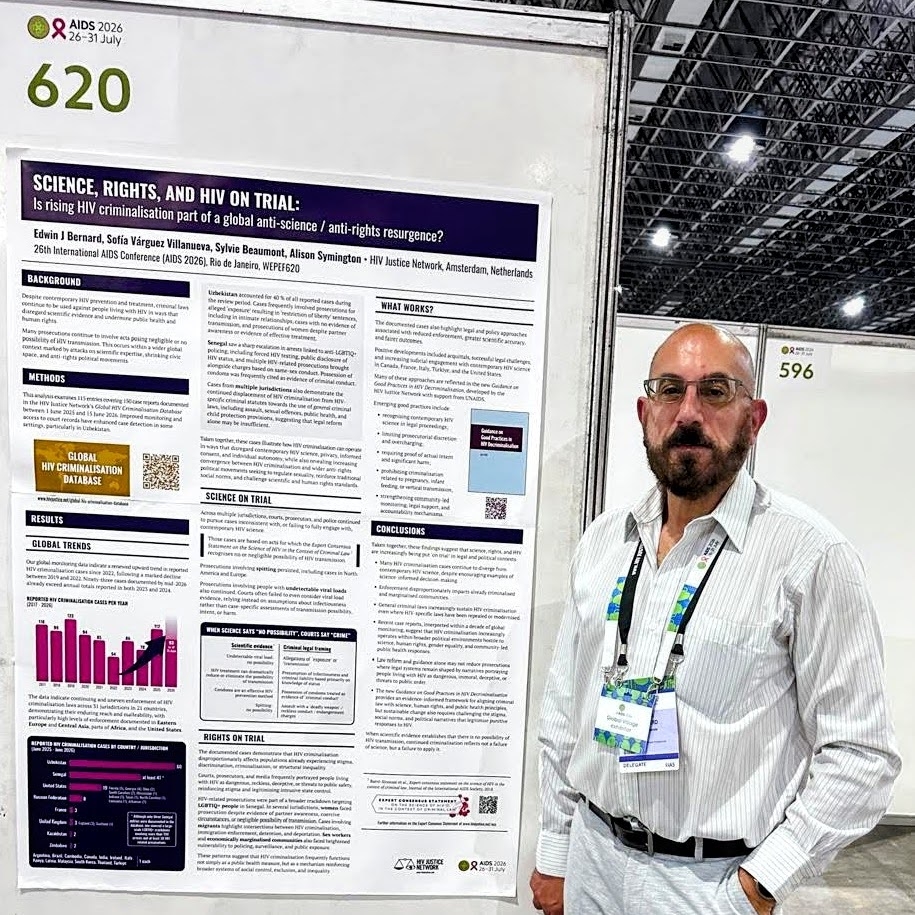
HIV criminalisation is increasing again after several years of decline, with prosecutions continuing to ignore established scientific evidence and disproportionately targeting already marginalised communities, according to new research presented today at the 26th International AIDS Conference (AIDS 2026).
The analysis examined 115 database entries covering 150 reported HIV criminalisation cases documented between 1 June 2025 and 15 June 2026. We conclude that these findings reflect not only failures to apply contemporary HIV science but also a broader global resurgence of anti-science and anti-rights politics.
The data show a clear upward trend in reported cases since 2022. By mid-June 2026, 93 reported cases had already been documented, exceeding the total annual cases recorded during both 2023 (70) and 2024 (86), although still below pre-COVID-19 pandemic levels.
“Our findings suggest that science, rights and HIV are increasingly being put on trial together,” said Edwin J Bernard, Executive Director of the HIV Justice Network, who presented the findings on behalf of his co-authors, Sylvie Beaumont, Alison Symington and Sofia Varguez. “When courts continue to prosecute people for acts that science tells us pose no possibility of HIV transmission, this is no longer a scientific problem. It is a political and legal one.”
Uzbekistan and Senegal dominate reported cases
Uzbekistan accounted for 60 of the reported cases during the study period – around 40% of all documented cases. Many involved allegations of HIV “exposure” without evidence of transmission, prosecutions involving intimate partners, and cases against women whose partners were aware of their HIV status or who were receiving effective treatment.
We also highlight a major escalation in Senegal, where a broader crackdown on LGBTIQ+ communities led to more than 200 arrests. By mid-June at least 39 people were prosecuted in relation to their HIV status, often alongside charges linked to same-sex conduct. (See this report for the most recent numbers, which increase on a daily basis.) The poster documents reports of forced HIV testing, public disclosure of HIV status, and the use of condom possession as evidence of criminal conduct.
Other countries with multiple reported cases included the United States (19), the Russian Federation (eight), France (three), the United Kingdom (three), Kazakhstan (two) and Zimbabwe (two).
Courts continue to disregard HIV science
We found that prosecutions continue to involve conduct for which there is either no possibility or only negligible possibility of HIV transmission, despite overwhelming scientific consensus.
Cases involving people with sustained undetectable viral loads continued to be prosecuted, with courts often failing even to consider viral load evidence. Prosecutions for spitting also persisted in both North America and Europe, despite scientific consensus that HIV cannot be transmitted this way.
These prosecutions stand in stark contrast to the 2018 Expert Consensus Statement on the Science of HIV in the Context of Criminal Law, which concluded that effective HIV treatment eliminates the possibility of sexual HIV transmission, condoms are highly effective prevention tools, and acts such as spitting cannot transmit HIV.
Criminalisation increasingly shifts into general criminal law
We also identified an important legal trend: HIV criminalisation increasingly continues through general criminal laws even where HIV-specific criminal statutes have been repealed or modernised.
Our data show that prosecutions increasingly rely on offences such as assault, sexual offences, public health legislation and child protection laws, suggesting that reforming HIV-specific statutes alone is insufficient unless broader criminal law and prosecutorial practices also change.
Structural inequalities reinforced
We argue that HIV criminalisation functions as a mechanism reinforcing wider systems of social control rather than protecting public health.
Women, migrants, sex workers, LGBTIQ+ people and economically marginalised communities continued to experience disproportionate enforcement. Many prosecutions occurred despite evidence of partner awareness, coercive circumstances or negligible possibility of transmission.
We conclude that HIV criminalisation increasingly operates within political environments characterised by hostility towards science, human rights, gender equality and community-led public health responses.
Positive developments offer a roadmap
Despite these concerns, we also identified encouraging developments.
Courts in Canada, France, Italy, Türkiye and the United States increasingly engaged with contemporary HIV science, while acquittals, successful legal challenges and improved judicial reasoning demonstrated that evidence-based approaches remain possible.
These examples are reflected in the newly launched Guidance on Good Practices in HIV Decriminalisation, developed by the HIV Justice Network with support from UNAIDS, which recommends:
- recognising contemporary HIV science in criminal proceedings;
- limiting prosecutorial discretion and overcharging;
- requiring proof of actual intent and significant harm;
- prohibiting criminalisation related to pregnancy, infant feeding and vertical transmission; and
- strengthening community-led monitoring, legal support and accountability.
“The evidence increasingly shows what works,” Bernard said. “Where legal systems engage with science, require evidence of genuine harm and respect human rights, prosecutions decline and justice improves. But sustainable change also requires confronting the stigma and political narratives that continue to portray people living with HIV as dangerous.”