In July 2024, six members of the HIV Justice Network team travelled to Munich to take part in AIDS 2024, the 25th International AIDS Conference, which brought together more than 11,000 participants from across the world.
The daily poster exhibitions provided an opportunity to learn of the incredible work undertaken by researchers, advocates, and people living with HIV to challenge discriminatory, criminalising laws and policies that single out people living with HIV.
HJN presented five posters at the conference (click on the link to download the pdf of the poster):
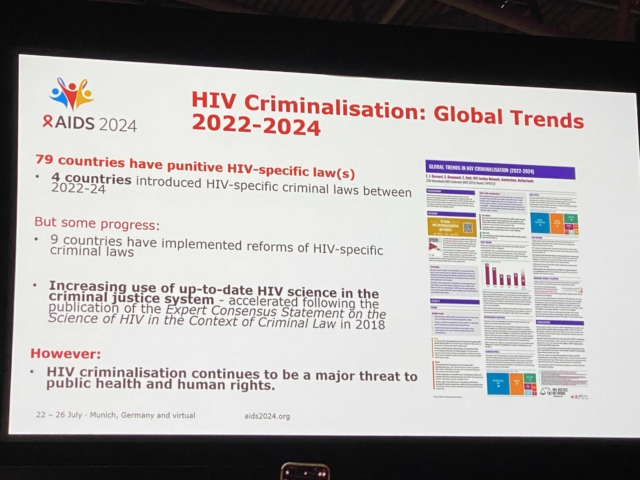
• Global Trends in HIV Criminalisation
• The Relevance of Gender to Potential or Perceived HIV ‘Exposure’ Charges in HIV Criminalisation Cases
• The ABCs of HIV Law Reform in Latin America and the Caribbean: Case Studies on HIV (De)criminalisation in Argentina, Belize, and Colombia
• Challenging Coercion and Misplaced Punishment: HIV and Infant Feeding Choices; and
• Prepared for Action: Lessons Learned from the First Year of the HIV Justice Academy.
There were also a number of other interesting and important poster presentations by others working on ending or limiting HIV criminalisation.
In The who and how of HIV criminalization in the United States, Nathan Cisneros from the Williams Institute – an organisation whose rigorous research has substantially advanced the understanding of the enforcement of HIV criminal laws in the US – delivered a poster drawing together several patterns identified from this groundbreaking research and highlighting the pressing need to address unjust prosecution practices. The findings demonstrate that criminalisation has occurred at a much deeper rate than previous estimates suggested that marginalised communities, notably black people, women, and sex workers, are disproportionately targeted under these laws, and that enforcement does not correlate to ‘risk’, meaning that many people are criminalised carrying no risk of transmission.
Advocates from Aotearoa (New Zealand) including the Burnett Foundation Aotearoa, presented a poster, No U-turns allowed: a roadmap to challenge criminalisation of HIV in Aotearoa New Zealand highlighting the difficulties of challenging HIV criminalisation where it occurs under general criminal laws. Given that general laws do not specifically target HIV, they do not account for HIV transmission risks and ignore modern HIV science, meaning they may be applied in cases where HIV has not, or cannot, be transmitted, as occurs in New Zealand. This poster underlined the importance of HIV-specific prosecutorial guidance to limit prosecutions, as well as other interventions including education, lobbying, and advocacy of the police, judiciary, and media.
Similarly, in Preventing overly broad criminalisation of HIV exposure, non-disclosure and transmission through multi-sector collaboration on education initiatives advocates from Queensland, Australia, highlighted the importance of working within existing legal frameworks to limit unjust prosecutions where reform of HIV criminal laws is politically challenging. This poster outlined work done by HIV organisations in Queensland to educate law enforcement on public health and human rights alternatives to HIV criminalisation, which was received positively and helps to reduce the overly broad use of criminal laws.
Several posters also examined the impacts of broader punitive legal environments on people living with HIV who are additionally criminalised due to other identities of behaviours. In the wake of anti-LGBTQ legislation in Ghana and Uganda, the latter which originally made alleged HIV transmission by gay men punishable with death, a number of posters presented at AIDS 2024 demonstrated the chilling effect of these laws, along with laws criminalising sex work, on HIV service provision for people living with HIV in Ghana and Uganda (1, 2, 3, 4, 5, 6) with centres shutting down and individuals limiting their health-seeking behaviour due to fear of criminalisation.
This vital research demonstrates that both HIV criminalisation and broader criminalisation of key populations must end in order to achieve health, dignity and rights for all people living with HIV.