The next phase of HIV decriminalisation: closing the translation gap

Last month, I wrote about the limits of relying on “U=U” as the primary message for HIV decriminalisation. In doing so, I also reflected on how “U=U” has transformed the lives of people living with HIV. Grounded in compelling science and amplified through years of advocacy, it has become a powerful message of hope, dignity and self-acceptance. Its success also demonstrates something broader: science changes lives only when it is translated into policy, practice and public understanding.

HIV criminalisation reminds us that translating science into justice remains unfinished. Forty-five years into the HIV epidemic, advances in HIV science have fundamentally transformed our understanding of transmission, treatment and prognosis. Yet people living with HIV continue to be investigated, prosecuted and imprisoned based on outdated assumptions about risk and harm.

This contradiction formed the basis of my presentation yesterday at AIDS 2026, the 26th International AIDS Conference in Rio de Janeiro. The question I posed was simple: Why does HIV criminalisation persist despite contemporary HIV science? The answer, I argued, lies in what I call the translation gap: the persistent failure – or refusal – to translate contemporary HIV science into law, policy and practice.
 
Scientific evidence does not change society on its own. It changes society only when institutions choose to translate it into legal standards, public policy and everyday practice. That process is never purely technical; it is shaped by politics, power and values.
 
The evidence for this is clear. Over the past decade, 50 jurisdictions across 28 countries have moved towards HIV decriminalisation through legislative reform, constitutional and supreme court decisions, and updated prosecutorial guidance. Together, these reforms demonstrate that when contemporary HIV science is effectively translated into law and policy, legal systems do change.
 
But progress has been highly uneven. In some parts of the world, reform has accelerated. In others, it has barely begun. At the same time, the HIV Justice Network’s Global HIV Criminalisation Database continues to document new prosecutions around the world, suggesting that the pace of reform has slowed.
 
The challenge facing the HIV justice movement has therefore evolved. In many countries, the problem is no longer simply HIV-specific criminal laws. Increasingly, criminalisation is sustained through the interaction of criminal law, public health systems, policing, politics, and stigma.
 
Our recent research illustrates this shift. In Uzbekistan, for example, HIV criminalisation often begins long before anyone enters a courtroom. Mandatory registration, public health surveillance, referrals from healthcare providers to law enforcement, and the use of medical records as evidence all demonstrate how healthcare systems themselves can become part of the machinery of criminalisation.
 
Recognising this changes what justice requires. Contemporary HIV science requires greater legal precision. Non-disclosure is not the same as intent. Perceived risk is not the same as actual risk. An allegation of HIV transmission is not proof of who transmitted HIV, and establishing the direction of transmission often requires scientific evidence that courts fail to consider or misinterpret. Even where harm has occurred, criminal punishment is not automatically the appropriate response.
 
But science alone cannot produce these changes. Translation depends on institutions that value evidence, independent courts, governments willing to act and civil society organisations able to advocate for reform. Increasingly, these conditions are being undermined by broader attacks on public health, human rights and democratic institutions.
 
This is where structural violence helps explain why the translation gap persists. Scientific evidence alone is insufficient because law does not operate independently of politics or power. Organised anti-rights movements have become increasingly influential in reshaping the political environments in which legal reform takes place. As civic space shrinks and scientific expertise is challenged, translating contemporary HIV science into law becomes increasingly difficult.
 
Yet communities continue to create pathways to justice. Even where legal reform is blocked, advocates document prosecutions, provide legal literacy and paralegal support, engage international human rights mechanisms, influence global health policy and support those living under punitive laws. Communities do not simply wait for the law to change; they continue creating opportunities for justice despite the obstacles they face.
 
That is why the next phase of HIV decriminalisation is not simply about changing more laws. It is about closing the translation gap. Yesterday we launched the Guidance on Good Practices in HIV Decriminalisation. The Guidance brings together contemporary HIV science, legal expertise and the experience of communities around the world to support countries wherever they are on the journey towards HIV decriminalisation.
 
Closing the translation gap requires more than scientific evidence. It requires practical tools that help governments, courts, advocates and communities translate that evidence into action. The Guidance is designed to be one of those tools.
 
The success of “U=U” demonstrates what is possible when science is translated into practice. The persistence of HIV criminalisation demonstrates what happens when the translation of science into justice is resisted. Closing that translation gap is now the central challenge for HIV justice. The new Guidance is intended to help meet that challenge by helping ensure that science is translated into justice.
New data presented at AIDS 2026 reveal renewed rise in HIV criminalisation amid global anti-rights backlash

HIV criminalisation is increasing again after several years of decline, with prosecutions continuing to ignore established scientific evidence and disproportionately targeting already marginalised communities, according to new research presented today at the 26th International AIDS Conference (AIDS 2026).

The analysis examined 115 database entries covering 150 reported HIV criminalisation cases documented between 1 June 2025 and 15 June 2026. We conclude that these findings reflect not only failures to apply contemporary HIV science but also a broader global resurgence of anti-science and anti-rights politics.

The data show a clear upward trend in reported cases since 2022. By mid-June 2026, 93 reported cases had already been documented, exceeding the total annual cases recorded during both 2023 (70) and 2024 (86), although still below pre-COVID-19 pandemic levels.

“Our findings suggest that science, rights and HIV are increasingly being put on trial together,” said Edwin J Bernard, Executive Director of the HIV Justice Network, who presented the findings on behalf of his co-authors, Sylvie Beaumont, Alison Symington and Sofia Varguez. “When courts continue to prosecute people for acts that science tells us pose no possibility of HIV transmission, this is no longer a scientific problem. It is a political and legal one.”

Uzbekistan and Senegal dominate reported cases

Uzbekistan accounted for 60 of the reported cases during the study period – around 40% of all documented cases. Many involved allegations of HIV “exposure” without evidence of transmission, prosecutions involving intimate partners, and cases against women whose partners were aware of their HIV status or who were receiving effective treatment.

We also highlight a major escalation in Senegal, where a broader crackdown on LGBTIQ+ communities led to more than 200 arrests. By mid-June at least 39 people were prosecuted in relation to their HIV status, often alongside charges linked to same-sex conduct. (See this report for the most recent numbers, which increase on a daily basis.)  The poster documents reports of forced HIV testing, public disclosure of HIV status, and the use of condom possession as evidence of criminal conduct.

Other countries with multiple reported cases included the United States (19), the Russian Federation (eight), France (three), the United Kingdom (three), Kazakhstan (two) and Zimbabwe (two).

Courts continue to disregard HIV science

We found that prosecutions continue to involve conduct for which there is either no possibility or only negligible possibility of HIV transmission, despite overwhelming scientific consensus.

Cases involving people with sustained undetectable viral loads continued to be prosecuted, with courts often failing even to consider viral load evidence. Prosecutions for spitting also persisted in both North America and Europe, despite scientific consensus that HIV cannot be transmitted this way.

These prosecutions stand in stark contrast to the 2018 Expert Consensus Statement on the Science of HIV in the Context of Criminal Law, which concluded that effective HIV treatment eliminates the possibility of sexual HIV transmission, condoms are highly effective prevention tools, and acts such as spitting cannot transmit HIV.

Criminalisation increasingly shifts into general criminal law

We also identified an important legal trend: HIV criminalisation increasingly continues through general criminal laws even where HIV-specific criminal statutes have been repealed or modernised.

Our data show that prosecutions increasingly rely on offences such as assault, sexual offences, public health legislation and child protection laws, suggesting that reforming HIV-specific statutes alone is insufficient unless broader criminal law and prosecutorial practices also change.

Structural inequalities reinforced

We argue that HIV criminalisation functions as a mechanism reinforcing wider systems of social control rather than protecting public health.

Women, migrants, sex workers, LGBTIQ+ people and economically marginalised communities continued to experience disproportionate enforcement. Many prosecutions occurred despite evidence of partner awareness, coercive circumstances or negligible possibility of transmission.

We conclude that HIV criminalisation increasingly operates within political environments characterised by hostility towards science, human rights, gender equality and community-led public health responses.

Positive developments offer a roadmap

Despite these concerns, we also identified encouraging developments.

Courts in Canada, France, Italy, Türkiye and the United States increasingly engaged with contemporary HIV science, while acquittals, successful legal challenges and improved judicial reasoning demonstrated that evidence-based approaches remain possible.

These examples are reflected in the newly launched Guidance on Good Practices in HIV Decriminalisation, developed by the HIV Justice Network with support from UNAIDS, which recommends:

  • recognising contemporary HIV science in criminal proceedings;
  • limiting prosecutorial discretion and overcharging;
  • requiring proof of actual intent and significant harm;
  • prohibiting criminalisation related to pregnancy, infant feeding and vertical transmission; and
  • strengthening community-led monitoring, legal support and accountability.

“The evidence increasingly shows what works,” Bernard said. “Where legal systems engage with science, require evidence of genuine harm and respect human rights, prosecutions decline and justice improves. But sustainable change also requires confronting the stigma and political narratives that continue to portray people living with HIV as dangerous.”

Download E J Bernard et al. WEPEF620, Science, rights, and HIV on trial: Is rising HIV criminalisation part of a global anti-science / anti-rights resurgence?

Senegal: Media frenzy meets CNLS reality check in alleged homosexuals prosecution

The CNLS warns of an offence that is difficult to substantiate

In the case known as the ‘alleged homosexuals’ case, the classification of deliberate transmission of HIV/AIDS is the subject of heated debate. However, according to a note from the National Council for the Fight against AIDS (CNLS), this offence remains one of the most complex to prove in law.

The offence of ‘deliberate transmission of HIV/AIDS’ introduces a demanding scientific dimension to the case of the ‘alleged homosexuals’. They are being prosecuted for ‘unnatural acts, criminal association, money laundering and drug trafficking’. According to the National Council for the Fight against AIDS (CNLS), the justice system must rely on precise, consistent and solidly established evidence. In a note, the entity headed by Dr Safiatou Thiam states that ‘proof of voluntary transmission of HIV is difficult’. The CNLS notes that it ‘is a particularly complex process, involving legal, scientific and medico-legal aspects’.

The 2010 Senegalese law on HIV provides for penalties against any person who, knowing that they are HIV-positive, deliberately exposes others to the risk of infection.

However, ‘the establishment of this offence is based on the cumulative evidence of several factors,’ the note specifies. The first essential element is knowledge of one’s HIV status. “It must be proven that the accused knew they were HIV-positive at the time of the offence.

Without this prior knowledge, intent or gross negligence cannot be established,” emphasises the CNLS. The second requirement is proof of risky behaviour. Thus, the analysis is not limited to the statements of the parties. ‘The risk assessment also takes into account the therapeutic situation (ARV treatment, undetectable viral load or not),’ states the text. This clarification is important because a person undergoing effective treatment, with an undetectable viral load, ‘does not transmit HIV through sexual contact (U=U: undetectable = untransmittable)’.

From a scientific point of view, proving the causal link is just as delicate. “It is not enough for two people to be living with HIV. It must be demonstrated that the transmission did indeed come from the person being prosecuted,” adds the CNLS. Moreover, the body maintains that phylogenicetic analyses have their limitations: ‘However, even in cases of high genetic proximity, this analysis alone does not prove direct transmission or the exact chronology of events.’ Finally, the element of intent remains central. ‘To qualify as deliberate transmission in the criminal sense, it must be proven that there was either a deliberate intention to transmit the virus or an awareness of the risk associated with accepting it,’ explains the CNLS.


Dans l’affaire dite des « pré­su­més homo­sexuels », la qua­li­fi­ca­tion de trans­mis­sion volon­taire du Vih/Sida sus­cite de vifs débats. Pour­tant, selon une note du Conseil natio­nal de lutte contre le Sida (Cnls), cette infrac­tion demeure l’une des plus com­plexes à prou­ver en droit.

L’infrac­tion « trans­mis­sion volon­taire du Vih/Sida » intro­duit une dimen­sion scien­ti­fique exi­geante dans l’affaire des « pré­su­més homo­sexuels ». Ils sont pour­sui­vis pour « actes contre nature, asso­cia­tion de mal­fai­teurs, blan­chi­ment de capi­taux et tra­fic de drogue ». Selon le Conseil natio­nal de lutte contre le Sida (Cnls), la jus­tice devra s’appuyer sur des preuves pré­cises, concor­dantes et soli­de­ment éta­blies. Dans une note, l’entité diri­gée par le Dr Safia­tou Thiam ren­seigne que la « preuve de la trans­mis­sion volon­taire du Vih est dif­fi­cile ». Le Cnls relève, en effet, qu’elle « consti­tue une démarche par­ti­cu­liè­re­ment com­plexe, à la fois juri­dique, scien­ti­fique et médico-légale ». La loi séné­ga­laise de 2010 rela­tive au

Vih pré­voit des sanc­tions contre toute per­sonne qui, en connais­sance de sa séro­po­si­ti­vité, expose déli­bé­ré­ment autrui à un risque de conta­mi­na­tion. Mais, « l’éta­blis­se­ment de cette infrac­tion repose sur la réunion cumu­la­tive de plu­sieurs élé­ments pro­bants », pré­cise la note. Le pre­mier élé­ment indis­pen­sable est la connais­sance du sta­tut séro­lo­gique. « Il doit être démon­tré que la per­sonne mise en cause savait qu’elle était séro­po­si­tive au moment des faits. Sans cette connais­sance préa­lable, l’inten­tion ou la faute carac­té­ri­sée ne peut être rete­nue », sou­ligne le Cnls. Deuxième exi­gence : la preuve d’un com­por­te­ment à risque. Ainsi, l’ana­lyse ne se limite pas aux décla­ra­tions des par­ties. « L’éva­lua­tion du risque tient aussi compte de la situa­tion thé­ra­peu­tique (prise d’Arv, charge virale indé­tec­table ou non) », énonce le texte. Cette pré­ci­sion est majeure, car une per­sonne sous trai­te­ment effi­cace, avec une charge virale indé­tec­table, « ne trans­met pas le Vih par voie sexuelle (i = i : indé­tec­table = intrans­mis­sible) ».

Sur le plan scien­ti­fique, la démons­tra­tion du lien de cau­sa­lité est tout aussi déli­cate. « Il ne suf­fit pas que deux per­sonnes vivent avec le Vih. Il faut démon­trer que la trans­mis­sion pro­vient bien de la per­sonne pour­sui­vie », ajoute le Cnls. D’ailleurs, sou­tient l’organe, les ana­lyses phy­lo­gé­né­tiques ont leurs limites : « Tou­te­fois, même en cas de forte proxi­mité géné­tique, cette ana­lyse ne prouve pas à elle seule la trans­mis­sion directe ni la chro­no­lo­gie exacte des faits ». Enfin, l’élé­ment inten­tion­nel reste cen­tral. « Pour qua­li­fier la trans­mis­sion volon­taire au sens pénal, il faut prou­ver soit la volonté déli­bé­rée de trans­mettre le virus, soit la conscience du risque asso­ciée à son accep­ta­tion », explique le Cnls.

New Zealand: Government backs U=U, opening door to reform of HIV non-disclosure laws

Burnett Foundation Aotearoa welcomes the Government’s decision on U=U

Associate Health Minister Doocey’s decision to sign the U=U declaration today is a critical step on the road towards zero locally acquired HIV transmissions in Aotearoa New Zealand.

U = U stands for Undetectable = Untransmittable (U=U). It means that a person living with HIV who is on effective treatment and maintains an undetectable viral load cannot transmit HIV to sexual partner(s).

“The U=U message helps increase testing, treatment adherence, and viral suppression rates, but most importantly, it increases the confidence and dignity of people living with HIV. It’s proof that science and compassion walk hand in hand,” says Liz Gibbs, CEO of Burnett Foundation Aotearoa.

This decision makes New Zealand the 5th country to sign the multinational U=U Call to Action, behind Australia, Canada, the USA, and Vietnam.

“Currently people living with HIV may face prosecution under the Crimes Act for HIV non-disclosure to their sexual partners (unless they are using a condom), even if they are on treatment with an undetectable viral load and therefore pose zero risk of transmission. With the Government’s official endorsement of U=U, it gives the Police, Courts and government departments the backing required to modernise outdated guidelines and policies, so they are in-keeping with the latest science.” says Gibbs.

This is a significant step forward that many across the HIV and sexual health community have been advocating for several years, and we are thrilled to see it finally come to pass.


2025 in review: more reported cases, uneven reform

In 2025, HIV criminalisation remained a persistent, global human rights and public health failure – visible both in the rise in reported prosecutions and in the continued mismatch between HIV science and legal practice. Despite significant law reform momentum in several jurisdictions, we found evidence of unjust arrests, charges, and convictions reported in 27 countries. However, while the number of reported HIV criminalisation cases increased in 2025, this rise was driven largely by intensified enforcement and reporting in a limited number of countries, rather than a widening of criminalisation across new jurisdictions.

Rising case numbers concentrated in fewer countries

Our Global HIV Criminalisation Database included 112 reported cases between January 1st and December 31st, 2025. This represents the highest annual total recorded in the database in recent years – almost double the number documented in 2024, and more than twice the annual totals seen between 2021 and 2023.

A defining feature of 2025 was how strongly case reports clustered in specific countries. However, unless cases are systematically reported either in official, public-facing court databases, relying on media and/or civil society reported cases means we are only seeing the most visible portion of a much larger reality.

Nevertheless, one country – Uzbekistan – accounted for more than half of all reported cases. This is partly because Uzbek courts publish all HIV criminalisation cases online, but mainly due to an exceptionally broad and punitive legal framework combined with extensive mandatory HIV testing. Article 113 of the Criminal Code criminalises mere awareness of HIV status, with no distinction between exposure and transmission and no defences for condoms, viral suppression, or informed consent, creating a very low threshold for prosecution. Mandatory testing laws targeting key populations and returning migrants further increase detection without any link to alleged criminal conduct, resulting in more people being identified and prosecuted than anywhere else.

Alongside this, Russia and the United States continue to feature prominently in HIV criminalisation case reports, with the United Kingdom, France, South Korea and Canada represented by at least two reported cases in 2025.

Same harms, familiar forms

Across the 2025 cases list, several recurring patterns stood out:

  • Non-disclosure and “exposure” prosecutions remained the default legal response, with multiple non-disclosure prosecutions in the United States proceeding without allegations of transmission, and exposure-only cases continuing in Russia despite no demonstrated risk of harm.
  • Criminal cases disproportionately arose from contact between law enforcement and marginalised people – including gay men, sex workers, trans people, and people already in detention – illustrating how HIV criminalisation disproportionately arises in contexts shaped by stigma, surveillance, and law enforcement contact with marginalised communities.
  • Criminalisation extended beyond sexual contexts, with no-risk conduct framed as intentional harm, including spitting prosecutions in Canada and the United States, and prosecutions linked to needle or blood incidents in the United Kingdom and Brazil.
  • Cross-border consequences persisted even after legal “wins”, illustrated by Ireland’s deportation of a man whose conviction had been overturned by the Supreme Court, and by the persistent risk of immigration and residency consequences in Canada and the United States, where HIV-related prosecutions can have lasting effects beyond the criminal process itself.
  • Legacy criminalisation continued to create procedural chaos, as seen in Zimbabwe where prosecutions and litigation persisted despite the HIV criminalisation law having previously been repealed, and in countries such as Russia where outdated HIV-specific provisions continue to be applied alongside general criminal law, producing inconsistent charging practices.

Legal reform: progress alongside persistent risk

Despite a challenging political environment, 2025 saw several concrete legal and policy developments that signalled continued momentum toward reform, particularly at the sub-national level.

In the United States, state-level action remained the primary driver of change. In Maryland, the governor signed legislation repealing the state’s HIV-specific criminal statute, removing a law long criticised for its incompatibility with current scientific evidence. North Dakota also enacted legislation addressing outdated HIV criminalisation provisions, narrowing their scope and reducing the reach of HIV-specific penalties.

In Mexico, reform efforts continued across multiple jurisdictions. Baja California eliminated “danger of contagion” language from its criminal code, and advocacy to repeal or amend similar provisions continued in other states, alongside renewed engagement at the federal level.

In Ukraine, parliament approved the first reading of legislation to remove HIV criminalisation from the Criminal Code. While the law reform process has stalled in the context of ongoing conflict, the move towards repeal represents a significant legislative step and an important signal of political commitment under difficult circumstances.

Alongside these gains, 2025 also highlighted the fragility of reform and the persistence of resistance in several settings.

In Canada, frustration grew over the continued absence of comprehensive federal reform of HIV non-disclosure criminalisation. Despite longstanding commitments and extensive advocacy, progress remained stalled, reinforcing concerns about the ongoing misuse of the criminal law.

In Australia, debate intensified in South Australia and New South Wales around the use of mandatory or forced HIV testing powers. Public health experts and community advocates raised concerns about the scientific basis, proportionality, and potential harms of these approaches.

And the United States faced a renewed and deeply troubling risk of regression under the shadow of the Trump administration’s domestic and global anti-rights agenda. Proposals to expand sexually transmitted infection criminalisation – including legislative initiatives in Louisiana – signalled how rapidly decades of hard-won progress can be dismantled when punishment, surveillance, and moral regulation are reasserted as policy priorities. In this climate, HIV criminalisation once again becomes a ready tool of control, underscoring how fragile reform remains and how urgently sustained resistance is required.

Looking ahead to 2026

Legal reform is both possible and underway, yet unjust prosecutions persist – and in some settings appear to be accelerating – even as HIV science has never been clearer about the effectiveness of treatment and the realities of transmission risk. The 112 reported cases are not merely a statistic; they reflect the continued, routine embedding of stigma within criminal legal systems, where outdated assumptions are enforced despite overwhelming evidence to the contrary.

In 2026, the HIV Justice Network will prioritise consolidating reform gains while confronting jurisdictions where criminalisation remains entrenched or is intensifying. This will include targeted advocacy and capacity-building in high-volume prosecution settings; strengthened documentation and analysis of enforcement patterns to support evidence-based reform; and deeper engagement with prosecutors, judges, and policymakers to bring law and practice into line with contemporary HIV science.

Central to this work will be two UNAIDS-supported initiatives: the completion and dissemination of Good Practices in HIV Decriminalisation, providing practical, jurisdiction-tested guidance for lawmakers and advocates; and the expansion of the Expert Consensus Statement on the Science of HIV in the Context of Criminal Law to explicitly address breastfeeding, ensuring that evolving evidence is accurately reflected in legal and policy frameworks.

Together, these efforts aim to prevent new prosecutions, reduce harm, and accelerate a coordinated, science-based push to end HIV criminalisation worldwide.

From Courtrooms to Communities:
Funding Advocacy to Sustain HIV Responses

Our Executive Director’s remarks on today’s webinar aimed at philanthropic funders, convened by Funders Concerned About AIDS.

Today, I’ll be connecting two major forces shaping the global HIV response: the wave of criminalisation targeting people living with HIV, people most vulnerable to HIV, and their advocacy organisations, as well as the expanding reach and impact of the Global Gag Order.

Both of these reflect the same problem – the use of law and policy to control bodies, silence communities, and restrict access to health and rights. By the end of this webinar, I hope it will be crystal clear why funding advocacy remains the single highest-impact investment funders can make.

The HIV Justice Network, which I lead, works to end the unjust use of criminal law against people living with HIV worldwide. We document laws and cases, support and train advocates, and co-ordinate the HIV JUSTICE WORLDWIDE coalition – connecting the global to local and back again, linking community organisations, lawyers, and human rights defenders across all regions of the world to reform laws and prosecutorial practices.

HIV criminalisation remains stubbornly and worryingly widespread. More than 130 countries have used criminal law against people living with HIV accused of non-disclosure, potential or perceived HIV exposure or unintentional HIV transmission. Currently, 83 countries have HIV-specific criminal laws. Others use general criminal laws like “bodily harm”, “endangering health,” and even “attempted murder.”

These laws, and their application, are often based on outdated science and moral panic. They make people living with HIV to be singularly responsible for HIV prevention. They punish us for transmission risks that no longer exist in the era of treatment as prevention – and consider the harm of HIV to be so exceptional they have special laws, or prosecutions, that specifically target people diagnosed HIV-positive. No other communicable disease is treated so problematically in law.

But HIV criminalisation doesn’t exist in isolation. It is part of a broader ecosystem of criminalisation that targets the very communities most affected by HIV – sex workers, migrants, people who use drugs, and LGBTQ+ people. When these populations are criminalised, they are pushed underground, excluded from health services, and made more vulnerable to violence and exploitation.

HIV criminalisation also has a gendered impact. Women are often the first to be diagnosed, especially during pregnancy, and therefore the first to face prosecution. In some countries, pregnant women living with HIV have been charged with endangering their unborn child or accused of transmission through breastfeeding.

Gender-based violence, unequal access to legal representation, and social stigma amplify these injustices. At the same time, the criminalisation of sex work and gender nonconformity exposes women – particularly trans women – to harassment and violence from authorities.

And increasingly, advocacy organisations themselves are being restricted by laws that limit freedom of association, deny foreign funding, or create a chilling effect through so-called “anti-propaganda” or “foreign agent” measures. In more and more countries, simply speaking out against criminalisation is considered to be subversive.

And then there is the Global Gag Order, reinstated and expanded in early 2025 under the Protecting Life in Global Health Assistance policy. This policy prohibits non-U.S. NGOs receiving U.S. global health funds from providing, referring for, or even discussing abortion as a method of family planning – even when using their own, non-U.S. resources. It now applies to all U.S. global health assistance, including HIV funding.

For communities and organisations already constrained by criminal laws, the gag order adds another layer of silencing.
• It disrupts integrated HIV and reproductive-health services.
• It forces organisations to choose between funding and integrity.
• It weakens partnerships built over decades of global health cooperation.
• And it amplifies the chilling effect – discouraging advocacy, speech, and even data collection on reproductive rights.

Once again, women and girls bear the brunt. When abortion access is restricted, maternal deaths rise, and the same clinics providing HIV care lose their ability to deliver comprehensive, rights-based health services.

So when we talk about decriminalisation, we’re not just talking about repealing one set of laws. We’re talking about defending the space for civil society, for public health, and for human rights to function at all.

Despite these challenges, advocacy works. Here’s some examples – with a focus on HIV decriminalisation.
• In the US, in the past year alone, Maryland and North Dakota have repealed their HIV-specific criminal laws, while Tennessee removed mandatory sex offender registration for HIV-related convictions.
• In Mexico, again thanks to community leadership, five states have repealed vague “danger of contagion” laws used for HIV criminalisation, with more to come.
• In EECA, civil society in Ukraine is working right now with parliamentary champions to remove an HIV criminalisation law from its criminal code, despite being in the middle of a war.
• In Africa, sustained community advocacy led to the repeal of Zimbabwe’s HIV-specific criminal law and the prevention of a new HIV criminalisation law in Malawi.

But these victories didn’t happen overnight. They resulted from years of partnership between communities, legal and scientific experts, and funders willing to invest in advocacy infrastructure.

Community-led organisations are the foundation of all this progress. We are the early-warning systems when new laws are proposed, and we are the first responders when individuals face charges. We mobilise people living with HIV, key population and women’s networks, and human rights defenders to speak directly with policymakers, prosecutors, and the media.

Philanthropy has a crucial role here. Advocacy funding remains a small fraction of global HIV philanthropy, yet it has exponential impact. Advocacy capacity cannot be switched on only when a law or case hits the headlines. It requires continuity, institutional memory, and relationships built over time.

Funding advocacy protects every other investment in prevention, treatment, and care. Without enabling environments – without legal and policy reform – those investments cannot succeed.

Funders can make the difference by:
• Providing core, flexible, multi-year support that allows community-led groups to stay engaged between crises.
• Investing in coalitions and regional and global networks, like HIV JUSTICE WORLDWIDE, linking legal, scientific and human rights expertise with communities.
• Supporting data, storytelling, and knowledge translation – turning lived experience and evidence into policy change.
• Protecting civil-society space, especially where advocacy itself is criminalised or restricted.

To close, I want to leave one thought: HIV justice is prevention.

Every law that criminalises people living with HIV, every law that targets LGBTQ+ people, sex workers, people who use drugs, or migrants – and every funding policy that silences reproductive rights – makes the global epidemic harder to end.

Ending AIDS requires more than medicines. It requires dismantling the legal and policy barriers that drive people away from care and from each other.

Ending HIV criminalisation is achievable. We have the science, the evidence, and the community power to do it. What we don’t always have is flexible, sustained, core funding. Advocacy is not optional; it is infrastructure – the connective tissue that holds the HIV response together.

Philanthropy has both the freedom and the responsibility to keep that justice space open – ensuring that evidence, human rights, and community leadership remain at the heart of the global HIV response.

That is how we move from courtrooms to communities – and closer to ending AIDS as a public-health and human-rights crisis.

Humanising the Law: Reflections on Two Decades of Advocacy Against HIV Criminalisation

This week, the international peer-reviewed journal, AIDS Care, published online a research paper that examines how two decades of scientific progress, community advocacy, and storytelling have come together to influence laws, policies, and public understanding of HIV in the context of the criminal law. 

In Humanising the law: harnessing science and community voices to end HIV criminalisation, I trace nearly twenty years of work to challenge HIV criminalisation, drawing on my own involvement and on the collective efforts of so many others in the HIV justice movement. 

Some of the key points include:

  • Science as evidence for change. The consensus that people on effective treatment cannot transmit HIV, and the 2018 Expert Consensus Statement, have reshaped legal reasoning and prevented unjust prosecutions.

  • Stories bring the impact to life. The ordeals of people such as Ugandan nurse Rosemary Namubiru and the real Malawian woman at the centre of our short film, Mwayi’s Story, highlight the human cost of HIV criminalisation and the resilience of those most affected.

  • Legal reforms are possible. Since the HIV JUSTICE WORLDWIDE coalition was created in 2016, over a dozen countries and jurisdictions around the world have repealed or modernised their HIV criminalisation laws.

But I also make it clear that much remains to be done. HIV criminalisation continues to undermine public health and human rights, particularly in environments shaped by authoritarianism, disinformation, and broader crackdowns on sexuality, gender, migration, sex work, and drug use.

That is why I argue for a paradigm shift – a humanisation of the law that centres lived experiences, affirms dignity, and ensures legal systems reflect science and rights rather than fear and prejudice. Achieving this requires:

  • Ongoing investment in legal reform, advocacy, and community-led monitoring.

  • Stronger cross-movement solidarity with those facing overlapping forms of criminalisation.

  • Sustained funding to support the global HIV justice movement for the long term.

As I conclude in the article: ending HIV criminalisation is not only about changing laws, but also about changing cultures. It is about recognising that our lives, our rights, and our voices matter.


A limited number of free eprints of this article are available from this link.

New global data reveals rising HIV criminalisation amid stalling legal reforms

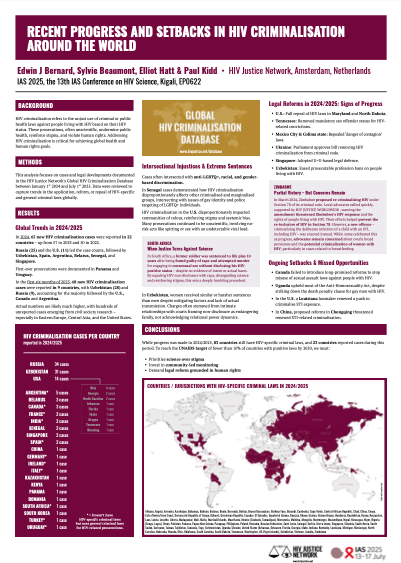
The HIV Justice Network published new data this week showing a troubling rise in the number of people criminalised for HIV non-disclosure, potential or perceived exposure, or unintentional transmission in 2024 and the first half of 2025. As legal reforms appear to be stalling, discriminatory prosecutions, harsh sentences, and misuse of outdated laws continue to impact people with HIV and the HIV response.

The figures, presented at the 13h IAS Conference on HIV Science (IAS 2025) in Kigali, Rwanda, are drawn from the Global HIV Criminalisation Database. The database documents criminal cases and legal developments involving HIV-specific or general criminal laws worldwide.

In 2024, at least 65 HIV criminalisation cases were reported across 22 countries – up from 57 in 2023 and 50 in 2022. Russia (25 cases) and the United States (11) led the global tally, followed by Uzbekistan, Spain, Argentina, Belarus, Senegal, and Singapore. For the first time, prosecutions were documented in Panama and Uruguay.

The upward trend continued into 2025, with 48 cases reported in just the first six months. Uzbekistan (28) and Russia (9) again accounted for the majority, alongside new cases in the U.S., Canada, and Argentina. However, the actual number of cases is likely much higher, particularly in Eastern Europe, Central Asia, and the United States, where civil society organisations report many cases go undocumented.

“These cases show that HIV criminalisation remains a global crisis,” said Edwin J. Bernard, Executive Director of the HIV Justice Network. “Far too often, people living with HIV are prosecuted not for causing harm, but simply for living with a health condition – often in ways that are unscientific, discriminatory, and deeply unjust.”

                 Download the poster by clicking on the image

The report highlights the intersection of HIV criminalisation with racism, homophobia, gender-based discrimination, and systemic inequality. In Senegal, for example, prosecutions have disproportionately targeted LGBTQ+ individuals. In the U.S., criminal laws continue to be weaponised against communities of colour, even in cases involving no risk of transmission – such as spitting, or sex with an undetectable viral load.

One of the most alarming cases occurred in South Africa, where a former soldier was sentenced to life plus ten years for rape and attempted murder after failing to disclose his HIV status to a consenting partner – despite no evidence of intent or actual transmission. Advocates warn that such cases equate HIV non-disclosure with sexual violence and undermine decades of public health and human rights gains.

Yet, amidst the setbacks, 2024/2025 also brought some signs of hope. Maryland and North Dakota fully repealed their HIV-specific laws, while Tennessee removed mandatory sex offender registration for HIV-related convictions. Mexico City and Colima repealed vague “danger of contagion” laws, and Ukraine’s parliament voted to remove HIV from its criminal code.

In Zimbabwe, community activism helped block a proposal to re-criminalise HIV transmission. However, a new law was introduced criminalising the deliberate transmission of STIs to children, including HIV – raising fears it could be used against mothers living with HIV, particularly in breastfeeding cases.

Despite these advances, HIV criminalisation remains widespread. A total of 83 countries still have HIV-specific laws, and 23 countries reported prosecutions in this period using either HIV-specific or general laws. The HIV Justice Network warns that without urgent action, the world is unlikely to meet UNAIDS’ target of reducing punitive laws to below 10% of countries by 2030.

“The path forward must be rooted in science, rights, and community leadership,” Bernard said. “We must end laws that punish people for their status, and instead build legal systems that support health, dignity, and justice.”


EPO622 Recent progress and setbacks in HIV criminalisation around the world by Edwin J Bernard, Sylvie Beaumont, and Elliot Hatt was presented at IAS 2025 by Paul Kidd at 13th IAS Conference on HIV Science in Kigali, Rwanda.


Humanising the Law: Harnessing Science and
Community Voices to End HIV Criminalisation

Speech delivered on the final morning plenary session of the 16th AIDSImpact Conference, Casablanca, 28th May 2025

Good morning.

I am deeply honoured to stand here with you today in Casablanca – a city whose name evokes stories of resistance and solidarity – to share our own story of resistance and solidarity: the global movement to end HIV criminalisation.

It’s especially meaningful to be back at AIDSImpact. Because, you see, this is where it all began for me. Eighteen years ago, in Marseille, I stood on a stage like this one, trembling slightly, as I spoke publicly for the very first time about HIV criminalisation.

I had no idea that moment would change the course of my life – or that it would help spark a movement that continues to grow today.

Later that same year, NAM – where I worked as an HIV treatment journalist – published my first book on the subject aimed at explaining HIV science and social science to the criminal legal system, and I started a blog – Criminal HIV Transmission – as a way of documenting the mounting number of unjust prosecutions and problematic new laws taking place across the world.

What started as a mostly solitary – and primarily UK-focused – effort quickly became a shared and surprisingly international one.

By AIDS 2008 in Mexico City, I began to understand that my blog was becoming a de facto global network, and many of the cases it documented were cited by South African Justice Edwin Cameron when, during his now-legendary plenary, he called for a global movement to end HIV criminalisation.

That same year UNAIDS and UNDP released guidance opposing overly broad criminal laws, and it was clear that something was shifting.

Two years later, at AIDS 2010 in Vienna we – that is NAM, GNP+, and the Canadian HIV/AIDS Legal Network – convened the first-ever pre-conference on HIV criminalisation. It brought together scientists, advocates, lawyers, and most importantly, people living with HIV.  I had planned to start the HIV Justice Network then, but a consultancy job at UNAIDS, providing scientific and legal support for clear guidance to limit the overly broad use of the criminal law, kept me busy.

So it wasn’t until 2012, when we gathered in Oslo at a UNAIDS consultation on HIV and the criminal law, that the network finally came together. On the sidelines of the consultation, key representatives of civil society worked together to draft the Oslo Declaration on HIV Criminalisation – a ten-point call to action that was endorsed by more than 1700 individuals and organisations from 130 countries and, to my astonishment, also appeared as an appendix to the official UNAIDS guidance note that was published in 2013.

The Oslo Declaration became the founding document of the HIV Justice Network. From that point on, we were no longer reacting – we were organising.

By AIDS 2014 in Melbourne, with the support of several Australian and international HIV organisations, we held the Beyond Blame pre-conference, where our first major victory was announced: the repeal of the Australian state of Victoria’s HIV-specific criminal law. We knew then that change was possible.

In 2015, we joined forces with ARASA, the HIV Legal Network, GNP+, the Sero Project, and Positive Women’s Network–USA to form a powerful global consortium. With support from the Robert Carr Fund, we launched the HIV JUSTICE WORLDWIDE coalition in 2016, committing ourselves to collective action against the unjust criminalisation of people living with HIV.

Together, we developed a range of advocacy tools and resources, including the Expert Consensus Statement on the Science of HIV in the Context of Criminal Law, launched at AIDS 2018 in Amsterdam. The Consensus Statement translated complex science – about viral load, transmission routes, treatment effectiveness, and HIV forensics – into language that courts and lawmakers could understand.

Because the truth is: the law had not kept pace with science. Outdated laws continued to criminalise people living with HIV as though it were still the ‘90s. And behind each of these prosecutions was a human life: interrupted, humiliated, punished, often for simply living with a virus.

Today we know that people living with HIV on effective treatment cannot transmit the virus. U=U is not just a slogan – it’s a scientific fact.  And that message has been useful in limiting unjust prosecutions, primarily in the global North.

But HIV criminalisation is a global phenomenon, and we cannot rely on science alone as an argument against HIV criminalisation, especially in places where access to treatment or viral load testing is limited or is being taken away; nor in this brave new world of integration, where treatment or prevention is only likely to be accessed by people who are not marginalised, stigmatised, or otherwise criminalised.

That’s why our key messaging must always be that making people living with HIV solely responsible – and criminally liable – for HIV prevention is simply wrong: it’s ineffective, counterproductive, and unjust. That’s where storytelling comes in – to shine a spotlight on the human cost. So over the years we made documentaries focusing on the impact of HIV criminalisation on people.

Documentaries like More Harm Than Goodwhich brought to life all the social science studies that overwhelmingly found mandating disclosure, criminalising non-disclosure, and sending people to prison for potentially exposing or allegedly passing on HIV did the opposite of what lawmakers intended.

And Mwayi’s Story, about a woman in Malawi unjustly prosecuted for briefly comfort-nursing another woman’s baby and the subsequent empowered movement of women living with HIV in Malawi who spoke truth to power and persuaded their Parliament not to pass an HIV-specific criminalisation law.

We wanted to show that these laws and prosecutions do nothing to protect public health – in fact, they undermine in, and they destroy lives in the process. They increase stigma, turning vulnerable people away from prevention, treatment and care services.

And we have never stopped centring the voices of those most harmed.

People like Rosemary Namubiru, a kind, elderly nurse in Uganda, who dedicated her life to caring for others. She was falsely accused of exposing a child to HIV while administering an injection – a claim later shown to be scientifically impossible. Yet she was arrested live on TV, vilified in the press, and imprisoned. Rosemary was a survivor, but she never recovered from what was done to her. When she passed away in 2022, she left behind not only grief and anger, but also a legacy – a reminder of why we do this work. To honour her. To fight for the dignity and rights of people like her. And to ensure that no one else is ever treated the way she was.

And here in Morocco – where people living with HIV and key populations still face stigma, criminalisation, and exclusion – we must also honour the rich legacy of resistance, solidarity, and resilience that continues to inspire advocates demanding justice, dignity, and change.

Throughout this movement, it has always been communities who’ve led the way: survivors who dared to speak their truths; advocates who pushed for reform; scientists who stood up for evidence-based policy; and networks like ours, who bring it all together.

I never imagined, back in 2007, that this would become my life’s work. But here I am, 18 years later, standing before you with immense pride in what we’ve achieved – and profound concern for what we’re up against. Because the truth is: we are facing an existential moment.

Globally, we’ve witnessed the rise of authoritarianism and the anti-rights movement, which along with the funding crisis is leading to a rollback of hard-won human rights, and the erosion of multilateral cooperation.

Some governments are already doubling down on criminalisation – of people and of NGOs – using stigma and fear to justify their repression. And I worry that punitive approaches to HIV prevention will become the new normal, including policing of the bodies and lives of people living with HIV that was considered acceptable in the ‘90s.

And people living with HIV – especially those who are Black, Brown, gay or queer, trans, migrants, sex workers, people who use drugs – will be the first to be caught in the crosshairs.

The HIV justice movement was born out of crisis, but it is sustained by hope. We know change is possible – because we’ve seen it, even under the most difficult conditions. In fact, over the past five years 25 jurisdictions in 11 countries have repealed or revised their HIV criminalisation laws based on a range of reasons –  from futility to privacy rights, to recognising up-to-date science, to concerns over the financial, human or public health cost.

We have been making progress. But now we cannot take any of that progress for granted.

This movement belongs to all of us. And together, even with dwindling resources and some formidable enemies, I believe we can still create a world where justice is not just a concept, but a lived reality for every person living with HIV.

Thank you.

Australia: Controversial HIV testing bill in South Australia faces backlash from experts

Alarm raised over proposed HIV testing laws in South Australia

South Australia is moving to bring in laws forcing people to be tested for HIV despite a report in New South Wales describing similar legislation as ineffective and unneeded.

Health organisation Thorne Harbour Health has expressed strong opposition to the South Australian Government’s proposed Criminal Law (Forensic Procedures) (Blood Testing) Amendment Bill 2024, citing concerns over its scientific validity, potential to spread disinformation, and its exacerbation of stigma toward people living with blood-borne viruses (BBVs).

The bill intends to protect frontline emergency services workers by mandating blood testing of individuals who spit at or bite them. Yet, expert bodies such as the Australasian Society for HIV, Viral Hepatitis and Sexual Health Medicine have firmly stated that mandatory testing for BBVs is not an effective or evidence-based approach to public health.

“We support policies that ensure a safe workplace for all workers, including emergency services personnel. However, this bill is not an evidence-based approach to achieving that goal. It creates unnecessary anxiety for workers and does nothing to improve public health outcomes,” said Thorne Harbour Health Vice President and Secretary of the HIV Justice Network, Paul Kidd.

“The bill, as drafted, does not consider the actual risk of transmission,” said Kidd.

Throne Harbour Health argues that Testing should only be permitted where there is risk of transmission. HIV, Hepatitis B, and Hepatitis C cannot be transmitted through saliva, meaning spitting does not pose a risk.

They also advocate that testing should only be ordered within 72 hours of alleged exposure, as this is the window in which prophylactic interventions (such as post-exposure prophylaxis, or PEP) can prevent transmission. They say the proposed six-month time frame is ineffective and misleading.

They also highlight that emergency service workers should undergo immediate medical treatment if a risk is identified, rather than waiting for mandatory test results that may be misleading or delayed.

“People living with HIV continue to face stigma across many aspects of our lives, including in our interactions with police. It’s vital that emergency workers understand how HIV is transmitted and when they are at risk of transmission. There have been zero recorded cases of HIV transmission to an on-duty police officer in Australia,” said President of Positive Life SA, Kath Leane.

“By promoting inaccurate information about how BBVs are transmitted, this legislation does more harm than good. Not only does it put emergency workers at risk of misunderstanding real threats, but it also increases discrimination against people living with HIV,” said Leane.

Similar legislation has been passed in New South Wales and Western Australia. Last month the New South Wales Ombudsman questioned if the laws truly served the purpose they were designed for.

The NSW Ombudsman report monitoring the operation and administration of the Mandatory Disease Testing Act 2021, tabled in Parliament on 5 February, found the Act does not have “clear and measurable benefits” for workers.

The report recommends the NSW Government consider whether the Act “should be continued at all”. The report also found that the Act is mostly being used in situations where there is no risk of blood-borne transmission to a frontline worker.

Similar legislation was introduced in Western Australia by both the Barnett Liberal and McGowan Labor governments similarly against the recommendations of experts in the field of HIV. There were suggestions in 2019 that WA’s mandatory disease testing laws were being overused.

OUTinPerth recently approached both the Labor party and the Liberal party and asked if they still supported the Western Australian laws. We are waiting for a response.